Accountability · Opportunity · National strength
Who Are You Working For?
At some point, Americans are going to have to ask the people we elect a simple question: do you remember who you work for?
By Vincent Cordova · Cordova 2028 · November 22, 2026
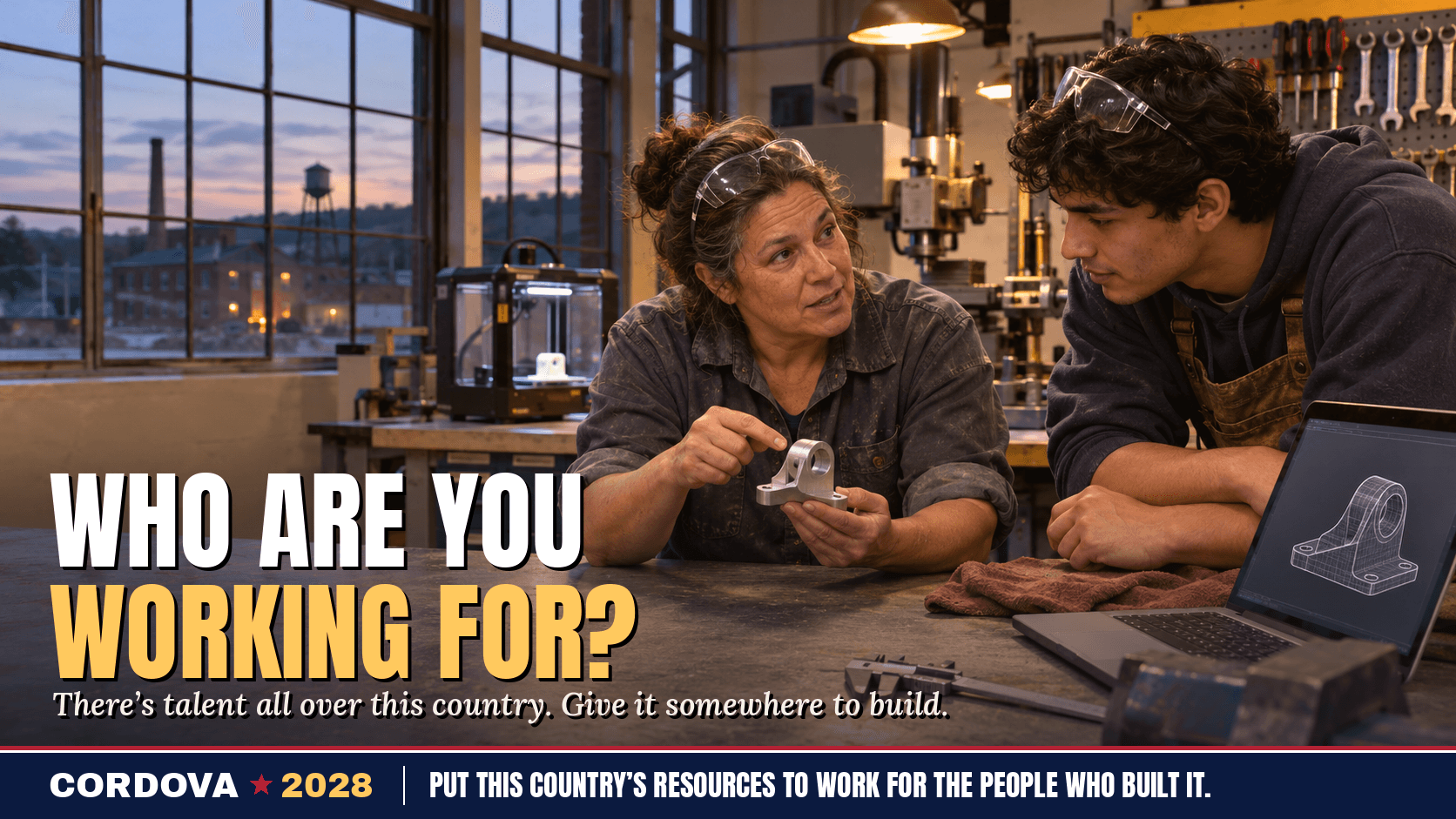
Do you remember who you work for?
At some point, Americans are going to have to ask the people we elect a simple question. Do you remember who you work for?
When a parent works full time and still can’t afford rent, when a young person wonders whether they’ll ever be able to afford to start a family, and when the people making the rules keep protecting the few who benefit from those rules, what are Americans supposed to conclude?
$34.73
An hour. What a full-time worker needs to afford a modest two-bedroom rental in the U.S. in 2026.1
$24.84
An hour. What the average renter actually earns. That is $9.89 short, every hour, of a modest two-bedroom.1
$377
A month. All the rent a full-time worker on the $7.25 federal minimum wage can afford.1
33%
Of a single parent’s median income goes to the average price of child care: $13,184 a year in 2025.3
Those are not opinions. A full-time worker needs $34.73 an hour to afford a modest two-bedroom home. The average renter makes $24.84. A worker on the federal minimum wage can afford $377 a month in rent.1 Births fell to a record-low rate in 2025.2 Child care alone averages $13,184 a year.3
Then they point you at your neighbor
Then, when people get angry, watch where that anger gets directed.
- The immigrant down the street
- The person receiving food assistance
- The worker who voted differently
The people being told to blame each other often have more in common with each other than with the people asking them to fight.
As long as we’re arguing over which of our neighbors deserves less, the people writing the rules face fewer questions about why so many of us are struggling in the first place.
We teach people who counts
We teach social hierarchy every time we show people whose voice gets heard, whose mistake gets forgiven, and whose suffering can wait. A child can see that lesson long before they learn the term social stratification. They hear it in how adults talk about a family that needs help. They see it when someone with money gets a meeting that everybody else spends months trying to get.
73% → 17%
Share of Americans who trust the government in Washington to do what is right most of the time, from 1958 to September 2025.6
$5.3B
Spent lobbying the federal government in 2025, a record.5
1,779
Policy issues studied over two decades. Economic elites and business groups had substantial independent influence. Average citizens had little or none.4
The research says the same thing the child sees. Across 1,779 policy questions, economic elites and organized business interests had substantial independent influence on what Washington did. Average citizens had little or none.4 Lobbying hit a record $5.3 billion in 2025.5 And trust in the government in Washington has fallen from 73% in 1958 to 17%.6
When you’re one bad week away from missing rent, it’s hard to find the time or energy to ask who wrote the rules. It’s easy to hear that somebody else is getting something you were denied and feel angry about it.
We should ask who benefits when that anger stops at the neighbor’s door.
Would we recognize the damage if we were doing it to ourselves?
- 2024Russia, Iran and ChinaAssessed
U.S. intelligence warned that foreign actors remained intent on fanning divisive narratives to divide Americans and undermine confidence in our democratic system.9
The U.S. Senate Intelligence Committee documented how Russia’s Internet Research Agency posed as Americans online and used divisions around race, immigration, and gun rights to stir hostility and distrust. These were already real points of contention in American life. That gave the operation something to work with.78
Our own government has used covert influence abroad. Declassified records show that the CIA funded opposition parties, media, and private-sector organizations in Chile under President Salvador Allende. Americans should remember that history when we talk about how foreign governments exercise influence inside another country.1011
It takes evidence to say a foreign government funded or directed an operation. We can also examine the damage our own leaders do in plain sight. A foreign adversary can benefit from Americans losing trust in each other and in their government. An American politician can help produce the same outcome while protecting a donor, preserving a privilege, or trying to win one more election. The motives can be different. The people living with the damage still have to live with it.
To every elected official
How far are you willing to push Americans apart to protect the status quo? At what point does protecting the few make the whole country easier for a foreign adversary to exploit?
What could Americans build if we gave them the chance?
I look at some of the new cars coming out of China and think about the people who imagined them, designed them, and figured out how to build them. China produced 16.6 million new energy vehicles in 2025.12 Then I think about the people here who never got the chance.
The machinist
who has an idea for a better tool but can’t afford the equipment to try it.
The student
who has a design but nowhere to build a prototype.
The small manufacturer
who could do the work but can’t get a fair shot at a federal contract.
We’re a wealthy country. We have skilled workers, engineers, independent inventors, and small manufacturers. How many good ideas have we already lost because the people who had them never got a real chance to build them?
We have a measure of it. Children from the top 1% of families are ten times as likely to become inventors as children from families below the median. Even among children with top math scores in third grade, the gap holds. What changes the odds is exposure to innovation.14 Researchers estimate that if children from every background invented at the same rate as white boys from high-income families, America would have four times as many inventors.15 Those are the lost ideas. They belonged to us.
AI can help shorten the distance between an idea and a first design. Imagine coming home from a shift, sketching an idea, and using AI to explore three versions that same evening. You can get to something you can show another person much sooner. Then you need somewhere to go with it. Somewhere you can talk it through with someone who knows the equipment, build a first prototype, test it, and make it better.
Community prototyping centers
If elected, we’ll work with community colleges, libraries, unions, and local manufacturers to open community prototyping centers and expand the workshops we already have. People should be able to walk in with a rough sketch and get access to AI tools, design software, 3D printers, shop equipment, and experienced people who can teach them how to use it all.
Walk in with a sketch
No membership politics, no gatekeeping. A rough idea is enough to start.
AI and design tools
Explore three versions of an idea the same evening you came home from a shift.
3D printers and shop equipment
Build the first prototype. Test it. Break it. Make it better.
Experienced people
Someone who knows the equipment and can teach you to use all of it.
Hours that fit a shift
A shop that closes before your shift ends is still out of reach.
A path to contracts
Help small businesses compete for federal work, and give workers a say in how new technology changes their jobs.
We’ll start by asking the people who would use these spaces what they need. A shop that closes before your shift ends is still out of reach. We’ll help more small businesses compete for federal contracts and give workers a say in how new technology changes their jobs. Then we’ll report back in public.
The public report, every year
- Who got access?
- What did they build?
- How many small businesses got a fair shot?
- Who still couldn’t get through the door, and what are we doing about it?
There’s talent all over this country that our government has chosen to overlook. We won’t.
The lines are already moving. Look where they point.
None of this is a prediction. It is the record, and the direction the record has been moving for decades. If we keep doing what we’re doing, we already know what comes next, because we are living in the middle of it.
Trust in government
Then73% in 1958
Now17% in Sept. 2025
A government most people no longer believe is working for them. An adversary never has to invent that distrust. It only has to amplify it.69
Small businesses winning federal contracts
Then≈121,270 in 2010
NowUnder 60,000 in FY2022
Fewer, larger firms get more of the work. New entrants were already down 79% from 2005 to 2019. The shop that could have built it closes, and the skill leaves with it.1617
Who gets to invent
ThenTop 1% kids: 10× likelier
NowUp to 4× more inventors possible
If children from every background invented at the rate of high-income white boys, America would have about four times as many inventors. Every year we wait, more of those ideas are never built.1415
Manufacturing jobs
Then19.6 million in 1979
Now12.8 million in 2019
Meanwhile China produced 16.6 million new energy vehicles in 2025 alone. Tariffs and speeches do not build capacity. People with access to tools do.1312
Starting a family
ThenFertility rate down nearly 23% since 2007
Now53.1 per 1,000, a record low in 2025
We can argue about every reason. We cannot pretend that rent above wages and child care at a third of a single parent’s income are not part of it.231
Public land and water
ThenOak Flat in a national forest; no new California oil lease since 1984
NowOak Flat transferred; 34 offshore sales proposed; seafloor auctioned
What is sold does not come back. A forest that becomes a mine, a seafloor that becomes a lease, a coast that becomes a drilling area: none of it returns to the next generation, or to the other species that live there.21232425
The price of being heard
ThenLobbying records set year after year
Now$5.3 billion in 2025
Every year this goes unanswered, the cost of getting a meeting goes up, and the line for everyone else gets longer.5
If we do nothing, the anger keeps stopping at the neighbor’s door. The renter blames the immigrant. The worker blames the family on food assistance. The people who wrote the rules keep writing them, and every year it costs more to be in the room where they do it.
If we do nothing, the people who would have built the next tool, the next part, the next car, spend their best years surviving instead. Their ideas don’t move to another state. They disappear. Small shops that could have done the work stop bidding, and the knowledge in their hands retires with them.
If we do nothing, we hand our adversaries the one thing no budget can buy them: an America that has stopped trusting itself. U.S. intelligence has already told us they are working the same fault lines.9 We don’t have to be invaded to be weakened. We only have to keep doing this to each other.
And if we do nothing, the next generation inherits all of it: higher rents, fewer chances to build, a government even fewer of them believe in, and the same lesson about who counts that we were taught.
A powerful country can still weaken itself
Empires have fractured, contracted, and fallen for different reasons. Their power never guaranteed their future. Ours doesn’t either. We can spend whatever we want on national defense and still leave ourselves vulnerable if millions of Americans come to believe their government hears them only when it needs their vote.
The choice for the people we elect is right in front of them. Will they change course and put this country’s resources to work for the people who built it? Or will they sell off pieces of what Americans built together to buy a few more years for the people who benefit from things staying exactly as they are?
This is not a metaphor. It is happening now.
- November 2026On land
The Interior Department’s strategic plan for 2026 to 2030 says it “will work to decrease the size of the federal estate,” offering federal land for sale to states, localities and tribes, which could then resell it. In June 2025, a Senate budget proposal would have ordered the sale of up to 3.29 million acres of BLM and Forest Service land. It was pulled from the bill. Seventeen months later, the plan to shrink public land is back as department policy.181920
- March 2026Sacred land
The Forest Service transferred 2,422 acres of Arizona’s Tonto National Forest, including Oak Flat, to Resolution Copper, a joint venture of Rio Tinto and BHP. The appeals court itself recognized the transfer will destroy sites sacred to the San Carlos Apache. Congress set this sale in motion in 2014, inside a defense bill.212228
- November 19, 2026The seafloor
The first deep-sea mining lease sale in U.S. history auctioned about 31.5 million acres of seafloor off American Samoa for $6 million in bids. That is about 19 cents an acre. It went ahead three days after a judge voided its endangered species approval, and American Samoa will not receive any of the money.25262729
Public land, sacred land, and now the land under the water. These sales destroy the very land we and other species depend on: the forests, the coasts, the seafloor, the water that runs through all of it. Once it is sold, it is not coming back. A country that sells off its ground to cover the short term is not getting stronger. It is spending its children’s inheritance.
These sales do not make us strong. They make the few who buy them stronger, and leave the rest of us with less.
When someone blames your neighbor, trace the rule
When someone tells you your neighbor is the reason you can’t get ahead, ask who wrote the rule, who voted for it, and who got paid under it. Ask those questions even when the answers lead back to someone you voted for.
Who wrote the rule?
Every federal bill lists its sponsor and cosponsors, along with its full text and every version as it changed.
Ask these questions even when the answers lead back to someone you voted for. These are public records, open to every American.
If you hold public office
Remember who you work for.
When your decisions ask the same people to sacrifice again and again, they’re entitled to ask who you’re serving. You owe them an answer they can check against your record.
If the status quo is dying, let it die. Don’t take the rest of us down with it.
— Vincent Cordova
Independent Candidate for President of the United States, 2028
Moving Forward Together.
Sources
- 1.National Low Income Housing Coalition, Out of Reach 2026: The High Cost of Housing
- 2.CDC National Center for Health Statistics, “U.S. Births down 1% in 2025” (Births: Provisional Data for 2025), April 9, 2026
- 3.Child Care Aware of America, Child Care in America: 2025 Price & Supply (press release)
- 4.Martin Gilens and Benjamin I. Page, “Testing Theories of American Politics: Elites, Interest Groups, and Average Citizens,” Perspectives on Politics, 2014
- 5.Bloomberg Government, Annual Top Lobbying Firms Report: $5.3 billion in lobbying spending in 2025
- 6.Pew Research Center, Public Trust in Government: 1958–2025, December 4, 2025
- 7.U.S. Senate Select Committee on Intelligence, “Senate Intel Committee Releases Bipartisan Report on Russia’s Use of Social Media,” October 8, 2019
- 8.U.S. Senate Select Committee on Intelligence, Russian Active Measures Campaigns and Interference in the 2016 U.S. Election, Volume 2: Russia’s Use of Social Media
- 9.Office of the Director of National Intelligence, Election Security Update, October 21, 2024
- 10.U.S. Senate Select Committee to Study Governmental Operations with Respect to Intelligence Activities (Church Committee), Covert Action in Chile, 1963–1973
- 11.U.S. Department of State, Foreign Relations of the United States, 1969–1976, Volume E–16, Document 145
- 12.Xinhua, “China’s auto output, sales reach new highs in 2025” (China Association of Automobile Manufacturers data)
- 13.U.S. Bureau of Labor Statistics, “Forty years of falling manufacturing employment,” Beyond the Numbers
- 14.Alex Bell, Raj Chetty, Xavier Jaravel, Neviana Petkova and John Van Reenen, “Who Becomes an Inventor in America? The Importance of Exposure to Innovation,” Quarterly Journal of Economics, 2019
- 15.Opportunity Insights, “Groundbreaking empirical research shows where innovation really comes from”
- 16.Washington Technology, “Small business participation in federal marketplace continues decline despite $159 billion in awards,” February 2023
- 17.Bipartisan Policy Center, Supporting Small Business and Strengthening the Economy Through Procurement Reform
- 18.Inside Climate News, “Federal Government Could Sell Off Untold Acres of Public Lands,” November 13, 2026
- 19.High Country News, “Senate Republicans want to sell 3 million acres of public land,” June 11, 2025
- 20.KHOL 89.1 FM, “A public lands sell-off has been yanked from the budget bill, but other threats to public lands remain,” June 30, 2025
- 21.E&E News, “Feds complete swap of Apache holy site to copper miners,” March 16, 2026
- 22.Associated Press via WTOP, “Apache women seek court intervention as federal land is turned over for copper mining,” March 2026
- 23.Bureau of Ocean Energy Management, 11th National OCS Oil and Gas Leasing Program: Details of the Secretary’s 1st Proposal
- 24.CBS News, “Trump administration aims to auction offshore oil leases along U.S. coastlines that have been off-limits for decades”
- 25.Bureau of Ocean Energy Management / Marine Minerals Administration, American Samoa Activities (Lease Sale PACM-1)
- 26.Samoa News, “Deep-sea mining leases on millions of acres of seafloor near American Samoa garners $6 million,” November 2026
- 27.Pasquines, “American Samoa deep-sea mining lease sale goes ahead days after court voids species approval,” November 20, 2026
- 28.U.S. Department of Agriculture, Forest Service completes the Southeast Arizona Land Exchange, March 16, 2026
- 29.Samoa News, “Interior Secretary says US deep-sea mining permits could come within months” (lease area sizes), September 2026
Editorial note: the figures, numbered source links, stat tags, dated record of influence operations, prototyping-center cards, the “What happens if we do nothing” ledger, and the trace-the-rule tool were added by the campaign design team to support the original essay. The ledger shows recorded trends and the direction they point; it is not a statistical forecast. The $6,476,166 figure for Chile comes from a single 1973 State Department record of approvals since January 1971. The 31.5 million acres for the American Samoa sale is the sum of the two lease areas offered (about 16.3 and 15.2 million acres); 19 cents an acre is $6 million divided by that total. The illustration is an editorial image, not a photograph of real people.
Further reading
They Don’t Have to Fire a Shot
How adversaries already exploit our divisions →
Working in America, Living in Poverty
The case for a Federal Reality Standard →
Your Limitations Are Not Someone Else’s Destiny
Using AI to expand opportunity for everyone →
Who Owns Our Government?
The public deserves to know who controls essential functions →