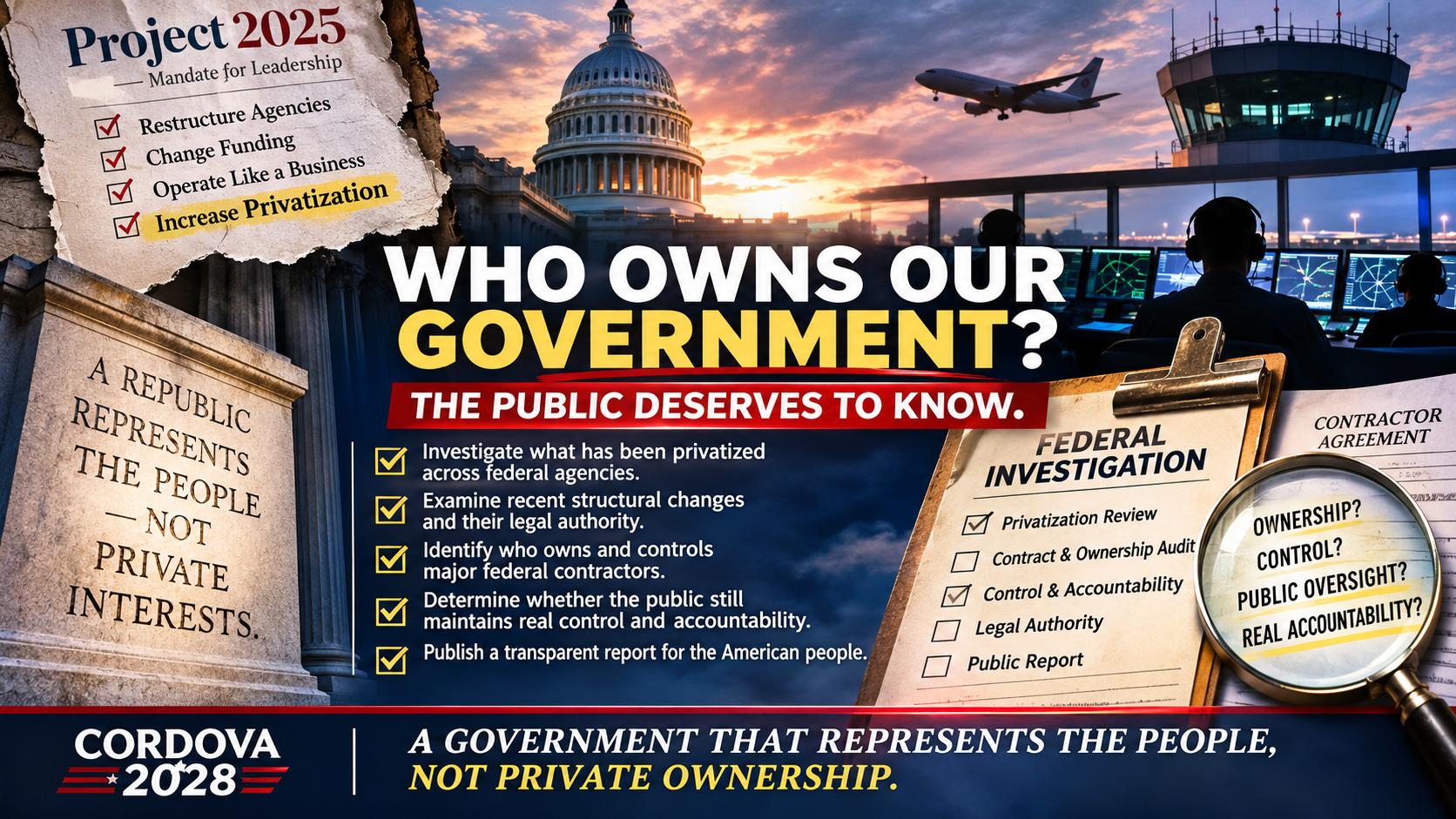
Who Owns OurGovernment?The Public Deserves to Know.
When Public Institutions Are Restructured, Privatized, or Placed Under Private Control, the American People Have a Right to Know Who Benefits, Who Decides, and Who Remains Accountable.
By Vincent Cordova · Cordova 2028 · November 18, 2026
CORDOVA 2028
A government that represents the people, not private ownership.
The question
A Question the American People Are Asking
Across social media, including TikTok, Americans are raising a troubling question about the future of their government.
Some believe they are witnessing a pattern: public institutions experience serious problems, those problems become the justification for declaring government ineffective, and privatization is subsequently presented as the solution.
Some associate that concern with Project 2025.
The allegation can be summarized this way:
Step 1
Allow a public institution to deteriorate.
Step 2
Point to its failures.
Step 3
Then use those failures to justify transferring its responsibilities into private hands.
But we must be responsible about what we say.
I do not currently have evidence establishing that the federal government is deliberately damaging public institutions to justify privatization. A coincidence, a political proposal, or a public suspicion is not proof of a coordinated scheme.
And yet, the absence of established proof does not mean the public’s questions should be dismissed.
It means we must investigate.
If Americans are raising legitimate concerns about who controls their government, who profits from its restructuring, and whether public responsibilities are being transferred without meaningful oversight, their representatives have a responsibility to examine those concerns.
We are a constitutional republic. Our government exists to serve the people—not to place the people under the unchecked authority of private interests.
The FAA
The FAA: A Question That Deserves Answers
Consider the Federal Aviation Administration.
The FAA is responsible for vital aviation safety functions, including oversight of the nation’s air traffic system.
Americans depend on that system every day. Passengers, pilots, air traffic controllers, emergency services, cargo operators, and countless businesses rely on its safety and reliability.
Modernization is necessary. Aging infrastructure, staffing shortages, and technological limitations are real concerns.
But modernization and privatization are not the same thing.
A government can
Purchase new technology
without surrendering its authority.
A government can
Hire contractors
without transferring ownership of its responsibilities.
A government can
Improve efficiency
without removing public accountability.
So why should the American people accept a restructuring proposal without understanding precisely what is changing?
Project 2025’s aviation proposals include separating the FAA from the Department of Transportation, or separating its Air Traffic Organization from the FAA, restructuring its funding, and operating the FAA more like a business. Mandate for Leadership, pp. 632–634 ↗
Project 2025
— Mandate for Leadership, Chapter 19: Department of Transportation
What the FAA section recommends
Separate the FAA from DOT or, at a minimum, separate the ATO from the FAA. (p. 633)
Restructure the FAA’s funding so aviation is not tied to annual appropriations. (p. 633)
Require the FAA to operate more like a business. (p. 633)
Move the ATO to separate headquarters outside the District of Columbia. (p. 634)
Shift from aviation user taxes to fees for air traffic services paid directly to the ATO. (p. 634)
Allow the ATO to issue long-term revenue bonds for major projects. (p. 634)
The document describes these as organizational changes that would require legislation. It does not use the word “privatize.” Whether these proposals have been carried out is a question of evidence, which is exactly what the review below is designed to answer.
Those proposals deserve careful examination on their own terms.
They do not, by themselves, prove an intention to sabotage the agency.
But they raise important questions about the future structure of public aviation services.
And those questions become particularly important when billions of taxpayer dollars are being committed to modernization.
On November 17, 2026, the Department of Transportation announced that the administration was requesting congressional funding for a $50.1 billion air traffic control modernization effort.
That is a significant public investment.
The request, as written · Nov. 17, 2026
$50.1B
Air traffic control modernization
Common automation platform and controller workstations, cloud computing and NAS telecommunications, flow management, terminal consolidation
$10.1B
Airport infrastructure
Airport Improvement Program and Airport Terminal Program discretionary grants
$10B
Terminal pilot program
Replacing or rebuilding aging terminals at high-impact hub airports
$10B
Air route traffic control centers
Up to five new consolidated centers to replace 1960s facilities
$10B
Air traffic control towers
Constructing, replacing or improving up to 140 FAA-owned towers
$10B
Signed by the Secretary of Transportation, the FAA Administrator and the OMB Director and sent to the House and Senate Appropriations Committees. The letter does not address who will own the systems, who will operate them, or what role private contractors will hold. Read the letter ↗
Before such investments and structural changes proceed, Americans deserve clear answers:
Americans deserve clear answers
1Who will own the new equipment?
2Who will own and control the software?
3Who will control the data and communications infrastructure?
4Will the federal government retain the ability to operate the system independently?
5Will private contractors control essential operations?
6Who will employ the people operating the infrastructure?
7Who will receive the contracts, and how will their costs be evaluated?
8Will the public remain protected from monopoly pricing, vendor lock-in, and unnecessary fees?
9Can future administrations replace contractors without jeopardizing essential services?
These questions are not an accusation against the aviation workforce, and they are not an argument against modernizing aviation.
They are questions about public ownership, operational independence, and accountability.
If taxpayers are financing the modernization of a public institution, they deserve to know whether they are strengthening that institution or financing a future dependency on private owners.
Without a vote?
Can a President Privatize Government Without a Vote?
This is one of the most important questions.
The answer requires distinguishing between a public referendum, a congressional vote, and executive authority.
A public referendum
Not required by the Constitution every time the federal government contracts for services or restructures an agency.
A congressional vote
Congress can authorize public-private arrangements through legislation and controls appropriations.
Executive authority
Agencies may hold existing statutory authority to buy, contract or reorganize, but that power is not unlimited.
The Constitution does not require a nationwide popular referendum every time the federal government contracts for services or restructures an agency.
Congress can authorize certain public-private arrangements through legislation. Agencies may also possess existing statutory authority to purchase equipment, hire contractors, or reorganize operations.
But those powers are not unlimited.
The President cannot simply disregard congressional statutes, redirect restricted appropriations without lawful authority, or delegate governmental powers in violation of constitutional requirements.
The question is not merely whether the public voted directly on a particular contract.
The question is whether the action was authorized through our constitutional system and whether public officials retain the authority and accountability the law requires.
If an administration transfers a governmental function beyond its legal authority, that action may be challenged and potentially invalidated.
It does not automatically become void simply because voters were not directly consulted.
But neither does a government contract become lawful merely because an administration signs it.
Public authority must remain grounded in law—not in the preferences of whichever administration happens to hold office.
Behind the seal
What If a Private Company Owns the Equipment and Employs the Personnel?
Consider another possibility.
Suppose the government keeps the name of a federal agency.
The public still sees the same federal seal.
The agency still appears on official websites.
But behind that name, a private company owns essential infrastructure, controls proprietary software, and employs much of the workforce responsible for operating the system.
Would that be privatization?
Potentially, yes—at least in part.
Would it be illegal?
Not necessarily.
Federal law permits many forms of contracting and public-private cooperation. The legality depends on the responsibilities being transferred, the governing statutes, and the government’s continuing authority. FAR 7.5 ↗CRS IF13307 ↗
But the arrangement creates questions that cannot be answered by simply pointing to the agency’s name.
Who actually has control?
Can the federal government operate without the contractor?
Can it inspect the software?
Can it access and preserve the data?
Can it replace the equipment?
Can it terminate the contract without disrupting public services?
Can the contractor increase costs because the government has become dependent on its proprietary technology?
And, most importantly, are decisions involving sovereign governmental authority still being made by properly authorized public officials?
A government must not use contracting as a mechanism to evade responsibilities it is legally required to perform.
Outsourcing a task does not automatically outsource the government’s accountability for that task.
Essential services
What Happens When Private Companies Control Essential Public Services?
Private companies can provide valuable technology, engineering, construction, maintenance, and specialized expertise.
That is not inherently objectionable.
The concern arises when an essential public service becomes dependent on private ownership arrangements that undermine transparency, competition, continuity, or meaningful public control.
Imagine a future in which an essential government service cannot function unless taxpayers continue paying a particular private company.
Imagine that replacing the company would require rebuilding infrastructure, replacing software, or retraining an entire workforce.
Imagine that the public cannot determine the ultimate ownership of the companies receiving billions of dollars in contracts.
Now consider what happens if multiple contractors across several agencies are ultimately controlled by the same investment institution or concentrated group of beneficial owners.
Such common ownership is not, by itself, evidence of wrongdoing.
But it may create risks involving conflicts of interest, market concentration, resilience, and public dependence.
We must be able to identify those risks before they become permanent features of our government.
A republic cannot responsibly surrender its ability to govern essential public functions simply because private contracting appears convenient in the short term.
Our commitment
Our Administration Will Investigate the Structure of Federal Government
If entrusted with the presidency, our administration will initiate a comprehensive, lawful review of privatization, contracting, ownership, and operational control throughout the federal government.
This will not be a political retaliation exercise.
It will not presume that contractors are corrupt or that public officials have acted unlawfully.
It will be an evidence-based examination of how our government operates and whether the public retains meaningful control over the institutions created to serve it.
We will direct federal agencies to compile inventories of major outsourced functions, privately operated infrastructure, long-term service contracts, and public-private arrangements.
We will distinguish between ordinary procurement, contracted support services, privately operated programs, and the delegation of governmental authority.
We will examine what the government owns, what contractors own, and what the public is obligated to finance.
2Examine Changes Made by Previous Administrations
We will review significant structural changes, including those made during the current administration, and determine their legal authority and operational consequences.
We will examine whether changes were properly documented, whether required disclosures were made, and whether any arrangements were structured to conceal transfers of control or evade oversight.
We will not assume concealment occurred.
We will investigate whether the evidence establishes it.
3Identify the Ultimate Beneficial Owners
We will examine the ownership and control of major federal contractors through lawful records and oversight mechanisms.
That includes reviewing relevant parent companies, subsidiaries, private equity structures, investment funds, and other ownership arrangements.
Where multiple contractors share ownership or control, we will assess whether that creates conflicts, competition concerns, or systemic dependence.
Ownership alone will not be treated as wrongdoing.
Our purpose will be to understand who controls essential services and whether safeguards are adequate.
4Examine Government Dependence on Private Contractors
We will determine whether agencies can continue essential operations when contracts expire, contractors fail, or disputes arise.
We will examine proprietary technology, data portability, replacement costs, cybersecurity, emergency continuity, and the government’s ability to recover operational control.
A federal agency should not discover during a national emergency that its ability to serve the public depends entirely on a contractor’s willingness or capacity to cooperate.
5Investigate the Legal Authority Behind Transfers of Public Functions
We will examine whether outsourcing arrangements comply with federal statutes, appropriations restrictions, procurement law, constitutional requirements, and rules governing inherently governmental functions.
Where credible evidence suggests unlawful action, the appropriate inspectors general, oversight bodies, and law enforcement authorities must be able to investigate independently.
Our administration will not predetermine the outcome.
6Publish a Federal Public-Control and Privatization Report
The American people will receive a clear public accounting of our findings.
The report will identify major contracting structures, costs, public-versus-private ownership, operational risks, and recommended safeguards.
We will protect classified information, legitimate security-sensitive details, personal privacy, and other legally protected information.
But confidentiality must not become an excuse for concealing information that the public is legally entitled to examine.
7Listen to the People Who Operate These Institutions
We will consult federal employees, air traffic controllers, engineers, technicians, contractors, labor representatives, inspectors, affected businesses, and the communities served by these agencies.
These individuals often understand operational weaknesses long before they appear in official reports.
They must have meaningful opportunities to raise concerns without retaliation.
We cannot responsibly redesign institutions without listening to the people who operate them and the people whose lives depend on them.
The cost of silence
What Happens If We Ignore This?
If we fail to examine these structures, we risk allowing important decisions to become increasingly difficult to reverse.
▲Public agencies could become dependent on private systems they cannot independently operate.
▲Taxpayers could finance infrastructure while losing meaningful control over how it is used.
▲Essential services could become vulnerable to contract disputes, financial failures, cybersecurity incidents, or concentrated market power.
▲Public employees could lose protections or institutional expertise could disappear.
▲Future administrations could inherit contractual obligations that severely limit their practical choices.
▲And citizens could find themselves unable to determine who is responsible when essential services fail.
These are risks—not inevitable outcomes.
But they are serious enough to justify preventive oversight.
The cost of investigating these questions now may be far smaller than the cost of discovering years later that public institutions have lost the capacity to function independently.
The republic
This Is About the Republic We Intend to Preserve
The United States is a constitutional republic.
We elect representatives to exercise public authority under the Constitution and laws of the United States.
Our government is not a private corporation.
The presidency is not a transferable business asset.
Federal agencies are not personal property.
And the American people are not customers who must accept whatever terms a private owner chooses to impose.
Government contractors may provide services, technology, and expertise. But they do not acquire sovereign authority simply because the government pays them.
Our constitutional system places limits on the transfer of governmental power, including restrictions on unsupervised delegations of authority to private entities.
If a privatization arrangement violates those limits, it must be subject to legal challenge and correction.
If a transfer is lawful but creates unacceptable risks to public accountability, Congress and the administration should consider stronger safeguards or legislative reforms.
And if a public function is so essential that private dependence threatens the nation’s ability to govern, we must be willing to examine whether direct public ownership and operation better protect the public interest.
Accountable to the people
Our Commitment: The Government Must Remain Accountable to the People
I want to be clear about what our administration will stand for.
We will not accuse without evidence.
We will not ignore credible concerns because investigating them may be politically uncomfortable.
We will not treat public questions as inconveniences.
We will examine the contracts.
We will examine the ownership.
We will examine the money.
We will examine the laws.
We will examine who makes the decisions and who has the power to reverse them.
And we will make the findings available to the American people to the fullest extent permitted by law.
The American people should never have to wonder whether the government they elected still controls the institutions operating in their name.
There is a fundamental difference between a private company helping the government serve the public and a government becoming dependent on private interests to exercise its own responsibilities.
That distinction deserves constitutional scrutiny, legislative oversight, and public debate.
And where evidence establishes that public authority has been unlawfully transferred, our administration will pursue lawful remedies to restore accountability.
We must never confuse private ownership with public sovereignty.
We are a republic.
Our government represents the people.
Our public institutions exist to serve the people.
And no contract, corporate structure, investment arrangement, or administrative reorganization should place essential governmental authority beyond the reach of the Constitution, the law, and democratic accountability.
The American people deserve to know who owns the infrastructure, who controls the operations, who receives their money, and who is ultimately responsible.
Because the government of the United States belongs to no corporation, no investment fund, no political administration, and no individual.
Its authority comes from the people.
And that is where its accountability must remain.
Vincent Cordova
2028 U.S. Presidential Candidate
Moving Forward Together
Cordova 2028 — A government that listens—and proves it with results.
The FAA has used private contractors for certain air traffic services for decades, including the Contract Tower Program established in 1982. The review described here is meant to separate long-standing, authorized arrangements from new transfers of authority, not to treat every contract as privatization.