FOR IMMEDIATE RELEASE
DATE: November 18, 2026
CONTACT: info@cordova2028.com | cordova2028.com
Cordova 2028 today released three connected pieces of work on a question many Americans are now asking: when public institutions are restructured, contracted out, or placed under private control, who benefits, who decides, and who remains accountable?
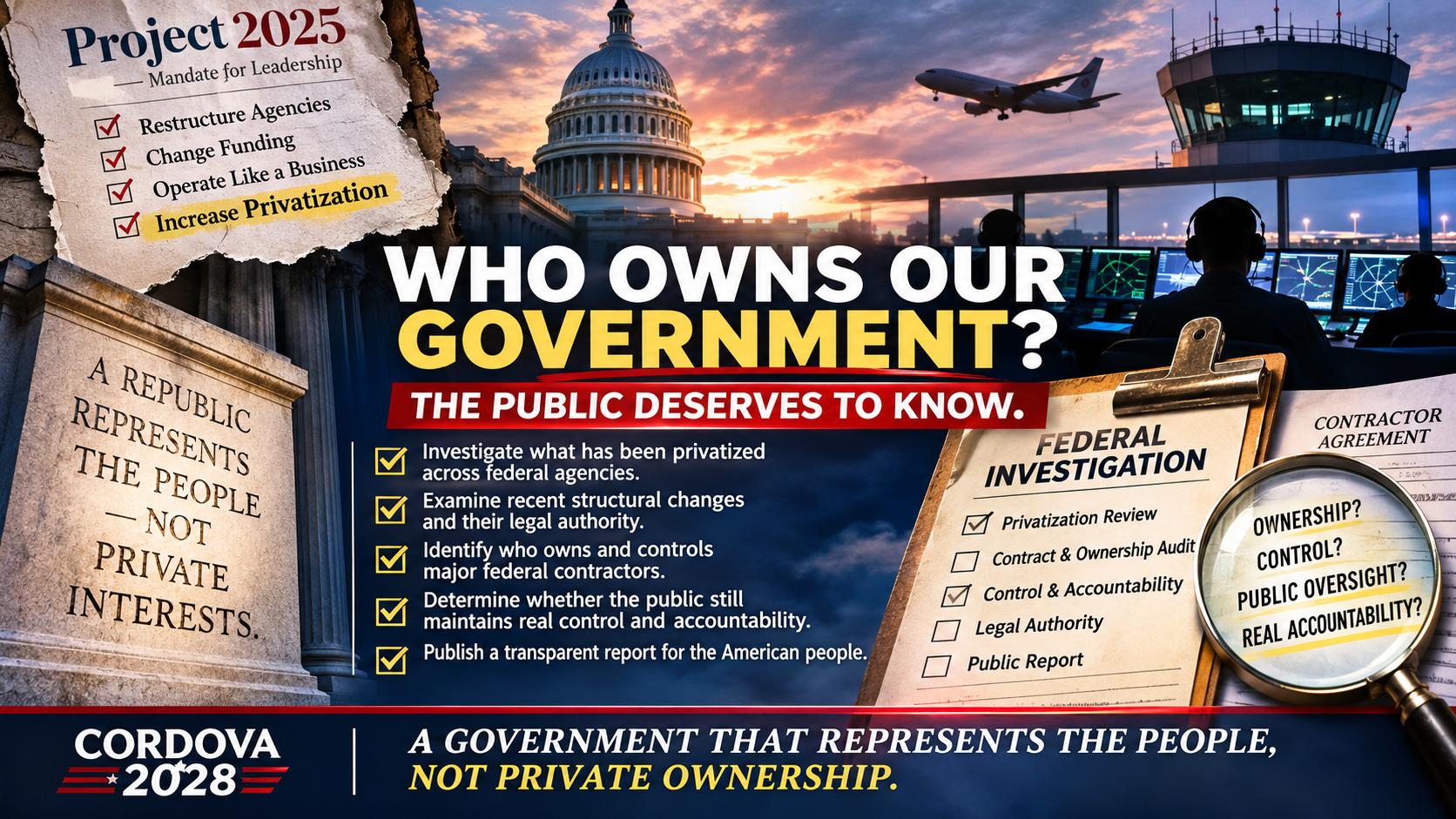
- Who Owns Our Government? The Public Deserves to Know, a campaign essay using the Federal Aviation Administration as its example.
- The Federal Public Authority, Privatization Transparency, and Accountability Initiative, a discussion-draft governing framework with a draft executive order and draft legislation.
- A separate pre-litigation investigation on the United for Accountability People’s Docket, titled “The People’s Government,” which examines documented federal arrangements and the remedies the law allows. No complaint has been filed.
The release comes one day after the Department of Transportation, the Office of Management and Budget, and the FAA asked the House and Senate Appropriations Committees for $50.1 billion to modernize air traffic control and airport infrastructure, and five days after a failure in legacy telecommunications equipment led the FAA to stop departures nationwide. The request letter breaks down how the money would be spent. It does not say who will own the new systems, who will operate them, or how the government will avoid depending on a single vendor.
“If taxpayers are financing the modernization of a public institution, they deserve to know whether they are strengthening that institution or financing a future dependency on private owners.” — Vincent Cordova
Evidence before accusation
Some Americans believe they are seeing a pattern in which public institutions are allowed to deteriorate, their failures are used to declare government ineffective, and privatization is offered as the solution. The campaign treats that as a question to investigate, not a conclusion. Project 2025’s Department of Transportation chapter recommends separating the FAA from DOT or the Air Traffic Organization from the FAA, funding air traffic services through user fees, and operating the FAA more like a business. It describes those changes as requiring legislation. None of the three documents treats a proposal as proof that it has been carried out.
“I do not currently have evidence establishing that the federal government is deliberately damaging public institutions to justify privatization. A coincidence, a political proposal, or a public suspicion is not proof of a coordinated scheme. And yet, the absence of established proof does not mean the public’s questions should be dismissed. It means we must investigate.” — Vincent Cordova
What the initiative includes
- A ten-category classification system that separates ordinary procurement from contractor-owned infrastructure, the delegation of public authority, asset transfers, and full privatization, so ordinary contracting is never mislabeled and real transfers are never hidden.
- A first-day executive order with 30-, 90-, 180-, and 365-day deadlines, limited to what existing law allows a president to require, and a table showing which steps need Congress.
- The Federal Public Authority and Privatization Accountability Act of 2029 with definitions of essential governmental function, sovereign authority, operational control, and critical contractor dependency; congressional notice before material transfers; government data and step-in rights; ownership disclosure; and worker protections.
- An FAA and air traffic control pilot review with a dated chronology that labels every event as a proposal, announcement, law, appropriation, contract, or documented harm, and an ownership-and-control map of equipment, software, networks, data, workforce, and decision authority.
- A beneficial-ownership and concentration review that distinguishes passive investment from real control and treats shared ownership as something to record, not evidence of misconduct.
- A public transparency portal specification with a published data model, a dependency risk model, and a source verification register.
- Worker protections and a public consultation plan so the people who run these institutions help finish the framework before it is final.
The framework does not treat contracting, private equity, or shared ownership as evidence of wrongdoing. It lists every legal and factual question that still needs review by licensed attorneys, legislative counsel, and the Congressional Budget Office.
A letter to Congress, sent today
The campaign also sent a formal letter today to the leaders of the House and Senate Appropriations Committees asking them to obtain answers on ownership, operational control, contractor concentration, the workforce, and the full lifecycle cost before committing the additional $50.1 billion. Read the announcement and the letter.
“Government may purchase private expertise. It must remain legally accountable for public authority.”
How to take part
The initiative is a working draft. Air traffic controllers, technicians, federal and contract employees, labor organizations, procurement professionals, and the public are invited to send corrections and comments through cordova2028.com/contact.
About Vincent Cordova
Vincent Cordova is a 2028 presidential candidate based in Manteca, California. The Cordova 2028 campaign, Moving Forward Together, is built on the conviction that the systems governing people's lives were designed by people and can be redesigned by people, and that the next generation should inherit a government that still belongs to them.
MEDIA CONTACT
Cordova 2028 Presidential Campaign
info@cordova2028.com • cordova2028.com