This site is under construction - will be ready soon.
Your Guide to Our Vision
← Back to Blog

Wages · Poverty · Representation · The Federal Reality Standard

Working in America, Living in Poverty: Who Does Our Government Represent?

The numbers say we are winning. The people living it say otherwise. It is time for a Federal Reality Standard that measures the conditions Americans actually live in.

By Vincent Cordova · Independent Presidential Candidate, 2028 ·

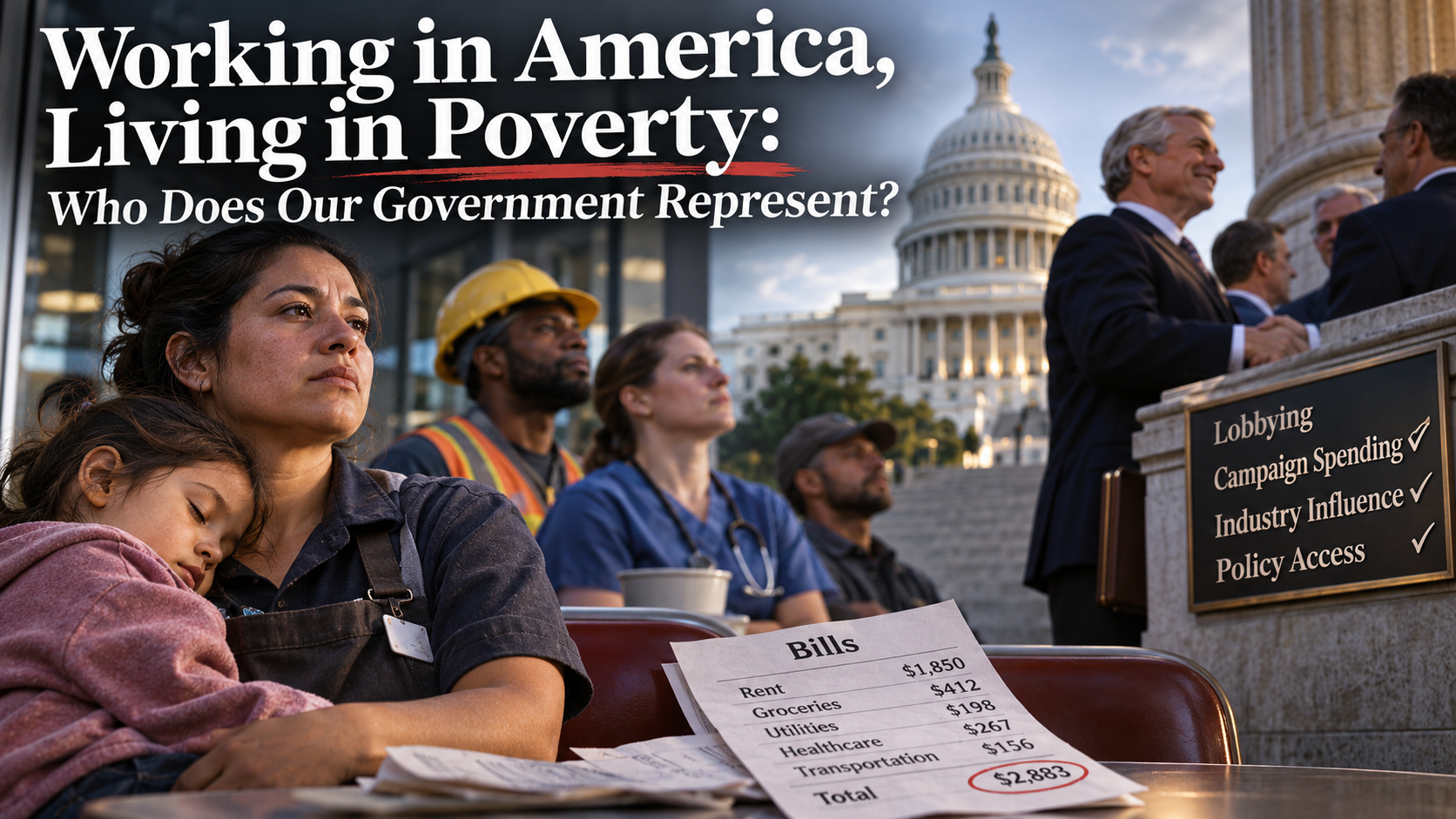
A tired mother in a work apron holds her sleeping daughter at a table covered in bills totaling $2,883 for rent, groceries, utilities, healthcare and transportation. Behind her sit a construction worker in a hard hat, a nurse in scrubs and another worker. Across from them, men in suits shake hands on the steps near the U.S. Capitol beside a plaque that reads “Lobbying, Campaign Spending, Industry Influence, Policy Access.”
Illustration by the campaign design team

A job is supposed to be a way out of insecurity. A government is supposed to be able to look its own people, and the world, in the eye.

Right now America is failing at both, and the numbers we use to grade ourselves are helping us hide it.

The scoreboard

The scoreboard says we’re winning

In October the unemployment rate was 4.1% (BLS). In September the Census Bureau announced that the official poverty rate for 2025 fell to 10.2%, the lowest since the government started keeping track in 1959 (Census Bureau). Politicians took their victory laps.

Now walk into any grocery store, any pharmacy line, any apartment complex the week rent is due, and ask people if they feel like they’re living in the best year on record.

You already know the answer. The gap between those numbers and that answer is what this post is about.

The measurement

The rulers are broken

The official poverty line was built in 1963 by a Social Security economist named Mollie Orshansky. She took the cost of the cheapest food plan the Agriculture Department published and multiplied it by three, because families back then spent about a third of their income on food. Since then the line has been adjusted for inflation and almost nothing else (Institute for Research on Poverty).

That is the ruler. A grocery bill from the Kennedy years, times three.

It does not know what rent costs in Manteca or Atlanta or Boston. It does not know what childcare costs, what an insurance deductible is, or what it takes to keep a car running so you can get to the job the unemployment rate is so proud of.

By that ruler, a family of four stopped being poor in 2025 at $32,970 a year (Census Bureau). That is about $2,750 a month, before taxes, for four people. Housing, food, power, transportation, medicine, clothes, school. All of it.

Now compare that to where I live. In San Joaquin County, California, MIT’s Living Wage Calculator estimates that a family of four needs about $96,000 a year before taxes to cover the basics with one parent working, and about $130,000 if both parents work and have to pay for childcare (MIT Living Wage Calculator). That is three to four times the federal poverty line. A family here can earn double the poverty line, be counted as doing fine, and still be tens of thousands of dollars short of what life actually costs.

Look at what the government’s own data says when you change the ruler even a little:

34.5 million

people lived in poverty in 2025 by the official measure. (Census Bureau)

About 44.4 million

lived in poverty by the Census Bureau’s own Supplemental Poverty Measure, which counts taxes, housing costs, and necessary expenses. Same country, same year, roughly ten million more people. (Center for American Progress)

6.2 million

people spent at least half of 2024 in the labor force and still lived below the poverty line. (BLS)

2.79 million

of them were full-time wage and salary workers. Nearly two out of three of those full-time workers had the same problem: low earnings. Not laziness. Not bad choices. The job did not pay enough. (BLS)

7.9%

was the broader U-6 rate in October, which includes people stuck in part-time work who want full-time and people who have given up looking. The headline unemployment rate was 4.1%. (BLS)

$7.25

is the federal minimum wage. It has not moved since July 2009.

None of these numbers are lies. Every one of them is published by the federal government. The lie is in which ones we put on the podium and which ones we bury in a table.

A person who is employed and can’t afford to live is counted as a success. A family that earns one dollar over a 1963 food formula is counted as not poor. That is not measurement. That is a country grading its own test with an answer key from sixty years ago.

The proposal

The Federal Reality Standard

I am not going to patch the old rulers. I intend to replace them.

As President, I will work to establish a Federal Reality Standard: one honest, legally defined measure of what it actually costs to live in the United States, built from real prices in real places, and used at every level of federal policy where the old standards are used today.

What it measures. The real cost of a secure life for each household type in each local area: housing, food, healthcare, childcare, transportation, utilities, taxes, and a margin for emergencies. Not survival. Security.

Where it applies. Everywhere the old numbers quietly decide people’s lives:

  1. 1

    Poverty and hardship statistics. The government reports every year how many people fall below the Reality Standard, including how many of them work.

  2. 2

    Jobs reports. Alongside the unemployment rate, the government reports how many jobs pay enough to meet the Reality Standard where the job is located. A job that cannot support the person doing it gets counted as what it is.

  3. 3

    Wage floors. The federal minimum wage is measured against the Reality Standard and publicly reviewed every year, so it can never again sit frozen for seventeen years while rent doubles.

  4. 4

    Program eligibility. Eligibility for federal assistance is tied to what life costs now, not to a 1963 formula.

  5. 5

    Federal contracts and subsidies. Companies that take public money report how many of their workers earn below the Reality Standard. Taxpayers have the right to know when they are subsidizing a payroll.

  6. 6

    Policy scorecards. Major economic legislation is scored on whether it moves people above the Reality Standard or pushes them below it.

How we keep it honest. Every standard gets gamed the moment it matters, so the loopholes get closed up front:

  • It is calculated by career statisticians, insulated by law from the White House and from Congress. That includes my White House.
  • The method and the data are public. Anyone can check the math.
  • The basket of necessities cannot be shrunk to make the numbers look better. Any change that lowers the standard requires a public finding and a public hearing.
  • Working people and people who have lived through poverty and homelessness sit on the board that oversees it. Lived experience is evidence.
  • The old measures keep getting published next to the new one, so nobody can claim we changed the ruler to hide the history.
  • No one loses assistance they qualify for today because of the changeover.

What it costs, and what we are already paying. I am not going to pretend this is free. An honest ruler will show more hardship than the old one, and tying assistance to real living costs means more people qualify. So here is how we do it responsibly.

Year one is measurement. The Reality Standard gets built, published, and reported next to every jobs and poverty number. Telling the truth costs almost nothing. Changes to wage floors and eligibility are phased in after that, each with a public cost estimate that anyone can read before Congress votes.

And understand what the current system costs. When a full-time job does not cover rent and food, the public makes up the difference through food assistance, Medicaid, housing aid, and emergency rooms. We are already paying. We are just paying on the back end, after the damage is done, and sending the bill to taxpayers instead of asking why the job fell short. Add to that the public resource wealth this country already owns, which I have proposed managing through a National Resource Trust for the benefit of the people. The money question is real. It is also answerable, and it is not an excuse to keep measuring a lie.

If a politician wants to brag about the economy, they will have to brag about this number.
The people

Working against the people who keep America moving

Think about who we are talking about. The driver who gets your package to the door. The nurse’s aide on the overnight shift. The warehouse crew, the line cook, the farmworker, the janitor who has the building ready before anyone else shows up. When they stop, the country stops. We learned that not long ago, when we called them essential.

So I have to ask: how can we keep working against the very people who keep America moving?

Because that is what these conditions amount to. Wages that don’t cover rent. Measurements that erase their hardship. A political system where their employer has a lobbyist and they have a time clock.

Each of these workers has one life. One. It is not a labor input or a line on a jobs report. That one life matters to our species, and every year it spends on survival instead of building, raising a family, learning, or creating is a loss to all of us.

Now ask yourself an uncomfortable question. If someone who hated America sat down to design conditions for its working people, what would they come up with? Keep them working and keep them broke. Make housing, healthcare, and childcare cost more than the job pays. Leave them too tired and too stretched to participate in their own democracy. Then publish a statistic that says everything is fine.

From where I stand, the conditions millions of Americans live in today appear no different from what that person would want. I am not saying anyone set out to do it. I am saying the outcome is the same either way, and a country that loves its people does not accept that outcome.

Loving America means loving the people who make it run. You can’t claim one and work against the other.

The influence

Who benefits from the old rulers

Ask who is comfortable with the measurements we have now.

When a profitable company’s full-time workers qualify for public assistance, the public is covering the gap between what the job pays and what life costs. The old numbers make that invisible. The worker is “employed.” The family is “above the poverty line.” The subsidy never shows up on the company’s books.

Then look at who has the government’s ear. Federal law bars corporations from giving treasury money directly to federal candidates, but it allows unlimited independent spending (FEC), and industries keep full-time lobbyists, lawyers, and former officials on payroll. The worker pulling a double shift has no lobbyist. Both of them are technically participating in democracy. Only one of them gets their calls returned.

I am not saying every employer is exploiting people or every official is bought. Businesses face real costs, and plenty of them do right by their workers. I am saying the people who live with the consequences of economic policy have the least say in writing it, and the measurements we use make it easy to ignore them.

I say this as an employer. I founded Cordova Courier, a delivery company built with no shareholders, to serve the people who work there and the public we deliver for. I know what payroll costs. I know what insurance, fuel, and a slow month do to a small business. Nothing in this post comes from someone who has never had to make the numbers work. The Reality Standard will apply to my company the same as everyone else’s, and I would rather be measured by it than hide behind a number that flatters me.

So alongside the Reality Standard, my administration will push for:

  • Open books on influence. Plain-language, searchable disclosure of lobbying, independent political spending, and financial conflicts.
  • A revolving door that locks. Real cooling-off periods, enforceable recusals, and the staff to enforce them.
  • Workers in the room. Before major decisions on wages, schedules, workplace technology, and labor protections, not after.
  • Accountability between elections. Complaint systems, public hearings, and independent oversight that a person working two jobs can actually use.
The world is watching

The empty seat in Geneva

On November 10, the United States was scheduled to stand in front of the world at the UN Human Rights Council and answer for its own human rights record. Every one of the 193 member countries goes through this review. When the session opened, the council president looked at the American nameplate and announced that the U.S. delegation was not in the room (NPR).

It was the second year in a row. No other country has ever done that. The review has been pushed to January. I wrote about it in The Empty Chair in Geneva.

The administration’s stated reason is that the council is biased and beyond repair, and that showing up would amount to endorsing it (TRT World). That is their explanation, and people can weigh it for themselves. I’ll note that the State Department did not answer questions about the actual American record.

Here is what I believe. I think the conditions described in this post are part of why that seat was empty.

Human rights are not only about what a government does to people. They are also about what people are left to live in. Housing, food, health, and a decent standard of living are in the Universal Declaration of Human Rights that this country helped write in 1948. American organizations filed close to 200 submissions for this review, and they were not only about immigration and policing. They were about homelessness, about cities making it a crime to be poor (National Homelessness Law Center), about cuts to health care and food assistance (Human Rights Watch).

A government that showed up would have had to answer for all of it. It would have had to explain why, in the wealthiest nation in history, millions of people work full time and stay poor, and why its proudest statistic is measured against a grocery bill from 1963.

You don’t skip an exam you expect to pass.

A Cordova administration will fill that seat. We will submit our report, take the questions, and bring the Reality Standard numbers with us, the good and the bad. A country that is confident in how it treats its people does not need an empty chair to speak for it.

The cost of waiting

If we do nothing

We don’t have to guess what doing nothing looks like. We have been running that experiment for decades.

The poverty formula has gone more than sixty years without a real update. The federal minimum wage has been frozen since 2009. Nobody held a vote to abandon working people. Washington just kept not acting, and inaction did the rest.

Stay on this path and here is what follows. The cost of living keeps climbing against a ruler that cannot see it, so the official numbers keep looking better while more working families fall short. Leaders keep celebrating. The people living it keep being told that what they feel isn’t real, and they stop believing anything their government says. They would have reason to.

Some of it is already on the calendar. Human Rights Watch told the UN that the 2025 federal budget is expected to take Medicaid coverage away from about 11.8 million people by 2034 (Human Rights Watch). Many of them will be counted as employed and above the poverty line the whole way down.

The world has set a new date for our human rights review: January 2027. If nothing changes, that is a third empty chair.

And every year we wait, millions of people spend another year of the only life they get on just getting by. That time does not come back. Not to them, and not to our species.

Doing nothing is a decision. We have been making it for sixty years. I am asking you to help me stop.

The questions

Measure the truth, then answer for it

We are one species. We can grow food at a scale our grandparents couldn’t imagine, move goods across the planet overnight, and build machines that think. We are not short on capability. We are short on honesty about who that capability is serving.

So here are my questions for every person holding office or asking for one, including me:

  • If the people you represent are working and still can’t afford to live, what number are you using to tell yourself things are fine?
  • If the businesses that benefit from the current arrangement are lobbying to keep it, who is in the room for the workers?
  • And if the world asks to see our record, why wouldn’t we show up?

Employment is not the same as economic security. Political access is not the same as representation. Holding office is not the same as being accountable. And a statistic is not the same as the truth.

If this is the country you want, don’t wait for 2028 to say so. Share this with someone who works full time and still comes up short at the end of the month. Tell us what the real cost of living looks like where you are by sharing your story. And if a system that was supposed to serve you has failed you, add your voice through United for Accountability.

Measure the reality. Publish it. Answer for it.

A government that listens, and proves it with results.

I am a piece of the collective essence of this world that never gives up and needs every other piece to be whole.

Vinnie Cordova

Cordova 2028: Moving Forward Together

Community Comments

Community Comments

Share a public response to this post. Submissions are reviewed before they appear.

0 approved comments

Loading comments...

Comments are moderated for spam, abuse, and off-topic submissions.

Your age, area, and IP address are collected for moderation and internal reporting only.