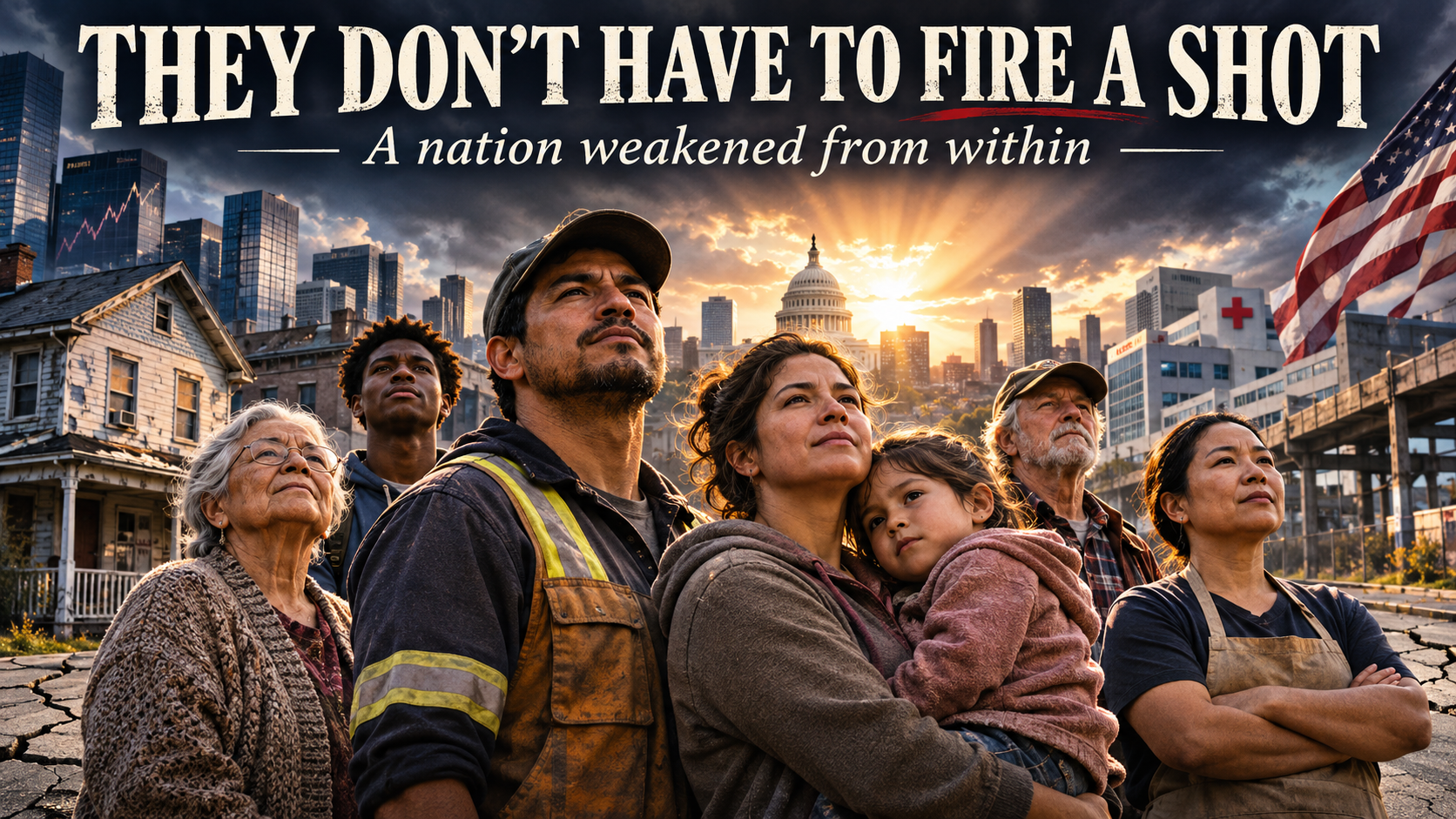
National Security · Economic Justice · The Condition of the Country
They Don’t Have to Fire a Shot
A nation weakened from within.
By Vincent Cordova · Independent Presidential Candidate, 2028 ·
Illustration by the campaign design team
Capitalism, in the condition it is in today, is a foreign adversary’s dream.
No one has to invade us. No one has to fire a shot. They only have to sit back and watch as we destroy, hurt, and devalue everything that holds this country together, including each other.
This is not an argument against markets, against work, or against building something of your own. It is an argument about condition. A system can be sound in design and still be sick in practice. Ours is sick. And a nation that lets its own people sink is doing an enemy’s work for free.
The damage report
The damage report
Start with the number that will be used to dismiss this argument. The official poverty rate for 2025 was 10.2 percent, the lowest on record, and median household income reached a high of $87,460 (Census Bureau, Sept. 15, 2026). On paper, we have never been better.
Now look at what the paper measures. A family of four counts as poor only if it lives on less than $32,649 a year. Above that line the government stops counting, and people keep struggling. Even by that standard, 34.5 million Americans live in poverty. Count taxes, benefits and real costs, and the rate climbs to 13.1 percent.
Then read the rest of the ledger:
Rent22.7M
A record 22.7 million renter households, 49 percent of all renters, spend more than 30 percent of their income on housing. 12.1 million spend more than half. Asking rents are up 29 percent since 2020 (Harvard JCHS via NLIHC, Novogradac).
Ownership~5×
Home prices now run nearly five times median income. In the 1990s the norm was three (Harvard JCHS).
The floor11M / 3.8M
11 million of the lowest-income renter households compete for 3.8 million homes they can afford.
The street745,652
745,652 people were homeless on a single night in January 2025, 26 percent more than in 2013. Chronic homelessness hit the highest level on record (HUD count via NLIHC, MyChesCo).
Health26.7M
26.7 million people went all of 2025 without health insurance. More than one in four adults say they or their family owe medical debt (Urban Institute survey, Dec. 2025).
Work2.9×
From 1948 to 1979, pay and productivity rose together. Since 1979, productivity is up 95.9 percent and the typical worker’s pay is up 33.1 percent. Productivity has grown 2.9 times as much as pay (EPI).
Now make it one household.
In California the minimum wage is $16.90 an hour. Work full time, every week of the year, and that comes to about $2,930 a month before taxes. The fair market rent on a modest two-bedroom home in this state is $2,745 (NLIHC, Out of Reach 2026).
California · one full-time minimum wage paycheck
$16.90 × 40 hrs × 52 wks ÷ 12$2,930
Two-bedroom fair market rent · $2,745
$185
What remains, before taxes: $185 for food, the car, the light bill, the school shoes, the tooth, the tire, the fever.
Job 1Job 2Job 3.13.1 full-time jobs to afford that home
Read that again. The whole paycheck, gone, before food. Before the car that gets you to the job. Before the light bill, the school shoes, the tooth, the tire, the fever nobody planned for. It takes 3.1 full-time minimum wage jobs to afford that home. A household has two adults at most, and children who need one of them.
This is not only California. Across the country the average renter earns $24.84 an hour and needs $34.73 to afford a two-bedroom (NLIHC).
That family is not failing. The math is.
A record low on one measure. Record highs on the bills people pay every month. That is not prosperity. That is a yardstick built to miss the pain.
On the record
They are already using it
This is not a theory. It is on the record.
Senate Intelligence Committee · 2019
In 2019 the Senate Intelligence Committee, led by a Republican chairman and a Democratic vice chairman, laid out how Russia’s Internet Research Agency worked on us (NPR). The operation did not invent American divisions. It found the ones already here and pushed on them, race above all. Its activity went up after the 2016 election, not down. The goal was never one election. The goal was a country that cannot trust itself.
The committee’s chairman warned that China, Iran and North Korea were following the same playbook (RFE/RL).
That report was about race and politics. So ask the next question: what makes a country easy to divide?
A person who works full time and still cannot make rent has no reason to believe the system is on their side. A parent choosing between a prescription and a utility bill is not thinking about national unity. Desperation is the opening. Every family we push to the edge is one more crack for someone else to pry at.
77%
of Americans 17–24
It reaches the armed forces too. The Pentagon’s own study found that 77 percent of Americans aged 17 to 24 could not qualify for military service without a waiver. The leading reasons were weight, drug use, and physical and mental health (Department of Defense, Military.com). You cannot neglect the health of a generation and then count on it to defend you.
An adversary does not need to build that. We build it for them, every month, on the first.
The lesson
What history already told us
The Soviet Union was never invaded. It had thousands of nuclear weapons and one of the largest armies on earth, and it came apart from the inside in 1991. Its people stopped believing in it. No arsenal can defend a country against that.
We have been on the receiving end of this lesson before. During the Cold War, Soviet propaganda carried American segregation around the world. It worked because the oppression was real and the world knew it. When Brown v. Board of Education reached the Supreme Court, the Justice Department told the justices that racial discrimination was “grist for the Communist propaganda mills” and was damaging the country’s standing abroad (Mary Dudziak, SCOTUSblog). Our injustice at home was a weapon in someone else’s hand, and our own government said so.
And look at when America was strongest. In the three decades after World War II, when this country outbuilt and outlasted every rival, a worker’s pay rose almost in step with what that worker produced. Growth was shared. People had a stake, so people believed.
1946
Kennan’s Long Telegram
1948–1979
Pay and productivity rise together
1954
Brown v. Board of Education
1979 →
Productivity and pay split
1991
The Soviet Union comes apart from the inside
The diplomat George Kennan said it at the very start of the Cold War, in the 1946 cable that shaped American strategy for forty years: much depends on the health and vigor of our own society. He called it the point where domestic and foreign policy meet (the Long Telegram). He was right then. It is still the test.
The objection
The strongest objection
Markets built American power. That objection deserves a straight answer, because it is true.
American industry won a world war. American enterprise built the technology the world runs on. Household income is at a record. The official poverty rate is at a record low. Anyone who says none of that matters is not being serious.
But look at which capitalism did the building. The version that won the twentieth century shared its gains. Wages tracked productivity. Workers could bargain. Public money built the highways, the universities and the research labs that private fortunes were later made on. A returning soldier could buy a home and send a child to college.
That is not the version we are living in. Defending today’s condition by pointing at yesterday’s results is like praising a patient’s health by showing an old photograph.
Serious people dispute how wide the gap between pay and productivity really is, and argue that living standards are higher than these numbers suggest. Fine. Argue the size. Nobody can argue the direction to a family paying half its income in rent.
The argument here was never markets or no markets. It is condition. A system that once gave people a stake now charges them for the right to stand still.
The arithmetic
If we do nothing
Here is what happens if we do nothing. Not a prediction. Arithmetic.
A system built to extract does not stop when it has taken enough. There is no enough. When housing, health care and debt become revenue streams, hardship stops being a failure of the system and becomes a source of its income.
A private equity firm buys a company with borrowed money and puts the debt on the company’s own books. The fund has promised its investors a return and has a few years to deliver it. An institutional holder answers every quarter to the same demand: more than last time. Neither one is allowed to say “this is enough.” The quota does not have a ceiling.
So there are only a few moves left.
Raise the price.Cut the staff.Make the product thinner, cheaper, smaller.Sell the building and rent it back.Load on more debt.And when those run out, find something new to squeeze.
We already know what that looks like, because it has been measured:
Nursing homes.+11%
When private equity takes over, deaths among Medicare patients rise by about 11 percent. Nurse staffing falls. Money shifts toward fees, interest and lease payments (NBER).
Hospitals.+25%
After a private equity buyout, patient harm inside the hospital rises 25 percent. Falls are up 27 percent. Central line infections are up 38 percent (NIH on the JAMA study).
Homes.450,000
Large investors went from owning almost no single-family rentals in 2011 to 450,000 by 2022. They hold a quarter of the single-family rentals in Atlanta. Studies reviewed by the Government Accountability Office found they may have pushed up both prices and rents (GAO, NLIHC).
Jobs.54%
Private equity is about 7 percent of the economy. It was involved in 54 percent of the largest corporate bankruptcies of 2025, with at least 36,802 layoffs behind them (Private Equity Stakeholder Project).
The industry says it rescues struggling companies and gives them the capital to grow, and sometimes it does. That is not the point. The point is what the structure demands when rescue and return pull in different directions. Return wins. It has to.
And this is not a story about villains. The people inside these firms did not wake up wanting your grandmother to fall in a hallway with no nurse on the floor. Many of the investors they answer to are pension funds. That is our own retirement, demanding a return that gets paid for with our own rent, our own care, our own jobs.
We are being squeezed to pay ourselves.
And while the squeeze tightens from above, the floor is being pulled out from below:
The Congressional Budget Office estimates the 2025 budget law will leave 10 million more people without health insurance by 2034 (Georgetown CCF on CBO).
The same office projects that law will cut the incomes of the poorest tenth of households by 3.1 percent while raising the incomes of the richest tenth by 2.7 percent (Medicare Rights Center on CBO).
Low-cost rentals keep disappearing as the housing stock shifts to higher rents (Harvard JCHS).
None of this corrects itself. Nothing in the machine is designed to notice the people it is grinding down.
Now run it forward. When there is nothing left to raise and nothing left to cut in one place, the money moves to the next one. Childcare. Water. Veterinary care. Funeral homes. Whatever people cannot refuse to buy. Every need becomes a meter, and the meter only runs one way.
Childcare
Water
Veterinary care
Funeral homes
A system like that will eventually choose its essence over ours. It is not built to ask whether a child ate, whether a patient lived, whether a town still has a hospital. It is built to ask one question: did the number go up?
And it does not spare anyone. Not the worker, not the retiree, not the small business owner, not the investor who also grows old and needs a nurse. It hurts all of us, because all of us live inside it.
The decision
What we build instead
We know this can be fixed, because we have fixed pieces of it. Veteran homelessness is down 56 percent since 2009. That did not happen by accident. The country decided those lives were worth the effort, and then made the effort. The only thing missing everywhere else is the decision.
So decide:
1
Measure the truth. A Federal Reality Standard that replaces the old yardsticks at every level with one that counts the conditions people actually live in, not a poverty line that stops looking at $32,649.
2
Give people a stake. A National Resource Trust and an American Resource Dividend. The natural wealth of this country belongs to its people, and it should pay them: toward health care, toward ending property taxes, toward a secure retirement.
3
Take health off the auction block. A nonprofit healthcare system with no copays at the point of care, no private equity in medicine, and no power to deny a claim. If your doctor says you need it, it gets paid.
4
Treat a home as a home. A National Housing public benefit corporation, locked to its mission so it can never be sold off, with affordability written into the deed of every property it builds.
5
Raise guardians. A Guardian Curriculum from kindergarten through college that teaches every student they are a long-term guardian of public wealth. Thinkers, builders and owners, not just a workforce.
None of these plans belongs to a campaign. Take any part that makes sense and build your own. This was never supposed to be a competition.
Start tonight. Read the plans at cordova2028.com. And if a system has taken from you, put it on the record at unitedforaccountability.org. One complaint filed alone is a grievance. Ten thousand filed together are a case.
The strongest defense a nation can have is a people with reason to believe in each other. No adversary can divide a country whose people are housed, healthy and holding a share of what they build. The children growing up right now will inherit whatever we decide. They are watching too.
Let them watch us build.
A letter
One human to another
Set the numbers down for a minute.
Whoever you are, however you vote, whatever you have or do not have: you get one life. So does the person next to you. So does the person you were taught to blame.
You were not born a market, a demographic or a cost. Nobody was. We are one species, and we share almost everything that makes us what we are. The lines we were handed, rich and poor, left and right, deserving and undeserving, are the cheapest tools ever made, and they have been used on all of us.
If you are struggling tonight, that is not a verdict on your worth. If you are comfortable tonight, that is not proof the system works. It only means it has not reached you yet.
None of us is whole alone. Every one of us needs every other one. That is not weakness. It is how our species has survived everything it has ever survived.
So look at the next person you pass and decide that their one life matters as much as yours - that is your species, protect it. Then build like you mean it.