This site is under construction - will be ready soon.
Your Guide to Our Vision

Human Potential · Opportunity · Dignity

Your Limitations Are Not Someone Else’s Destiny

The greatest responsibility we have to one another is not to decide what someone can become, but to help create a world where they have the opportunity to find out.

By Vincent Cordova · Cordova 2028 ·

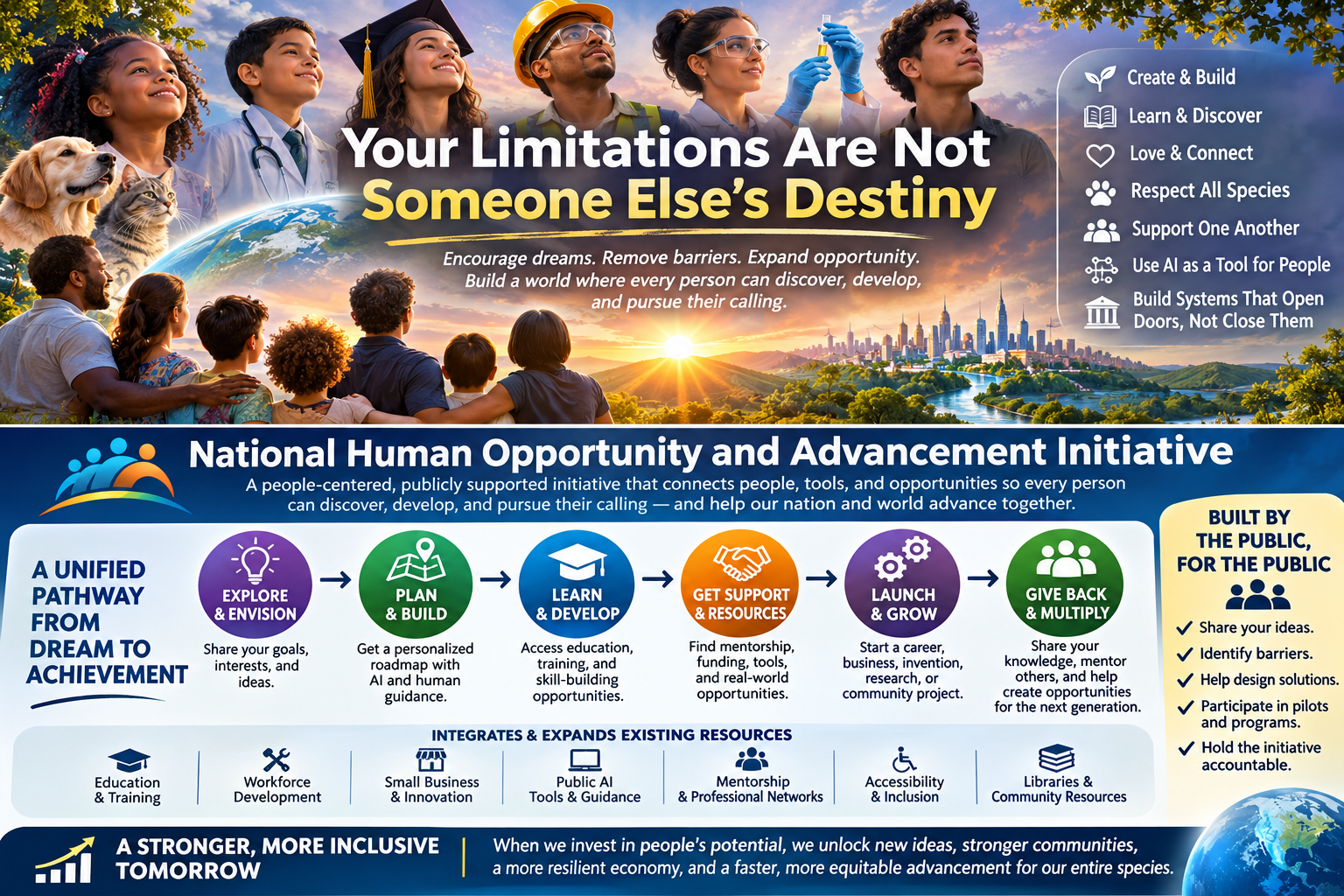
Poster titled “Your Limitations Are Not Someone Else’s Destiny.” A child, a boy in a doctor’s coat, a graduate, a construction worker, a scientist and a young man look upward beside a golden retriever and a cat, while a family watches the sun rise over a river city. Tagline: “Encourage dreams. Remove barriers. Expand opportunity. Build a world where every person can discover, develop, and pursue their calling.” A side panel lists Create & Build, Learn & Discover, Love & Connect, Respect All Species, Support One Another, Use AI as a Tool for People, and Build Systems That Open Doors, Not Close Them. Below, a navy band titled “National Human Opportunity and Advancement Initiative” shows a unified pathway from dream to achievement: Explore & Envision, Plan & Build, Learn & Develop, Get Support & Resources, Launch & Grow, Give Back & Multiply. It integrates education and training, workforce development, small business and innovation, public AI tools and guidance, mentorship and professional networks, accessibility and inclusion, and libraries and community resources. A “Built by the public, for the public” card reads: share your ideas, identify barriers, help design solutions, participate in pilots and programs, hold the initiative accountable. Footer: A stronger, more inclusive tomorrow.

There is something extraordinary about being alive.

We have the ability to create, build, discover, experience, love, learn, and understand. We can imagine something that does not yet exist and then work to bring it into existence.

We can look beyond ourselves and recognize the beauty of other living species. We can form bonds with animals, care for life that looks nothing like us, and discover that compassion does not have to end at the boundaries of our own species.

We are part of something much greater than any one individual.

We are a human species continuing to learn, evolve, and build upon the knowledge and experiences of generations before us.

And yet, despite these extraordinary gifts, we continue to do something that deserves serious reflection.

We place limitations on one another.

Sometimes those limitations come from our institutions, our economic systems, or the circumstances into which someone was born.

Other times, they come from something much closer to us.

Our own beliefs.

A Child’s Dream

Just Because You Believe You Cannot Does Not Mean Someone Else Cannot

Imagine a child approaching you with excitement.

“I want to become a doctor.”

Or perhaps:

“I’m going to become a lawyer.”

“I’m going to build something that changes the world.”

“I’m going to discover something nobody has discovered before.”

Now imagine that the person listening has spent much of their life believing those opportunities were never possible for them.

  • Perhaps they were told they were not intelligent enough.
  • Perhaps they grew up in poverty.
  • Perhaps they tried and failed.
  • Perhaps someone they trusted convinced them that certain dreams were reserved for other people.

Over time, they began to accept those limitations as truth.

And now, standing before them, is a child who has not yet learned to believe those same limitations.

What happens next matters.

Will that adult encourage the child?

Or will they respond:

“That’s not realistic.”

“People like us don’t become doctors.”

“You’re dreaming too big.”

“You’ll never be able to do that.”

Consider what just happened.

Someone took a limitation they had accepted in their own life and attempted to place it into the mind of another human being.

And because children often trust the adults around them, that child may believe it.

A possibility that once felt limitless begins to shrink.

Not because the child lacked potential.

But because someone else could not imagine that potential becoming reality.

We must become conscious of this.

Your experiences are not the boundaries of another person’s future.

Your disappointments are not proof that someone else’s dreams are impossible.

And your beliefs about your own limitations do not belong to anyone else.

The Walls We Build

Sometimes We Become the Barrier Standing in Our Own Way

There is another truth we must be willing to examine.

Sometimes the limitations we believe in are the very things preventing us from moving forward.

We tell ourselves we are too old.

  • Too young.
  • Not educated enough.
  • Not wealthy enough.
  • Not connected enough.
  • Not talented enough.

We imagine failure before we have even attempted the journey.

And slowly, those beliefs become walls.

But a belief is not necessarily a fact.

Not knowing how to accomplish something does not mean it cannot be accomplished.

It may simply mean that we have not yet discovered the path, acquired the knowledge, or found the people and resources needed to move forward.

Of course, determination alone cannot eliminate every obstacle. Some barriers are structural, financial, physical, or discriminatory. They require collective solutions.

But we should be careful not to add another unnecessary barrier by deciding that growth is impossible before we have explored the possibilities.

We do not have to know how to accomplish our dreams before allowing ourselves to have them.

  1. Sometimes the dream comes first.
  2. Then the blueprint.
  3. Then the work.
  4. Then the discovery.
Survival Is Not a Calling

What About Those Who Have Lived With a Foot on Their Neck?

We also have to acknowledge something deeply painful.

Millions of people have spent their lives trying to survive circumstances they did not create.

  • People born into poverty.
  • Children who never received the educational opportunities they deserved.
  • Workers spending their lives earning wages that barely cover basic necessities.
  • People facing discrimination, exploitation, violence, or systems that make advancement unnecessarily difficult.
  • People who have worked extraordinarily hard and still find themselves unable to escape the conditions surrounding them.

Some have spent decades with what feels like a foot pressed against their neck.

And while others have had the freedom to explore their talents, pursue education, build businesses, travel, or discover their calling, these individuals have been forced to devote much of their existence to survival.

Think about what humanity may have lost.

  • How many potential doctors never became doctors?
  • How many scientists never entered a laboratory?
  • How many teachers never reached a classroom?
  • How many artists never had the time or resources to create?
  • How many extraordinary ideas were never developed because the person carrying them was too busy trying to survive?

We may never know.

And that should trouble us.

Because when we deny people meaningful opportunities to develop their abilities, we are not only limiting individual lives.

We are limiting the advancement of our entire species.

We owe an acknowledgment, and where harm has been done, an apology and meaningful repair, to those whose opportunities were taken away, whose potential was dismissed, or whose lives were made unnecessarily difficult.

But an apology without change is not enough.

Real growth requires us to remove those barriers and create opportunities for people to pursue their callings, dreams, and wishes, while respecting the rights and well-being of others.

Change the Reply

Imagine What Humanity Could Become If We Encouraged One Another

What if we changed the way we responded to people’s dreams?

Instead of saying, “You can’t do that,” we asked:

“How can we help you get there?”

Instead of dismissing someone’s ambition because it seems unfamiliar, we asked:

“What would you need to make that possible?”

Instead of allowing our own disappointments to define another person’s possibilities, we shared what we learned and helped them avoid the obstacles we encountered.

  • Imagine parents encouraging children to explore.
  • Teachers helping students discover abilities they did not know they possessed.
  • Employers investing in the advancement of their workers.
  • Communities supporting individuals who want to learn, build, invent, or begin again.

Imagine a society where people were not made to feel ashamed for having extraordinary dreams.

We do not have to agree with every ambition, and we should not promise that every goal will be achieved.

But we can respect the pursuit.

We can encourage learning.

We can help people develop realistic plans.

And we can stop confusing someone’s current circumstances with their ultimate potential.

A person’s present situation is not a permanent definition of who they can become.

A Tool for People

Artificial Intelligence Has Given Us Another Extraordinary Opportunity

We are living through a period in human history when access to knowledge and powerful tools is expanding in remarkable ways.

Artificial intelligence offers possibilities that previous generations could scarcely have imagined.

A person with an idea may now be able to use AI to help research it, understand unfamiliar subjects, organize a business plan, develop a blueprint, practice new skills, or explore possible solutions.

Someone who once believed they could never begin because they did not know where to start may now have access to tools that help them take the first step.

  • Imagine a young person who wants to design an environmentally responsible transportation system.
  • A worker who dreams of creating a business.
  • A student who wants to study medicine but needs help understanding the educational pathway.
  • A parent who wants to return to school.
  • An individual with a disability who has an invention that could improve accessibility.

We can use technology to help these individuals move from imagination toward practical action.

Be honest about the limits

AI cannot guarantee success, replace every expert, or eliminate the need for education, human judgment, and real-world resources.

But it can help make knowledge and planning more accessible.

And that matters.

However, we must be careful.

If the most powerful tools are available only to those who already possess wealth, influence, and opportunity, we risk creating another generation of people whose potential is restricted by circumstances beyond their control.

Human advancement should not become a privilege reserved for those who can afford the tools of advancement.

We should be using AI to expand human capabilities, not simply to replace workers, concentrate wealth, or remove people from the decisions that shape their lives.

Technology should serve humanity.

Not the other way around.

The Question for Government

Every Administration Should Be Challenged to Expand Human Opportunity

This brings us to a question I believe every government should be required to answer:

What are you doing to help the people you represent discover and develop their full potential?

We measure

  • We measure economic growth.
  • We measure corporate performance.
  • We measure employment.
  • We measure government spending.

But…

But how seriously do we measure the opportunities people have to pursue their callings?

  • How many individuals want to return to school but cannot afford it?
  • How many people have inventions they cannot develop?
  • How many workers have the ability to build something extraordinary but lack access to training, mentorship, or capital?
  • How many people have spent years believing their dreams were impossible simply because nobody ever showed them a pathway?

I believe every administration should face meaningful public pressure to create mechanisms that help answer these questions and remove the barriers they reveal.

Imagine a national framework for human opportunity and advancement, supported by state and local partnerships.

A system where an individual could explain what they hope to accomplish and receive meaningful assistance in identifying the steps required.

That assistance could include:

  • Access to education, training, and professional development.
  • Publicly accessible AI tools and educational resources.
  • Mentorship from qualified professionals.
  • Assistance developing business plans, inventions, or research proposals.
  • Connections to apprenticeships, employment opportunities, and existing public programs.
  • Guidance on grants, financing, licensing, and other practical requirements.
  • Accessibility support for people with disabilities.
  • Support for people rebuilding their lives after poverty, homelessness, incarceration, or other significant barriers.

We would need to build these systems responsibly, with privacy protections, human oversight, equitable access, and clear accountability.

And most importantly, we should design them with the people who would actually use them.

We should not assume we know what someone needs without asking.

As illustrated on the poster

A Unified Pathway From Dream to Achievement

  1. 1Explore & EnvisionShare your goals, interests, and ideas.
  2. 2Plan & BuildGet a personalized roadmap with AI and human guidance.
  3. 3Learn & DevelopAccess education, training, and skill-building opportunities.
  4. 4Get Support & ResourcesFind mentorship, funding, tools, and real-world opportunities.
  5. 5Launch & GrowStart a career, business, invention, research, or community project.
  6. 6Give Back & MultiplyShare your knowledge, mentor others, and help create opportunities for the next generation.

Integrates & expands existing resources

  • Education & Training
  • Workforce Development
  • Small Business & Innovation
  • Public AI Tools & Guidance
  • Mentorship & Professional Networks
  • Accessibility & Inclusion
  • Libraries & Community Resources

Built by the public, for the public

  • Share your ideas.
  • Identify barriers.
  • Help design solutions.
  • Participate in pilots and programs.
  • Hold the initiative accountable.

The purpose of government should not be to decide which dreams are worthy.

It should be to help ensure that opportunity is not unnecessarily denied.

We cannot promise every person the outcome they desire.

But we can work toward giving every person a fair opportunity to pursue it.

A Shared Journey

Human Advancement Is Not a Competition Against One Another

Somewhere along the way, we began treating human success as though one person’s advancement must come at another person’s expense.

But human progress does not have to operate that way.

  1. When someone becomes a doctor,we may all benefit.
  2. When someone develops cleaner energy,future generations may benefit.
  3. When someone creates a more humane workplace,families and communities may benefit.
  4. When someone discovers a better way to protect animals or preserve our environment,other species may benefit.
  5. When someone overcomes a limitation and shares what they learned,countless others may find their own path forward.

Our greatest achievements have often come from people building upon the knowledge and discoveries of those who came before them.

We are not starting over with every generation.

We are continuing a shared human journey.

Imagine how much faster we could advance if more people had the freedom, resources, encouragement, and opportunity to participate.

And imagine how much suffering we could prevent if our institutions valued human development as seriously as financial growth.

Open the Door

Be Mindful of What You Place Into Another Person’s Mind

The next time someone tells you about a dream, consider the influence your response may have.

You may be speaking to a future physician.

  • A future scientist.
  • A future teacher.
  • A future inventor.
  • A future parent who will raise children with extraordinary compassion.
  • Or simply a person who wants to build a peaceful, meaningful life.

Not everyone needs to change the world in a way that makes headlines.

A life filled with love, purpose, security, and dignity is already something worth protecting.

And remember, you do not have to understand another person’s calling to respect it.

You do not have to share their dream to encourage them.

You do not have to believe you could accomplish something yourself to recognize that someone else might.

Sometimes the most important thing we can say is:

“I don’t know how you will accomplish that, but let’s explore what it would take.”

Those words can open a door.

And sometimes opening a door is enough to change the direction of someone’s life.

A Final Reflection

What If We Stopped Limiting One Another?

We have been given an extraordinary opportunity to experience life.

  • To love.
  • To create.
  • To learn.
  • To build.
  • To care for other living beings.
  • To discover what we are capable of becoming.

And to leave something better for the generations that follow.

But we cannot fully honor that opportunity while continuing to place unnecessary limitations on ourselves and one another.

  • We must learn to recognize the difference between a real obstacle and a belief we have mistaken for an absolute truth.
  • We must confront the systems that keep people trapped in survival.
  • We must encourage children to explore their potential without inheriting our fears.
  • We must give adults the opportunity to begin again.
  • And we must challenge our institutions to make human advancement a measurable public responsibility.

Because the question should never be whether every dream will come true.

The question should be whether we are doing everything reasonably within our power to give people the opportunity to try.

Your limitations are not someone else’s destiny.

Your inability to imagine their future does not mean that future is impossible.

And the circumstances into which someone was born should never determine the limits of what they are allowed to pursue.

We are one human species, sharing one planet with countless other forms of life.

We have the ability to help one another grow.

We have the tools to expand opportunity.

And we have generations ahead of us who will inherit the world we choose to build today.

Let us stop asking people to make their dreams smaller to fit the limitations of our present systems.

Let us build systems worthy of the potential of the people they are meant to serve.

Moving Forward Together.

An Invitation to Participate

What dream, calling, or purpose have you been discouraged from pursuing? What barriers have stood in your way? And what practical changes would help you or someone else move forward?

We want to hear your experiences and your proposed solutions.

Share your thoughts:

solutions@vincentcordova.com

Your experiences matter. Your ideas matter. And the opportunity to help shape a better future should belong to everyone.

Participation is open to everyone, regardless of political affiliation, and does not imply support for any candidate or campaign.

Vincent Cordova

Independent Candidate for President of the United States — 2028

Moving Forward Together

www.cordova2028.com

A stronger, more inclusive tomorrow

When we invest in people’s potential, we unlock new ideas, stronger communities, a more resilient economy, and a faster, more equitable advancement for our entire species.

Community Comments

Community Comments

Share a public response to this post. Submissions are reviewed before they appear.

0 approved comments

Loading comments...

Comments are moderated for spam, abuse, and off-topic submissions.

Your age, area, and IP address are collected for moderation and internal reporting only.