This site is under construction - will be ready soon.
Your Guide to Our Vision

Faith · Human Dignity · Prevention

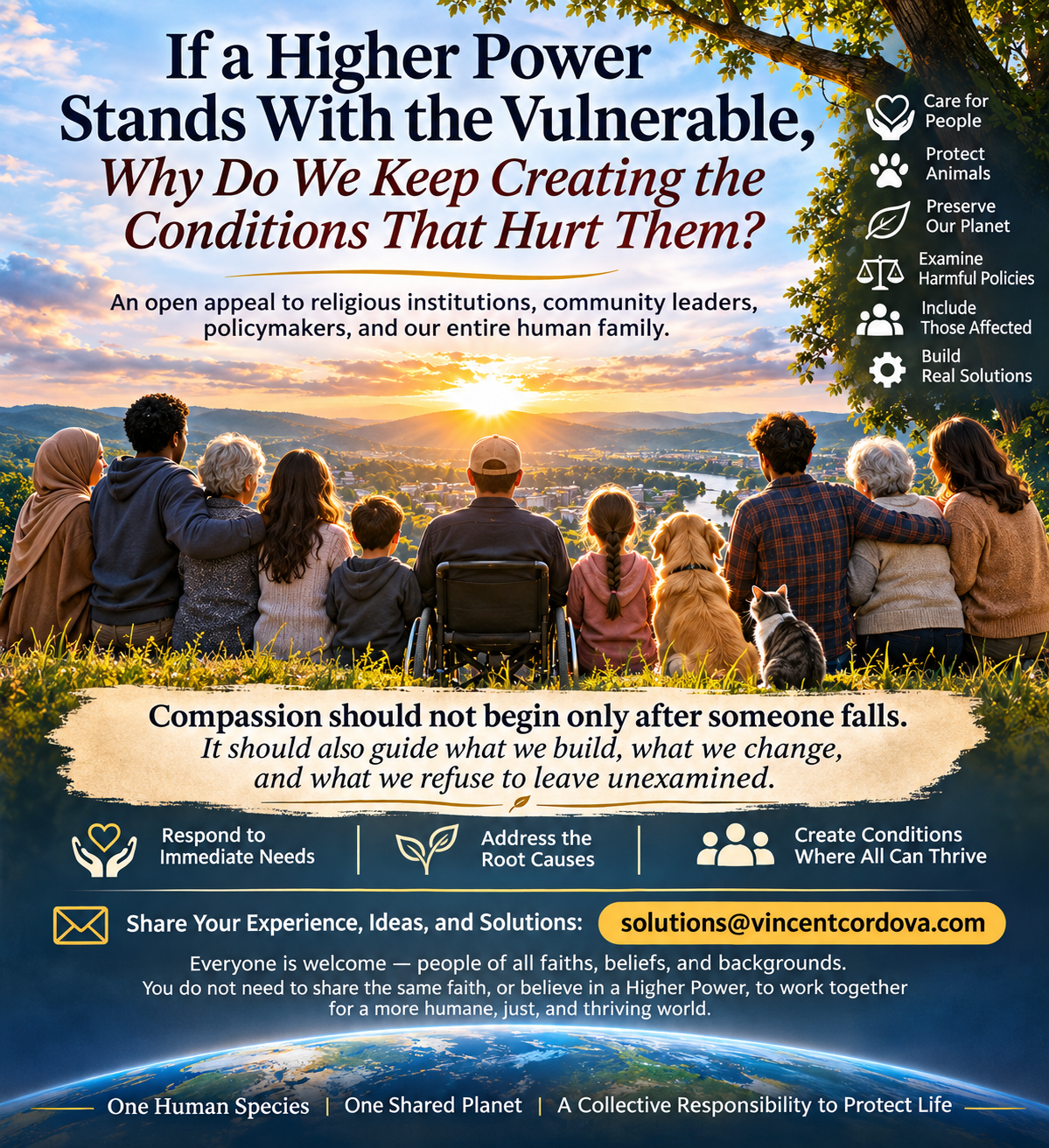
If a Higher Power Stands With the Vulnerable, Why Do We Keep Creating the Conditions That Hurt Them?

An appeal to religious institutions, community leaders, policymakers, and every member of our human family.

By Vincent Cordova · Cordova 2028 ·

Poster titled “If a Higher Power Stands With the Vulnerable, Why Do We Keep Creating the Conditions That Hurt Them?” subtitled “An open appeal to religious institutions, community leaders, policymakers, and our entire human family.” A diverse family of people, including a woman in a hijab, elders, children, and a man in a wheelchair, sit on a hillside with a golden retriever and a cat, watching the sun rise over a valley town. A side panel lists Care for People, Protect Animals, Preserve Our Planet, Examine Harmful Policies, Include Those Affected, and Build Real Solutions. A parchment banner reads: “Compassion should not begin only after someone falls. It should also guide what we build, what we change, and what we refuse to leave unexamined.” Below: Respond to Immediate Needs, Address the Root Causes, Create Conditions Where All Can Thrive. “Share Your Experience, Ideas, and Solutions: solutions@vincentcordova.com. Everyone is welcome — people of all faiths, beliefs, and backgrounds.” Footer over the Earth: One Human Species, One Shared Planet, A Collective Responsibility to Protect Life.
A Reflection

We are all part of the same human family

We often hear that God, or a Higher Power, stands closest to the most vulnerable among us. But perhaps we should ask ourselves why.

Could it be that the Creator, who gave life to every one of us, sees the suffering of the vulnerable and grieves—not only for those who are hurting, but also for those who have forgotten that we are all part of the same human family?

Imagine creating humanity, only to watch some of your creation turn away from others, design policies that deepen their suffering, or remain silent while their fellow human beings struggle to survive.

Perhaps God stands closest to the vulnerable because they are the ones who have been abandoned by the very people who were meant to recognize them as equals.

And perhaps the greatest disappointment is not simply that humanity suffers, but that so much of that suffering comes from humanity forgetting who we are to one another.

We are one human species.

Different in our beliefs, cultures, identities, and experiences, but equal in our humanity.

If we truly believe that we were created by the same Higher Power, then our responsibility should never be to build systems that abandon some of us while rewarding others. It should be to protect one another, especially those who have the least power to protect themselves.

Because how can we claim to honor the Creator while forgetting the equal worth of all creation?

And whether we believe in a Higher Power or not, the responsibility to one another remains.

We must ask not only how to help those who are suffering, but what we can change to prevent that suffering in the first place.

Prevention

The Responsibility to Prevent Suffering

Compassion should not begin only after suffering occurs.

While religious institutions, nonprofits, and communities provide essential assistance to vulnerable people, we must also examine the laws, policies, economic structures, and institutional practices that contribute to preventable suffering.

Whether we believe in a Higher Power or not, we share a responsibility to protect human dignity, animal welfare, and the planet we call home.

01

Respond to Immediate Needs

02

Address the Root Causes

03

Create Conditions Where All Can Thrive

This is an invitation to move beyond responding to hardship, listen to those directly affected, and work together to create lasting solutions.

Because our goal should not simply be to help life survive, but to create conditions in which life can thrive.

After the fall

Helping People After They Fall Is Not the Same as Preventing the Fall

Across our communities, churches, mosques, synagogues, temples, charitable organizations, and volunteers provide food, shelter, clothing, counseling, and countless other forms of assistance.

That work matters enormously.

There are people alive today because someone opened a door when they had nowhere else to turn.

Those acts of compassion deserve recognition and gratitude.

But we must also ask a difficult question:

Why are we so willing to help people after they have fallen, yet so hesitant to confront the conditions that keep pushing them down?

Food pantry

If a family visits a food pantry every week because their wages cannot cover basic necessities, providing food is an act of compassion.

But asking why their wages cannot sustain them is an act of responsibility.

Shelter

If someone becomes homeless because housing costs exceed their income, offering shelter can save their life.

But examining the policies, economic incentives, and institutional decisions that make housing inaccessible is part of preventing the next family from experiencing the same suffering.

Animal rescue

If an animal rescue must repeatedly save animals from neglect or abandonment,

we should also examine the circumstances, laws, and enforcement failures that allow preventable suffering to continue.

Water · air · land

If communities repeatedly face contaminated water, polluted air, or environmental destruction,

we must examine the decisions that expose people, wildlife, and ecosystems to those harms.

We need both immediate compassion and long-term prevention.

Charity responds to suffering.

Structural reform seeks to prevent avoidable suffering.

One should never become an excuse to neglect the other.

Faith communities

A Question for Our Religious Institutions

If religious institutions teach us to love our neighbors, care for the poor, protect children, and defend the vulnerable, should those responsibilities end at the doors of a food pantry?

What happens when suffering is connected to laws, wages, housing policies, healthcare costs, environmental decisions, or institutional practices?

Should faith communities remain silent?

Or should they help society understand why these conditions exist and what can be done to change them?

This is not an accusation against every religious institution.

Many have spent generations confronting injustice, advocating for human dignity, protecting vulnerable communities, and helping build better futures.

Their work demonstrates that faith and structural responsibility can coexist.

But it also raises a question for every institution that claims compassion as a central value:

Are we only treating the wounds, or are we also asking why people keep getting wounded?

Imagine what could happen if more religious institutions brought their community knowledge, compassion, and organizational experience into constructive discussions about preventing suffering.

  • Not to dictate how others must live.
  • Not to impose religious beliefs.
  • Not to promote a political candidate.

But to help identify problems and develop solutions that protect the dignity of life.

Section 501(c)(3)

Why the Rules Protecting Religious Institutions Matter

There is another issue we must address thoughtfully.

In the United States, churches and other qualifying religious organizations operate under federal tax rules that restrict certain political activities.

26 U.S.C. § 501(c)(3)

Under Section 501(c)(3), organizations are generally prohibited from participating or intervening in political campaigns for or against candidates for public office. Legislative lobbying is also limited, although some lobbying is permitted, and nonpartisan public-policy education and advocacy can be lawful.

IRS guidance: political campaign intervention · lobbying · Publication 1828 (churches)

There are legitimate reasons to maintain protections against partisan political intervention.

Imagine someone creating a religious institution, attracting a large following, obtaining tax-exempt status, and then using the institution primarily as a vehicle to influence elections or concentrate political power.

That possibility raises serious concerns about public trust, religious independence, and the appropriate use of tax-exempt resources.

We should protect religious freedom without allowing religious institutions to become instruments of political control.

But we must also recognize an important distinction.

Examining a law that harms vulnerable people

is not inherently the same as endorsing a political candidate.

Studying the causes of poverty

is not inherently partisan campaigning.

Discussing environmental destruction, animal welfare, housing affordability, or barriers to healthcare

does not automatically constitute prohibited political activity.

Religious institutions can engage in many forms of nonpartisan education and public discussion while respecting the legal boundaries applicable to their activities.

We should examine whether those boundaries are clearly understood, appropriately balanced, and applied in ways that protect both institutional independence and legitimate civic participation.

The objective should not be to turn places of worship into political campaign organizations.

It should be to encourage lawful, independent, evidence-based participation in addressing the conditions affecting our communities.

Protecting people from harm should never require allegiance to a political party, candidate, or religious belief.

Faith, science, philosophy

And If You Do Not Believe in a Higher Power?

Then the responsibility remains.

We do not need to agree about the origins of humanity to recognize the humanity we share.

Science tells us that we belong to the same species

Homo sapiens

We have different histories, beliefs, cultures, languages, and identities.

But our fundamental needs are remarkably similar.

  • Food
  • Water
  • Shelter
  • Safety
  • Connection
  • Dignity
  • Opportunities to build meaningful lives

We need food, water, shelter, safety, connection, dignity, and opportunities to build meaningful lives.

A child does not need to share your religion to deserve protection.

A worker does not need to share your political beliefs to deserve fair treatment.

A person experiencing homelessness does not need to prove their worth before receiving compassion.

And an animal does not need to belong to our species for its suffering to matter.

The natural world does not exist separately from our well-being. Healthy ecosystems, clean water, breathable air, and biodiversity support life across generations.

Whether your understanding of existence comes from faith, science, philosophy, or personal experience, we can recognize a shared responsibility to protect the conditions that sustain life.

We do not have to believe in the same Creator—or believe in one at all—to recognize that we share the same home and a responsibility to protect life.

The structures

We Must Examine the Structures, Not Simply Blame Individuals

When people suffer, it can be tempting to search for one person or institution to blame.

But lasting solutions require a deeper examination.

  1. 1What rules are producing these outcomes?
  2. 2What financial incentives encourage harmful practices?
  3. 3What protections are missing?
  4. 4What policies are working, and which are failing?
  5. 5Who benefits from the current arrangements?
  6. 6Who bears the costs?
  7. 7And who has been excluded from the decisions?

Sometimes harmful outcomes result from deliberate choices. Sometimes they arise from unintended consequences, outdated rules, competing priorities, or failures of oversight.

We should investigate those differences rather than assume every harmful outcome has the same cause.

Accountability requires evidence.

And meaningful reform requires understanding.

Our objective should not be revenge.

It should be

correctionpreventionand the protection of life.

Our objective should not be revenge. It should be correction, prevention, and the protection of life.

Include those affected

Those Experiencing the Consequences Must Help Design the Solutions

For too long, important decisions have been made about people’s lives without sufficient participation from the people who must live with the consequences.

If we want to understand why families cannot afford housing, we should speak directly with those families.

If we want to understand why workers remain in poverty despite working full-time, we should listen to those workers.

If we want to address homelessness, we must include people who have experienced homelessness.

If we want to improve animal welfare, we should hear from rescuers, veterinarians, animal welfare researchers, and communities affected by existing policies.

If we want to protect our environment, we must listen to residents, scientists, conservationists, and those whose livelihoods depend on the land and water.

And we should invite institutions that have the resources, experience, and willingness to help.

  • Religious institutions.
  • Secular nonprofits.
  • Schools and universities.
  • Community organizations.
  • Businesses.
  • Researchers.
  • Public officials.
  • And individuals who simply care about the future.

No single institution has every answer.

But together, we can ask better questions, investigate problems more thoroughly, and develop solutions that reflect real experiences.

Those directly affected by a problem deserve a meaningful voice in designing its solution.

An open invitation

An Open Invitation: Help Us Find Solutions

Today, we are opening another door for public participation.

Share Your Experience, Ideas, and Solutions:

solutions@vincentcordova.com

This email address is open to anyone who wants to share experiences, identify harmful laws or institutional practices, contribute research, or propose solutions that protect people, animals, and the environment.

  • You do not need to belong to a religious institution.
  • You do not need to agree with my political views.
  • You do not need to support my candidacy, endorse anyone, or belong to any political party.

Those decisions are yours alone.

This initiative is not about me.

It is about us.

It is about recognizing that no person, organization, or political leader possesses all the answers—and that people living with the consequences of our systems may understand problems that decision-makers have overlooked.

We invite you to consider three questions:

  1. 1

    What is happening?

    Identify the law, policy, practice, or condition causing concern.

  2. 2

    Who or what is being harmed?

    Tell us about the effects on people, animals, communities, or ecosystems.

  3. 3

    What should change?

    Share your ideas, experiences, research, or proposed solutions.

We will approach these contributions with respect, examine claims carefully, and seek meaningful input from those affected.

A note on privacy

Messages will be handled with care. We will not intentionally publish identifying information from submissions without permission. However, ordinary email is not a guaranteed confidential or emergency communication channel, so please avoid sending highly sensitive personal information.

Our purpose is to learn, understand, and work toward practical improvements.

Imagine

Imagine What We Could Build Instead

Imagine communities where working families can afford safe housing.

Where children have access to education, nutrition, healthcare, and opportunities to discover their abilities.

Where older adults do not have to choose between medicine and electricity.

Where people with disabilities can live with dignity and independence.

Where animals are protected from preventable cruelty and neglect.

Where our forests, waterways, oceans, and ecosystems are protected for generations we will never meet.

Where technology advances human well-being rather than treating people as disposable.

Where religious and secular organizations work alongside communities without requiring everyone to share the same beliefs.

And where the people most affected by public decisions have a meaningful voice in making them.

These outcomes require more than goodwill.

They require evidence, resources, accountability, cooperation, and sustained effort.

But they are worthy goals for a society that recognizes the value of life.

The wrong question

Perhaps We Have Been Asking the Wrong Question

For generations, people have asked:

Why does a Higher Power allow so much suffering?

Perhaps another question deserves equal consideration:

How much suffering do we, as human beings, have the power to prevent—and why have we allowed so much of it to continue?

We cannot eliminate every hardship.

We cannot prevent every illness, disaster, loss, or tragedy.

  • But we can examine the decisions within our control.
  • We can challenge systems that create unnecessary barriers to basic needs.
  • We can improve the laws and policies that fail to protect vulnerable people.
  • We can protect animals and the ecosystems upon which life depends.
  • And we can stop treating preventable suffering as an unavoidable feature of human existence.

If you believe in a Higher Power, perhaps honoring that Higher Power means caring for all life, especially those who have been forgotten.

And if you do not believe in a Higher Power, the responsibility to our fellow living beings is no less real.

Perhaps the greatest tragedy is not simply that humanity suffers, but that so much suffering continues while humanity possesses the knowledge, resources, and collective ability to address it.

We are one human species, sharing one extraordinary planet with countless other forms of life.

We do not have to share the same religion to protect one another.

We do not have to agree on every policy to recognize someone’s dignity.

And we do not have to wait until another person has lost everything before deciding their life matters.

Compassion should not begin only after someone falls.

It should also guide what we build, what we change, and what we refuse to leave unexamined.

Because the goal should never be merely to help people survive the world we have created.

It should be to create a world in which people, animals, and the natural world have the opportunity to thrive.

This is not about me.

This is about us—and how we move forward together.

Share your experiences and solutions:

solutions@vincentcordova.com

Every voice matters. Every life has value. Our future is a shared responsibility.

Vincent Cordova

Independent Candidate for President of the United States — 2028

Moving Forward Together

www.cordova2028.com

One Human Species | One Shared Planet | A Collective Responsibility to Protect Life

Community Comments

Community Comments

Share a public response to this post. Submissions are reviewed before they appear.

0 approved comments

Loading comments...

Comments are moderated for spam, abuse, and off-topic submissions.

Your age, area, and IP address are collected for moderation and internal reporting only.