This site is under construction - will be ready soon.
Your Guide to Our Vision

Feeding PeopleIs Not a Crime

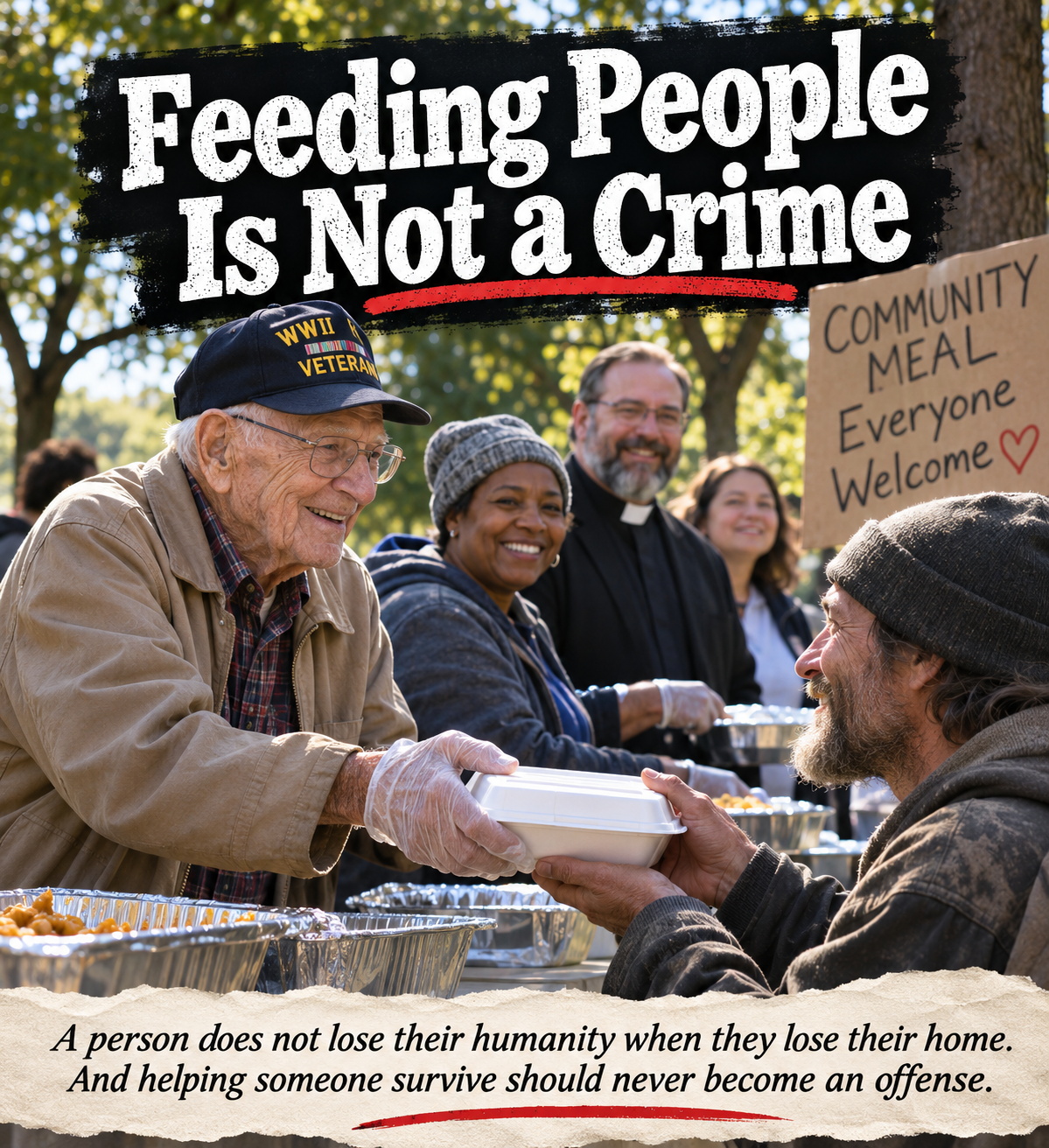
A person does not lose their humanity when they lose their home. And helping someone survive should never become an offense.

Cordova 2028 ·

By Vince Cordova (Vinnie) · Cordova 2028: Moving Forward Together

Poster: Feeding People Is Not a Crime. In a sunlit park, an elderly World War II veteran wearing gloves hands a meal container to a smiling homeless man, while volunteers and a pastor serve food from foil trays behind a cardboard sign reading Community Meal, Everyone Welcome. Caption: A person does not lose their humanity when they lose their home. And helping someone survive should never become an offense.
Campaign design team

In November 2014, police in Fort Lauderdale, Florida, cited a 90-year-old World War II veteran named Arnold Abbott. His offense was handing out food to homeless people in a public park, something he had done for decades. Two pastors standing beside him were cited too. Each faced up to 60 days in jail and a $500 fine. Abbott went back three days later and fed people again. He was cited again.

Notice of Citation

Date
November 2014
Location
Public park, Fort Lauderdale, FL
Cited
Arnold Abbott, 90, World War II veteran
Also cited
Two pastors standing beside him
Offense
Handing out food to homeless people
Penalty
Up to 60 days in jail · $500 fine
Three days later he went back and fed people again. He was cited again.
Not a crime

Fort Lauderdale was not an outlier. Between 2013 and 2015 alone, the National Coalition for the Homeless counted 26 cities that passed food-sharing bans. Volunteers have been arrested in Orlando and Tampa. In El Cajon, California, a dozen people were charged with misdemeanors for sharing food in a park. Houston has ticketed volunteers under an ordinance requiring permission to feed more than five people.

26

cities passed food-sharing bans, 2013–2015

90

years old: the veteran cited for feeding people

12

charged in El Cajon for sharing food

111

citations to volunteers in Houston

Read that again. In the richest nation in human history, governments have written laws to punish people for feeding the hungry.

We Are One People

We are one human species. Our capacity for empathy, cooperation, and love is not a weakness to be regulated out of public life. It is the reason we survived as a species at all. No one made it through the long history of famine, plague, and hardship alone. We made it because people shared what they had.

When you see another person hungry and you feed them, you are not causing a problem. You are doing the most basic thing a conscience asks of us. You are meeting a responsibility we all carry to one another.

Reject the Politics of Turning Away

There is a message hidden inside every feeding ban, and it needs to be said out loud. The message is: look away. Don't help. Don't get involved. That person on the sidewalk is not your neighbor. Their hunger is their problem, and your compassion is a nuisance.

look away.

I reject that message completely, and I'm asking you to reject it with me.

The idea that we must turn our backs on one another is not toughness. It is not realism. It is not responsible governance. It is a failure of nerve dressed up as policy. It asks decent people to unlearn decency so that officials can avoid the harder work of fixing what's broken.

We hear the justifications. It encourages them to stay. It hurts business downtown. It's not the right way to help. Strip away the language and what remains is a simple wish: that suffering would become less visible. But hiding hunger does not end hunger. Pushing people out of a park does not put a roof over their heads. Ticketing a grandmother with a casserole dish does not make a single life better.

“It encourages them to stay.”

Hiding hunger does not end hunger.

“It hurts business downtown.”

Pushing people out of a park does not put a roof over their heads.

“It’s not the right way to help.”

Ticketing a grandmother with a casserole dish does not make a single life better.

A society that punishes kindness is teaching its people to be cruel. We should refuse that lesson. Every time.

Ask the Simple Questions

Any government that tickets people simply for feeding someone experiencing homelessness needs to examine its own priorities.

What public purpose is served by leaving someone hungry?

Whose life becomes better when a neighbor is punished for offering a meal?

No one has a good answer, because there isn't one.

Safety Is a Duty to Help, Not a License to Forbid

Food safety, sanitation, and public access are legitimate responsibilities. I take them seriously. But those responsibilities point in one direction: government should help communities feed people safely. That means accessible restrooms and handwashing stations, waste collection, safe-handling guidance, shared kitchen space, and practical support for the churches, mutual aid groups, and neighbors already doing this work.

Accessible restrooms
Handwashing stations
Waste collection
Safe-handling guidance
Shared kitchen space
Support for churches, mutual aid groups, and neighbors

Those responsibilities must never become excuses to make compassion impossible. When a rule's real effect is to stop people from eating, it is not a health rule. It is a removal rule wearing a health rule's clothes.

Fort Lauderdale Food Not Bombs v. City of Fort Lauderdale · 11th Cir. 2018

The courts have noticed. In 2018, a federal appeals court ruled that a group sharing food in a Fort Lauderdale park was engaged in expression protected by the First Amendment. Sharing a meal in public is a statement about who we are. It deserves protection, not punishment.

Protected by the First Amendment

Look at the Conditions, Not the Kindness

If leaders are serious about homelessness, they should be confronting why people lose their homes in the first place.

The federal minimum wage is still $7.25 an hour. It has not moved since July 2009, the longest stretch without an increase since the federal minimum wage was created in 1938. At 40 hours a week, 52 weeks a year, that is $15,080 before taxes. Inflation alone means that $7.25 today buys what roughly $4.60 bought when it was set. Try finding rent anywhere in America on that.

The federal minimum wage

$7.25 · $7.25 · $7.25 · … · $7.25

17+ yrs

without an increase, the longest stretch since 1938

$15,080

a year before taxes at 40 hours × 52 weeks

≈ $4.60

what $7.25 buys today, in 2009 dollars

2009$7.25
Today≈ $4.60

The real questions are these: Do wages cover basic necessities? Is housing affordable? Can people get help before they lose their homes, not after?

When public policy leaves people unable to meet their basic needs, government has a responsibility to change those conditions. Punishing the people who respond to that suffering is a profound failure of leadership. It blames the people bandaging the wound for the wound itself.

Humanity Is a Qualification for Leadership

If you hold public office and believe a hungry person should be denied a meal simply because they are homeless, you should reconsider whether you are prepared to serve the public.

I mean that plainly. Public service is service to all of the public, including the person with nowhere to sleep tonight.

Humanity is not optional for those who hold power over others. It is the qualification.

What We Will Do

Community Meal · Everyone Welcome ♥

  1. 1

    Repeal ordinances that punish the simple act of feeding people.

  2. 2

    Protect community food sharing in law, so no volunteer, congregation, or neighbor is cited for offering a meal.

  3. 3

    Support safe food sharing with public restrooms, handwashing stations, waste collection, and access to shared kitchens.

  4. 4

    Invest in housing people can actually afford.

  5. 5

    Raise wages so a full-time job covers a full life.

  6. 6

    Prevent homelessness through eviction prevention and emergency rental help.

  7. 7

    Expand accessible care, including health and mental health services people can reach without barriers.

The Measure of a Government

A government should measure its success by how well people can live, and whether it helps them when they cannot.

Arnold Abbott understood that. The people still carrying trays of food into parks across this country understand it too. They are not the problem. They are the proof that we have not given up on each other.

Neither will we.

Feed people. Protect their dignity. Fix the conditions that leave them hungry.

I am a piece of the collective essence of this world that never gives up and needs every other piece to be whole.

— Vincent Cordova

Cordova 2028: Moving Forward Together

cordova2028.com

Vincent Cordova · Candidate for U.S. President 2028

Community Comments

Community Comments

Share a public response to this post. Submissions are reviewed before they appear.

0 approved comments

Loading comments...

Comments are moderated for spam, abuse, and off-topic submissions.

Your age, area, and IP address are collected for moderation and internal reporting only.