This site is under construction - will be ready soon.
Your Guide to Our Vision
← Back to Blog

Counted Out:How Jail Makes Homelessness Disappear —and Who Pays for It

Cordova 2028 ·

You have to know what you’re not counting.

By Vince Cordova (Vinnie) · Cordova 2028: Moving Forward Together

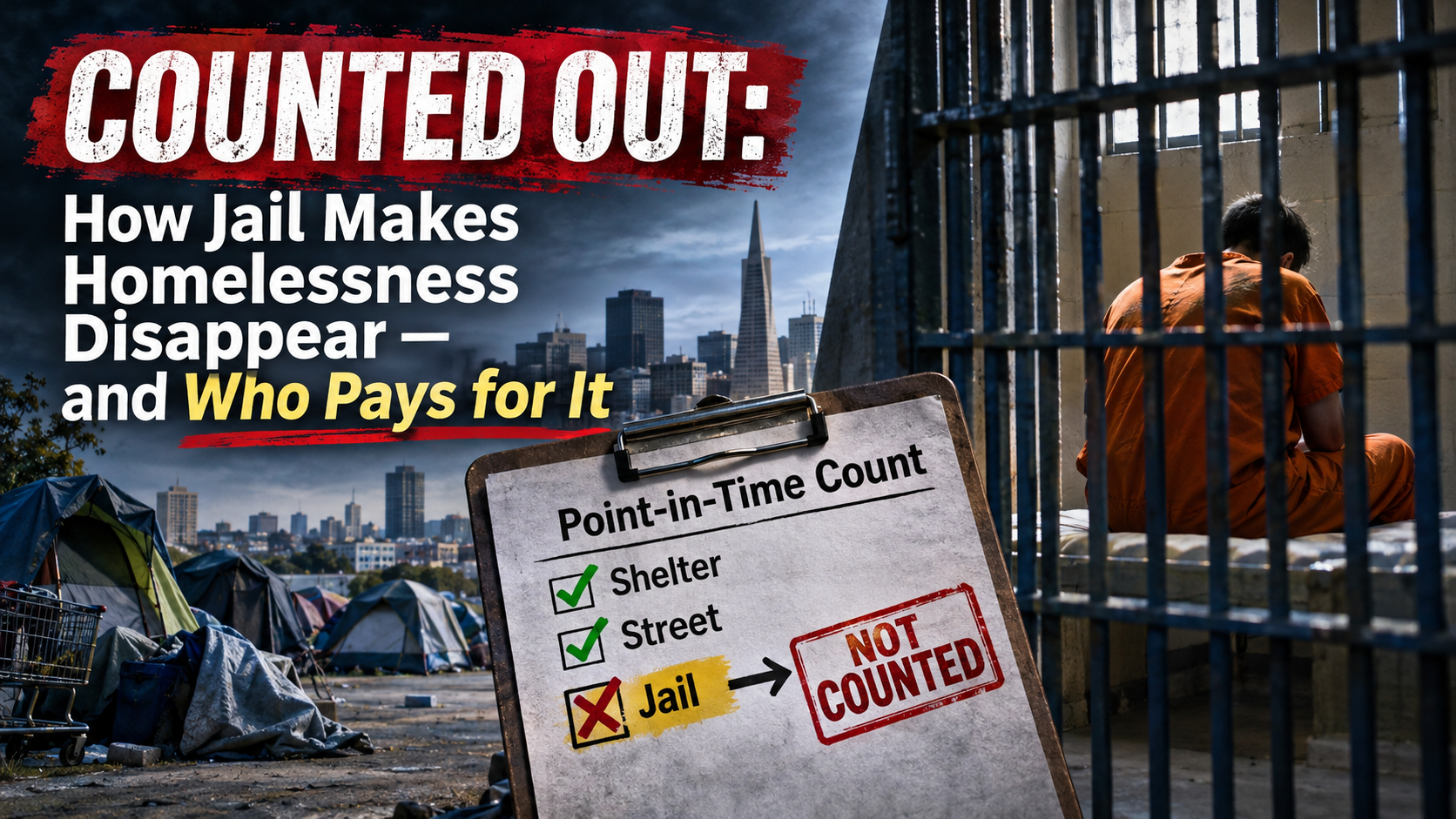
Poster: Counted Out: How Jail Makes Homelessness Disappear — and Who Pays for It. A homeless encampment sits below the San Francisco skyline while a man in an orange jumpsuit sits behind jail bars. A Point-in-Time Count clipboard checks Shelter and Street, but marks Jail with a red X and a “Not Counted” stamp.
Campaign design team

The headlines this year say homelessness is going down. Counties up and down California are reporting drops. San Francisco says its street count is the lowest in fifteen years. Washington finally released its national number in May — 745,652 people on a single night in January 2025, down 3%, five months late. (LeadingAge, LAist)

745,652

People counted homeless on one night, January 2025

↓ 3%

National change reported by HUD

5 months

How late the report reached the public

I want those numbers to be true. Every person who comes inside is a life that matters. But I have run a business for years, and I know the first rule of any count: you have to know what you're not counting.

And right now, one of the fastest-growing places a homeless person can be on the night of the count is a place the count never looks.

Jail.

The rule nobody talks about

Every January, communities across America conduct the federal Point-in-Time count. Volunteers walk the streets. Shelters report their beds. The numbers go to HUD, and HUD tells Congress how many Americans are homeless.

Point-in-Time Count

  • Shelter
  • Street
  • JailNot
    Counted

But the federal definition draws a line. If you are in a shelter, you count. If you are on the sidewalk, you count. If you are in a jail cell — even if you were sleeping on that sidewalk the night before, even if you will be released back onto it the morning after — you do not count. HUD treats jails the same way it treats hospitals and foster care: as institutions, outside the count. (Nevada County)

That rule has existed for years. What changed is how many people it now swallows.

June 2024 · U.S. Supreme Court

What changed: Grants Pass

In June 2024, the Supreme Court decided City of Grants Pass v. Johnson. The Court ruled that cities can arrest and punish people for sleeping outside — even when there is no shelter bed available for them to go to.

Cities moved fast.

Sacramento

Police made three camping-related arrests in January 2024 — then none again until July, one month after the ruling. From July through December, they made 45. County park rangers on the American River Parkway went from zero camping arrests for a full year to 45 in November 2024 and 62 in December. (Center for Health Journalism)

Sacramento County jail

About one-third of bookings in the Main Jail involve homeless people. On average, roughly 838 homeless individuals were held in the jail each month. The Sheriff's Office told reporters it does not track an arrestee's housing status. (Center for Health Journalism)

San Francisco

Arrests and citations for illegal lodging rose from 71 in the six months before Grants Pass to 427 in the six months after — roughly a 500% increase. The city's average daily jail population reached about 1,294 by February 2026. It reopened a closed annex in San Bruno to hold the overflow, and the Sheriff's budget asks for 110 new positions to staff it. (Davis Vanguard, SF Sheriff)

San Francisco · illegal-lodging arrests & citations

6 months before Grants Pass71
6 months after427

American River Parkway · camping arrests

A full year before0
December 202462

This spring, San Francisco announced a 22% drop in street homelessness — down to 3,400 people — using a brand-new counting method that advocates say can't be compared with prior years. The count found an 85% drop in people living in tents. Over the same stretch, the jail filled up. (SF Standard)

Street count

↓ 22%

Jail, average daily

~1,294

I am not telling you every person who left the street went to jail. Shelter beds were added. Some people were housed. San Joaquin County, where I live, added 304 shelter beds and over a thousand permanent housing units between 2024 and 2026 — that is real work by real people. (Piedmont Exedra) But here is the problem: nobody can tell you how much of the drop is people housed and how much is people locked up, because the count is built not to see the second group. One advocacy analysis estimates that roughly one in four people in the national homeless count will spend time in jail within a year. (Homes4theHomeless) Austin, Texas actually checks — it counts homeless people in its county jail on the night of the count, and that number has risen sharply since 2011. (Austin ECHO) Almost nobody else does.

When you can't see a number,

you can't be held accountable for it.

Follow the money

So the next question is the one every taxpayer should ask: who is paying for these jail beds? Mostly, it's you — through county budgets. But federal money flows in through several doors, and in the last eighteen months Washington has started pushing local governments toward enforcement.

  1. 1

    Door 1 · Executive Order 14321

    The White House tied homelessness grants to enforcement

    On July 24, 2025, President Trump signed Executive Order 14321, Ending Crime and Disorder on America's Streets. It directs federal agencies to prioritize grant money for states and cities that enforce bans on urban camping and loitering, and to push "maximally flexible" civil commitment — institutionalizing people. It also directs the Attorney General to make Emergency Federal Law Enforcement Assistance funds available in support. (American Presidency Project, GovInfo)

    Read that plainly: federal dollars are now being steered toward places that arrest people for sleeping outside.

  2. 2

    Door 2 · HUD Continuum of Care · ~$4B

    HUD docked points from communities that don’t arrest

    HUD's Continuum of Care program is the main federal homelessness grant — about $4 billion. HUD's late-2025 funding notice deducted points from applicants located in jurisdictions that don't enforce policies like public camping bans, according to the states that sued. The same notice tried to cap permanent housing at 30% of the money, down from nearly 90%. A court blocked it. In June 2026, HUD came back with a $1.3 billion "set-aside" that works out to a de facto cap of around 68%. A coalition of states sued again. The National Alliance to End Homelessness estimates at least 97,000 people living in permanent housing are at risk of losing it. (2025 complaint, Colorado AG, Illinois AG)

    So think about the full picture. Washington is rewarding arrests on one side and cutting housing on the other. Both push people out of the count. Only one of them actually ends homelessness.

  3. 3

    Door 3 · Byrne JAG · SCAAP

    Justice grants that flow to jails

    The Byrne Justice Assistance Grant (JAG) program is the federal government's leading source of justice funding for states and local governments — $770.8 million in FY 2023. Counties can use it for policing, courts, and corrections. The State Criminal Alien Assistance Program (SCAAP) reimburses jails for holding certain undocumented inmates; it was funded around $244 million in recent years. Neither program asks whether the people being jailed were homeless. (NACo, NACo)

  4. 4

    Door 4 · U.S. Marshals per diem

    Renting beds to Washington

    The U.S. Marshals Service pays county and city jails a daily rate — a per diem — to hold federal detainees. Santa Ana's jail, for example, negotiated $115 per person per day, worth about $16.8 million a year at 400 detainees. Researchers at the Vera Institute have documented how these per diem payments helped counties build bigger jails and grow their budgets for decades. Bigger jails need to stay full. (Santa Ana, Vera Institute)

  5. 5

    Door 5 · Medi-Cal reentry · $410M

    Medicaid — now paying for care inside jail

    Since Medicaid was created in 1965, federal law barred it from paying for the health care of incarcerated people. In January 2023, California became the first state allowed to use federal Medicaid money for a targeted set of services in state prisons and county jails during the 90 days before release. Every California county had to implement it by October 1, 2026, and the state got $410 million in federal-backed funds to build the systems. (CHCF, CSAC, Mercer)

    Let me be fair: this is a good program. Connecting someone to treatment and coverage before they walk out the door saves lives. But it proves my point. The federal government now pays for care inside the jail and is cutting the housing that waits outside it. If a person leaves jail with a Medi-Cal card and no address, we have built a very expensive revolving door.

The honest gap

I went looking for a single public number: how many federal dollars go to jailing people whose only "crime" is having nowhere to sleep.

Federal dollars spent jailing homeless people

$ ? ? ? ? ? ?

That number does not exist.

That number does not exist. Sheriffs don't track housing status at booking. HUD doesn't count people in jail. The grant programs don't ask.

That is not an accident of paperwork. It is a design that lets every level of government claim progress while the cost moves somewhere nobody is measuring. Sacramento County spends more than $55 million a year on its homeless services department — and that figure does not include the cost of holding homeless people in a jail that is already under a federal court order over conditions and slated for $450 million in improvements. (Center for Health Journalism, Sacramento Bee)

Are we being represented — or managed?

So I have to ask the question out loud: are we being managed by our own government instead of represented by it?

Look at what happened in a single year. The national homelessness report came out five months late. When it arrived, it stopped saying "people experiencing homelessness" and started saying "homeless persons." Cities changed their counting methods in the same season they announced record drops. Sheriffs say they don't track whether the people they arrest have a home. And the official count was built, from the start, not to look inside the jail. (NOTUS, HeySoCal)

I can't prove that every one of those choices was made to hide failure. I don't have to. When every change in how we measure points the same direction — toward a smaller number, a later report, a softer word, a blind spot right where people are being sent — the burden of proof belongs to the people in power, not to the people asking.

We have seen this before. In Vietnam, the government measured progress by body counts, and the count became the goal. The Pentagon Papers later showed Americans that officials had told them one story in public while knowing another in private. The lesson isn't that every official lies. The lesson is that when a number decides whether a politician looks like a success, that number will be bent until it says yes — unless the people demand to see how it's made.

So why do we accept it?

  • Why do we accept a homelessness count that doesn’t count people in jail?
  • Why do we accept federal grants that reward arresting a person for sleeping, while the housing that would actually end their homelessness gets capped?
  • Why do we accept “we don’t track that” from a sheriff spending our money?
  • Why do we accept a report to Congress that shows up whenever it’s convenient?

We accept it because we've been trained to. We've been trained to read the headline and not the method. To trust the press conference and not ask who's missing from the room. To believe that if the number went down, someone must have done something right.

That is not representation. Representation means government works for you and answers to you — including telling you the truth when the truth makes it look bad. A government that changes the ruler every time it doesn't like the measurement is not representing you. It's managing you.

You have every right to question it. You have a duty to. The people sleeping in that jail cell tonight are your neighbors, and they count — whether Washington counts them or not.

What a Cordova administration will do

We don't fix what we refuse to see. Here is what I will do:

  1. 1. Count everyone.

    Every community that receives federal homelessness funding will report how many people in its jails on the night of the count were homeless at booking — published alongside the Point-in-Time number. Austin already does it. Every county can.

  2. 2. Track housing status where federal money touches a jail.

    Any jail that receives Byrne JAG funds, Marshals per diem payments, or Medicaid reentry dollars will record housing status at booking and at release, and publish it. No exceptions, no waivers, no “we don’t track that.”

  3. 3. No federal reward for arresting people for sleeping.

    I will rescind Executive Order 14321’s enforcement priority and remove any HUD scoring that penalizes communities for refusing to jail people who have nowhere to go. Federal grants will reward housing placements that last — not arrests.

  4. 4. No release to the street.

    If federal Medicaid dollars pay for someone’s care in the 90 days before release, the plan for their release must include a place to sleep. Coverage without a door is not a plan.

  5. 5. Restore permanent housing.

    The Continuum of Care program will fund what works, and Congress’s own law — the McKinney-Vento Act — will be followed, not worked around.

  6. 6. Honest numbers, every year, on time.

    The national report goes to Congress on schedule, with any change in counting method published alongside a side-by-side comparison. No more five-month delays. No more counts that can’t be compared to last year’s.

The question was never whether homelessness numbers can go down. Of course they can. The question is whether they're going down because people are coming home — or because we've found new places to hide them.

I'd rather know the truth and fix it

than celebrate a number I can't trust.

I am a piece of the collective essence of this world that never gives up and needs every other piece to be whole.

— Vinnie Cordova

Cordova 2028: Moving Forward Together

cordova2028.com · info@cordova2028.com

Sources

Vincent Cordova · Candidate for U.S. President 2028

Community Comments

Community Comments

Share a public response to this post. Submissions are reviewed before they appear.

0 approved comments

Loading comments...

Comments are moderated for spam, abuse, and off-topic submissions.

Your age, area, and IP address are collected for moderation and internal reporting only.