This site is under construction - will be ready soon.
Your Guide to Our Vision
← Back to Blog

Homelessness · Heating Security · One Species

Winter Is Coming.How Many of Our Own Species Will We Allow to Suffer?

By Vincent Cordova · Independent Presidential Candidate, 2028 ·

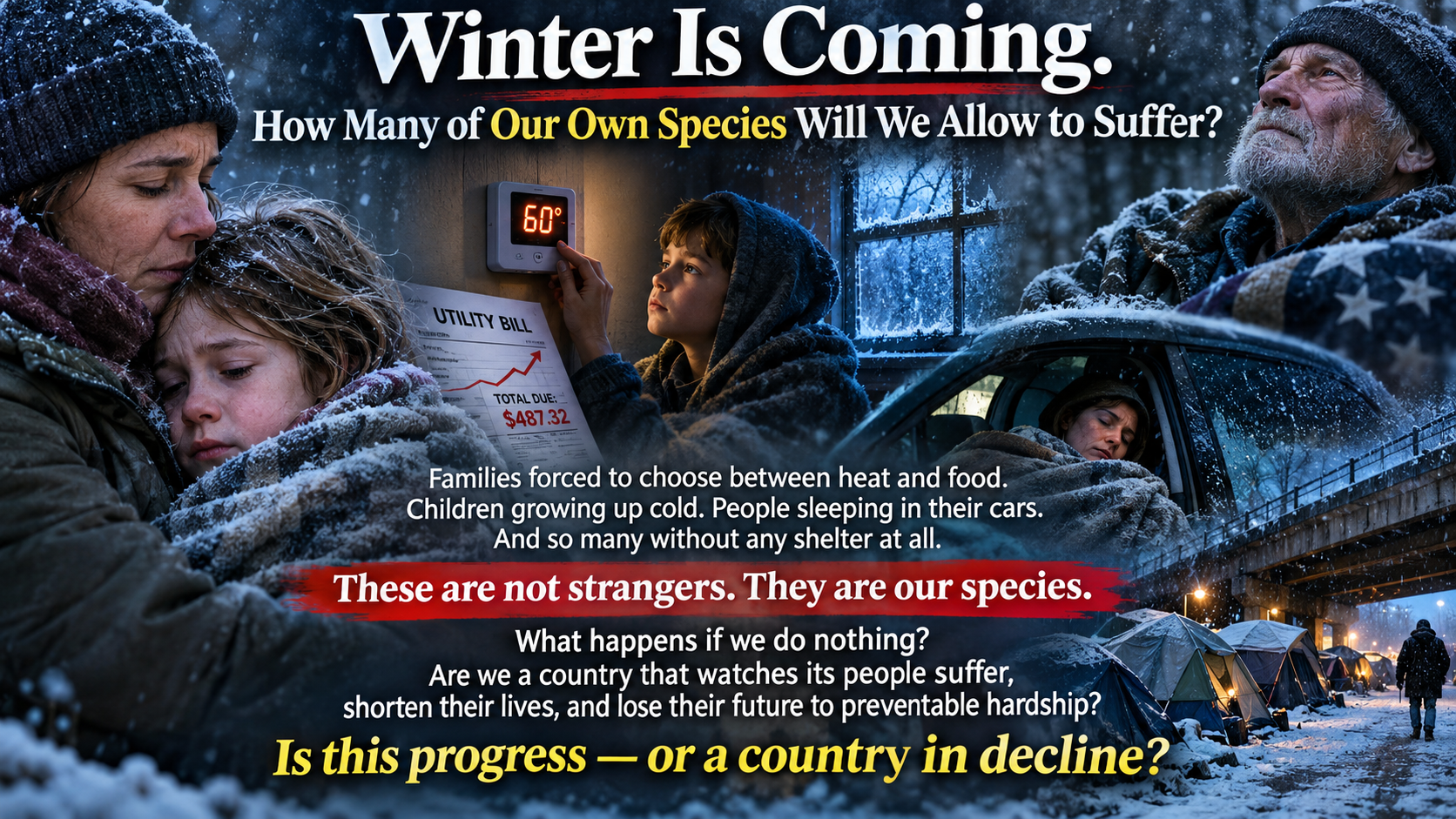
Poster titled “Winter Is Coming. How Many of Our Own Species Will We Allow to Suffer?” In falling snow, a mother holds her shivering daughter beside a utility bill showing a total due of $487.32; a hooded boy reaches for a thermostat set to 60 degrees; an elderly man wrapped in an American flag blanket looks up; a woman sleeps in a snow-covered car; tents line a frozen street under an overpass. The text reads: “Families forced to choose between heat and food. Children growing up cold. People sleeping in their cars. And so many without any shelter at all. These are not strangers. They are our species. What happens if we do nothing? Are we a country that watches its people suffer, shorten their lives, and lose their future to preventable hardship? Is this progress — or a country in decline?”
Illustration by the campaign design team

Winter is approaching.

For some Americans that means holidays, warm blankets, and the comfort of knowing that when the temperature falls, they can turn up the thermostat.

For others, winter brings fear. Fear of the next utility bill. Fear of the next rent increase. Fear of choosing between keeping the children warm and putting a healthy meal on the table. Fear of falling asleep in a vehicle and wondering how cold it will get before morning.

And for people living on the street, winter can mean something worse: the possibility that they may not survive it.

These are not strangers from another species. They are not a separate category of life whose suffering becomes acceptable because of income, employment, disability, age or housing status. They are human beings. They are members of our own species. They are us.

These are not strangers. They are our species.

So as another cold season arrives, one question should disturb every American: what kind of country have we become if we can watch members of our own species live in conditions that shorten their lives, and carry on as though nothing is fundamentally wrong?

This is not only an emotional argument. The evidence exists. The suffering is documented. The consequences are measurable. And for the first time in this piece, so is the future: the numbers below show where each of these conditions is headed if we do nothing.

The count

745,652 human beings. One night. One country.

On a single night in January 2025, 745,652 people were experiencing homelessness in the United States. Of those, 266,320 were unsheltered: living on streets, in vehicles, in encampments, in places never meant for human habitation. Another 479,332 were in shelters (Congressional Research Service).

One night · January 2025

745,652

people experiencing homelessness

266,320 unsheltered
479,332 in shelters

549,928

2016

771,480

2024 · record

745,652

2025

Source: Congressional Research Service

That count fell about 3.3 percent from the record of 771,480 set in 2024. It is still 36 percent higher than the 549,928 counted in 2016. We should not mistake one year of improvement for the end of a national crisis.

745,652 is not a statistic. It is hundreds of thousands of individual lives. People who were once children. People with parents, siblings and histories. People who have worked, raised families, served their communities, and still have abilities, ambitions and futures.

And the count does not capture everyone. It is one night, not a year. It misses the family doubled up in a relative’s spare room, the worker rotating between friends’ couches, the elderly person staying somewhere unsafe because there is nowhere else to go. In 2025, 29 of the country’s roughly 400 local continuums did not conduct an unsheltered count at all.

We must stop treating the people we manage to count as the only people who matter.

Inside the house

A roof is not the same as warmth

Now consider the Americans who have a home.

In the federal government’s most recent full survey, 34 million households, 27 percent of all households in the country, reported difficulty paying energy bills or keeping their homes at a safe temperature. Five million could not use their heating equipment because it was broken or they could not afford the fuel. In 1.4 million homes, someone needed medical attention because the house was kept at an unsafe temperature (U.S. Energy Information Administration).

Those figures are from 2020. They are a floor, not a measure of today. Since then the pressure has only grown: one in six households is behind on its utility bills, and utilities cut off electric service about 13.4 million times for nonpayment in 2024 alone (NEADA, ConsumerAffairs).

60°
▼ BillHeat ▲

Held low. Extra blankets. Rooms closed off.

Utility Bill

EIA survey · 2020

Households with difficulty paying for energy or keeping a safe temperature
34 million
Share of all U.S. households
27%
Could not use heating equipment (broken or unaffordable fuel)
5 million
Homes where someone needed medical attention for an unsafe temperature
1.4 million

Shutoffs for nonpayment, 2024

13.4 million

Sources: EIA, NEADA, ConsumerAffairs

What good is a heating system if the people who need it cannot afford to turn it on?

Picture a child at home in November, wearing a jacket indoors. The parent knows the house is too cold. The parent also knows what happens when the heater runs: the bill goes up, and that money comes out of groceries, medicine or rent. So the thermostat stays low. Extra blankets. Rooms closed off. Try to get through another night.

The child does not understand utility pricing or wage stagnation. The child only understands that they are cold, that their parent is worried, and that there are things you learn not to ask for.

A child’s body does not become less deserving of warmth because their parents earn less money.

The same math follows that family into the grocery store. Fresh food gets compared, calculated and put back. A parent skips a meal so the children can eat. And for the person living in a car, even affordable groceries raise questions with no answer: where do you refrigerate them, cook them, wash them?

A person can have an address and still live in deprivation. A person can have a job and still live in poverty. Survival is not the same as security. And security is not luxury. We are talking about warmth, food, water, shelter, sanitation and health care. These are not extravagant demands. They are the conditions of staying alive and well.

The parking lot

The people sleeping in their cars are not invisible

Across America, people sleep in vehicles. Some are employed. Some are elderly. Some are veterans. Some have children in the back seat.

Think about what that means. Where do you park safely? Where do you use the bathroom, shower, store medication? Where does your child do homework? Where do you go when it drops below freezing, or when someone tells you to move? And what happens when the vehicle that is your last shelter breaks down?

Where do you…

Park safely?Use the bathroom?Shower?Store medication?Do homework?Go below freezing?Go when told to move?

We have built a society in which a person can work, pay taxes and still have no secure place to sleep. Then we treat that person’s presence in a parking lot as the problem.

A vehicle is transportation. It should not have to become someone’s final defense against homelessness.

This is not only hardship. It is a measurable health emergency.

The largest study ever done of homeless Americans followed about 140,000 people for twelve years. It found that people who experience homelessness face 3.5 times the risk of death of people who are housed. A 40-year-old without a home faces about the same risk of dying as a housed person nearly twenty years older. And a shelter bed did not change that risk much: people counted in shelters died at about the same rate as people counted on the street (National Bureau of Economic Research).

Without a home

40

years old

same risk of dying

Housed

~60

years old

3.5×

risk of death vs. housed people · ~140,000 followed for 12 years

Cold-related deaths per 100,000: 0.44 (1999) → 0.92 (2022)

Twenty years. That is how much older a body becomes, in its risk of dying, when it has no home.

The cold itself is killing more of us too. The rate of cold-related deaths in the United States more than doubled between 1999 and 2022, and the researchers named rising homelessness and social isolation among the possible reasons (JAMA study, reported by Healio).

A person moved from one sidewalk to another sidewalk is still exposed. A person discharged from a hospital with nowhere to recover goes back to the conditions that made them sick. Housing and health are not separate subjects. They are the same subject.

The machinery

Nobody has to intend it

Our economic systems did not come from nature. Human beings made them. We wrote the laws that govern corporations. We built the incentives that reward financial performance. We decided which costs could be passed along and which protections the public would get.

Now watch those decisions land on one household.

A company raises prices. Another cuts labor costs. A manufacturer finds cheaper ingredients. An investor wants a higher return. A landlord raises the rent. A utility files for a rate increase. Each one can be explained as normal business. Each one says it is only responding to conditions.

But the worker is also the consumer. The worker is also the parent, the tenant, the patient, the person paying the light bill. And that person cannot raise their own income every time another institution raises its prices.

So they cut the grocery budget. They put off the doctor. They lower the thermostat. They work more hours and sleep less. They take on debt. They move somewhere smaller. Some lose their homes. Some start sleeping in the car.

A company raises prices
Another cuts labor costs
A manufacturer finds cheaper ingredients
An investor wants a higher return
A landlord raises the rent
A utility files for a rate increase
One household: the worker, consumer, parent, tenant, patient
  1. Cut the grocery budget
  2. Put off the doctor
  3. Lower the thermostat
  4. Work more, sleep less
  5. Take on debt
  6. Move somewhere smaller
  7. Lose the home
  8. Sleep in the car

No single company has to intend that outcome for the combined system to produce it.

That is why this is not a hunt for one villain. A system can produce harm without anyone choosing harm as its goal. But once we can see the harm, we are responsible for the machinery that produces it.

If our systems can generate extraordinary wealth, why are they still leaving so many members of our own species unable to afford warmth, shelter and food? The purpose of an economy is to serve the people in it. It is not to require those people to give up their health to keep it running.

If we do nothing

If we do nothing, here is where the numbers go

We do not have to guess what doing nothing looks like. The trend lines already exist. Extend them, and this is the country we are choosing.

People homeless on a single night

The record so far

549,928 (2016) to 745,652 (2025)

If nothing changes

About 883,000 by 2030. Past 1 million by 2034.

Trend: the 2016 to 2025 pace of 3.4% a year, continued

People chronically homeless

The record so far

77,486 (2016) to 155,750 (2025), the highest ever recorded

If nothing changes

About 313,000 by 2034

Trend: it doubled in nine years; the same pace doubles it again

Homeless adults 65 and older

The record so far

40,000 (2017)

If nothing changes

106,000 by 2030

Published projection, University of Pennsylvania

People who could lose federally funded permanent housing

The record so far

About 90% of this funding was protected for renewals; the 2026 rules protect 60%

If nothing changes

97,000 to 170,000 people back at risk of the street

Advocates’ estimates, National Coalition for the Homeless

Cold-related death rate

The record so far

0.44 per 100,000 (1999) to 0.92 (2022)

If nothing changes

About 1.2 per 100,000 by 2030

Trend: the study’s average rise of 3.4% a year, continued

Average winter heating bill

The record so far

Up 23.9% since winter 2021-22, to $1,030 this winter

If nothing changes

About $1,280 by winter 2031-32

Trend: the same five-year pace, continued (NEADA)

Utility rate increases

The record so far

275+ utilities have raised or proposed higher rates since 2025

If nothing changes

More than $101 billion in added customer costs through 2028

Published estimate, NEADA

People without health insurance

The record so far

26.7 million (2025)

If nothing changes

10 million more by 2034

Published projection, Congressional Budget Office

Read the first row again. On the path we are on, about 137,000 more human beings will be without a home on a single night by 2030. A few years after that, the number crosses one million.

People homeless on a single night

Solid: counted. Dashed: the 2016 to 2025 pace of 3.4% a year, continued. Arithmetic, not prophecy.

400k600k800k1MOne million people20162020202520302034549,928771,480745,652~883,075~1.01M

One million people. In the wealthiest country in the history of our species.

Be honest about what these numbers are. The rows marked “trend” are arithmetic, not prophecy. They take the pace we have already lived through and carry it forward. The 2025 count dipped, and a line can bend. But a line only bends when someone bends it. These are not forecasts of what must happen. They are the price of deciding that nothing needs to change.

And the numbers are only the part we can count. Behind them:

Years of life.

Every added person on that first row carries the same 3.5 times risk of death. Those years do not come back.

Childhoods.

A child who grows up cold, hungry or moving from place to place carries it into school, into health, into adulthood.

Public cost.

Emergency rooms, crisis response and repeat hospital stays cost more than the stability that would have prevented them. The Pennsylvania researchers put health and shelter costs for homeless seniors alone at about $5 billion a year.

Trust.

People who suffer for years while others prosper stop believing their institutions will ever answer.

The next generation.

Children who watch preventable suffering treated as normal learn that this is simply how civilization works.

The greatest danger is that we become a country that no longer sees preventable human suffering as an urgent reason to change.

A proposal

A proposal: the National Winter Human Protection Standard

Every year communities open warming centers, add shelter beds, hand out blankets and meals. Those efforts save lives, and the people behind them deserve recognition. But a warming center protects someone for a night. What happens the next night?

Winter should trigger protection, not another cycle of emergencies. If we know that cold, housing insecurity and energy deprivation create measurable risk, then we should measure that risk and be held to reducing it.

That is the purpose of a National Winter Human Protection Standard. Not another bureaucracy that counts suffering. A public standard with eight parts:

  1. 1

    Count every cold-related death.

    Report them, including deaths among people without housing, and examine whether timely action could have prevented each one.

  2. 2

    Measure heating security.

    Track how many households cannot keep a safe indoor temperature, along with shutoffs, utility debt and unsafe heating.

  3. 3

    Prove shelter capacity.

    Every community reports whether its shelter and warming space is enough in dangerous weather, and who is being turned away or cannot get there.

  4. 4

    See vehicle homelessness.

    Safe parking, sanitation, outreach and a path into permanent housing for people living in cars.

  5. 5

    Protect the most vulnerable first.

    Children, older adults, and people with medical conditions or disabilities, based on actual health risk and not on assumptions about who deserves help.

  6. 6

    Report in public.

    Plain reports showing what improved, what got worse, and where intervention is needed.

  7. 7

    Answer for outcomes.

    Independent evaluation. What fails gets revised. What works gets expanded.

  8. 8

    Give affected people a real voice.

    The people living these conditions help design the standard and judge whether it works.

Success is measured in lives protected, suffering prevented and healthy years preserved. Not in dollars distributed or programs announced.

Whenever a proposal like this comes up, one question follows: how much will it cost? That is a fair question. Public money must be managed responsibly. But it deserves a partner: how much does doing nothing cost? The table above is the beginning of that answer. Until we count both, we are measuring the price of helping and leaving the price of neglect off the books.

Price of helping

On the books

Price of neglect

Left off the books

There will be honest disagreement about funding, about federal and state roles, about what works. Those debates should happen. They should not be used as a reason to wait through another winter.

Tonight

What will we say to the next generation?

Inside

Warm houses. Dinner. Children put to bed. Blankets.

A few streets away

A safe place to park. A heater rationed. A cold room. A child asking why.

Tonight, millions of Americans will come home to warm houses. They will make dinner, put their children to bed, and sleep under blankets.

And tonight, somewhere close by, another person will be looking for a safe place to park. Another parent will be working out how long they can afford to run the heater. Another elderly person will sit in a cold room to avoid the bill. Another child will wonder why their home is so cold.

These lives are happening at the same time, in the same country, among members of the same species. Sometimes only a few streets apart.

The person on the sidewalk has the same need for warmth as the person in the mansion. Money changes a person’s access to protection. It does not change their worth.

One day the children growing up now will look back at what we accepted. They may ask why people slept outside in freezing weather while buildings stood empty. Why working families could not afford heat. Why we spent so long arguing about whether people deserved help instead of finding out what worked.

And they may ask the hardest question: if you knew people were suffering, why didn’t you do more?

That it was complicated? That it was expensive? That it was someone else’s job? Those answers describe the obstacles. They do not erase the consequences.

Winter will come. That was never the uncertainty. The uncertainty is whether we will be any different when it does.

We should not measure a civilization by how much suffering its people can endure. We should measure it by how much preventable suffering it is willing to end.

So ask every institution that serves you one question this winter: what are you doing to make sure the people of this country can live, and not merely survive?

Because a nation is not moving forward if it leaves its own people freezing behind.

We are one species. Every life has value. And the future we build must reflect that truth.

Vincent Cordova

Independent Presidential Candidate, 2028

Sources

  1. Congressional Research Service: Homelessness, updated July 16, 2026 (point-in-time counts for 2007, 2016, 2024 and 2025; chronic homelessness)
  2. U.S. Energy Information Administration: In 2020, 27% of U.S. households had difficulty meeting their energy needs
  3. NEADA: Winter heating costs projected to jump 8.7 percent, Sept. 14, 2026
  4. NEADA: Winter Heating Report
  5. ConsumerAffairs on the NEADA forecast (one in six households behind on utility bills)
  6. NBER Digest: Estimating Mortality Rates for the US Homeless Population
  7. Healio on the JAMA study of cold-related deaths, 1999 to 2022
  8. University of Pennsylvania: Aging Homeless Population Will Nearly Triple by 2030
  9. National Coalition for the Homeless: Statement on HUD’s Fiscal Year 2026 Continuum of Care notice, July 17, 2026
  10. Georgetown Center for Children and Families on CBO coverage estimates
  11. Census Bureau: Income, Poverty and Health Insurance Coverage in the United States: 2025 (26.7 million uninsured)
  12. From the original draft, not re-opened here: HUD release on the 2025 Annual Homelessness Assessment Report
  13. From the original draft, not re-opened here: National Alliance to End Homelessness

How the trend rows were calculated. Homelessness: 745,652 divided by 549,928 over nine years is 3.44% a year; continued, that gives 883,075 in 2030 and 1,011,036 in 2034. Chronic homelessness: 155,750 divided by 77,486 over nine years is 8.07% a year; continued, 313,064 in 2034. Cold deaths: 0.92 x 1.034 to the eighth power is 1.20. Heating: $1,030 x 1.239 is $1,276. These extend past trends and are not forecasts.

Vincent Cordova · Candidate for U.S. President 2028

← Back to Blog

Community Comments

Community Comments

Share a public response to this post. Submissions are reviewed before they appear.

0 approved comments

Loading comments...

Comments are moderated for spam, abuse, and off-topic submissions.

Your age, area, and IP address are collected for moderation and internal reporting only.