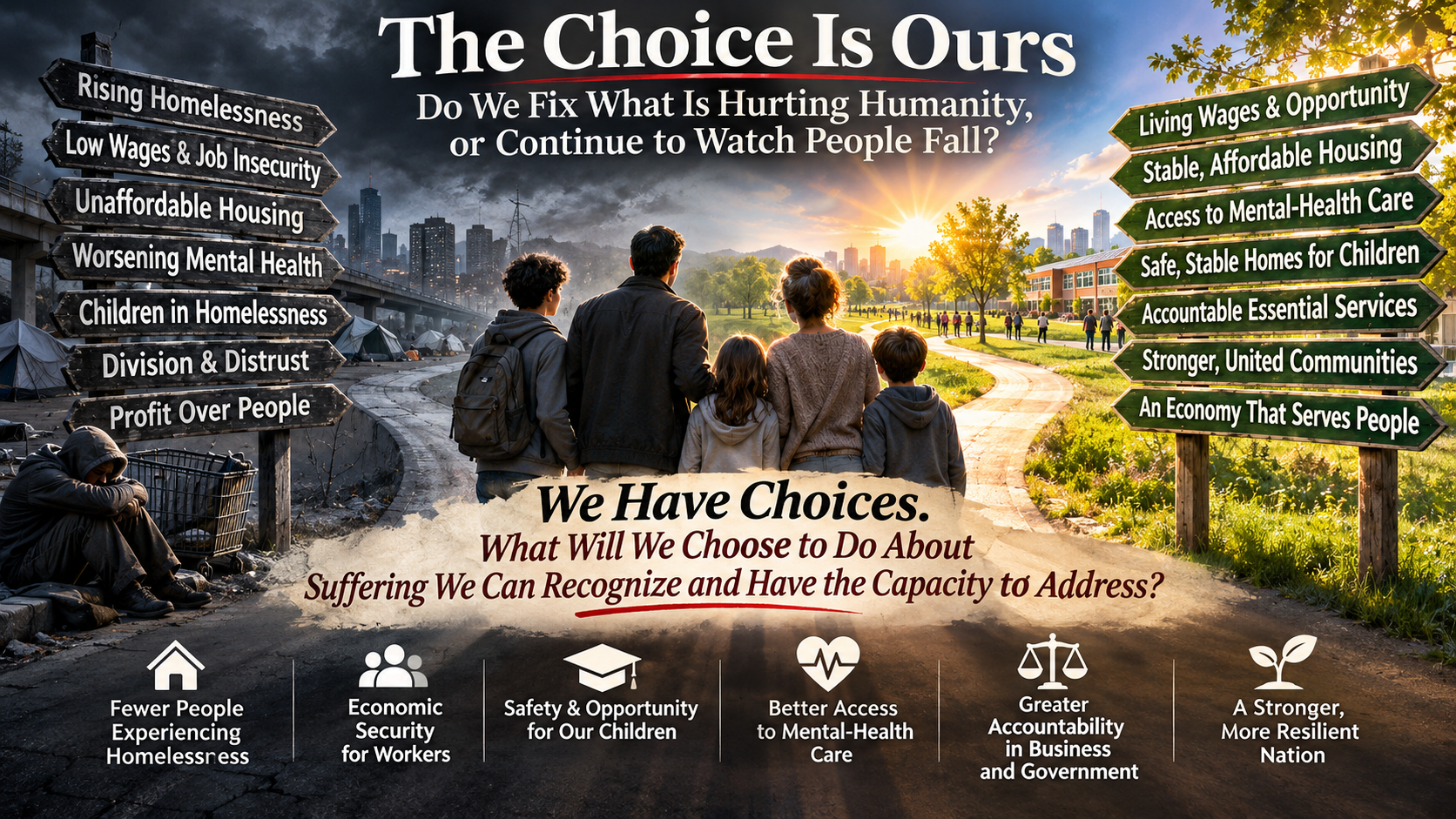
The Choice Is OursDo We Fix What Is Hurting Humanity, or Continue to Watch People Fall?
We created our institutions, our corporations, our laws, and our economic systems. We have the power to examine them, change them, and build something that serves humanity.
By Vincent Cordova · Cordova 2028 · November 20, 2026
We Have Choices.
What Will We Choose to Do About Suffering We Can Recognize and Have the Capacity to Address?
Fewer People Experiencing Homelessness
Economic Security for Workers
Safety & Opportunity for Our Children
Better Access to Mental-Health Care
Greater Accountability in Business and Government
A Stronger, More Resilient Nation
Where we stand
A Question for Our Humanity
There comes a point when we must stop asking whether people are suffering and begin asking ourselves what we are prepared to do about it.
Look around us.
People are working and still struggling to afford housing.
Parents are working multiple jobs while missing precious moments with their children.
Young adults are entering the workforce, hoping to build a future, only to discover that the wages they earn may not support the most basic necessities of life.
Families are living in vehicles. Children are experiencing homelessness. People are delaying medical care because they cannot afford it. Others are carrying tremendous emotional burdens while trying to appear as though everything is fine.
And throughout all of this, we continue debating whether our society can afford to help people.
Perhaps the greater question is whether we can afford to continue ignoring what happens when we do not.
We are not powerless observers of some natural phenomenon.
We created our economic systems.
We wrote our laws.
We authorized our institutions.
We established corporations and determined the legal protections and responsibilities they would have.
These arrangements were created by human beings.
They are not laws of nature.
And if their operation contributes to preventable human suffering, we have the ability—and the responsibility—to examine them.
We have choices.
The question is what we are going to do with them.
Stand at the fork
Seven signposts. Two roads.
These are the signs from the poster. Tap a row to turn from the storm road toward the sunrise road, and see how far the choice carries us.
0 of 7 roads chosen
Low wages & job insecurity
When Survival Replaces Living
What does it mean to live?
Is life supposed to be an endless struggle to earn enough money to survive another month?
Is a person’s purpose simply to work, pay bills, accumulate debt, become exhausted, and repeat the process until they can no longer work?
Or should life also provide opportunities to create, learn, love, raise a family, explore the world, discover our abilities, and contribute to the advancement of humanity?
The storm road
Survival
The sunrise road
Living
Create
Learn
Love
Raise a family
Explore the world
Discover our abilities
Contribute to humanity
Every word on both roads is taken from the questions below.
Think about the person working full-time who still cannot afford an apartment.
Think about the parent who must choose between medication and groceries.
Think about the worker whose employer celebrates record profits while employees cannot afford the products or services they help create.
Think about the young person who has done everything society told them to do—graduate, find employment, work hard, be responsible—yet still cannot imagine being able to afford a home.
At what point do we stop telling these people to try harder and start examining whether the opportunities available to them are sufficient?
Personal responsibility matters.
But so do the conditions under which people are expected to exercise that responsibility.
An economy should be evaluated not only by how much wealth it produces, but also by whether the people contributing to that wealth have meaningful opportunities to build lives of their own.
Worsening mental health
When Emotional Suffering Becomes a Warning
There is another part of this discussion that deserves our attention.
What happens to human beings when they experience prolonged financial insecurity, unstable housing, exhausting work schedules, isolation, or a persistent sense that their circumstances cannot improve?
Stress does not simply disappear when a person clocks out.
It can follow them home.
It can affect their relationships, sleep, physical health, emotional well-being, and sense of possibility.
Some people seek professional mental-health treatment. Some receive prescribed medication that genuinely helps them live healthier lives.
Others may turn to alcohol or drugs to escape overwhelming circumstances, although substance-use disorders have multiple causes and cannot be explained by economic stress alone.
We must never confuse legitimate medical treatment with efforts to suppress people or assume that everyone who needs medication has been harmed by society.
But we should be willing to ask a difficult question:
Are we investing enough in changing the circumstances that contribute to suffering, or are we too often leaving individuals to manage those circumstances alone?
A prescription cannot raise an inadequate wage. A counseling appointment cannot, by itself, make housing affordable. And telling an exhausted parent to practice self-care does not create additional hours in the day or guarantee access to childcare.
℞
A prescription
cannot raise an inadequate wage.
☏
A counseling appointment
cannot, by itself, make housing affordable.
✎
Telling an exhausted parent to practice self-care
does not create additional hours in the day or guarantee access to childcare.
Mental-health services are essential. So are safe workplaces, stable housing, supportive communities, and real economic opportunities.
We need both treatment and prevention.
We need to listen to people before their circumstances become a crisis.
Children in homelessness
What Are Our Children Trying to Tell Us?
Consider the young people growing up under these conditions.
According to the CDC’s 2025 National Youth Risk Behavior Survey, approximately 14% of U.S. high school students—about one in seven—reported seriously considering attempting suicide during the preceding year.
That is an improvement from 20% in 2023.
We should recognize that progress.
But we should also recognize the human significance of the remaining number.
Seriously considered attempting suicide · U.S. high school students
If you are struggling, you are not alone. Call or text 988, the Suicide & Crisis Lifeline, any time. 988lifeline.org
One in seven.
These are children whose lives are still unfolding.
Children who deserve safety, meaningful relationships, opportunities, encouragement, and reasons to look toward the future with hope.
And consider another reality.
According to the National Center for Homeless Education, approximately 1.54 million children and youth experiencing homelessness were identified in American public schools during the 2023–24 school year.
Some were living in shelters. Others were staying temporarily with relatives or friends, in motels, or in other unstable housing arrangements.
The Department of Housing and Urban Development reported 745,652 people experiencing homelessness on a single night in January 2025, compared with 771,480 in January 2024.
That decline deserves acknowledgment, but the remaining human need deserves attention.
HUD · one night in January
2024771,480
2025745,652
People experiencing homelessness on a single night. Down 25,828. Narrower definition.
NCHE · the whole 2023–24 school year
1.54 million
children and youth identified in public schools
Shelters
Doubled up with relatives or friends
Motels
Other unstable housing
Two different measures · not directly comparable
These two homelessness measures cannot be directly compared. HUD’s point-in-time count measures homelessness on a particular night using a narrower definition. The education data measures students identified throughout the school year and includes additional forms of unstable housing.
The statistics do not establish that homelessness causes every mental-health challenge among young people.
But together, they demand serious attention.
What does it mean for a child to concentrate on school when they do not know where they will sleep?
How does a child plan for the future when their family is struggling to survive the present?
Our children should not have to reach adulthood before society decides their suffering matters.
Their experiences should inform the policies we create today.
And before we design those policies, we should ask young people themselves what they are experiencing, what support they need, and what they believe would improve their lives.
We should listen to parents, teachers, counselors, social workers, and those who have experienced homelessness.
Not simply speak for them.
Listen to them.
Profit over people
What Happens When Profit Becomes More Important Than People?
Corporations are human creations.
They can develop lifesaving medicines, build homes, transport necessities, create technologies, employ millions of people, and contribute enormously to human advancement.
Profit can support investment, innovation, expansion, and employment.
There is nothing inherently wrong with a business being financially successful.
The question is what happens when financial incentives reward decisions that impose serious costs on workers, communities, consumers, or the environment.
Consider a business that can legally structure employment around low wages, unpredictable scheduling, minimal benefits, and limited opportunities for advancement.
Suppose it uses every available loophole to reduce its obligations while shifting the resulting economic burden onto workers and public assistance programs.
Even where particular practices are lawful, we should ask whether the overall outcome is acceptable.
?Does the public effectively subsidize a business model when workers earn too little to support themselves?
?Are companies being rewarded for genuinely improving productivity, or for transferring risks and costs to people with less bargaining power?
?Do unpredictable schedules prevent workers from arranging childcare, continuing their education, or holding another job?
?Does limited competition leave workers with fewer employment options and consumers with fewer alternatives?
?Are public subsidies and tax incentives producing measurable public benefits, or primarily increasing private financial returns?
?Should business success be measured entirely by financial returns, or should worker well-being, customer safety, and long-term community outcomes also matter?
These are legitimate questions for a democratic society.
A company can be financially successful while the people making that success possible struggle to survive.
A company can be financially successful while the people making that success possible struggle to survive.
Fact one
The company is financially successful.
Fact two
The people making that success possible struggle to survive.
We should be able to recognize both facts at once.
And we should be willing to change incentives that produce harmful outcomes.
Accountable essential services
Privatization: Who Remains Accountable to the Public?
We also need a serious conversation about privatization.
Public institutions exist to carry out responsibilities established through democratic government.
Private companies operate under different ownership, governance, and financial incentives.
Some private organizations deliver services effectively. Some public institutions have significant shortcomings. Neither ownership model guarantees good outcomes.
But when an essential public service is transferred to private control, important questions arise.
Before the contract is signed
Who determines the price?
Who must provide service when serving a particular community is unprofitable?
Who has access to the contracts and performance records?
What happens if a provider fails?
Can the public replace leadership or change policy through democratic processes?
Who ultimately benefits from cost savings, and who bears the consequences of service reductions?
A private contractor can have enforceable legal duties to the public. It would be inaccurate to suggest that private providers have no obligations whatsoever.
Contractual accountability
≠
Direct democratic accountability
But contractual accountability is not identical to direct democratic accountability.
And when an essential service becomes dependent on a profit-seeking entity, the public deserves to understand the consequences before that decision is made.
If a service is essential to human life, public safety, or equal opportunity, its governance must protect those purposes regardless of who delivers it.
We should demand transparency, measurable performance, meaningful public oversight, enforceable safeguards, and clear procedures for responding to failures.
The future of essential services should not be decided behind closed doors.
Division & distrust
Would We Even Recognize the Difference?
There is another question I believe deserves serious examination.
What if the economic outcomes we are creating through our own decisions resemble outcomes a foreign adversary might deliberately seek to produce?
Consider the possibilities.
A nation whose workers struggle to survive despite being employed.
A nation where families lose their homes and children experience homelessness.
A nation where financial insecurity contributes to stress, exhaustion, and declining opportunities.
A nation where communities become divided, people lose confidence in institutions, and economic pressures make cooperation more difficult.
A nation where strategically important services become concentrated among a small number of owners, making communities dependent on decisions they cannot easily influence.
Now imagine a foreign adversary whose objective was to weaken that nation’s economic stability, social cohesion, institutional trust, or long-term competitiveness.
Might some of those outcomes serve its interests?
Potentially.
But here is the more important question.
If similar outcomes can arise from domestic economic incentives, policy failures, or deliberate external interference, would we even recognize the difference?
Suppose a company adopts a business model built around the lowest legally permissible wages, minimal benefits, aggressive cost reductions, and the transfer of financial risk onto its workforce.
Perhaps the company is operating under ordinary financial incentives.
Perhaps its leadership believes those decisions are necessary for competitiveness.
Perhaps ownership is hidden behind complex investment structures.
Or perhaps, in a hypothetical case, an actor genuinely intends to weaken communities or exploit economic vulnerabilities.
From the perspective of the worker who loses their home, the immediate consequences may look remarkably similar.
The worker still cannot afford rent. The parent still struggles to feed their children. The community still loses economic stability.
Different motives · the same road
Perhaps
Ordinary financial incentives
Perhaps
Hidden ownership structures
Perhaps
Deliberate hostile intent
From the perspective of the worker who loses their home
The worker still cannot afford rent.
The parent still struggles to feed their children.
The community still loses economic stability.
Illustration of the hypothetical described in the text. It does not describe any specific company.
And the public may not have enough information to determine the motives behind the decisions.
That is the distinction we must understand: similar outcomes do not prove similar intentions. But harmful outcomes do not become acceptable simply because the intentions behind them are domestic rather than foreign.
We should not accuse companies or investors of foreign interference without credible evidence. There are legal standards, investigative procedures, and national-security reviews designed to evaluate genuine threats.
Nor should we assume that foreign ownership is inherently harmful or that domestic ownership guarantees responsible conduct.
But we should recognize the possibility that economic vulnerabilities created through ordinary policy and business decisions could also be exploited by actors seeking to cause harm.
That possibility raises a series of questions.
Would we recognize when essential industries become dangerously concentrated?
Would we know who ultimately controls companies whose decisions affect critical infrastructure, employment, housing, or essential services?
Would we detect coordinated misconduct rather than treating each harmful decision as an isolated incident?
Would our laws protect workers and communities regardless of an owner’s identity?
And most importantly:
If we recognize that the outcomes themselves are harmful, why would we wait to discover a hostile motive before deciding those outcomes deserve scrutiny?
We do not need to establish that a foreign adversary designed an economic vulnerability before we acknowledge that the vulnerability exists.
We do not need to prove sabotage before examining whether policies have undermined resilience.
And we should not have to demonstrate malicious intent before asking whether a business practice imposes unacceptable costs on society.
This is not an argument that all economic hardship is intentional. It is not a claim that our country is secretly being directed by foreign interests. It is a question about whether our institutions are designed to recognize harmful consequences, identify their causes, and respond effectively.
This is not
an argument that all economic hardship is intentional.
It is not
a claim that our country is secretly being directed by foreign interests.
It is
a question about whether our institutions are designed to recognize harmful consequences, identify their causes, and respond effectively.
A responsible approach would examine beneficial ownership, competition, labor protections, essential-service dependencies, national-security risks, and the distribution of economic costs.
It would distinguish actual misconduct from lawful business decisions, and genuine security threats from speculation.
And it would protect the rights of everyone involved.
A nation should not have to determine whether suffering was intentionally engineered before it decides that preventable suffering deserves attention.
That is the question I want us to confront.
Because whether a harmful outcome results from deliberate hostility, short-term financial incentives, institutional neglect, or poorly designed policies, the people experiencing its consequences still need solutions.
Zoom out
They Only Have to Sit Back and Watch
There is a saying about the United States that has been repeated for generations.
No one will ever have to defeat America from the outside. All they have to do is sit back and watch it destroy itself.
No one can say for certain who said it first. But the warning behind it is older than any rival nation, and it came from one of our own.
In January 1838, a 28-year-old Abraham Lincoln stood before the Young Men’s Lyceum of Springfield, Illinois, and asked where the real danger to this country would come from.
Lyceum Address · Springfield, Illinois · January 27, 1838
“All the armies of Europe, Asia and Africa combined, with all the treasure of the earth (our own excepted) in their military chest; with a Buonaparte for a commander, could not by force, take a drink from the Ohio, or make a track on the Blue Ridge, in a trial of a thousand years.
At what point then is the approach of danger to be expected? I answer, if it ever reach us, it must spring up amongst us. It cannot come from abroad.
If destruction be our lot, we must ourselves be its author and finisher.”
Lincoln was not talking about private equity or quarterly earnings. He was warning a young nation that the greatest threat to it would be the slow abandonment of what held it together.
Nearly two centuries later, his question belongs to us.
So zoom out.
One paycheck
One household
One neighborhood
One generation
One nation
Not one company. Not one bad quarter. Not one eviction notice. Step back far enough and look at the whole picture.
What do you see?
When the number that matters most is a bottom line that must rise every quarter, without end, that value has to come from somewhere.
Where does it come from?
The wages that support our living→treated first as a cost to cut
The homes we raise our children in→bought up and priced as an asset class
The essential services we depend on→measured by margin before they are measured by whether people are served
The time we have with our families→traded for second and third jobs just to keep up
Flowing upward to
A bottom line that must always increase
Private equity firms · large institutional holders · returns that are never enough
This is not a story about villains. Many of these firms and funds are doing exactly what the system rewards them for doing.
That is the point.
If our system rewards taking more and more of the value we depend on—our wages, our homes, our essential services, our time—then it will keep taking it, quarter after quarter, whether anyone intends harm or not.
Are we wearing away the very fabric we built?
And if it continues, year after year, where will we be when our essence—the things that made us who we are—has been bought, priced, and taken over?
A day’s work that supports a family
A home that is ours
A neighborhood that knows our name
Children who can expect more than we had
A government that answers to its people
That is our essence. None of it should be for sale.
We would not need an enemy to do this to us. We would be doing it to ourselves—and sitting back, watching.
Where this road endsChange direction
We can see the end.
I hope we change direction.
Stronger, united communities
Division Is Not a Solution to Suffering
When people experience insecurity, frustration, and fear, it can become easier to see another struggling person as the source of the problem.
Workers blame other workers.
Generations blame one another.
Communities become divided by income, nationality, religion, political identity, and social status.
People who are struggling to support their families may be encouraged to see someone else’s modest assistance or opportunity as a threat to their own survival.
But division does not build a home. It does not create a living wage. It does not make medical treatment affordable. It does not strengthen a school or reunite a family. And it does not solve the underlying causes of economic insecurity.
Division does not…
build a home
create a living wage
make medical treatment affordable
strengthen a school
reunite a family
solve the underlying causes of economic insecurity
We can disagree about the proper size of government, the role of private enterprise, taxation, public services, or the design of social programs.
Those disagreements are legitimate.
What should unite us is a willingness to examine the evidence, acknowledge human suffering, and evaluate whether our institutions are achieving their stated purposes.
We do not need to agree on every policy to agree that every human life deserves serious consideration.
Our differences should help us discover better solutions, not become an excuse to stop looking for them.
Living wages & opportunity
What Would Meaningful Change Look Like?
Recognizing a problem is only the beginning.
If we are serious about improving people’s lives, we must define what progress would actually look like and establish ways to measure it.
We should examine whether:
1More workers earn enough to meet essential living expenses and build financial stability.
2Fewer families experience eviction, housing instability, or homelessness.
3More children have safe, stable housing and meaningful educational opportunities.
4People experiencing mental-health challenges can access timely, appropriate care.
5Workers have greater access to predictable schedules, benefits, and opportunities for advancement.
6Essential services remain affordable, reliable, and accountable to the public.
7Corporate ownership and government contracts are sufficiently transparent to identify and address conflicts, concentration, and misconduct.
8Public investments demonstrate measurable benefits for the communities they are intended to serve.
These objectives require more than promises.
They require reliable data, clear timelines, independent evaluation, public participation, and a willingness to revise policies that fail to achieve their objectives.
Economic growth matters.Innovation matters.Business development matters.
But we should also ask whether those achievements are translating into improved lives.
If our economy grows while families become less secure, we should examine why those outcomes are moving in different directions.
If public money supports a program, we should understand what the public receives in return. If a policy is intended to improve housing affordability, we should measure affordability. If a workforce initiative is intended to create opportunity, we should measure whether people can actually advance. And if an institution repeatedly fails the people it was created to serve, we should investigate the causes and evaluate what needs to change.
If public money supports a program,
→ we should understand what the public receives in return.
If a policy is intended to improve housing affordability,
→ we should measure affordability.
If a workforce initiative is intended to create opportunity,
→ we should measure whether people can actually advance.
And if an institution repeatedly fails the people it was created to serve,
→ we should investigate the causes and evaluate what needs to change.
Listen first
We Must Listen Before We Build
There is something I believe we need to change about the way we develop public policy.
Too often, decisions are made about people’s lives without sufficiently involving the people who will experience their consequences.
If we want to improve conditions for workers, we need to listen to workers. If we want to address homelessness, we need to listen to people experiencing homelessness. If we want to improve education, we need to listen to students, educators, and families. If we want to understand the pressures facing small businesses, independent contractors, and entrepreneurs, we need to hear directly from them. If we want to improve healthcare and mental-health support, we must include patients, clinicians, caregivers, and communities.
Workers
If we want to improve conditions for workers, we need to listen to workers.
People experiencing homelessness
If we want to address homelessness, we need to listen to people experiencing homelessness.
Students, educators, families
If we want to improve education, we need to listen to students, educators, and families.
Small businesses, contractors, entrepreneurs
If we want to understand the pressures facing small businesses, independent contractors, and entrepreneurs, we need to hear directly from them.
Patients, clinicians, caregivers, communities
If we want to improve healthcare and mental-health support, we must include patients, clinicians, caregivers, and communities.
And listening must be more than collecting stories for a report that no one reads.
It should shape the questions we investigate, the policies we develop, the safeguards we establish, and the outcomes we measure.
Under the Cordova 2028 policy vision, I want public participation to be a meaningful part of developing solutions.
That means inviting people to tell us not only what is going wrong, but also what they believe would make a difference.
It means testing proposals against evidence, examining costs, protecting rights, and revising our approach when the people affected identify problems we did not anticipate.
A government that listens must also be prepared to demonstrate what it learned and what it changed.
An economy that serves people
What Are We Willing to Change?
We should be asking questions that extend beyond whether a particular institution or company is financially successful.
Are the people who work within it able to build stable lives?
Are children growing up with access to safety, education, healthcare, and opportunities to discover who they can become?
Are the essential services on which communities depend accountable to the people they serve?
When a policy fails to accomplish its stated purpose, do we examine why and correct it—or do we allow the consequences to fall on the people least able to absorb them?
We should measure our progress through real improvements in people’s lives, and we should be willing to publish those results, including when our efforts fall short.
Because what we choose to measure, what we choose to tolerate, and what we choose to change will shape the world inherited by the next seven generations.
Safe, stable homes for children
What Future Are We Building for the Next Seven Generations?
Imagine a child born today.
1A child born today
2Gen. 2
3Gen. 3
4Gen. 4
5Gen. 5
6Gen. 6
7Gen. 7
What kind of society do we want that child to inherit?
One where housing security is increasingly difficult to achieve?
One where productive workers cannot consistently afford basic necessities?
One where essential services are governed without meaningful public accountability?
One where a person is judged primarily by their economic value?
Or one where human advancement is a fundamental consideration in the decisions we make?
Imagine instead a society where productive work offers a realistic pathway to economic stability.
Where people have access to healthcare without the fear of financial devastation.
Where children have safe places to sleep and opportunities to develop their abilities.
Where technological progress expands human potential rather than leaving workers behind.
Where businesses can succeed while respecting the people whose labor makes that success possible.
Where essential services remain accountable to the communities that depend on them.
And where no one is treated as disposable simply because helping them would not produce a financial return.
That future will not appear because we wish for it.
It requires institutions, policies, investments, responsibility, and the participation of the public.
It also requires humility.
We must be prepared to learn when something does not work and change course.
Our responsibility should extend beyond the next election, the next financial quarter, or even our own lifetimes.
We should be thinking about the next seven generations.
The choice
The Choice Is Ours to Make
I want to leave you with a question.
1If we know that people are losing their homes, what do we choose to do?
2If we know that workers cannot support themselves despite working hard, what do we choose to do?
3If we know that children are experiencing homelessness, what do we choose to do?
4If we know that many young people are struggling with their mental health, what do we choose to do?
5If we know that some of our laws and institutions permit outcomes that harm people, what do we choose to do?
←Do we accept these conditions because changing them might challenge established financial interests?
←Do we convince ourselves that someone else will solve them?
←Do we continue dividing ourselves while the problems remain?
Or do we recognize something extraordinary about being human?
We can learn.We can cooperate.We can reconsider our decisions.We can create institutions that did not exist before.We can repair the systems we inherited.
And we can build better ones for those who come after us.
The people living in their cars
are part of our human family.
The exhausted workers
are part of our human family.
The children wondering where they will sleep
are part of our human family.
The person struggling with addiction, depression, or economic hardship
is part of our human family.
Their lives are not separate from the future we are creating together.
We have a choice between continuing to tolerate preventable suffering and doing the difficult work of reducing it.
We cannot promise that every problem will disappear.
But we can refuse to treat human suffering as an acceptable measure of economic success.
We can measure progress by more than profits, asset values, or economic growth.
We can also ask whether more children are safely housed, whether more families can afford necessities, whether workers have opportunities to advance, whether people are healthier, and whether our institutions are worthy of the public’s trust.
And perhaps the greatest question of all is this:
If we have the intelligence to create these systems, and the conscience to recognize when they are hurting people, what will we tell the next generations if we choose not to change them?
The choice is ours.
And so is the responsibility.
Share your experience
Your Experiences. Your Voices. Our Shared Future.
Meaningful change begins with listening.
If you have experienced harmful employment practices, housing insecurity, unaffordable essential services, institutional failures, or other conditions that have limited your opportunities, I invite you to share your experiences and the solutions you believe deserve consideration.
You do not have to support my candidacy to participate. This conversation is about people, not political allegiance.
Editorial note: HUD’s point-in-time count and NCHE’s school-year count use different definitions and periods and are not added together or directly compared. Survey figures refer to U.S. high school students in the years stated. The company and ownership scenarios in this article are hypothetical illustrations and do not describe any specific business. The saying that America will destroy itself while others watch is widely repeated, but its origin has not been verified; Lincoln’s 1838 words are quoted from his Lyceum Address.