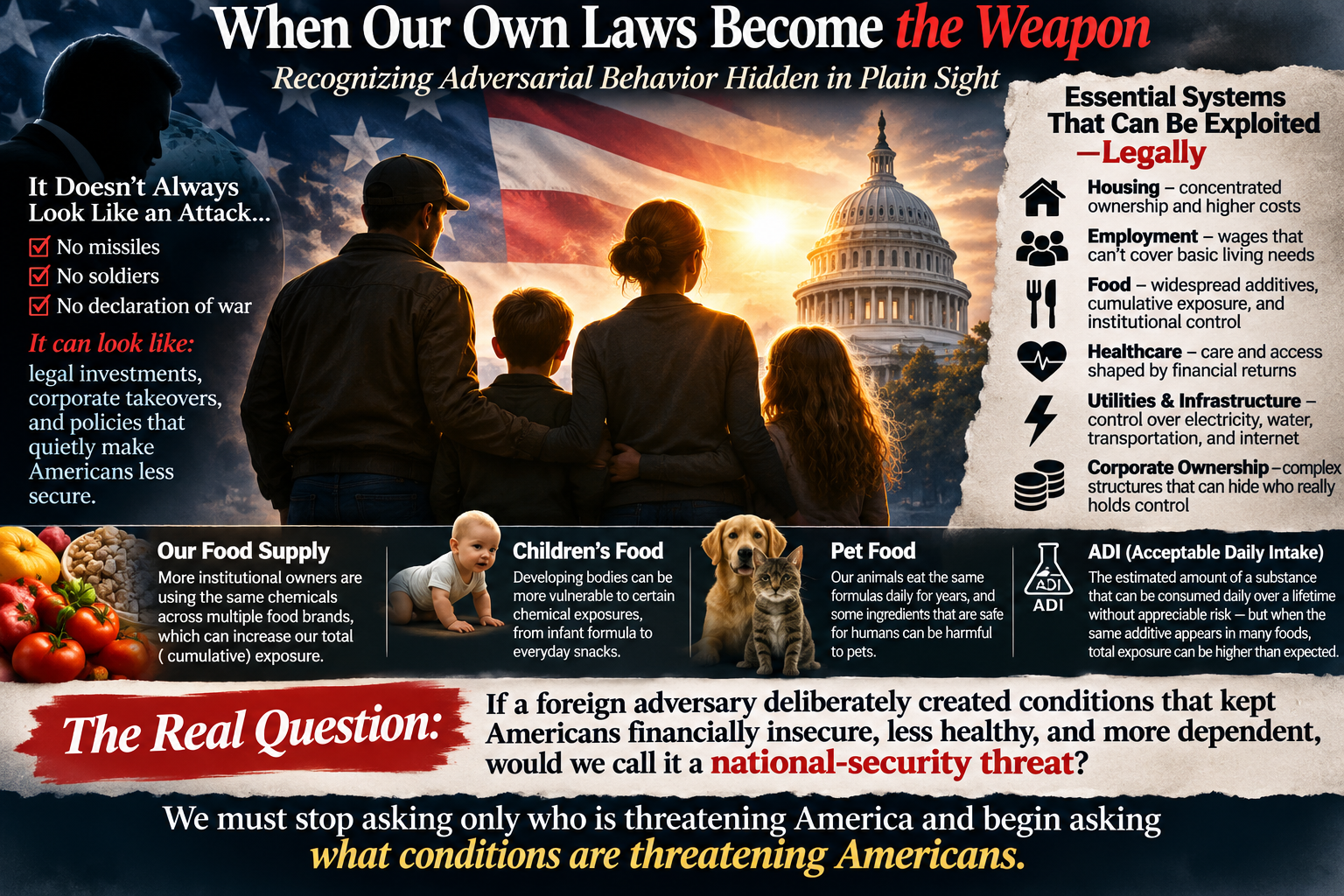
Recognizing Adversarial Behavior Hidden in Plain Sight
Foreign adversaries, corporate power, institutional ownership, food safety, economic exploitation, and the national-security threats we may be creating ourselves.
By Vincent Cordova · Cordova2028 ·
Campaign design team
What If an Adversary Doesn’t Need to Attack America Because Our Laws Already Allow Americans to Be Harmed?
I want every American to consider a question that challenges how we understand national security, foreign adversaries, corporate ownership, and the responsibility of government.
We spend enormous resources identifying foreign threats. We build military defenses, maintain intelligence agencies, monitor hostile governments, and prepare for attacks against our nation.
But what if some of the conditions that could weaken America are already permitted by American law?
What if an individual, corporation, investment fund, or organization wanted to exploit American families—not through bombs or weapons, but through housing, employment, healthcare, food, utilities, and financial systems?
Would they necessarily need to break our laws?
Or could they simply establish a business, acquire assets, follow existing rules, and profit from conditions that leave millions of Americans struggling?
And here is the question that troubles me most:
If a foreign adversary deliberately created conditions that left Americans unable to afford housing, healthcare, nutritious food, or basic necessities, would we recognize those conditions as a threat to our national security?
If so, why should those same conditions become acceptable simply because they emerge from our own economic policies?
This is not an accusation that every corporation, investor, or foreign-owned business is working against America.
It is a challenge to examine the systems we have created, the vulnerabilities they contain, and the consequences they impose on our own species.
Because whether harm is intentional or unintentional, the people experiencing it still suffer.
And a nation that understands its responsibilities should be willing to investigate both.
Part 1 of 16
We Must First Recognize the Harm America Has Caused Beyond Its Borders
Before discussing foreign adversaries, we should be willing to examine the consequences of American actions around the world.
The United States has participated in wars, military interventions, bombing campaigns, and policies that have caused civilian deaths, displacement, destruction, and lasting economic hardship.
Behind every civilian casualty is a human being.
A mother. A father. A child. A family. Someone whose life held the same inherent value as ours.
We are the same species.
99.9%We share approximately 99.9% of our DNA with one another. Our nationalities, religions, languages, and political systems do not erase our common humanity.
When American weapons kill civilians, we should not expect surviving families to experience that destruction as an abstract foreign-policy decision.
They experience it as the loss of someone they loved.
Some may seek justice. Others may demand accountability, restitution, or political change. A small number of individuals may become motivated toward retaliation or hostility.
We must distinguish between those responses.
People who have been harmed by American actions are not automatically America’s enemies.
Treating victims as adversaries merely because they demand accountability would repeat the failure of empathy that contributed to the problem.
But we should still ask whether our foreign-policy decisions can create grievances that hostile actors later exploit.
And if we recognize that possibility, we must also consider the economic tools available to anyone seeking influence within the United States.
Part 2 of 16
What If the Next Attack Doesn’t Look Like an Attack?
It Doesn’t Always Look Like an Attack…
No missiles
No soldiers
No declaration of war
It can look like:
legal investments, corporate takeovers, and policies that quietly make Americans less secure.
Imagine a hypothetical organization that wants to weaken the economic security of American families.
It does not send soldiers.
It does not launch missiles.
Instead, it seeks ownership or influence over businesses that Americans depend upon.
It invests in housing. It acquires healthcare businesses. It gains exposure to food production, transportation, utilities, or companies holding sensitive personal information.
It uses corporations, investment partnerships, and holding companies—structures that can have entirely legitimate purposes.
It then seeks to maximize financial returns through whatever practices the law permits.
Some of those practices may involve higher prices, reduced labor costs, aggressive debt structures, or consolidation of competitors.
None of this, by itself, proves a hostile operation. Many domestic businesses pursue similar strategies for ordinary commercial reasons.
But consider the possibility that an actor’s purpose was not merely financial profit.
What if its objective was also to create economic instability?
What if it wanted Americans to become increasingly dependent on a small number of institutional owners?
What if it wanted communities to lose independent businesses, workers to lose bargaining power, and families to lose the ability to build wealth?
Would our existing legal and regulatory systems reliably distinguish ordinary investment from a coordinated effort to exploit economic vulnerabilities?
That is a national-security question worth investigating.
The hypothetical is not evidence that such a coordinated operation exists. It demonstrates why ownership transparency, competition policy, financial oversight, and public accountability matter.
Part 3 of 16
When Legal Corporate Structures Can Conceal Who Holds Power
Americans should understand that the name appearing on a business registration does not always tell the complete story of ownership or control.
Layer 1
The name on the registration
A company may be owned by another company.
Layer 2
Another company
That company may be controlled through investment funds, partnerships, trusts, or other entities.
Layer 3
Funds · partnerships · trusts
Who ultimately controls it?
Some of these structures are established for legitimate reasons, including financing, liability management, and investment administration.
But complex ownership can also make it more difficult for the public to understand who ultimately controls an essential service.
And the legal landscape illustrates the challenge.
In 2025, the Financial Crimes Enforcement Network narrowed federal beneficial-ownership reporting requirements under the Corporate Transparency Act, exempting entities created in the United States and U.S. persons from that particular reporting regime.
This does not eliminate every ownership-disclosure requirement or law-enforcement investigative authority. But it means that the general federal reporting framework is substantially narrower than originally envisioned.
These developments raise important questions.
?How effectively can regulators trace control across multiple legal entities?
?Can communities identify the institutional owners of essential local services?
?Can national-security authorities detect foreign-directed control when investments pass through domestic entities?
?And can the public determine whether multiple seemingly independent businesses are actually controlled by related financial interests?
Transparency is not an attack on legitimate investment. It is a safeguard against the abuse of power.
Part 4 of 16
Housing: When the Place We Need to Survive Becomes an Instrument of Financial Pressure
Consider housing.
A human being requires shelter.
A child needs a safe place to sleep.
A family needs stability to work, learn, grow, and participate in society.
Yet housing can also function as a financial asset.
Institutional investors may purchase residential properties, manage rental portfolios, acquire apartment buildings, or finance housing developments.
Some investment can increase housing supply and improve properties.
But concentrated ownership, excessive market power, speculative activity, and weak tenant protections can create serious risks.
Imagine an investment strategy built around acquiring substantial portions of the available housing in a particular community.
Red: one owner.
As independent ownership decreases, residents may face fewer alternatives.
Where owners possess significant pricing power, tenants may experience rent increases that outpace their wages.
A family can be employed full-time and still become unable to afford housing.
Now consider the national-security implications.
If a hostile foreign actor deliberately engineered housing instability to weaken American communities, we would have reason to investigate.
But if comparable instability emerges through domestic ownership practices and inadequate housing policy, should the government ignore the consequences?
The child who loses a home does not experience less harm because the property owner is American.
The source of the harm matters for legal accountability.
The harm itself matters for human security.
Part 5 of 16
Employment: A Country Cannot Build Strength by Keeping Its Workers Economically Insecure
A nation’s workforce is one of its greatest assets.
Workers transport our food, build our homes, maintain infrastructure, care for patients, educate children, and operate the businesses that keep our communities functioning.
Yet many workers face a system in which compensation does not reliably cover essential living expenses.
The federal minimum wage remains $7.25 per hour, although many states and localities require higher wages.
At $7.25 an hour, working 40 hours per week for 52 weeks produces approximately $15,080 in annual gross wages.
FULL-TIME · FEDERAL MINIMUM
Hourly wage$7.25
× Hours per week40
× Weeks per year52
Annual gross≈ $15,080
Before taxes.
Before rent.
Before transportation.
Before healthcare.
Before food.
Now ask yourself:
What would happen if a foreign adversary designed an economic system in which large numbers of workers remained financially insecure despite working full-time?
Would we view that insecurity as a strategic vulnerability?
Would we worry about declining health, reduced family stability, lower economic mobility, and weakened communities?
Those outcomes would deserve attention.
But Americans can experience them without any foreign involvement.
The question is not whether every low-wage employer is malicious. Employers operate under different economic constraints, and small businesses may face genuine financial pressures.
The question is whether public policy has adequately aligned compensation, productivity, living costs, and the basic requirements of human survival.
A worker should not have to sacrifice health, housing, or family stability simply to remain employed.
A nation cannot reasonably claim to protect its people while treating their economic survival as someone else’s responsibility.
Part 6 of 16
Food: When Chemical Exposure, Institutional Ownership, and Public Health Intersect
Our Food Supply
More institutional owners are using the same chemicals across multiple food brands, which can increase our total (cumulative) exposure.
Children’s Food
Developing bodies can be more vulnerable to certain chemical exposures, from infant formula to everyday snacks.
Pet Food
Our animals eat the same formulas daily for years, and some ingredients that are safe for humans can be harmful to pets.
ADI (Acceptable Daily Intake)
The estimated amount of a substance that can be consumed daily over a lifetime without appreciable risk — but when the same additive appears in many foods, total exposure can be higher than expected.
From the campaign poster
Food is not optional.
Every human being needs access to adequate nutrition.
Yet Americans must navigate a complicated food environment involving agricultural production, additives, packaging, marketing, pricing, and corporate supply chains.
Some substances used in food are subject to federal safety reviews and regulatory restrictions. Others may enter the market through pathways such as the generally recognized as safe, or GRAS, framework.
A substance being permitted does not automatically establish that it is harmful. Likewise, a legal designation should not prevent continuing scientific review when new evidence emerges.
The public deserves transparent, evidence-based oversight.
But there is another question we should be asking—one that connects food safety directly to institutional ownership and national security.
What Happens When Multiple Food Companies Use the Same Chemical Additives?
Imagine an institutional investment firm acquiring several food manufacturers.
Breakfast cereal
Beverages
Packaged bread
Prepared meals
One institutional owner
Common ingredients · common suppliers
One produces breakfast cereal.
Another produces beverages.
Another produces packaged bread.
Another produces prepared meals.
These businesses may operate under different brand names, giving consumers the impression that they are purchasing products from unrelated manufacturers.
But what happens if those businesses share a common institutional owner?
What happens if that owner standardizes ingredients, formulations, or suppliers across its portfolio to reduce costs?
A particular food additive could begin appearing in an increasing number of products.
A consumer might encounter that same substance at breakfast, lunch, dinner, and throughout the day.
And this raises a question:
If a chemical is considered safe at a particular level of daily consumption, what happens when more companies begin using it across more products?
We must understand the difference between a substance being evaluated for safety and the total amount a human being actually consumes.
Understanding ADI: Acceptable Daily Intake
In food-safety science, Acceptable Daily Intake, or ADI, is an estimate of the amount of a substance that can be consumed daily over a lifetime without appreciable health risk.
ADI is generally expressed in milligrams per kilogram of body weight per day.
For example, imagine a hypothetical food additive with an ADI of 1 milligram per kilogram of body weight per day.
For a person weighing 70 kilograms, that would correspond to 70 milligrams per day.
Now imagine that person consumes four products containing the same additive:
Hypothetical additive · ADI 1 mg/kg/day
Illustrative only
Food product
Hypothetical additive intake
Breakfast cereal
8 mg
Packaged bread
12 mg
Beverage
15 mg
Prepared meal
20 mg
Total estimated daily intake
55 mg
Who is eating it?
ADI reference: 70 mg
55 mg is below the 70 mg reference amount for a 70 kg person (79%).
Hypothetical additive and amounts from the example above, not a measurement of any real additive. Exceeding an ADI does not automatically mean illness or toxicity will occur.
That is below the hypothetical 70-milligram reference amount.
But what happens if additional products begin containing the same additive?
What happens if manufacturers increase the concentration used in existing products?
What happens if the consumer is a child with a lower body weight?
What happens if consumption patterns differ significantly from the assumptions used in the original safety assessment?
These are legitimate scientific questions.
The example is illustrative, not a measurement of any actual food additive. Not every additive has an established ADI, and exceeding an ADI does not automatically mean illness or toxicity will occur. Safety assessments incorporate uncertainty factors and consider the nature, magnitude, and duration of exposure.
Nevertheless, cumulative exposure matters.
The FDA’s GRAS notification regulations already recognize the importance of estimating dietary exposure from intended uses and other dietary sources.
The question is whether those assessments and ongoing monitoring consistently capture meaningful changes in the marketplace.
We should evaluate the total exposure experienced by the human being—not merely examine each individual product in isolation.
Could Institutional Ownership Increase Cumulative Exposure?
Potentially, yes.
When multiple manufacturers share ownership or purchasing arrangements, decisions about ingredients and suppliers may be coordinated.
Such standardization is not inherently unsafe.
It can improve consistency, reduce costs, or simplify quality control.
But it could also increase the prevalence of a particular substance across multiple food categories.
If the resulting exposure materially exceeds previously evaluated assumptions, a new assessment may be warranted.
That concern is especially relevant when the same additive appears in products frequently consumed by children or other potentially vulnerable populations.
We should ask whether food manufacturers and regulators have adequate systems to identify these changes.
And we should ask whether institutional ownership creates incentives that deserve additional transparency when decisions affect broad portions of the food supply.
Protecting Our Most Vulnerable: Children’s Food and the Animals Who Depend on Us
There are two additional populations we must consider when examining cumulative chemical exposure and institutional control of food production: our children and the animals who depend on us for their survival.
Neither population has meaningful control over the ingredients selected by manufacturers, the ownership of food companies, or the regulatory decisions governing what enters their food.
That creates an additional responsibility for the institutions making those decisions.
Children’s Food: When Exposure Begins Before a Child Can Understand the Risk
Their bodies are developing, their nutritional requirements differ, and certain chemical exposures can pose greater risks during sensitive stages of development.
A child may also consume a relatively narrow range of foods repeatedly.
What happens when several manufacturers use the same additive or source ingredients across products frequently consumed by children?
Could cumulative exposure increase without parents realizing it?
And if multiple brands share an institutional owner or supplier, who is responsible for identifying that exposure?
These questions are especially important for substances that may affect neurological development, organ function, or other aspects of long-term health.
The FDA’s Closer to Zero initiative recognizes the need to reduce children’s dietary exposure to toxic elements such as lead, arsenic, cadmium, and mercury.
PbLeadAsArsenicCdCadmiumHgMercury
These contaminants are different from intentionally added ingredients, and their risks must be evaluated appropriately.
But they demonstrate why continuing scientific oversight matters.
Parents should not have to understand the ownership structure of every food manufacturer or calculate their child’s cumulative chemical exposure to have confidence in the food they purchase.
Pet Food: The Animals Who Cannot Choose What They Eat
Now consider our dogs, cats, and other companion animals.
Many pets eat the same commercial food every day.
Some consume the same brand, formula, and ingredients for years.
Unlike humans, they cannot read labels, compare ingredients, research manufacturers, or communicate emerging health concerns in words.
They depend on us.
Imagine an institutional investor acquiring several pet-food manufacturers and standardizing ingredients across multiple brands.
What happens if those formulations introduce a common additive, contaminant risk, or nutritional imbalance?
What happens when the same ingredient is consumed daily over years?
Could an ingredient considered safe for one species create risks for another?
The answer to that last question is yes. Species differences matter.
Human foods
Xylitol: used
Dogs
Extremely toxic
For example, xylitol can be used in certain human foods but is extremely toxic to dogs.
The FDA regulates pet-food ingredients and requires animal food to be safe, properly labeled, and produced under appropriate sanitary conditions.
But we should examine whether long-term exposure monitoring, independent testing, and post-market surveillance are sufficiently robust—particularly when common ingredients and suppliers serve multiple brands.
We must also recognize that human ADI values cannot simply be applied to pets. Safety assessments must account for the animal species, body weight, metabolism, life stage, and exposure patterns.
An animal’s inability to speak does not diminish our responsibility to protect its health.
Could These Vulnerabilities Be Exploited Intentionally?
Now consider the national-security question.
What if an actor knowingly increased the use of a substance across numerous food products despite credible evidence that the resulting exposure could create a serious health risk?
What if that actor deliberately concealed safety information, manipulated scientific data, or coordinated distribution for the purpose of harming consumers?
Such conduct could warrant serious regulatory, civil, criminal, or national-security investigation, depending on the evidence.
This is a hypothetical vulnerability, not evidence that institutional investors are currently conducting such an operation.
And the distinction is essential.
A deliberate effort to harm consumers is different from a regulatory failure, outdated exposure estimate, or ordinary business decision that produces unintended consequences.
But both intentional misconduct and preventable regulatory failures can require corrective action.
We should not have to prove that a foreign adversary is involved before protecting Americans from a credible food-safety risk.
What If the Harm Is Legal?
This brings us back to the larger issue.
A manufacturer may comply with existing requirements while changes in consumption patterns or scientific understanding create a need for reassessment.
A company may legally acquire other food businesses and standardize ingredients.
An investment group may lawfully seek lower production costs.
None of these facts alone establishes wrongdoing.
But if oversight does not adequately monitor changing exposures, a vulnerability can emerge without anyone necessarily violating an existing rule.
That is precisely why our laws and regulations must evolve with scientific evidence.
Imagine a hostile actor deliberately contaminating America’s food supply.
We would immediately recognize the seriousness of that threat.
But if preventable health risks accumulate through inadequate oversight, should we wait until widespread harm occurs before responding?
Our responsibility should be prevention.
A National Cumulative Food Exposure Protection Standard
I believe we should examine stronger protections that include:
1Independent cumulative-exposure assessmentswhen major formulation changes or expanded uses could materially increase consumption of an additive.
2Improved ingredient transparencyso regulators can assess concentrations and use patterns across the marketplace while appropriately protecting legitimate confidential business information.
3Regular reassessment of safety evidence,particularly when new toxicological research or consumption data becomes available.
4Appropriate safeguards for vulnerable populations,including infants, children, and people with higher exposure relative to body weight.
5Oversight of coordinated formulation decisionswhen common ownership or shared suppliers materially affect exposure across numerous brands.
6Species-specific safety assessments for pet-food ingredients,accounting for differences in metabolism, life stage, and long-term exposure.
7Independent monitoring of contaminants and additivesacross children’s food, infant nutrition, and pet-food products.
8Clear enforcement mechanismsfor intentional concealment, falsification, or violations of food-safety requirements.
These safeguards should be designed with independent scientists, public-health professionals, veterinarians, food manufacturers, workers, parents, caregivers, consumers, animal-welfare advocates, and communities directly affected by the policies.
The purpose is not to prohibit safe ingredients.
It is to ensure that the safety of our food supply remains grounded in current evidence and actual exposure.
If we would recognize the deliberate poisoning of America’s food supply as a national-security threat, we should also recognize the importance of preventing dangerous exposure through ordinary commercial practices.
Our food system should nourish people and protect the animals who depend on us.
Children cannot choose the systems they are born into.
Animals cannot choose the systems we create for them.
That makes our responsibility to protect them greater—not smaller.
Part 7 of 16
Healthcare: When Human Survival Becomes a Financial Calculation
Healthcare is another essential system in which financial ownership and public welfare can come into tension.
Private equity firms and other institutional investors can acquire healthcare practices, hospitals, staffing companies, and related businesses.
Ownership alone does not establish that patient care will deteriorate.
But when financial strategies prioritize short-term returns, heavy borrowing, aggressive cost reduction, or rapid resale, legitimate questions arise about staffing, affordability, continuity of care, and patient outcomes.
Consider a community that loses its only nearby medical facility.
Patients may travel farther.
Emergency access may deteriorate.
Workers may lose employment.
Families may face additional costs.
If an adversary intentionally disabled that community’s healthcare infrastructure, we would recognize the danger.
If the facility instead closes because of financial pressures, reimbursement problems, mismanagement, or ownership decisions, the immediate human consequences may be similar.
The causes must be investigated separately, but the need for protection remains.
We should ask whether healthcare oversight is designed to preserve access and quality—not merely determine whether transactions satisfy existing financial and competition laws.
A patient’s life should never become an afterthought in an ownership transaction.
Part 8 of 16
Utilities, Transportation, and Digital Infrastructure: Control Over Necessities Is Control Over Opportunity
Imagine trying to participate in modern society without electricity, clean water, transportation, or internet access.
These services influence whether people can work, attend school, access medical care, operate businesses, and communicate with others.
When essential infrastructure becomes highly concentrated, communities can become dependent on a small number of providers.
That dependency can create vulnerabilities.
Prices may become difficult to challenge.
Service disruptions may affect entire regions.
Smaller competitors may struggle to enter markets.
And sensitive infrastructure or data can create national-security concerns when foreign control is involved.
CFIUS can examine certain foreign investments involving American businesses, critical infrastructure, technology, sensitive personal data, and specified real estate.
But its statutory mission is national security—not the general correction of every harmful business practice or affordability problem.
This reveals an important distinction.
We have mechanisms to investigate certain foreign threats to critical infrastructure. But do we have adequate protections against domestic economic structures that make essential infrastructure inaccessible to the people who need it?
A system can be legally owned, financially profitable, and still fail to serve the public adequately.
Those outcomes deserve examination.
Part 9 of 16
Private Equity and Institutional Ownership: Who Benefits, Who Bears the Risk?
Private equity is not a nationality.
Institutional investors are not automatically adversaries.
And investment itself is not inherently harmful.
Capital can finance innovation, expand businesses, create employment, and support economic development.
But investment structures also deserve scrutiny when they place essential services under concentrated financial control.
Some transactions rely on substantial borrowing.
Some prioritize rapid financial returns.
Some involve acquisitions followed by restructuring, asset sales, staffing reductions, or consolidation.
Whether those strategies produce benefits or harms depends on the transaction, industry, market conditions, and regulatory environment.
The public should be able to ask:
Who owns the business?
Who controls its decisions?
How much debt has been placed on it?
Where do its profits go?
What happens to employees, customers, and communities?
And who is responsible when an essential service fails?
These questions should apply equally to American and foreign investors.
A domestic investor should not receive a free pass for harmful conduct.
A foreign investor should not be presumed hostile simply because of nationality.
The standard must be conduct, evidence, accountability, and measurable consequences for human beings.
Part 10 of 16
Recognizing Adversarial Behavior Without Inventing an Enemy
We must be careful with the term foreign adversary.
A harmful business outcome does not automatically mean foreign interference occurred.
Economic hardship does not prove sabotage.
Foreign ownership does not prove hostile intent.
And criticism of the United States does not make someone an enemy.
For this discussion, I propose distinguishing three categories.
First
Documented Hostile Conduct
This includes activities such as espionage, sabotage, coercion, illicit financing, cyberattacks, or covert operations directed by hostile actors.
Such allegations require credible evidence and appropriate investigation.
Intent required
Yes, with credible evidence
Second
Structural Vulnerability
This exists when laws, regulations, market conditions, or ownership arrangements create opportunities for exploitation—even when there is no evidence of a hostile actor.
Intent required
No hostile actor needed
Third
Adversarial Effects
These are consequences that can weaken a population’s health, economic security, autonomy, or resilience, regardless of whether anyone intended those consequences.
Intent required
No
This third category is a proposed framework for evaluating policy outcomes, not a legal designation of an enemy or proof of foreign involvement.
A policy can have adversarial effects without being an act of foreign aggression.
A corporation can produce harmful outcomes without participating in a conspiracy.
And a government can create harmful conditions through neglect, inadequate oversight, or poorly designed incentives rather than deliberate malice.
We should not confuse the absence of hostile intent with the absence of responsibility.
That principle allows us to examine real harm without encouraging suspicion toward innocent people.
Part 11 of 16
A Practical Test Every American Can Apply
When examining a policy, corporation, investment structure, or government decision, ask the following questions:
Question 1Does it affect an essential human need?Housing, food, healthcare, employment, water, energy, transportation, education, or communication?
Question 2Does it create unnecessary dependency?Are people losing meaningful alternatives, ownership opportunities, or the ability to make independent decisions?
Question 3Does it concentrate power?Can a small number of entities control prices, employment opportunities, access to services, or sensitive information?
Question 4Is ownership and decision-making transparent?Can regulators and the public identify the responsible parties?
Question 5Who receives the benefits, and who carries the costs?Are profits concentrated while risks are transferred to workers, families, taxpayers, or communities?
Question 6Can the people affected challenge the decisions?Do they have meaningful access to representation, legal remedies, and democratic accountability?
Question 7What evidence exists of intent?Is there documented coordination, deception, coercion, or hostile direction—or only an undesirable outcome?
Question 8Would we respond differently if a foreign adversary deliberately caused the same harm?If so, what does that reveal about our standards for protecting Americans?
The final question is especially important.
It does not mean that every harmful policy should be classified as a national-security attack.
It means we should be willing to examine whether our domestic protections are sufficient.
Part 12 of 16
Our Laws Can Be Used to Cause Harm Without Anyone Having to Break Them
This may be the most important point of the entire discussion.
Laws do not merely prohibit behavior.
They also establish what businesses, investors, employers, and institutions are permitted to do.
A company may comply with applicable wage laws while paying workers too little to afford local housing.Legal
An investor may legally acquire properties while contributing to concentrated ownership.Legal
A healthcare business may undertake legally permitted financial restructuring while creating risks for patients and workers.Legal
A food manufacturer may comply with existing requirements even as new scientific evidence raises questions deserving further investigation.Legal
A digital platform may use contractual arrangements that are lawful but leave smaller participants with little practical bargaining power.Legal
Not every example is harmful in every circumstance. Each requires evidence and context.
But the underlying principle remains:
Legal permission is not the same thing as proof that a practice serves the public interest.
If our laws permit preventable harm, we should examine the laws.
If our regulatory systems fail to identify serious risks, we should improve the systems.
If people cannot obtain meaningful remedies, we should investigate why.
And if an adversary could exploit those weaknesses, we should recognize that addressing the weaknesses serves both human welfare and national resilience.
Part 13 of 16
We Must Stop Treating Human Suffering as Acceptable Collateral Damage
There is something profoundly inconsistent about a society that recognizes human suffering as an emergency when it is caused by an enemy, but treats comparable suffering as an ordinary economic outcome when it emerges from its own institutions.
A family facing eviction still needs shelter.
A worker unable to afford food still needs nutrition.
A patient denied timely care still needs treatment.
A community losing access to essential services still needs those services restored.
The causes are important.
Responsibility must be established fairly.
But our willingness to respond should not depend entirely on whether we can identify an external enemy.
We should not need evidence of foreign sabotage before recognizing that preventable suffering deserves public attention.
Nor should we require families to demonstrate that someone intended to harm them before examining whether government policy is failing to protect them.
Human security should be a continuing responsibility of government—not a concern reserved for wartime.
Part 14 of 16
What Should Change? A National Human Security and Economic Resilience Framework
I believe the United States should seriously consider a broader framework for identifying economic and institutional vulnerabilities that threaten the well-being of its people.
Such a framework should include:
Transparent beneficial ownership.
Establish effective, constitutionally sound disclosure mechanisms for entities exercising meaningful control over essential industries, with appropriate privacy protections and law-enforcement access.
Stronger competition oversight.
Examine mergers, acquisitions, and ownership concentration not only through prices, but also through effects on workers, supply chains, access, innovation, and community resilience within applicable legal authority.
Essential-service protections.
Develop enforceable continuity and public-interest safeguards for healthcare, utilities, housing, and other critical necessities.
Living-wage and worker protections.
Evaluate compensation against actual regional living costs while accounting for small-business capacity, employment effects, and the need for sustainable implementation.
Independent food-safety and cumulative-exposure oversight.
Strengthen assessment of total dietary exposure, emerging scientific evidence, ingredient transparency, and coordinated formulation changes that could materially affect public health.
Children’s nutrition protections.
Require age-appropriate assessment of cumulative exposure to relevant additives and contaminants, with particular attention to infants, toddlers, and developing children.
Strengthen lawful mechanisms to investigate covert control, illicit financing, hostile state direction, and genuine national-security risks without discriminating against people based solely on nationality.
Public accountability.
Require meaningful reporting on how major policy decisions affect affordability, access, health, economic mobility, and essential services.
Participation by affected communities.
Before finalizing reforms, listen directly to workers, tenants, patients, small businesses, families, parents, caregivers, veterinarians, and others who live with the consequences of existing policies.
This last requirement is essential.
We cannot claim to build a government for the people while excluding those people from decisions that shape their lives.
Their lived experience is evidence that policymakers must take seriously, alongside scientific research, economic analysis, constitutional requirements, and independent oversight.
Part 15 of 16
A Government That Protects Its People Must Be Willing to Examine Itself
The United States should protect its population from genuine foreign threats.
It should investigate hostile operations, safeguard critical infrastructure, and enforce laws against espionage, corruption, and coercion.
But national strength requires more than identifying enemies.
It also requires examining whether our own institutions are delivering the conditions people need to thrive.
The examination
Are our workers economically secure?
Can families obtain safe housing?
Can children access nutritious food?
Can patients receive necessary healthcare?
Can communities maintain essential infrastructure?
Can small businesses compete fairly?
Can Americans understand who controls the institutions they depend upon?
And can people meaningfully challenge decisions that harm them?
If the answers reveal serious weaknesses, those weaknesses deserve attention whether they were created deliberately, negligently, or through accumulated policy failures.
The purpose of identifying vulnerabilities should not be to manufacture fear.
It should be to prevent harm.
Part 16 of 16
We Are One Species. Our Responsibility Does Not Stop at a Border.
I want to return to where this reflection began.
War.
Bombs.
Civilian casualties.
Families destroyed.
People who have lost loved ones because governments made decisions that placed human lives at risk.
We must be willing to recognize the humanity of those people, just as we recognize the humanity of Americans.
We cannot reasonably demand that the world respect American lives while treating lives elsewhere as less valuable.
And we should not allow our concern about foreign adversaries to become an excuse for prejudice, collective blame, or hostility toward innocent people.
The same principle applies within our borders.
A person experiencing homelessnessis not worth less thana property owner
A workeris not worth less thanan investor
A patientis not worth less thana hospital executive
A child born into povertyis not worth less thana child born into wealth
We are members of the same species.
Our institutions should reflect that reality.
Humanity has developed extraordinary scientific knowledge, technology, productive capacity, and the ability to communicate across the planet.
Yet we continue to operate systems in which access to the necessities of life can depend on the financial interests of institutions that may never encounter the people affected by their decisions.
We should be capable of something better.
Not because every investor is an adversary.
Not because every government decision is malicious.
And not because every hardship is evidence of a conspiracy.
But because we possess the capacity to recognize suffering, investigate its causes, correct preventable failures, and build systems that allow more people to thrive.
The greatest test of a government’s commitment to national security is not only whether it can defend its borders. It is whether the people living within those borders are genuinely secure.
And the greatest test of humanity is whether we can extend that understanding beyond our borders.
The Real Question:
A Question for Every American—and Every Elected Official
If a foreign adversary deliberately designed policies that kept Americans financially insecure, exposed them to preventable health risks, concentrated control over their necessities, and weakened their ability to build independent lives, would we call those policies a threat?
If the answer is yes, then we should be willing to investigate comparable harms arising from our own laws and institutions.
Not by assuming hostile intent.
Not by accusing people without evidence.
But by demanding transparency, accountability, and measurable protections for human beings.
We must stop asking only who is threatening America and begin asking what conditions are threatening Americans.
Because a government that listens must also be willing to examine itself.
And a government that serves its people must be prepared to prove it through results.
We are one species. Our laws should help us thrive—not make our suffering an acceptable cost of doing business.
Vincent Cordova
2028 U.S. Presidential Candidate
Moving Forward Together
A government that listens—and proves it with results.
Editorial note: The hypothetical examples in this article illustrate possible vulnerabilities, not documented foreign-directed operations. Claims of intentional misconduct require independent evidence and appropriate legal investigation.