This site is under construction - will be ready soon.
Your Guide to Our Vision
← Back to Blog

The Lowest Bid Wins.America Loses.

How Corporate Bidding Platforms, Gig Work, and the Race to the Bottom Threaten Workers, Small Businesses, and Our Economic Future

By Vincent Cordova · Independent Presidential Candidate, 2028 ·

Cordova 2028: Moving Forward Together

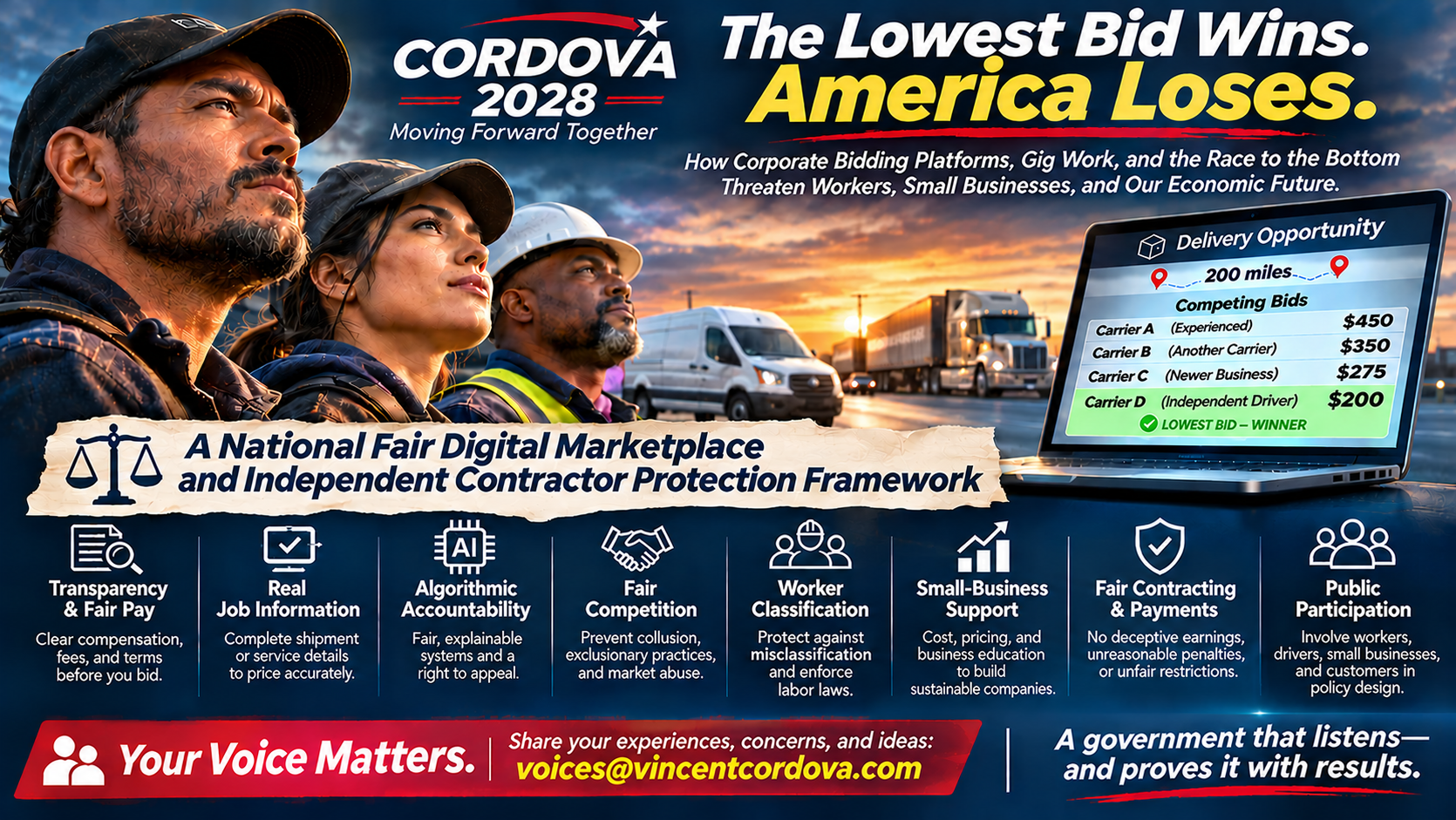
Campaign poster titled “The Lowest Bid Wins. America Loses.” Three workers in caps and a hard hat look toward a sunset over a highway with a delivery van and a semi truck. A laptop shows a 200-mile “Delivery Opportunity” with competing bids, the lowest marked “Lowest Bid – Winner.” A torn-paper banner with scales of justice reads “A National Fair Digital Marketplace and Independent Contractor Protection Framework,” above eight icons: Transparency & Fair Pay, Real Job Information, Algorithmic Accountability, Fair Competition, Worker Classification, Small-Business Support, Fair Contracting & Payments, and Public Participation. A red banner reads “Your Voice Matters,” beside “A government that listens, and proves it with results.”
Campaign design team
Cordova 2028

When Did We Decide That Human Labor Should Be Worth Less?

Across the United States, technology is transforming how people work, how businesses operate, and how corporations purchase services.

We have developed extraordinary tools capable of connecting millions of people, coordinating transportation, processing transactions, and making entire industries more efficient.

These advancements should be improving human life.

They should be reducing unnecessary labor, increasing productivity, creating opportunity, and allowing more people to participate in our economy.

But something troubling is happening.

In certain digital marketplaces, technology is being used to create an environment where independent workers and small businesses compete against one another to offer increasingly lower prices for their labor and services.

  1. 1A corporation needs a delivery completed.
  2. 2A digital platform publishes the opportunity.
  3. 3Independent contractors and transportation businesses submit competing bids.
  4. 4The company selects an offer, often with price playing a central role.
  5. 5The winning contractor may receive the work.

But what happens when the amount paid is insufficient to cover the actual cost of performing it?

What happens when the winning bidder is not the most efficient business, but simply the person least familiar with their expenses—or the person under the greatest financial pressure?

And what happens when this model spreads beyond transportation into construction, home services, freelance work, healthcare staffing, and other industries?

We must ask whether these systems are advancing our economy or creating new mechanisms for economic exploitation.

A nation cannot build lasting prosperity by continuously reducing the value of the people whose work makes prosperity possible.

This is not simply a transportation issue.

It is a question about the kind of economy we are choosing to build.

Part 1 of 12

The Race to the Bottom Is Not Economic Progress

Competition can benefit society.

It can encourage innovation, improve services, reduce unnecessary costs, and create opportunities for new businesses.

But competition becomes destructive when the structure of a marketplace consistently rewards prices that cannot sustain the businesses providing the services.

Consider a hypothetical transportation opportunity.

A delivery requires 200 miles of travel.

An experienced carrier calculates the costs of fuel, insurance, vehicle maintenance, depreciation, labor, and business overhead.

The carrier determines that the shipment requires $450 in compensation to remain financially viable.

Another carrier offers $350.

A newer business offers $275.

An independent contractor, facing immediate financial hardship, offers $200.

Delivery Opportunity

200 miles

Competing Bids

  • Experienced carrier$450

    Calculated fuel, insurance, maintenance, depreciation, labor, overhead

  • Another carrier$350
  • A newer business$275
  • Independent contractor$200

    Facing immediate financial hardship

    Lowest bid · Winner

The gap between a viable price and the winning bid: $250, or 56% below what the experienced carrier needs.

If the lowest bid wins, the corporation purchasing the transportation may achieve a short-term financial benefit.

But did the economy become more efficient?

Not necessarily.

Fuel · still paid

The driver still consumed fuel.

Wear · still paid

The vehicle still accumulated wear.

Insurance · still paid

The insurance premium still exists.

Time · still paid

The driver still invested time that could have been spent earning sustainable compensation.

The costs did not disappear.

They may simply have been transferred from the buyer to the person performing the work.

Transferring financial losses to someone with less bargaining power is not the same as creating economic efficiency.

Yet our economic systems do not always distinguish between these outcomes.

We celebrate lower procurement costs without necessarily examining whether the businesses performing the work can survive.

We celebrate transaction volume without asking whether workers are earning enough to live.

We celebrate corporate profitability without consistently examining the economic conditions of the people making that profitability possible.

That must change.

Part 2 of 12

Independent Contractors Deserve Genuine Independence

There is nothing inherently wrong with independent contracting.

Many Americans choose to operate their own businesses because they value flexibility, autonomy, entrepreneurship, and the opportunity to build something of their own.

Those choices deserve respect.

But independence should mean more than accepting responsibility for expenses that another company does not want to carry.

An independent contractor may be responsible for purchasing a vehicle, maintaining equipment, securing insurance, paying taxes, and absorbing fluctuations in demand.

They may have no guaranteed income, paid leave, or employer-provided benefits.

In return, they should have genuine opportunities to negotiate compensation, establish business relationships, and build financially sustainable enterprises.

But when a platform controls access to customers, determines how opportunities are displayed, influences bidding behavior, and reserves the power to suspend participation, we must examine how much independence the contractor actually possesses.

On paper

A person may technically have the freedom to reject a job.

In reality

But meaningful freedom requires more than the ability to say no.

If the available alternatives are accepting financially unsustainable work or having no income, we must examine the economic conditions creating that choice.

We must also distinguish legitimate independent businesses from workers who have been improperly classified as contractors.

The legal label attached to a worker should never be used to deny protections that the law otherwise requires.

A fair economy must support genuine entrepreneurship while enforcing appropriate worker protections.

Part 3 of 12

The Hidden Cost of Cheap Labor

When corporations purchase services at lower prices, those savings may appear beneficial.

Customers may pay less.

Businesses may improve their margins.

Investors may receive stronger returns.

But we must examine the entire economic transaction.

If the person performing the work cannot afford housing, healthcare, transportation, food, or the maintenance of the equipment required for their job, society has not eliminated those costs.

The consequences may appear elsewhere.

WHO PAYS THE DIFFERENCE

— itemized —

  • A worker may accumulate debt.
  • A small business may fail.
  • A family may experience housing insecurity.
  • A vehicle may be operated without adequate financial reserves for repairs.
  • A person may postpone necessary healthcare because they cannot afford to lose working hours.

BUYER’S SAVINGSPAID ELSEWHERE

These outcomes are not inevitable for every independent contractor. Many operate successful businesses.

But when compensation repeatedly falls below the cost of providing services, financial instability becomes a predictable risk.

We must stop examining economic transactions exclusively through the financial statements of the largest corporations involved.

The financial health of workers, families, and small businesses matters too.

An economy is not healthy simply because its largest participants are profitable.

It is healthy when the people contributing to its success have meaningful opportunities to live securely and prosper.

Part 4 of 12

The Role of Private Equity, Institutional Investors, and Corporate Ownership

We must examine the incentives shaping modern digital marketplaces.

Private equity firms, institutional investors, venture capital companies, and publicly traded corporations can provide capital that helps businesses grow and develop useful technologies.

Investment itself is not the problem.

The question is what financial behavior our systems reward.

When investors evaluate a digital platform, they may examine transaction volume, customer acquisition, revenue growth, operating margins, and profitability.

Those are legitimate business measurements.

But what happens when the financial well-being of participating workers and small businesses is not measured with equal seriousness?

A platform may become more profitable

while the contractors performing its services experience declining compensation.

A corporation may reduce procurement costs

while its suppliers struggle to remain financially viable.

These outcomes should concern policymakers, even when no law has been broken.

We should investigate whether platform design, ownership concentration, information asymmetries, or particular contractual practices create unfair competitive conditions.

We should also examine credible evidence of unlawful coordination, exclusionary conduct, or anticompetitive practices when it exists.

However, institutional ownership alone does not prove coordinated price suppression or illegal manipulation.

Public policy must be grounded in evidence.

The central issue is not whether a company earns a profit. It is whether the methods used to generate that profit create sustainable value or impose unreasonable burdens on other participants in the economy.

Our government should have the tools and willingness to examine that distinction.

Part 5 of 12

Artificial Intelligence Could Make These Problems Worse—or Help Solve Them

Artificial intelligence introduces another important dimension.

AI can improve transportation routing, reduce administrative expenses, predict demand, identify equipment requirements, and help businesses make better decisions.

Those capabilities can produce enormous benefits.

But algorithmic systems can also influence how work is distributed, which bids are visible, how workers are ranked, and what compensation opportunities are presented.

A platform might use automated systems to estimate the lowest price at which a contractor is likely to accept a job.

That possibility raises serious questions.

Q1.Should a corporation be permitted to use information about an individual’s financial vulnerability to determine how little compensation it can offer?

Q2.Should workers have the right to understand when automated decisions materially affect their access to employment or contracting opportunities?

Q3.Should independent businesses be able to challenge inaccurate automated assessments that restrict their access to customers?

These are questions Congress should address.

We should not assume every platform engages in such practices. Allegations about specific algorithms require evidence.

But we should establish protections before harmful practices become deeply embedded in our economy.

Artificial intelligence should help humanity become more productive, educated, secure, and prosperous—not provide increasingly sophisticated methods for exploiting economic vulnerability.

That principle should guide national AI policy.

Part 6 of 12

We Must Stop Confusing Corporate Savings With National Prosperity

For decades, public economic discussions have placed enormous emphasis on corporate earnings, stock market performance, productivity, and economic growth.

These measurements provide useful information.

But they do not tell us everything we need to know.

A corporation can report strong earnings while workers struggle to pay rent.

A technology company can achieve rapid growth while participating contractors absorb increasing operating costs.

An economy can expand while the benefits of that expansion remain concentrated among a relatively small number of participants.

We should measure more than aggregate output.

We should examine whether people can afford housing, healthcare, education, transportation, and the basic conditions necessary to participate in society.

We should measure whether small businesses can survive.

We should measure whether productivity improvements are translating into greater financial security for workers.

And we should examine whether the structure of our markets supports long-term economic stability.

A nation of financially insecure workers cannot become truly prosperous simply by increasing the wealth of those who purchase their labor.

The success of the American economy must include the success of the American people.

Not just shareholders.

Not just corporate executives.

Not just investors.

Everyone.

Part 7 of 12

The People Experiencing These Systems Must Help Design Their Replacement

One of the most important changes I want to bring to government is how we develop policy.

For too long, decisions affecting millions of people have been made without meaningful participation from the people who experience their consequences.

Workers should not have to wait for a corporation to explain what their working conditions are.

Independent contractors should not have to depend exclusively on industry representatives to explain their financial realities.

Small businesses should not be excluded from discussions dominated by large corporations and well-funded lobbying organizations.

We must ask the people directly affected.

  • What challenges are they experiencing?
  • What opportunities are these platforms providing?
  • What practices are harmful?
  • What changes would help them succeed?
  • And what unintended consequences might arise from proposed reforms?

We should also listen to businesses and customers who benefit from digital marketplaces.

Their experiences can help us preserve useful innovations while addressing harmful practices.

The objective is not to replace one system designed without public participation with another.

It is to create policy through meaningful collaboration.

The people affected by a policy must have a voice in shaping that policy.

That is how government begins to work for everyone.

Part 8 of 12

A National Fair Digital Marketplace and Independent Contractor Protection Framework

As part of the Cordova2028 platform, I believe we should develop a national legislative framework to protect workers, independent contractors, and small businesses participating in digital marketplaces.

This framework should be developed with affected communities and include the following priorities.

A

Transparent compensation and fees

Digital labor and service marketplaces should clearly disclose compensation terms, platform fees, deductions, cancellation penalties, and payment conditions.

Where applicable law provides access to broker transaction records, those rights must be enforceable.

Congress should examine whether additional transparency requirements are appropriate for other digital service marketplaces.

Context: federal rules already give carriers a right to review broker transaction records. FMCSA’s 2024 proposal would require electronic records and set response deadlines; it is not yet final.

B

Protection against deceptive earnings claims

Platforms should not misrepresent gross payments as net earnings.

Workers and contractors deserve accurate information about compensation and foreseeable expenses.

Federal regulators should have adequate authority and resources to address deceptive practices.

C

Meaningful algorithmic accountability

Where automated systems materially influence access to work, compensation opportunities, or account suspensions, affected individuals should have appropriate transparency, error-correction rights, and meaningful avenues for appeal.

Protections must also account for privacy, cybersecurity, and legitimate trade secrets.

D

Fair competition and antitrust enforcement

Federal competition authorities should investigate credible evidence of collusion, exclusionary conduct, unlawful price coordination, or anticompetitive market concentration.

Competition law should protect open markets, not simply preserve the ability of powerful buyers to obtain the lowest possible prices.

E

Stronger protections against worker misclassification

Independent contracting must remain a legitimate business option.

But companies should not be permitted to evade applicable employment obligations through contractual labels that do not reflect the actual working relationship.

Federal and state agencies should enforce worker classification laws fairly and consistently.

F

Small-business economic education

We should expand access to practical business education covering operating costs, contract negotiation, pricing, cash flow, insurance, taxes, and financial sustainability.

A person entering a marketplace should have the knowledge necessary to understand whether an opportunity is economically viable.

G

Fair contracting and payment practices

Congress should examine unreasonable payment delays, deceptive cancellation terms, unfair contract restrictions, and the lack of accessible dispute-resolution processes.

Small businesses should not have to surrender meaningful legal protections simply to access commercial opportunities.

H

Public participation and independent evaluation

Any new federal framework should include direct participation from workers, independent contractors, small businesses, customers, labor experts, and affected communities.

Reforms should be tested against measurable outcomes, including contractor earnings, small-business survival, market competition, service quality, and unintended barriers to entry.

The goal should not be to dictate a single price for every service.

Different businesses have different costs, capabilities, and competitive advantages.

Nor should the government prohibit legitimate competitive bidding simply because some bids are lower than others.

The goal is to ensure that marketplaces operate transparently, respect applicable laws, and do not depend on deception or abusive practices.

These reforms would require legislation, regulatory action, and cooperation with state governments. A president cannot establish all of them unilaterally.

Part 9 of 12

We Must Recognize the Human Consequences of Economic Policy

There is a larger principle behind this discussion.

99.9%

We are the same human species. We share approximately 99.9% of our DNA, and every person participating in our economy possesses inherent human worth.

Our economic circumstances do not change that worth.

A delivery driver

is not less valuable than

the executive purchasing the delivery

An independent contractor

is not less important than

the investor financing the platform

A small-business owner

is not less deserving of economic security than

the shareholders of a multinational corporation

We have created extraordinary technological capabilities.

We can communicate across continents instantly.

We can coordinate complex transportation networks.

We can use artificial intelligence to analyze enormous amounts of information.

And yet we continue to tolerate economic arrangements in which people performing necessary work may struggle to afford the conditions required to live.

That contradiction should concern us.

The purpose of technological progress should be to improve the human condition.

The purpose of economic development should be to expand opportunity.

And the responsibility of government should include protecting the public from unlawful and harmful practices while supporting the freedom to innovate, compete, and build successful businesses.

We should not measure human progress by how efficiently we can make people compete against one another for less.

We should measure it by how effectively we use our knowledge, technology, and collective resources to improve life.

Part 10 of 12

The America We Should Be Building

  • Imagine a digital marketplace where technology helps independent businesses calculate their costs accurately.
  • Where customers can compare transportation providers based on reliability, safety, experience, and fair pricing.
  • Where contractors understand the compensation they will receive before accepting work.
  • Where platforms are rewarded for improving efficiency rather than exploiting information imbalances.
  • Where new businesses receive the education and tools necessary to compete responsibly.
  • Where innovation creates opportunity without undermining the people performing essential services.

That is not an unreasonable vision.

It is an achievable direction for national policy.

We do not need to choose between technological innovation and human well-being.

We do not need to choose between successful corporations and sustainable small businesses.

And we do not need to accept the idea that economic progress requires someone else to become increasingly vulnerable.

Our systems are created by people.

They can be evaluated by people.

And when they fail to serve the public, they can be improved by people.

The question is whether our leadership has the understanding and determination to make those improvements.

Part 11 of 12

My Commitment to the American People

As an independent candidate for President of the United States in 2028, I believe government must recognize the relationship between economic policy, human well-being, and the opportunities available to future generations.

  • We must challenge systems that concentrate economic power while transferring disproportionate risks to workers and small businesses.
  • We must examine the role of corporate influence in shaping laws and regulations.
  • We must support responsible innovation.
  • We must enforce fair competition.
  • And we must ensure that the people whose labor sustains our economy have a meaningful voice in decisions affecting their lives.

I do not believe government should exist to guarantee corporate profitability.

I believe government should establish fair conditions under which individuals, families, communities, and businesses can prosper.

That requires accountability.

It requires transparency.

It requires listening.

And it requires recognizing that every person matters, regardless of their income, occupation, or position within our economy.

A government that listens—and proves it with results.

That is the standard we should expect.

Part 12 of 12

The Lowest Bid Wins. But What Happens to America?

When a digital platform awards work to the lowest bidder, it may appear that the marketplace has functioned successfully.

A customer received a service.

A contractor received a payment.

A company completed a transaction.

But those facts alone do not tell us whether the transaction created sustainable economic value.

We must ask what happened to the person performing the work.

  • Did they earn enough to cover their costs?
  • Could they maintain their equipment?
  • Could they support their family?
  • Could they continue operating their business?
  • Did the marketplace reward genuine efficiency, or did it reward financial desperation?

These questions should matter to every American.

Because the same economic pressures affecting an independent delivery driver can affect a construction contractor, a freelance worker, a home-service provider, or a small business competing for corporate contracts.

The industries may differ.

The technology may differ.

But the underlying question remains:

Are we creating economic systems that help people succeed, or systems that become more profitable when people have fewer alternatives?

We have the knowledge to recognize the difference.

We have the technological ability to build something better.

And we have the collective responsibility to ensure that progress benefits the people who make it possible.

The future of America should not be determined by how little we can pay one another.

It should be determined by how much opportunity, security, knowledge, and prosperity we can create together.

Because when the lowest bid wins at the expense of human well-being, America loses.

And we can choose a better future.

Read more: Why Small Businesses Keep Getting Held Back and One Flat Tire Away.

Your Voice Matters — Help Shape This Policy

The Cordova2028 campaign welcomes the experiences, concerns, and recommendations of independent contractors, gig workers, owner-operators, small-business owners, customers, researchers, and platform operators.

We want to hear what these marketplaces are doing well, where they are failing, and what a fairer system should look like.

Your experiences can help inform future policy proposals.

For transportation-specific experiences

voices@vincentcordova.com

For broader national policy discussions

https://www.cordova2028.com

Moving Forward Together.

Community Comments

Community Comments

Share a public response to this post. Submissions are reviewed before they appear.

0 approved comments

Loading comments...

Comments are moderated for spam, abuse, and off-topic submissions.

Your age, area, and IP address are collected for moderation and internal reporting only.