This site is under construction - will be ready soon.
Your Guide to Our Vision

To LGBTQ+ People Everywhere

You Belong.
Your life is not up for debate.

An open message to LGBTQ+ people in the United States and around the world—and to the United Nations.

By Vincent Cordova · Cordova 2028 · November 21, 2026

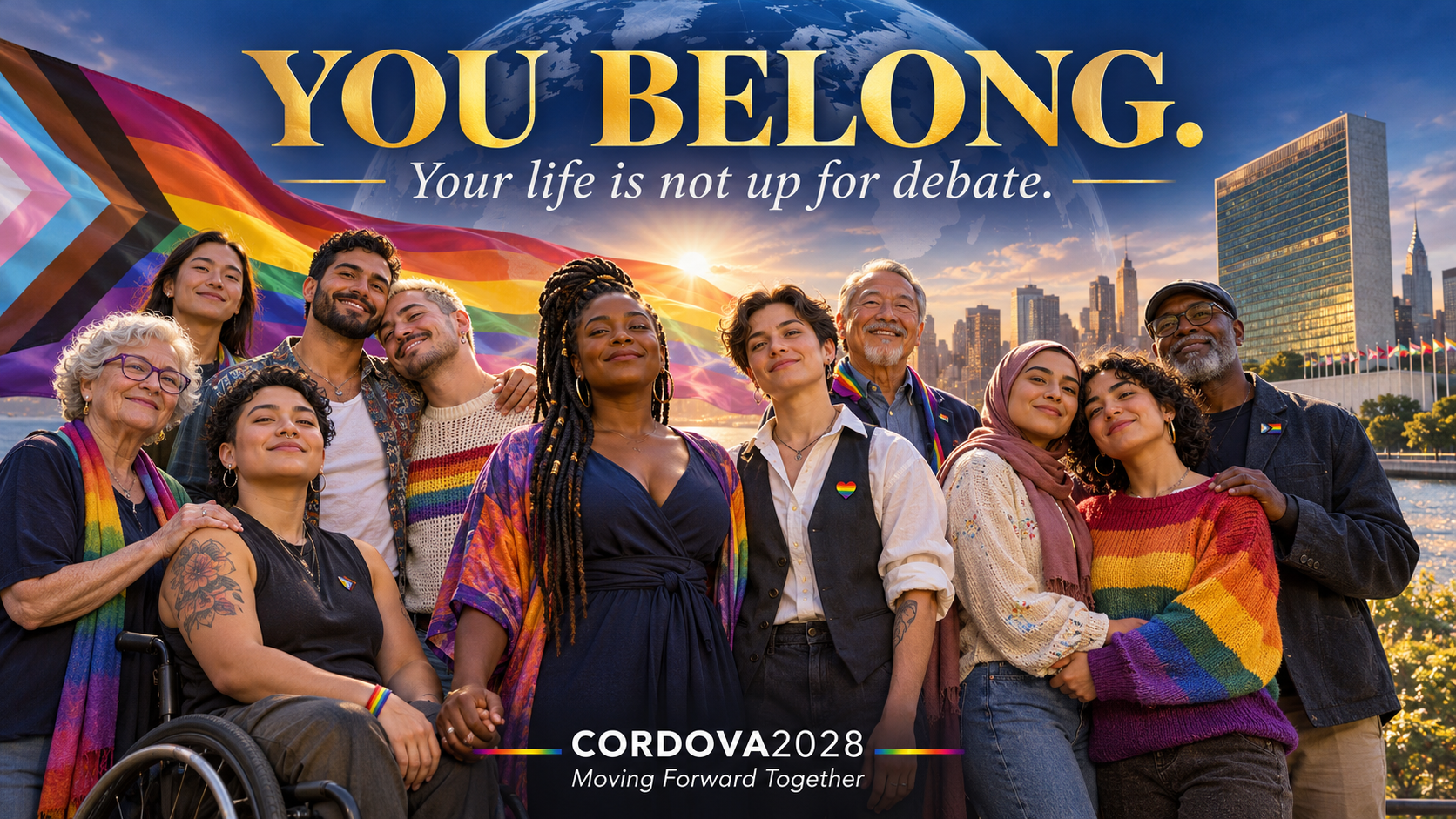
A diverse group of LGBTQ+ people of many ages, faiths and abilities stand together smiling beneath a rainbow sunrise, with a progress pride flag waving behind them, the Earth rising in a deep blue sky, and the United Nations headquarters and the New York skyline across the river. Gold title: You Belong. Your life is not up for debate. Footer: Cordova 2028, Moving Forward Together.

An open message · addressed to

  • LGBTQ+ people in the United States

    here at home

  • LGBTQ+ people around the world

    across every border

  • The United Nations and its Member States

    First Avenue, New York

To every LGBTQ+ person watching governments debate whether your community deserves to be named in a resolution against unlawful killings: you should never have to watch your humanity become a negotiating point.

You deserve to live safely. To love. To build a family, pursue your calling, grow older, and experience the possibilities of your own life.

Your government should help protect that future. You should not have to defend your place in it.

On November 13, 2026, the United States voted in the United Nations General Assembly’s Third Committee for an amendment that would have removed explicit references to sexual orientation and gender identity from a resolution addressing extrajudicial, summary or arbitrary executions. The amendment failed: 74 countries opposed it, 69 supported it, and 24 abstained. The committee approved the resolution with the language intact.12

Third Committee · November 13, 2026

Amendment to delete SOGI

74

Opposed

69

Supported

24

Abstained

Result: amendment failed. Resolution approved with the language intact.

United States: voted for removing the language.

Figures as stated in the text above and reported by ISHR.1 ISHR also reports the amendment was introduced by Egypt on behalf of the Organisation of Islamic Cooperation, and that the full resolution was then approved 131–0 with 47 abstentions. (Context line added by the campaign design team.)

I am grateful that the effort failed. I am deeply troubled that my country supported it.

That vote was cast in the name of the United States. It does not speak for every American, and it does not speak for me.
The language

Understand What Was Being Removed

This resolution addresses unlawful killings. It recognizes groups facing heightened risks and urges governments to investigate.

The European Union explained that the text already included broad language covering other people at heightened risk. Removing sexual orientation and gender identity would therefore have erased a specifically named group without expanding coverage. The EU opposed the deletion because every group listed has the same right to life and protection.3

The proposed edit · redline

…killings of persons because of their sexual orientation or gender identity any considerations that make them at heightened risk…

Wording of the replacement as reported by ISHR and the Washington Blade.12 The named group disappears; the general phrase it was replaced with already sat elsewhere in the text. (Illustration added by the campaign design team.)

There are human beings behind those words.

  • There are parents waiting for answers.

  • Partners grieving someone they expected to grow old with.

  • Friends who recognize the danger because they have lived with it themselves.

Removing an explicit reference does not erase those people’s suffering. It makes it easier for institutions to overlook why they were targeted.
Priorities

A Government’s Priorities Are Visible in Its Choices

Across our country, people are trying to afford a home, keep their utilities connected, find care, and build a future. Around the world, families are seeking safety and the chance to live without fear.

LGBTQ+ people share those struggles. They are workers, parents, students, neighbors, caregivers, and veterans. They are part of the public a government exists to serve.

Yet this administration chose to support removing their explicit recognition from a resolution against unlawful killings.

We are entitled to ask: Whose life becomes safer because those words disappear?

How does that choice help a family pay rent? Help a young person imagine a future? Strengthen a community? Prevent a killing?

Tap each question · Whose life becomes safer because those words disappear?

Interactive prompt added by the campaign design team; the questions are Vincent Cordova’s.

A country moves forward when more people can live safely and contribute fully. When its leaders single out a community for exclusion, they deepen division and weaken trust.

Essentials of life

Food, Water, and the Conditions That Allow People to Live

The administration’s voting record also includes opposition to resolutions affirming essential human needs.

On December 18, 2025, the United States voted against the UN General Assembly resolution “The right to food.” It passed 176–3, with two abstentions. The United States also voted against “The human rights to safe drinking water and sanitation,” which passed 176–2, with two abstentions.456

UN General Assembly · Dec 18, 2025

“The right to food”

176Yes

3No

2Abstain

Voting against: United States, Argentina, Israel

Passed despite U.S. opposition.

Official record · A/RES/80/210 →

UN General Assembly · Dec 18, 2025

“The human rights to safe drinking water and sanitation”

176Yes

2No

2Abstain

Voting against: United States, Argentina

Passed despite U.S. opposition.

Official record · A/RES/80/216 →

For accuracy, these were votes against the resolutions as a whole. The administration’s explanations criticized their effectiveness, use of UN resources, and particular language. Those explanations did not simply declare that people have no right to food or water.7

But Americans still deserve an answer: How did opposing these resolutions advance the well-being of the people our government represents?

Human beings cannot survive without food and water. We do not need another study to recognize that basic reality.

A government that represents its people should defend their access to the essentials of life.

If elected, our administration will work to reverse the United States’ opposition to resolutions affirming the right to food and the human rights to safe drinking water and sanitation. Where UN procedures permit and a further vote would strengthen these commitments, we intend to request one—and vote in support.

Both resolutions already passed despite our government’s opposition. Our responsibility is to change the position our country takes and demonstrate that commitment through action at home and abroad.

Our commitment must reach beyond words at the United Nations. We will work with Congress, communities, and the people directly affected to strengthen access to nutritious food, safe and affordable drinking water, and sanitation. We will publish clear goals and report our progress so the public can judge our actions against our promises.

If elected · the commitment, in four lines

  • 1Reverse the United States’ opposition to resolutions affirming the right to food and the human rights to safe drinking water and sanitation.
  • 2Where UN procedures permit and a further vote would strengthen these commitments, request one—and vote in support.
  • 3Work with Congress, communities, and the people directly affected on nutritious food, safe and affordable drinking water, and sanitation.
  • 4Publish clear goals and report progress so the public can judge actions against promises.

Summary of the paragraphs above, arranged by the campaign design team.

The principle is consistent: government must protect the conditions that allow people to live. That includes access to food and safe water, and protection from violence because of who someone is or whom they love.

Human dignity must guide every one of these decisions.
The public record

We Can Judge the Record Without Pretending to Read Minds

I cannot know every private intention behind an administration’s decisions. I can examine its public actions.

What we cannot know

Every private intention

What we can examine

Public actions · recorded votes

On the LGBTQ+ amendment, the record is clear: when presented with a choice about retaining explicit recognition of people targeted because of their sexual orientation or gender identity, the United States voted to remove it.12

That choice deserves scrutiny and condemnation.

Leadership is accountable for the decisions it makes, the people those decisions affect, and the message it sends to those who already face danger.

When a government supports deleting a vulnerable community from this kind of resolution, it gives that community reason to question whether its safety matters to those in power.

No one should have to carry that doubt about their own government.

Three letters · one message

To LGBTQ+ People Here at Home

You are part of this country. You belong in its present and its future.

You do not owe anyone an extraordinary achievement to deserve ordinary safety. You do not have to prove your economic value, defend your relationships, or persuade a politician to recognize your humanity.

Your rights must not depend on whether those in power understand your life.

As a candidate for President of the United States, my commitment is to listen directly to LGBTQ+ people about the decisions affecting them—and to make their safety, dignity, and equal treatment part of the work of governing.

That means listening to young people, elders, families, workers, people with disabilities, and people whose experiences are too often left out of public debate.

You deserve a government that listens—and proves it with results.

To LGBTQ+ People Around the World

Many Americans reject the message sent by this vote.

We recognize that your life has the same value as ours. National borders do not diminish that value. Neither do differences in faith, culture, sexual orientation, or gender identity.

You deserve protection from violence and a meaningful response when violence occurs. You deserve authorities who investigate rather than dismiss your suffering.

I want the United States to stand consistently for those principles, including when defending them is politically inconvenient.

Human rights require that consistency.

To the United Nations and Its Member States

Thank you to the countries that defended the language.

Please continue to hold that line when the resolution reaches the full General Assembly. The committee’s decision preserved explicit recognition, but the resolution still faces a plenary vote, and another amendment could be introduced.1

Keep the people affected at the center of the discussion. Listen to LGBTQ+ communities and those documenting violence. Preserve the language that helps identify targeted killings and supports demands for investigation and justice.

Every government should be prepared to answer a basic question:

Will you protect people even when their lives are different from your own?

The Country We Choose to Become

I want an America whose leadership sees everyone.

An America that measures progress by whether people can live safely, build a life, and participate without being made a target.

We have serious work before us. We need to reduce hardship, expand opportunity, and rebuild trust. That work requires our neighbors’ participation and our government’s commitment to their well-being.

To LGBTQ+ people here and everywhere: your future matters. Your safety matters. Your life matters.

You should never have to stand alone while governments debate whether to name the danger you face.

— Vincent Cordova

Independent Candidate for President of the United States, 2028

Moving Forward Together.

Sources

  1. 1.International Service for Human Rights, “UNGA81: Third Committee narrowly rejects attempt to erase LGBTIQ victims from resolution on extrajudicial executions” (vote of November 13, 2026)
  2. 2.Outright International, reporting on the 2026 Third Committee vote (first recorded U.S. vote since 2002 to remove the language), as covered by the Washington Blade, November 19, 2026
  3. 3.European Union, EU Explanation of Vote – UN General Assembly 3rd Committee: draft resolution on extrajudicial, summary or arbitrary executions, November 13, 2026
  4. 4.United Nations Digital Library, “The right to food” : resolution / adopted by the General Assembly, A/RES/80/210, December 18, 2025
  5. 5.United Nations Digital Library, “The human rights to safe drinking water and sanitation” : resolution / adopted by the General Assembly, A/RES/80/216, December 18, 2025
  6. 6.United Nations, official transcript of the General Assembly’s 80th session, 69th plenary meeting, December 18, 2025 (A/80/PV.69): right to food 176–3–2; safe drinking water and sanitation 176–2–2
  7. 7.United States Mission to the United Nations, Explanation of Vote for UNGA 80 Third Committee Resolution: “The Human Rights to Safe Drinking Water and Sanitation”
  8. 8.Human Rights Watch and partners, Joint Letter to UN Permanent Representatives to Vote to Continue to Protect All People from Unlawful Killings, November 12, 2026

Editorial note: numbered source links replace the plain-text source names in the original message. The vote board, redline, question cards, food-and-water tiles and four-line commitment summary were added by the campaign design team; every other sentence is Vincent Cordova’s. “SOGI” refers to sexual orientation and gender identity.

Community Comments

Community Comments

Share a public response to this post. Submissions are reviewed before they appear.

0 approved comments

Loading comments...

Comments are moderated for spam, abuse, and off-topic submissions.

Your age, area, and IP address are collected for moderation and internal reporting only.