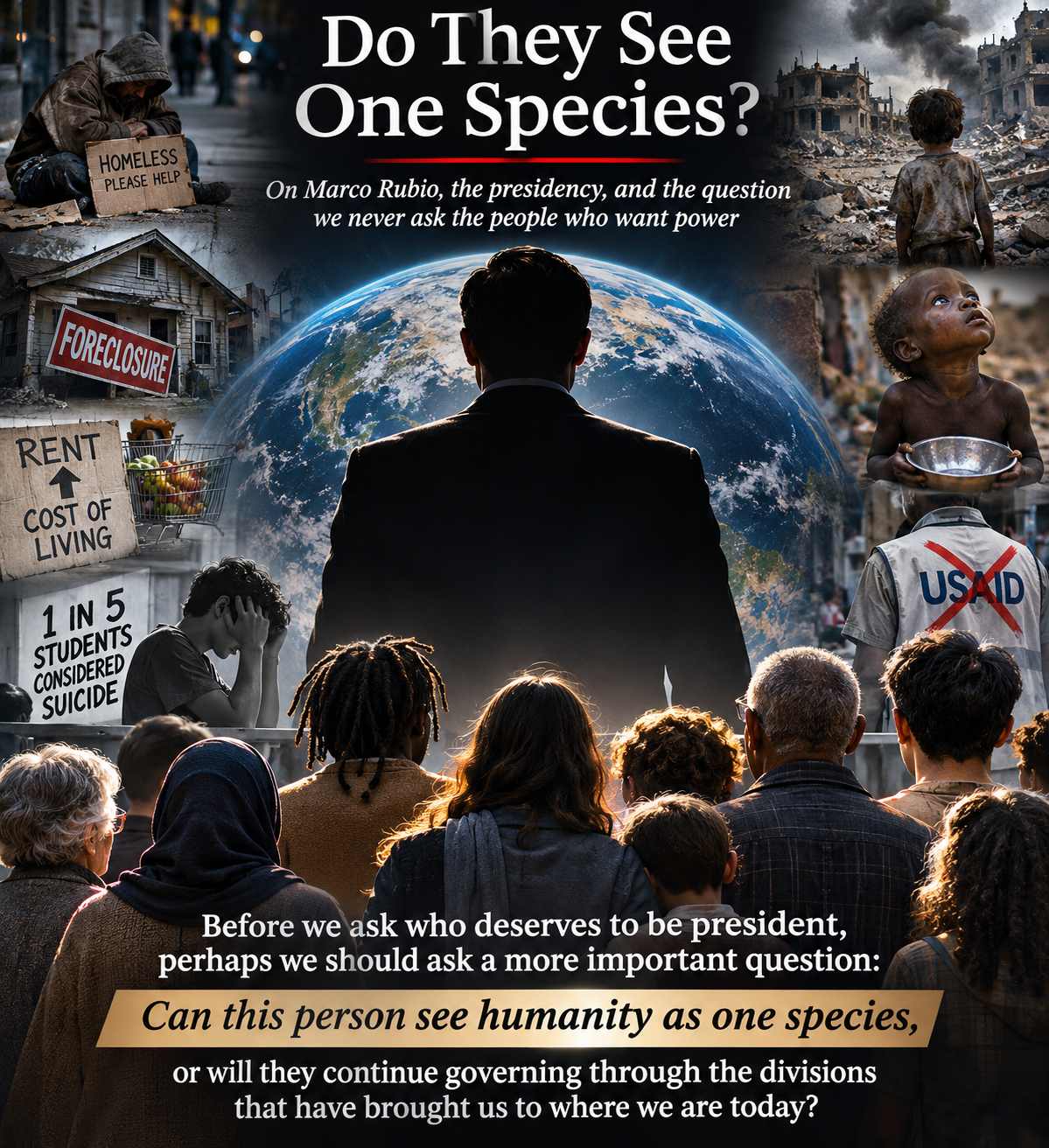
On Marco Rubio, the presidency, and the question we never ask the people who want power
Cordova 2028 ·
By Vincent Dean Cordova, Jr. · Cordova 2028: Moving Forward Together
Campaign design team
The midterms are over. And now the next conversation begins: who wants to be president in 2028?
One of the names being passed around Washington is Marco Rubio — the sitting United States Secretary of State, who is also serving as the President's interim National Security Adviser. Rubio has said publicly that he is not currently planning a run, while leaving the door open to a future one (i24NEWS / NBC). At the same time, the President has openly floated him as a successor or running mate, prediction markets have at times placed him at the top of the 2028 field, and Republican donors and allies have reportedly begun exploring the groundwork for a possible Rubio bid after the midterm elections (Washington Examiner).
So let me be clear about why I am writing this.
I am not here to tell anyone how to vote. I am not here to declare whether Marco Rubio would be a good or bad candidate. I am not interested in name-calling, party scorekeeping, or the kind of cable-news theater that turns human lives into talking points.
The facts, the actions, and the consequences of those actions must speak for themselves.
And before anyone in this country is handed the most powerful office on Earth, we need to start asking a question that almost nobody in the political establishment ever asks:
Do they understand humanity?
Every Official Has a Conscience
Every government official — elected or appointed — has a conscience. They have the capacity to understand right from wrong. They have a responsibility to recognize the human consequences of the decisions they make, the policies they support, and the suffering they allow to continue.
No one in power gets to say they didn't know. Not in this era. The reports are published. The studies are peer-reviewed. The images are on every phone in the world.
Never the question
Did they know?
Always the question
What did they do with what they knew?
The question is never whether they knew. The question is what they did with what they knew.
The country they built
Look Around You
Look at the news.
Look at the number of people experiencing homelessness. On a single night in January 2024, the federal government's own count found 771,480 people experiencing homelessness in the United States — the highest number ever recorded, up 18 percent in a single year. Homelessness among families with children jumped 39 percent in one year (HUD 2024 AHAR). And that count is a floor, not a ceiling: it does not include people doubled up on a friend's couch, people living in cars that nobody found, or people sitting in jail cells on the night of the count (Congressional Research Service).
Look at your rent. Look at the rising cost of living. Look at the families losing their homes.
Look at our children.
According to the CDC's Youth Risk Behavior Survey, 1 in 5 American high school students — 20 percent — seriously considered attempting suicide in the past year. That number rose from 17 percent in 2013 to 22 percent in 2021. Among LGBTQ+ students, it is roughly 4 in 10 (CDC YRBS via Healio).
A classroom of thirty
6 of 30 = 20%. Seriously considered attempting suicide in the past year (CDC YRBS).
201317%
202122%
LGBTQ+ students~4 in 10
Sit with that. In a classroom of thirty kids, six of them have seriously thought about ending their lives in the last twelve months. Those are our children. That is the country the people in charge have built.
Now look at our government.
What have our elected officials actually done to make life better for the people they are supposed to serve? More importantly — do they even understand how to create a society in which human beings can thrive?
Before the vote
The Deeper Question
We must begin asking a much deeper question about those who seek the presidency — especially those who have already held positions of power, because they have a record. They are not asking us to imagine what they would do. They are asking us to overlook what they have already done.
Do they understand that we are all members of the same species?
99.9%
That human beings share approximately 99.9 percent of their DNA with one another?
That the children suffering from war, poverty, displacement, exploitation, and hunger are fundamentally no different from their own children?
How can someone claim to understand leadership while accepting policies that devalue human life?
How can those who have supported, enabled, or failed to challenge actions that cause immense human suffering now present themselves as the solution?
Let's look at the record.
What has been done with power
The Record
1
The end of USAID — and the children it fed
“No one has died”
83%
of USAID programs cancelled
92M
deaths prevented, 2001–2021
14M+
projected additional deaths by 2030
4.5M
of them children under five
In March 2025, Secretary Rubio announced the cancellation of 83 percent of USAID's programs, saying they did not serve the core national interests of the United States. On July 1, 2025, USAID officially stopped implementing foreign assistance. Rubio celebrated it, declaring an era of "government-sanctioned inefficiency" over (CNN via WTTW).
The day before, The Lancet — one of the most respected medical journals in the world — published a study estimating that USAID-funded programs had prevented roughly 92 million deaths across 133 countries between 2001 and 2021, including more than 25 million deaths from HIV/AIDS and 8 million from malaria. The same study projected that the cuts could result in more than 14 million additional deaths by 2030 — about 4.5 million of them children under the age of five. The authors compared the scale of that loss to a global pandemic or a major war, and stressed that unlike those events, this one would come from a conscious, avoidable policy choice (NBC News).
What was the response from the man who led the dismantling? In testimony before Congress in May 2025, Rubio said that no one had died because of the USAID cuts. A senior State Department official waved off the Lancet findings as based on incorrect assumptions (Health Policy Watch).
I want you to think about a five-year-old in a refugee camp who no longer receives the food or the medicine that used to arrive. That child has a name. That child has a mother. That child shares 99.9 percent of their DNA with your own son or daughter. You do not get to call that child an "inefficiency."
2
The boat strikes — death without trial
No arrest · No evidence · No trial
11
killed in the first strike
230+
killed by September 2026
0
trials
Beginning in September 2025, the United States military began destroying boats in the Caribbean and eastern Pacific that the administration said were carrying drugs. The first strike killed 11 people. Secretary Rubio announced it, defended it, and promised there would be more. He also acknowledged that the drugs on that first boat were probably headed to Trinidad or some other Caribbean country — not the United States (CBS News).
By September 2026, the Pentagon itself had claimed attacks that killed at least 230 people. In many cases, the administration provided no public evidence that the boats were even carrying drugs. Human rights organizations have condemned the strikes as extrajudicial killings. Allied governments have raised questions about their legality under international law. The Pentagon's own inspector general announced it would evaluate whether the military followed its targeting framework. When Rubio was questioned by the Senate in June 2026, he said the Defense Department had determined the strikes were legal (PBS NewsHour / PolitiFact; Democracy Now!).
Here is what I want every American to understand: in this country, even a person accused of the worst crime imaginable gets a trial. They get a lawyer. They get evidence presented against them. They get a jury. What we have watched is the United States government deciding — on its own word, from the sky — that human beings are guilty and executing them on the open ocean. No arrest. No evidence. No trial. No names.
If a government can do that to people on a boat it labels "narco-terrorists," the only thing standing between that power and anyone else is the label.
3
Iran — the school, the wedding, the missiles
“Referred to the Pentagon”
168
reported dead in a strike on a girls’ school
14
territories with civilian harm in 40 days
4 · 67
killed and wounded at a wedding
On February 28, 2026, the United States and Israel launched a large-scale attack on Iran. Rubio acknowledged that Washington acted knowing Israel was preparing to strike and that Tehran would retaliate against American forces. American service members died. The war spread across the region; the independent monitoring group Airwars documented civilian harm in 14 territories in the first 40 days alone (Airwars).
In the opening days, Iran reported that 168 people died in a strike on a girls' school. Rubio's response: the United States "would not deliberately target a school," and the matter would be referred to the Pentagon (Dawn). In September 2026, after renewed U.S. strikes, Iran's health ministry reported 18 people killed and more than 100 wounded — including, according to the Iranian Red Crescent, four people killed and 67 wounded at a wedding ceremony. The Secretary-General of the United Nations said he was deeply alarmed and called for an immediate halt (Khaleej Times / Reuters).
Deliberately attacking a school, a hospital, or any civilian structure is a war crime under international humanitarian law. Whether these strikes were deliberate is exactly what an independent investigation exists to determine. "We wouldn't do that" is not an investigation. It is a press release.
4
Weapons to Israel — and the removal of the guardrails
Congress bypassed
$4B
expedited under emergency authority
~$12B
approved in the first weeks
2M
people in Gaza cut off from aid
In March 2025, Secretary Rubio invoked emergency authority to bypass the normal congressional review process and expedite roughly $4 billion in weapons to Israel — the second time in a matter of weeks the administration had done so, bringing approved sales to nearly $12 billion in the administration's first weeks (Deccan Herald / NYT). That same period, the administration rescinded a policy that had required the U.S. government to report potential violations of international law involving American-supplied weapons. And within days, Israel announced it was halting all goods and humanitarian aid into Gaza — a population of two million people (Shafaq News).
Let me be honest, because honesty is the only thing that separates a movement from a party: this did not start with Marco Rubio. The previous administration also used emergency authority to rush arms to Israel without congressional review, and approved nearly all of Israel's weapons requests. This is a bipartisan pattern. That is exactly my point. The machinery keeps running no matter whose name is on the door — and the people who operate it keep asking to be promoted.
5
Punishing the people who speak — and the courts that investigate
Words, not violence
1000s
student visas revoked
4
rounds of ICC sanctions
Hours
after a former ICC judge won the Nobel Peace Prize
In 2025, Secretary Rubio personally oversaw the revocation of student visas for people involved in protests against the war in Gaza — hundreds at first, which he later estimated to be in the thousands. He called them "lunatics." One of them, Tufts doctoral student Rumeysa Öztürk, was grabbed off the street by masked federal agents after co-authoring a student newspaper op-ed. Rubio confirmed that he revoked her visa (The National; The National).
Think about what was being punished. Not violence. Words. An opinion. A student asking her university to hold a government accountable for violations of international law.
And when international judges tried to do exactly that — hold people accountable — Rubio went after them too. Starting in June 2025, he sanctioned judges of the International Criminal Court (Axios). He sanctioned more in December 2025. In July 2026, he announced a "whole-of-government" effort to systematically disable the court and threatened its member states (IBTimes). In August 2026, he sanctioned the court's president (Express Tribune / Reuters). The sanctions were extended to a United Nations Special Rapporteur and Palestinian human rights organizations. In October 2026, the administration announced broader sanctions on the ICC just hours after a former judge of that very court, Navi Pillay, received the Nobel Peace Prize (The National Desk).
You can disagree with the ICC. You can argue about jurisdiction and sovereignty — and plenty of serious people do. But when a government's answer to allegations of war crimes is to sanction the judges rather than open its own records, ask yourself what it is afraid the evidence would show.
Human Suffering Has No Exemption Clause
Across presidential administrations — Republican and Democrat alike — our government has participated in or supported military actions that have caused devastating civilian suffering. Allegations of war crimes and violations of international law demand independent investigation and accountability, regardless of which political party holds power.
Human suffering does not become acceptable because a government calls it national security, foreign policy, economic necessity, or national interest.
The oldest anesthetic in politics
National securityForeign policyEconomic necessityNational interest
Those words are the oldest anesthetic in politics. They are how the powerful numb the public to what is being done in its name. "National interest" has been the justification for nearly every catastrophe in modern history. A child killed in a school is not less dead because the strike was described as "targeting missile capability." A five-year-old who dies of malaria is not less dead because the program was described as "misaligned with national interests."
And yet, we continue to evaluate presidential candidates primarily through political affiliation, wealth, influence, experience, and their ability to win elections.
What about their understanding of human life?
What about their ability to recognize that the person sleeping on the sidewalk, the worker struggling to pay rent, the child living in a war zone, and the billionaire sitting in a corporate boardroom all belong to the same human species?
The person sleeping on the sidewalk
99.9%
The worker struggling to pay rent
99.9%
The child living in a war zone
99.9%
The billionaire in a corporate boardroom
99.9%
Experience Is Not the Same as Understanding
We are told, over and over, that what matters most in a president is experience. Marco Rubio has plenty of it: fifteen years in the United States Senate, a seat on the Foreign Relations Committee, a run for president in 2016, and now the highest diplomatic office in the country.
Experience
How long someone has held power
15 years in the U.S. Senate
Senate Foreign Relations Committee
2016 presidential run
U.S. Secretary of State
Understanding
What they understand about the people that power touches
A profound understanding of humanity and the consequences of their decisions upon it.
But experience only tells you how long someone has held power. It does not tell you what they understand about the people that power touches.
A person seeking to lead this country must possess more than political experience, economic knowledge, or the ability to command a military.
They must possess a profound understanding of humanity and the consequences of their decisions upon it.
I have yet to see convincing evidence that the political establishment — including many of those positioning themselves for the presidency, in both parties — possesses that understanding.
Instead, too many continue to view the world through systems of stratification: nationality, race, religion, economic class, political affiliation, and social status. These divisions are treated as though they determine the value of a human life.
They do not.
When leaders view humanity through these divisions, their policies reproduce the same inequalities, exploitation, conflicts, and suffering that generations before them have failed to resolve. Every empire in history has drawn a line somewhere and said: the people on that side of the line count less. Every one of those empires told itself it was acting in the national interest. And every one of them left behind graves that history later called a crime.
Managing the Damage vs. Ending the Cause
Managing the damage
We do not need another president who simply manages the consequences of a system that continues to harm people.
Ending the cause
We need leadership capable of questioning why those consequences exist in the first place — and willing to change the structures that produce them.
That means asking why 771,000 people have no home in the wealthiest nation in human history. It means asking why one in five of our high school students has considered taking their own life. It means asking why we can find billions for weapons in a matter of days under "emergency authority," but cannot find the will to keep a child in a refugee camp fed. It means asking why the people who raise questions about war crimes are the ones who get punished.
Ask why
771,000
with no home in the wealthiest nation in human history
Ask why
1 in 5
high school students who have considered taking their own life
Ask why
Days
to find billions for weapons under “emergency authority”
Ask why
Punished
the people who raise questions about war crimes
The presidency should not be a reward for political loyalty, personal ambition, wealth, or years spent in government.
It should be a responsibility entrusted to someone who understands that every human life has value — regardless of where that person was born, how much money they possess, what they believe, or which side of a border they live on.
The Question Before the Question
So, to Secretary Rubio — and to every other person in either party quietly preparing to ask the American people for the presidency — I am not asking whether you can win. I am not asking whether you have the donors, the endorsements, or the experience.
I am asking you to answer for the record, in plain words, to the people whose lives it touched:
To the families of the children projected to die from the end of the aid that kept them alive.
To the families of the people killed on boats without a charge, a trial, or a name.
To the parents of the girls in that school, and the families at that wedding.
To the students who lost their right to remain in this country for writing their opinion down.
To the 771,480 people without a home, and the one in five children who are thinking about leaving this world.
They are not abstractions. They are not "collateral." They are not "inefficiencies." They are human beings — the same species as you, the same species as me.
Before we ask who deserves to be president, perhaps we should ask a more important question:
Can this person see humanity as one species
— or will they continue governing through the divisions that have brought us to where we are today?
Because if a leader cannot recognize the equal value of human life, how can we reasonably expect that leader to protect it?
I am a piece of the collective essence of this world that never gives up and needs every other piece to be whole.