This site is under construction - will be ready soon.
Your Guide to Our Vision
← Back to Blog

Cordova2028 | An open national conversation

When Parents Disown Their Children,Who Protects the Lives They Leave Behind?

An open national conversation about parental rejection, youth homelessness, suicide prevention, family responsibility, and the right of every child to become who they are.

By Vincent Cordova · Cordova2028 · November 18, 2026

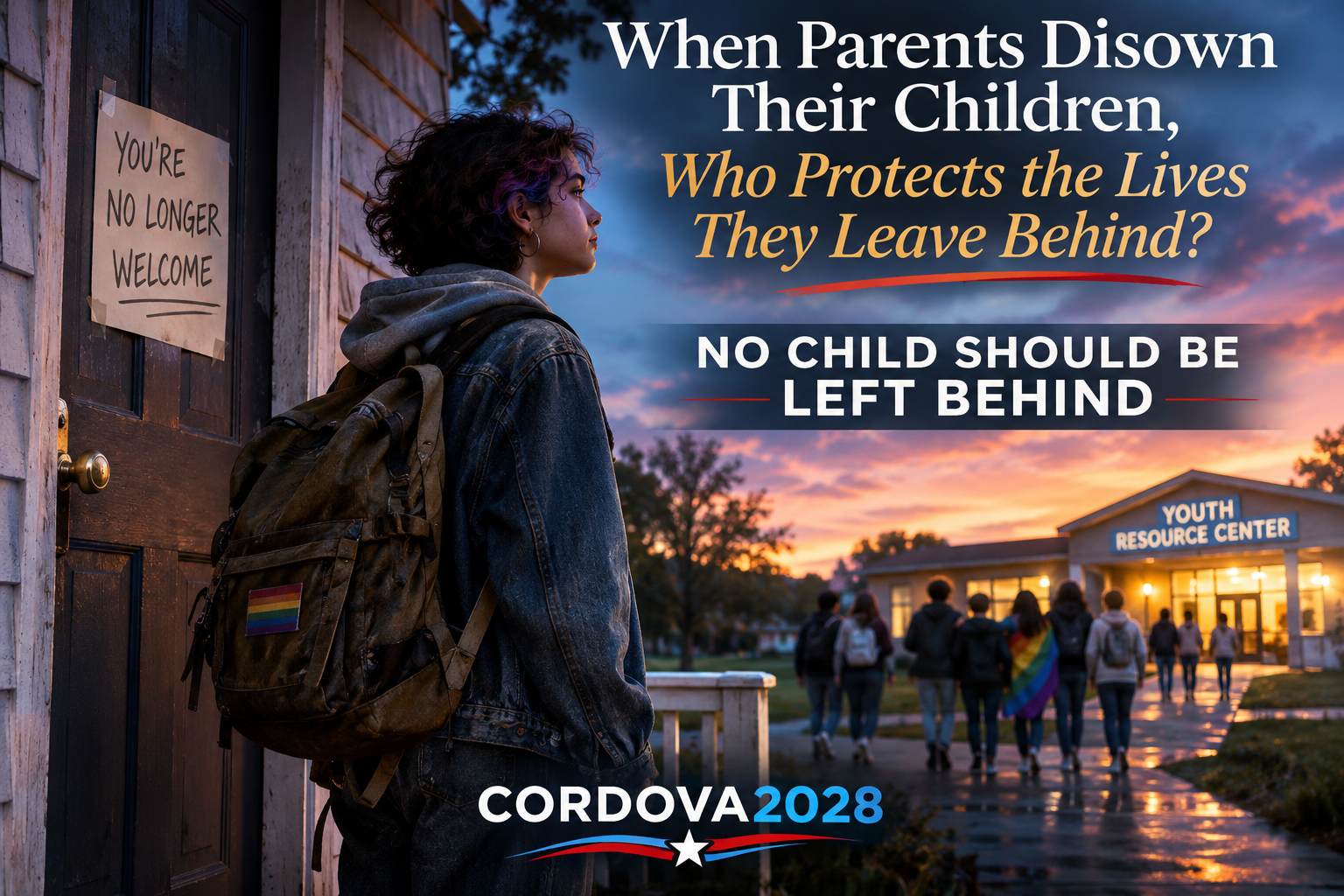
At dusk, a young person with a rainbow patch on a worn backpack stands outside a weathered door. A paper sign taped to the door reads: You’re no longer welcome. Down a rain-wet path, a group of young people, one wrapped in a rainbow flag, walk toward the warm lights of a Youth Resource Center. Headline: When Parents Disown Their Children, Who Protects the Lives They Leave Behind? Banner: No child should be left behind. Cordova2028.

No child should be
left behind

If you were told to leave, read this first

You did not lose your worth when you lost your key. There are people awake right now whose whole job is to help you.

If you are in immediate danger, call 911.

Entrusted, not owned

You Were Entrusted With a Child, Not Given Ownership of a Human Life

I want to begin by asking every parent and guardian to reflect on something.

When a child enters this world, what responsibility do we accept?

Is our responsibility to protect that life, nurture it, and help that child discover who they are?

Or do we believe that bringing a child into the world gives us the right to determine exactly who that person must become?

A child is not property.

A child is not an extension of a parent’s reputation, religion, political beliefs, personal expectations, or unfinished dreams.

A child is not

  • Property
  • A parent’s reputation
  • A religion
  • A political belief
  • Personal expectations
  • Unfinished dreams

A child is a separate human being.

Someone who will develop their own thoughts, discover their own talents, ask questions, form relationships, make mistakes, experience love, and eventually decide what kind of life they want to build.

You were entrusted with that life as a guardian.

You were not given ownership of its identity.

And yet, young people across America are being rejected, disowned, abandoned, or forced from their homes because they do not become the people their families expected.

Some are rejected because of their gender identity or sexual orientation. Others because of religious disagreements, pregnancy, relationships, family conflict, or choices about their future.

Others leave homes where abuse or violence has made remaining unsafe.

These circumstances are not all identical, and they should not be treated as though they are.

But they raise one question we must confront:

What are we supposed to do with the children we desert?

Are we expecting them to disappear?

Are we expecting a 16- or 17-year-old to suddenly afford an apartment, maintain employment, obtain healthcare, finish school, and become independent?

Or have we become so accustomed to watching young people struggle that we have stopped examining what happened to them before their struggle began?

Her story

Iris Delaney: Disowned at 17, Still Struggling at 26

I recently encountered a publicly shared TikTok video by Iris Delaney, a 26-year-old transgender woman.

In her video, Iris describes being disowned by her family at 17.

She says she lost family support, health insurance, and a stable place to call home.

She describes nearly a decade of intermittent homelessness, sleeping in shelters, on friends’ couches, and wherever she could find somewhere to rest.

She also describes working to meet her basic needs while struggling to maintain stability.

Iris’s account is her publicly shared personal testimony. I have not independently verified her circumstances, and I do not presume to know her family’s private history.

Watch Iris’s original video: tiktok.com/@irisdelany

In her own account

Testimony · not independently verified

9 years

From the day she was disowned to the day she told her story.

  • Age 17Disowned. Loses family support, health insurance and a stable home.
  • Age 20Shelters.
  • Age 22Friends’ couches.
  • Age 24Wherever she can find somewhere to rest.
  • Age 26Still working to meet basic needs.
▶ Watch Iris’s original video on TikTok ↗

What I want us to examine is not only what happened when she was 17.

It is what she describes experiencing afterward.

Nine years.

Nine years during which a young person might otherwise be pursuing education, building a career, developing financial stability, forming relationships, and exploring the possibilities of adulthood.

Instead, according to her account, much of that time has involved trying to secure basic necessities.

We cannot know what Iris’s life would have looked like under different circumstances.

But we can ask what opportunities become harder to pursue when a young person loses their housing and family support.

And we must ask how many others are experiencing something similar without ever sharing their stories publicly.

  • How many are sleeping in cars?
  • How many are moving from couch to couch?
  • How many are afraid to disclose who they are because they believe their parents will force them out?
  • How many are trying to survive while the rest of society assumes they simply need to work harder?
The count

The Numbers: Millions of Young Americans Have Experienced Homelessness

Research from Chapin Hall’s Voices of Youth Count estimated that approximately 4.2 million young Americans ages 13–25 experienced some form of homelessness over a year, based on 2016–2017 research.

That included approximately:

  • 700,000 adolescents ages 13–17.
  • 3.5 million young adults ages 18–25.

4.2 million

young Americans ages 13–25 experienced some form of homelessness over a year

700,000

adolescents ages 13–17

3.5 million

young adults ages 18–25

Chapin Hall, Voices of Youth Count, 2016–2017 research (published 2018). That is about 1 in 30 adolescents and 1 in 10 young adults. Includes young people staying temporarily with others because they lacked stable housing. Report ↗

These historical annual estimates include young people staying temporarily with others because they lacked stable housing, not just those sleeping outdoors or in shelters.

They are not a current 2026 census, and they do not establish that all 4.2 million were rejected by their families.

But the numbers reveal a substantial problem.

Hundreds of thousands of minors and millions of young adults have experienced housing instability under the study’s broad definition.

We need updated national measurements, including how many young people are homeless because they were rejected, expelled, abandoned, or unable to remain safely with family.

We cannot solve a problem we refuse to measure accurately.

The hard question

Why Are Parents Choosing to Disown Their Children?

This is a conversation we must have openly, including with parents.

Why does a parent decide that a disagreement is worth losing a relationship with their child?

  • Is it fear of what other people will think?
  • Is it a religious disagreement?
  • Is it discomfort with a child’s gender identity or sexual orientation?
  • Is it a belief that children must follow a predetermined life?
  • Is it family pressure, shame, unresolved conflict, or an inability to communicate?

There is no single explanation for every family estrangement.

Some parents are struggling with circumstances beyond their control. Some families are experiencing poverty, domestic violence, or serious mental-health challenges. Others may be deliberately withholding support because a child refuses to conform to their expectations.

We must understand those differences.

But we should also recognize a fundamental distinction:

Disagreement does not require abandonment.

You can hold deeply rooted beliefs

without denying a child food, shelter, or safety.

You can struggle to understand your child’s identity

without demanding that they surrender it.

You can disagree with a decision

without declaring that your child no longer belongs.

And you can seek counseling, education, or guidance

without making homelessness the consequence of your uncertainty.

Your child may not become the person you imagined.

That does not mean they have failed you.

It means they are becoming an individual.

Growing up

You Cannot Raise a Child to Become Themselves While Punishing Them for Trying

Consider what childhood and adolescence are supposed to offer.

  • The opportunity to learn.
  • To discover.
  • To explore.
  • To create.
  • To build friendships.
  • To experience love.
  • To understand the world.
  • To find interests and talents.
  • To imagine a future.

When a child believes that expressing who they are could cost them their home, what lesson are we teaching?

Are we teaching honesty?

concealment?

Are we teaching independence?

fear?

Are we teaching growth?

acceptance conditional upon obedience?

Are we teaching honesty? Or are we teaching concealment? Are we teaching independence? Or are we teaching fear? Are we encouraging growth? Or are we making acceptance conditional upon obedience?

When a child must hide who they are to remain safe, we are not helping them discover their identity. We are teaching them that their identity is dangerous to reveal.

The emotional consequences can be profound.

Young people may begin to question their worth, withdraw from relationships, or lose trust in those they depend upon.

Family rejection can contribute to psychological distress, particularly when combined with homelessness, discrimination, or a lack of supportive relationships.

And although not every rejected child will experience the same outcomes, the risks are too serious to dismiss.

A child should never have to spend their adulthood recovering from the belief that they were unworthy of love.

The question we cannot skip

Are We Contributing to the Number of Children Considering Suicide?

There is another question that deserves our attention.

When a child is rejected by their family, could that rejection contribute to the despair that leads some young people to consider ending their lives?

The research gives us reason to take that possibility seriously.

According to the CDC’s 2023 Youth Risk Behavior Survey of U.S. high school students:

  • 20.4% seriously considered attempting suicide during the preceding year.
  • 9.5% reported attempting suicide.
  • 39.7% experienced persistent feelings of sadness or hopelessness.

U.S. high school students

1 in 5 seriously considered ending their life.

20.4%

seriously considered attempting suicide

CDC YRBS · 2023

9.5%

reported attempting suicide

CDC YRBS · 2023

39.7%

persistent feelings of sadness or hopelessness

CDC YRBS · 2023

Newer · 2025: the CDC’s most recent survey found about 1 in 7 (14%) high school students seriously considered suicide. Better, but still millions of children. Source ↗

That means approximately one in five high school students seriously considered attempting suicide in 2023.

These are not figures attributable solely to parental rejection. Suicidal thoughts and behaviors have complex causes, and individual experiences vary.

But family relationships, housing stability, safety, and belonging are important parts of youth well-being.

The Trevor Project’s 2022 research, based on its 2021 survey of LGBTQ young people, found that:

  • 14% reported having slept away from parents or caregivers because they were kicked out or abandoned.
  • Among that group, 40% reported being kicked out or abandoned because of their LGBTQ identity.
  • 62% of surveyed LGBTQ young people experiencing current homelessness reported seriously considering suicide in the preceding year.
  • 35% of those currently experiencing homelessness reported attempting suicide during that year, compared with 10% of surveyed LGBTQ youth without housing instability.

The Trevor Project · surveyed LGBTQ young people

14%

slept away from parents or caregivers because they were kicked out or abandoned

40%

of that group were kicked out or abandoned because of their LGBTQ identity

62%

of those experiencing current homelessness seriously considered suicide in the past year

Attempted suicide in the past year

Currently experiencing homelessness35%
No housing instability10%

2022 research brief based on The Trevor Project’s 2021 national survey. Associations, not proof of cause. Brief ↗

These findings describe the surveyed LGBTQ population, not all American children. They establish associations, not proof that homelessness or parental rejection independently caused every suicide attempt.

Nevertheless, they demand attention.

Think about what these experiences can mean for a young person.

They may already be facing bullying, discrimination, loneliness, or uncertainty.

They may be struggling to understand themselves.

And then they may lose the home and relationships they relied upon for security.

  • Who is there to help them?
  • Who notices when they stop attending school?
  • Who makes sure they have access to counseling?
  • Who tells them that they still have a future?
  • Who ensures they have a safe place to sleep?

We cannot say that our children’s lives matter while treating the loss of their safety and belonging as an acceptable consequence of being different.

And we cannot assume that every child in crisis will find the courage, resources, or opportunity to ask for help.

  • That is why prevention matters.
  • That is why listening matters.

And that is why family rejection, youth homelessness, and youth mental health must be examined together.

If you are struggling right now, call or text 988, the Suicide & Crisis Lifeline, or chat at 988lifeline.org. It is free, confidential, and open 24/7.

Practical responsibility

What Are We Supposed to Do With the Children Parents Abandon?

Now we must move from moral concern to practical responsibility.

When a parent unlawfully expels a minor from home, who becomes responsible for that child’s immediate safety?

  • Who provides shelter?
  • Who ensures the child has food?
  • Who helps them continue attending school?
  • Who arranges necessary healthcare?
  • Who protects them from exploitation?
  • Who helps them reach adulthood without years of avoidable instability?

We need a system that can respond immediately.

And we need to examine parental responsibility.

Should parents who unlawfully abandon children contribute financially to their housing?

This is a serious policy question.

If a parent has the financial ability to provide for a minor child but deliberately refuses to do so, should a court be able to require financial contributions toward the child’s safe housing and essential care?

Should existing child-support, neglect, and abandonment laws be enforced more effectively?

Could appropriate court orders help cover the cost of a safe placement, supervised transitional housing, or support provided through a lawful caregiver?

We should investigate these possibilities with legal experts, child-welfare professionals, parents, and young people who have experienced abandonment.

The goal should not be punishment for ordinary family disagreements.

Nor should we impose financial penalties that deepen poverty and make children less safe.

We must distinguish between parents who cannot provide adequate housing and those who deliberately refuse to fulfill legal responsibilities despite having the means.

And we must recognize that a minor child may need a protective placement rather than an independent apartment.

A child’s access to safety must never depend on whether a parent pays a fine or whether a court case has concluded.

First

Protect the child.

Shelter, food, school, healthcare, safety. Tonight.

Afterward

Determine accountability.

Legal and financial responsibility, through due process.

Protect the child first. Determine legal and financial accountability through due process afterward.

Before the door closes

We Need to Intervene Before a Child Becomes Homeless

Why do we wait until a young person has lost their home before asking whether something could have prevented it?

Why aren’t we identifying warning signs earlier?

  • A student who says they are afraid to go home.
  • A teenager who is sleeping at friends’ houses because of family conflict.
  • A child who suddenly stops attending school.
  • A young person whose parents have threatened to expel them because of their identity.
  • A student who is struggling to maintain grades while working to survive.

These are situations where timely, qualified intervention may prevent greater harm.

Schools, youth organizations, healthcare providers, child-protection agencies, and housing programs need effective ways to coordinate assistance.

Young people also need direct access to help when a school or family member is part of the problem.

And every intervention must protect privacy, respect legal safeguards, and prioritize the young person’s safety.

Youth Resource Center

A Department That Listens Directly to Young People

In December 2024, I proposed the creation of a federal Department for Youth Leadership and Innovation (DYLI).

As we revisit this proposal for 2028, I want to expand its mission.

The department should not exist solely to develop future leaders.

It should also help protect young people whose opportunities are being undermined today.

I envision a department with direct relationships with participating schools, communities, youth-service organizations, and young people throughout the country.

Students should be able to communicate concerns, identify problems, propose solutions, and help evaluate whether government programs are working.

I also envision meaningful youth leadership at the highest level, including the possibility of an 18-year-old serving as Secretary, subject to the required legal appointment process and qualifications.

Young people should not merely be consulted about their future.

They should have real opportunities to help shape it.

First proposed priority

National Youth Family Protection and Housing Stability Initiative

  • The causes of family rejection
  • The adequacy of existing legal protections
  • Immediate housing responses
  • Mental-health support
  • The long-term consequences of childhood homelessness
  • Designed with young people who have lived it

One of the department’s first proposed priorities would be a National Youth Family Protection and Housing Stability Initiative.

It would examine the causes of family rejection, the adequacy of existing legal protections, immediate housing responses, mental-health support, and the long-term consequences of childhood homelessness.

It would also work with existing federal, state, tribal, and local programs rather than assuming that a new department must replace every service already available.

And before finalizing the policy, we would ask young people who have experienced these circumstances to help design it.

If we look away

What Happens If We Continue to Ignore This?

To every parent, guardian, policymaker, and member of our society: this is the part of the conversation we cannot afford to avoid.

When a child loses their home, the consequences do not necessarily end when they find another place to sleep.

When a teenager is rejected, the consequences do not necessarily disappear when they turn eighteen.

And when a young person spends years trying to survive, we cannot assume that the opportunities they lost will simply return.

Let us confront what the evidence shows.

1

We leave young people exposed to serious mental-health risks

In 2023, approximately one in five U.S. high school students seriously considered attempting suicide.

Among surveyed LGBTQ youth experiencing current homelessness, The Trevor Project found that 35% reported attempting suicide during the preceding year, compared with 10% of those without housing instability.

That difference is substantial.

It does not establish that family rejection caused every attempt.

But it makes one thing clear: young people experiencing housing instability can face exceptionally serious mental-health challenges.

If we continue ignoring family rejection and homelessness, we risk overlooking opportunities to prevent suffering and connect young people with effective support.

How many more children must tell us they are struggling before we take their experiences seriously?

2

We disrupt education during years that cannot be repeated

A student without stable housing may struggle to attend school consistently, find a quiet place to study, maintain transportation, or keep essential belongings secure.

They may need to work to survive.

They may change schools repeatedly.

They may lose access to counselors, teachers, and relationships that once provided stability.

These disruptions can make graduation, higher education, and career preparation more difficult.

And the consequences can extend into adulthood.

Think about that.

A child may lose educational opportunities not because they lack intelligence, ambition, or talent, but because they lack somewhere safe to sleep.

What does it say about our priorities when a child’s housing situation can interfere with their opportunity to learn?

3

We increase exposure to exploitation and unsafe conditions

Young people without stable housing may depend on strangers, temporary arrangements, or unsafe environments to meet basic needs.

Some may be exposed to violence, coercion, trafficking, or other forms of exploitation.

Research on youth homelessness identifies these as serious risks, although experiences differ and homelessness does not make exploitation inevitable.

A young person desperate for shelter may have fewer safe choices.

That is precisely why timely protection matters.

When a child is expelled from home, we should not leave them to navigate those risks alone.

4

We make financial independence harder to achieve

Consider what stable employment requires.

Reliable transportation.Regular sleep.Clean clothing.A safe place for personal belongings.Identification.Communication.The ability to arrive at work consistently.

A young person experiencing homelessness may struggle to maintain these basic conditions.

And without stable employment, obtaining housing becomes even harder.

This creates a cycle in which homelessness interferes with work, while insufficient income prevents a young person from securing housing.

We then risk blaming people for failing to achieve independence while overlooking the conditions preventing them from doing so.

How can we demand financial independence from young people while denying them the stability necessary to pursue it?

5

We transfer preventable suffering into adulthood

Iris’s publicly shared account illustrates this concern.

She describes losing family support at 17 and continuing to experience housing instability at 26.

Her story does not establish what would have happened under different circumstances.

But it raises an important question about the long-term effects of losing support during adolescence.

What happens to educational opportunities? To employment stability? To savings? To healthcare? To the ability to build relationships and plan for the future?

We should study these outcomes nationally.

We should also recognize that recovery is possible and that timely assistance can change a young person’s trajectory.

The objective is not to define people permanently by what happened to them.

It is to make sure their opportunities are not unnecessarily restricted by preventable hardship.

6

We place additional pressure on public systems

When young people experience homelessness, their needs may involve emergency shelters, healthcare providers, schools, child-welfare systems, and other public services.

Those systems provide essential assistance.

But crisis response alone does not necessarily resolve the conditions that caused the crisis.

We should examine whether earlier intervention could improve outcomes and reduce avoidable long-term public costs.

That requires careful evaluation, not assumptions that every prevention program automatically saves money.

The larger question is whether we are organizing our resources around preventing harm or waiting until people are already suffering.

7

We teach children that belonging is conditional

This may be one of the most painful consequences.

When a child is rejected for who they are, they may learn that love depends on conformity.

That expressing themselves is dangerous.

That asking questions creates conflict.

That revealing their identity could cost them their home.

Some young people may respond by hiding.

Others may withdraw.

Others may spend years trying to rebuild their sense of belonging.

No child should have to choose between personal authenticity and basic safety.

If we teach children that being themselves makes them unworthy of protection, what kind of society are we preparing them to inherit?

8

We risk losing human potential that cannot be measured

Think about every young person who could become a teacher, scientist, artist, physician, engineer, entrepreneur, caregiver, or community leader.

Think about the relationships they might build.

The discoveries they might make.

The people they might help.

The families they might create.

The contributions they might make to humanity.

We cannot calculate the precise value of opportunities lost to rejection and homelessness.

But we can recognize that every young person deserves the conditions necessary to pursue their potential.

And we can ask whether our society is doing enough to protect those opportunities.

We should not have to know what a child might accomplish before deciding that their life deserves safety and dignity.

9

We allow the next generation to inherit problems we refused to confront

When we ignore youth homelessness, we leave future communities to address its consequences.

When we ignore family rejection, we fail to understand why some young people enter adulthood without support.

When we ignore youth mental health, we miss opportunities to intervene early.

And when we exclude young people from policy decisions, we risk designing solutions without understanding the people they are supposed to serve.

This is not simply a question of what happens to individual families.

It is a question of what kind of future we are collectively creating.

If we continue ignoring children who are rejected, abandoned, or left homeless, we cannot reasonably claim that we have done everything possible to protect the next generation.

Imagine

A Question for Every Parent

A sign on a door is a sentence. The child still has to live the rest of it.

  • Imagine your child standing outside your home with a backpack.
  • Imagine them wondering where they will sleep.
  • Imagine them calling friends because they have nowhere else to go.
  • Imagine them trying to finish school while worrying about food.
  • Imagine them years later still struggling to recover from the loss of stability.

Now ask yourself:

  • Was the disagreement worth that possibility?
  • Was preserving an expectation worth placing their safety at risk?
  • Was the opinion of another person worth losing your relationship with your child?
  • Could you have disagreed and still protected them?
  • Could you have sought guidance?
  • Could you have listened?
  • Could you have chosen love without requiring complete understanding?

A parent does not have to agree with every choice their child makes to remain responsible for treating that child with dignity.

And for a minor, lawful parental responsibilities do not disappear simply because a relationship becomes difficult.

We must examine how those responsibilities are protected and enforced.

The Question We Must Answer Together

If we continue ignoring this problem, young people will continue reaching out for help after their lives have already been disrupted.

Some will find support and recover.

Others will face prolonged instability.

And some will experience serious harm that might have been prevented.

We should not accept that as inevitable.

  • We should ask what works.
  • We should measure outcomes.
  • We should listen to those who have lived through rejection.
  • And we should build systems capable of intervening before a child is left without somewhere safe to go.

The goal is not merely to reduce the number of homeless children we count.

The goal is to prevent children from becoming homeless in the first place—and to make sure those who do experience homelessness have a meaningful opportunity to recover and build their lives.

To religious parents & institutions

Who Do You Think God Will Be With?

To every religious parent, and to every religious institution, I ask you this:

Who do you think God is going to be with when you abandon them?

Not you.

Your child.

Because He gave them the gift of life to experience. To be who they are. Perfect.

You cannot yourself create and design a human being to decide the worth of another, even if you wanted to.

You may birth them, but you are not on a level to design the intelligence, love, and abilities that you and your deserted child have.

— Vincent Cordova

To the parents

To the Parents: You Were Given a Life to Protect

I want to close with a reflection.

Imagine being entrusted with a life.

A child who begins completely dependent on you.

A child who looks to you for warmth, food, protection, comfort, and reassurance.

A child who gradually discovers that the world is larger than the home in which they were raised.

They begin asking questions.

They begin forming opinions.

They begin discovering who they are.

They may become someone you did not expect.

They may believe differently.

They may love differently.

They may pursue a future you never imagined.

Does that make their life less valuable?

Does it erase their humanity?

Does it erase the years of love and care that came before?

If your child becomes someone different from the person you imagined, perhaps the challenge is not to change your child. Perhaps the challenge is to expand your understanding of love.

You can ask questions.

You can seek guidance.

You can learn.

You can disagree.

But please do not make homelessness the consequence of your uncertainty.

Do not make your child’s search for identity a struggle for survival.

Do not allow fear, pride, or the judgment of others to determine whether your child has somewhere safe to sleep.

And if you have already rejected your child, consider whether there is a safe and respectful path toward repairing the relationship.

Not by demanding that they surrender who they are.

But by recognizing that they are a human being whose life deserves dignity.

We want to hear from you

An Open Invitation: We Want to Hear From You

We are opening this conversation because we need to understand what young people are experiencing directly.

  • Not through assumptions.
  • Not through political talking points.
  • Not through decisions made exclusively by people who have never experienced these circumstances.

We want to hear from young people who have been disowned, abandoned, rejected, or forced from their homes.

We also want to hear from parents, guardians, educators, counselors, social workers, researchers, and families who have found ways to resolve serious disagreements without abandonment.

We want to understand what happened, what help was missing, and what would have made a difference.

We want to hear ideas for preventing family rejection, strengthening legal protections, improving emergency housing, and helping young people build stable, independent lives.

Share your experiences, concerns, and proposed solutions:

Participation is not an endorsement of any candidate or political party. This is an opportunity to inform public policy through lived experience and constructive discussion.

Please do not send Social Security numbers, medical records, precise shelter locations, or other highly sensitive identifying information by ordinary email. Submissions should be handled with appropriate privacy safeguards, particularly when they involve minors.

This mailbox is for listening and policy development, not emergency response.

If you are in immediate danger, contact local emergency services. In the United States, call or text 988 for suicide or emotional crisis support. Young people experiencing housing insecurity can contact the National Runaway Safeline at 1-800-RUNAWAY (1-800-786-2929).
A final reflection

A Final Reflection

Every child enters this world with possibilities.

  • A life to experience.
  • A life to create.
  • A life to learn.
  • A life to love.
  • A life to discover.
  • A life to build.

A life that belongs to them.

We cannot know everything that life will become.

And perhaps that is one of the most extraordinary things about being a parent.

You are given the opportunity to help another human being discover a future neither of you can fully imagine.

You were entrusted with a child as a guardian of their well-being—not appointed as the owner of their future.

  • Let them grow.
  • Let them ask questions.
  • Let them discover.
  • Let them become themselves.

And when they struggle, help them find their way.

Because the measure of our love should not be how successfully we make another person resemble us.

Perhaps it should be how safely and freely we allow them to become themselves.

No child should be abandoned for being who they are.

No young person should have to earn the right to exist safely.

And no society should look away when a child is left behind.

Moving Forward Together.

Vincent Cordova

2028 Presidential Candidate

Cordova2028

www.cordova2028.com

Research and sources

  1. 1.Chapin Hall, Voices of Youth Count Comprehensive Report (2018)
  2. 2.CDC, Mental Health and Suicide Risk Among High School Students and Protective Factors — YRBS, United States, 2023 (2024)
  3. 3.The Trevor Project, Homelessness and Housing Instability Among LGBTQ Youth (2022)
  4. 4.CDC, Mental Health — Adolescent and School Health
  5. 5.Iris Delaney, publicly shared TikTok account
  6. 6.Education Week: Teen mental health is improving, CDC finds (YRBS 2025) — added for the 2025 figure
  7. 7.988 Suicide & Crisis Lifeline
  8. 8.National Runaway Safeline

Editorial note: Personal testimony is attributed to its speaker and has not been independently verified. Research estimates refer to their specified populations and study periods. Proposed federal initiatives and parental financial-accountability measures remain subjects for public consultation and legal review.

Community Comments

Community Comments

Share a public response to this post. Submissions are reviewed before they appear.

0 approved comments

Loading comments...

Comments are moderated for spam, abuse, and off-topic submissions.

Your age, area, and IP address are collected for moderation and internal reporting only.