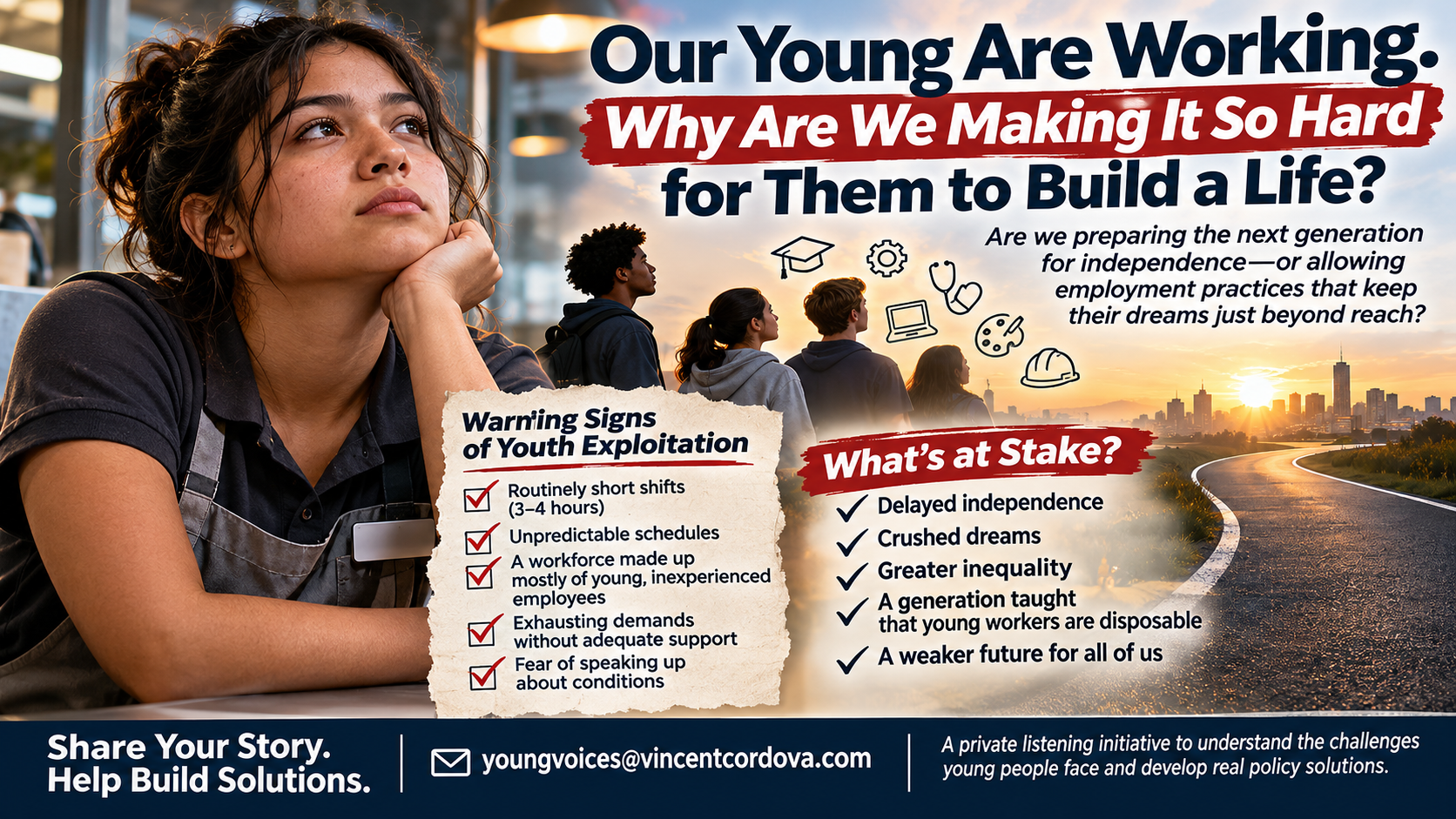
A private listening initiative to understand the challenges young people face and develop real policy solutions.
There is something happening to our young adults that deserves far more attention than it receives.
We tell them to work hard. We tell them to get their first job, save their money, build their credit, purchase a vehicle, pursue an education, and eventually become independent.
We tell them that their future is in their hands.
But have we stopped to examine the conditions we are handing them?
What if the very jobs we tell our children to accept are making it harder for them to build the lives we encourage them to dream about?
And perhaps an even more uncomfortable question:
Would we even recognize it if our children were being exploited?
Her first job
A Nineteen-Year-Old Trying to Begin Her Life
I recently heard a young woman, just nineteen years old, describing her experience at her first job.
She earns approximately $1,200 a month.
Her employer generally schedules her for four-hour shifts. She describes the work as physically exhausting, with expectations so demanding that she returns home with little energy left.
Shift cardAge 19 · first job
Hr 1
Hr 2
Hr 3
Hr 4
Hr 5
Hr 6
Hr 7
Hr 8
Scheduled
A four-hour shift. Physically exhausting work.
Offered without warning
Stay longer. But no lunch packed, and no extra money to buy food.
Earns about$1,200 / month
She wants to purchase a car. Not an expensive vehicle. Just something affordable that will allow her to travel to work, gain independence, and pursue better opportunities.
But how?
She needs money for the vehicle, insurance, fuel, maintenance, and registration. As a new driver, her insurance may be especially expensive.
What one affordable car really costs
The vehicle
Insurance
Fuel
Maintenance
Registration
+ new-driver insurance rates
And there is another detail that should concern us.
Sometimes her employer unexpectedly offers her the opportunity to stay longer and work additional hours.
But she cannot always accept.
Why?
Because she planned for a four-hour shift. She did not bring lunch, and she does not have the extra money to purchase food.
Think about that.
A young adult is being offered an opportunity to earn additional money but cannot necessarily accept because she cannot afford to eat during the longer workday.
That should make us question whether our employment systems are functioning as pathways to independence.
Reported · not verified
She also described overhearing a conversation in which a manager reportedly discussed hiring older workers, only to be told that younger employees had more energy and were easier to direct.
We cannot independently verify that conversation or conclude that it represents company policy.
But if accurately reported, it raises serious concerns.
Are younger workers being hired because employers genuinely want to develop their skills?
Or are some employers deliberately seeking inexperienced people because they believe those workers will be easier to control?
There is an enormous difference.
“Just a starter job”
When Did We Decide That a Starter Job Could Justify Financial Hardship?
We hear it all the time.
“It’s just a starter job.”
“Those jobs are for teenagers.”
“They probably still live with their parents.”
“They don’t need to earn that much.”
But who decided that?
A nineteen-year-old is not somehow less deserving of fair compensation because she is beginning her working life.
Her time is real.
Her physical effort is real.
Her exhaustion is real.
Her need for food, transportation, education, and financial security is real.
And her dreams are just as important as anyone else’s.
An entry-level position may require less experience, and compensation can reasonably reflect different responsibilities and skills.
But entry-level should describe experience—not establish that a worker’s well-being is expendable.
We should be particularly concerned when a company depends on young workers performing demanding tasks while offering limited hours, unpredictable schedules, inadequate training, or no realistic opportunity to advance.
Warning Signs of Youth Exploitation
Can We Recognize When Our Children Are Being Exploited?
This is a question every parent, employer, educator, and policymaker should consider.
Not every four-hour shift is exploitative. Some young people prefer shorter shifts because they attend school, care for family members, or have other responsibilities.
And a business employing many young adults is not automatically doing something wrong.
What matters is the pattern of employment practices, the conditions workers experience, and whether they have meaningful choices.
Here are warning signs we should learn to recognize:
Warning sign 1
Short Shifts That Prevent Financial Stability
Does the employer routinely offer only three- or four-hour shifts even when employees are requesting additional hours?
Does the employer expect workers to remain available for more hours without guaranteeing them?
Are workers effectively prevented from obtaining second jobs because their schedules constantly change?
The concern is not simply the length of a shift.
It is whether an employer controls a worker’s availability without providing enough predictable income to justify that control.
Warning sign 2
A Workforce That Appears Deliberately Selected for Youth and Inexperience
Does a company consistently hire very young workers while rejecting qualified older applicants?
Do managers describe younger workers as easier to control, less likely to complain, or more willing to accept unfavorable conditions?
Are experienced workers discouraged from applying?
These patterns deserve examination.
Federal age-discrimination law generally protects workers aged forty and older, while some state and local laws provide broader protections. EEOC ↗
A hiring preference based on assumptions that older workers lack energy can raise legal concerns.
We should investigate actual hiring records, job requirements, and management decisions rather than drawing conclusions from the ages of employees alone.
Warning sign 3
Exhausting Work Without Adequate Support
Are young workers being pushed to meet demanding productivity targets without adequate staffing, training, rest, or safety protections?
Do employees regularly return home physically or emotionally exhausted?
Are they afraid to request assistance because they believe their hours will be reduced?
Hard work is not automatically exploitation.
But when an employer benefits from a worker’s effort while disregarding preventable harm, we need to examine the conditions more closely.
Warning sign 4
Unpredictable Scheduling That Transfers Business Risk to Workers
A company may need flexibility because customer demand changes.
But why should employees carry all the financial uncertainty?
Imagine planning your transportation, meals, classes, and personal responsibilities around four hours of work, only to discover that your employer suddenly needs you for eight.
Or being scheduled for twenty hours one week and ten the next.
Week 120 hrs
Week 210 hrs
The employer may consider that operational flexibility.
The employee experiences it as uncertainty about whether they can afford basic necessities.
Warning sign 5
Fear of Speaking Up
Perhaps one of the most concerning signs is when young workers believe they cannot question their conditions.
Do they understand their rights?
Can they report unsafe practices?
Can they ask how their wages are calculated?
Can they request additional hours without retaliation?
Do they feel free to leave for a better opportunity?
A workplace that depends on workers being uninformed or afraid is not providing a healthy introduction to employment.
Evidence, not suspicion
How Do We Identify Companies That May Be Taking Advantage of Young Workers?
We need more than suspicion. We need practical mechanisms that identify patterns and distinguish legitimate business needs from harmful employment practices.
A meaningful examination could include:
Scheduling records:
Compare promised hours, scheduled hours, actual hours, last-minute changes, and requests for additional work.
Hiring and applicant data:
Examine whether qualified applicants are being rejected because of age, including whether management statements match hiring decisions.
Workload and safety records:
Review productivity expectations, injuries, staffing levels, breaks, and training.
Ask workers whether they feel pressured, misled, intimidated, or unable to afford basic necessities.
Retaliation monitoring:
Identify whether workers who request better conditions, report concerns, or seek additional hours subsequently lose shifts or opportunities.
These indicators should prompt questions, not automatic accusations.
Employers deserve fair, evidence-based evaluations. Workers deserve protection and a meaningful opportunity to be heard.
We should also examine whether existing labor enforcement systems have sufficient resources to identify these patterns before they become widespread.
The objective should be to prevent exploitation, correct harmful practices, and support responsible employers—not punish businesses merely for hiring young people.
What’s at Stake?
What Happens When We Ignore Our Young Adults?
Delayed independence
Crushed dreams
Greater inequality
A generation taught that young workers are disposable
A weaker future for all of us
This is where the conversation becomes bigger than one job.
When we ignore the economic conditions young people face, we risk creating consequences that follow them for years.
1We Delay Their Independence
A young person cannot easily purchase a vehicle without savings.
Without transportation, employment options may be limited.
Without better employment opportunities, building savings becomes more difficult.
Without savings, moving into independent housing becomes harder.
And without stable housing or income, pursuing education and career advancement can become increasingly challenging.
01No savings
02No vehicle
03Fewer job options
04Harder to save
05No independent housing
06Education on hold
↻ …and back to no savings. One barrier reinforces another.
One barrier reinforces another.
2We Risk Crushing Dreams Before They Have a Chance to Develop
Consider a young adult who dreams of becoming an engineer, physician, teacher, entrepreneur, artist, or scientist.
Now imagine that person working demanding shifts, struggling to afford transportation, worrying about meals, and wondering how to pay for school.
How much energy remains to pursue those ambitions?
How many talented young people abandon opportunities not because they lack ability or motivation, but because they lack resources?
We cannot measure every dream that never gets pursued.
But we should recognize that financial hardship can restrict the choices available to young people.
The question we cannot skip
Is this the pressure that is contributing to the 1 in 5, or 1 in 7, students who are considering suicide?
1 in 5
high school students seriously considered suicide · CDC, 2023
1 in 7
high school students seriously considered suicide · CDC, 2025
No single cause explains a suicide crisis, and these surveys count high school students, not every young worker. But when young people are asked to carry adult pressures (money, unpredictable schedules, exhaustion, fear of speaking up) without a realistic way forward, we owe them this question. And we owe them the work of finding the answer.
From the CDC’s Youth Risk Behavior Survey of U.S. high school students: 20% in 2023, 14% in 2025. Source ↗
If you or someone you know is struggling, call or text 988, the Suicide & Crisis Lifeline, or chat at 988lifeline.org. It’s free and confidential, 24/7.
3We Deepen Inequality Between Young Adults
Some young adults have parents who can help them purchase a vehicle, pay insurance, attend college, or remain at home while they save money.
Others have parents who are struggling themselves.
Some have no parental support at all.
Some are aging out of foster care.
Others are supporting siblings, caring for relatives, or trying to escape unsafe living situations.
We cannot design employment and economic policies around the assumption that every eighteen-year-old has a financially stable family waiting to help.
The Federal Reserve reported that in 2025, 47% of adults ages eighteen through twenty-nine received financial help from someone outside their household to cover at least one type of expense. Federal Reserve ↗
47%
of adults ages 18 to 29 received financial help from someone outside their household in 2025
Ages 18–2947%
Ages 30–4426%
Ages 45+13%
Federal Reserve, Economic Well-Being of U.S. Households in 2025 (May 2026). Comparison ages added by the editors from the same report. Source ↗
That is an important reminder of how much support can matter.
A society that expects young adults to become independent must recognize that they are not all starting from the same place.
4We Normalize the Idea That Young Workers Are Disposable
If young adults learn that employment means unpredictable hours, constant exhaustion, little opportunity, and fear of speaking up, what lessons are we teaching them about the value of their labor?
We should be teaching responsibility, cooperation, skill development, professionalism, and mutual respect.
We should not be teaching them that their youth makes their time less valuable or their concerns less worthy of attention.
5We Weaken Our Own Future
Today’s young workers will become tomorrow’s parents, educators, healthcare professionals, business owners, public servants, and community leaders.
Their ability to develop skills, build financial security, and pursue opportunities affects far more than their individual lives.
It affects the communities and institutions future generations will inherit.
When we ignore barriers to young adults’ advancement, we risk wasting human potential.
And that should concern all of us.
Reforms worth testing
What Should We Change?
We need to examine solutions with the young people directly affected, responsible employers, educators, labor experts, and communities.
Potential reforms deserve serious consideration.
Predictable scheduling protections.
Workers should have reasonable notice of their schedules, clear expectations about available hours, and protections against abusive last-minute scheduling practices. Any proposal should account for legitimate operational needs and voluntary shift changes.
Fair compensation and advancement.
Entry-level workers should receive lawful, fair compensation, transparent pay information, adequate training, and meaningful opportunities to develop skills and earn more.
Affordable transportation.
We should explore transportation assistance, accessible public transit, fair insurance practices, and affordable vehicle financing that help young adults reach employment and education opportunities.
A fair start to building credit.
Young adults should not have to take on harmful debt simply to establish a financial identity. We should explore safe credit-building options, transparent underwriting, protections against predatory products, and ways to recognize responsible financial behavior.
Protection against discriminatory hiring and workplace retaliation.
Enforcement agencies should be able to investigate credible allegations of discriminatory hiring, wage violations, unsafe conditions, and unlawful retaliation.
Stronger pathways from education into employment.
Students should have access to paid training, apprenticeships, career counseling, and opportunities that do not require them to sacrifice their health or education simply to survive.
These proposals should be evaluated for their effectiveness, costs, legal implications, and effects on small businesses and workers.
The people living with these conditions should help design the solutions.
The bigger picture
A National Human Opportunity and Advancement Initiative
This conversation belongs within a larger national effort to remove unnecessary barriers to human opportunity.
The proposed National Human Opportunity and Advancement Initiative should examine how education, employment, transportation, housing, healthcare, and financial systems interact.
Education
Employment
Transportation
Housing
Healthcare
Financial systems
A young adult’s opportunity to succeed should not depend entirely on whether their family can afford to help them.
And a first job should ideally be a stepping stone toward greater opportunity—not a trap that leaves someone working hard without a realistic way forward.
But before writing legislation, we need to listen.
We need to ask young workers what they experience.
We need to ask employers what constraints they face.
We need to ask educators what barriers their students encounter.
And we need to examine which existing policies work, which fail, and what needs to change.
Our Commitment
We Will Listen, Examine, and Act
Let me make something clear.
A future Cordova administration will not simply accept the explanation that young people must struggle because they are working “starter jobs.”
We will ask questions.
We will examine employment practices.
We will listen directly to young workers, including those who have been afraid to speak up.
We will seek to understand why some companies rely heavily on young, inexperienced employees, why certain workers receive only a few hours of employment despite wanting more, and whether scheduling, compensation, or workplace expectations are creating unnecessary barriers to independence.
We will distinguish responsible employers from those engaging in harmful or unlawful practices. We will work with appropriate enforcement agencies to investigate credible evidence and pursue accountability where violations are established.
And we will work with young people themselves to develop solutions.
We will not accept exploitation as the price our children must pay for entering the workforce.
Our responsibility is not to dictate what our young people should become.
Our responsibility is to help remove the unnecessary barriers standing between them and the lives they want to build.
Whether they dream of becoming teachers, scientists, entrepreneurs, artists, parents, skilled tradespeople, or something the world has not yet imagined, they deserve a genuine opportunity to pursue that calling.
That means listening before legislating, examining evidence before drawing conclusions, and measuring our success by whether conditions actually improve.
We are not building a future in which young people exist simply to provide inexpensive labor.
We are working toward a future in which employment helps young people discover their abilities, develop their independence, and pursue their dreams.
And we will not look away when credible evidence shows that those opportunities are being taken from them.
Young Voices
To Every Young Adult: We Want to Hear From You
If you are eighteen, nineteen, twenty, or just beginning your working life, your experience matters.
Are you working short shifts while struggling to earn enough money?
Are you exhausted after work?
Are you trying to afford your first car?
Are you attending school while working to support yourself?
Are you being denied additional hours?
Do you feel that your employer takes advantage of your age or inexperience?
Are you struggling to build credit, find housing, or access education?
Or have you found an employer who genuinely invests in your future and provides opportunities worth learning from?
We want to hear those stories, too.
Because understanding what works is just as important as identifying what needs to change.
This is a private listening and policy-development initiative. Outside submissions are welcome, and messages will not be made available to the public through the group.
We will treat your experiences with care, seek permission before publicly identifying anyone, and use what we learn to better understand the problems and develop solutions. Please avoid sending sensitive personal identifiers or confidential documents in your initial message.
This invitation is about understanding problems and developing solutions together. It is not a request for political endorsement.
Your voice matters. Your experience matters. Your future matters.
Pay attention
To Parents, Employers, and Everyone Who Cares About the Next Generation
We need to pay attention.
Ask your children how their jobs are going.
Not simply whether they are showing up on time or following instructions.
Tonight’s questions0 of 6 asked
To employers
To employers: young workers are not simply a source of energy or inexpensive labor.
They are human beings beginning their adult lives.
The way you treat them may influence their confidence, financial stability, professional development, and understanding of what a workplace should be.
You have an opportunity to help them build something meaningful.
What they inherit
The Future We Leave Behind
I keep returning to one thought.
What we build today, our children will inherit.
If we continue to accept employment systems that leave some young adults exhausted, financially insecure, and unable to pursue their ambitions, we should not be surprised when independence becomes harder to achieve.
We should not tell young people that they are our future while dismissing the conditions shaping their present.
We should not celebrate their willingness to work while ignoring whether that work is helping them move forward.
And we should never assume that because someone is young, their suffering is temporary, insignificant, or simply part of growing up.
Our young adults should not have to spend the beginning of their lives recovering from the conditions we allowed them to inherit.
They deserve the opportunity to learn, build, explore, create, love, contribute, and discover their calling.
They deserve a society willing to examine whether its institutions are helping them succeed.
And they deserve to be included in designing the changes that affect their future.
The question is no longer simply whether our young people are willing to work.
The question is whether we are willing to confront the barriers standing between their hard work and their dreams.
Because what we ignore today may become the burden they carry tomorrow.
And what we correct today may become the opportunity they pass on to the next generation.
Moving Forward Together.
Vincent Cordova
Independent Presidential Candidate, 2028
Cordova2028 — A government that listens—and proves it with results.