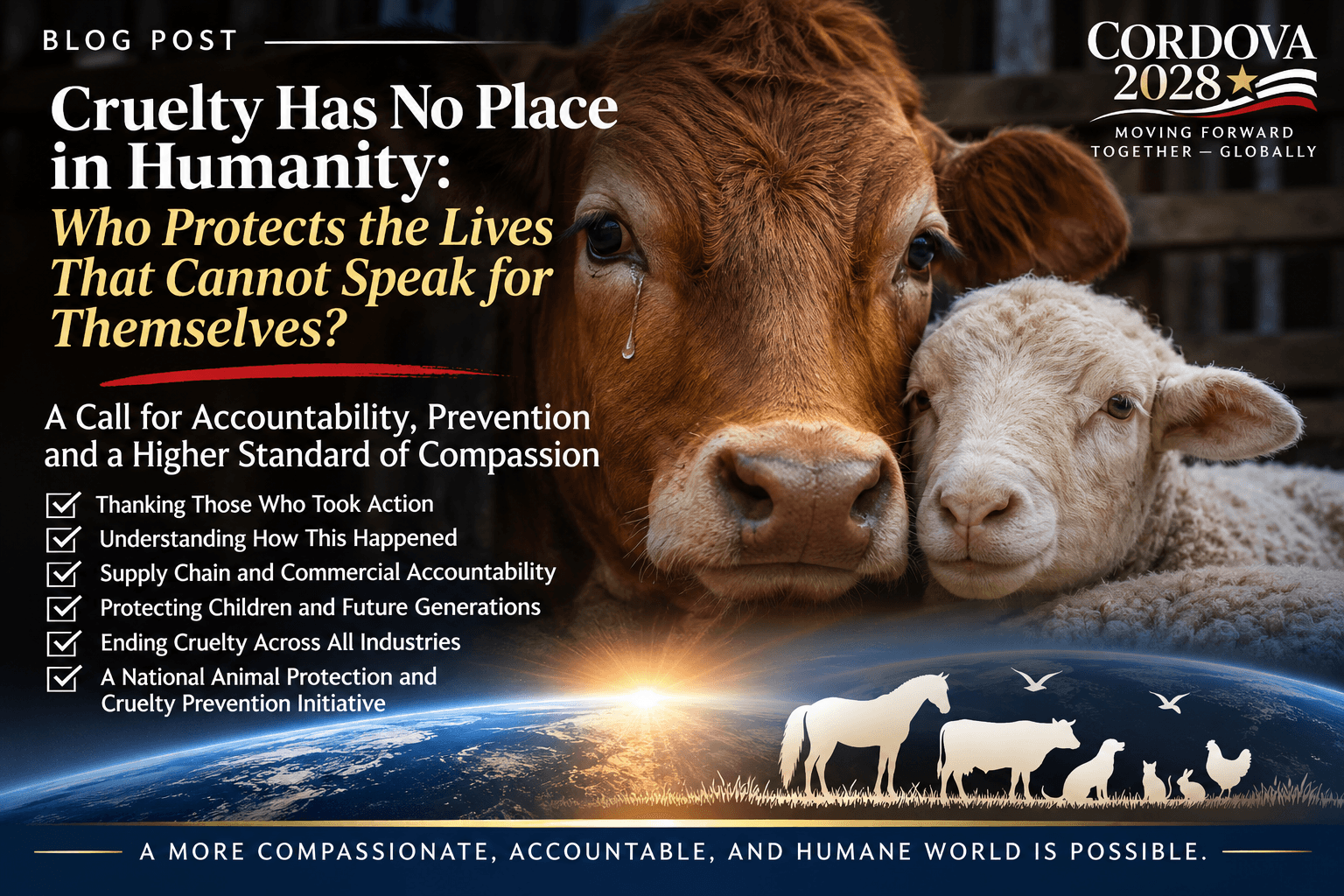
Cruelty Has No Place in Humanity:Who Protects the Lives That Cannot Speak for Themselves?
A call for accountability, prevention and a higher standard of compassion
By Vincent Cordova · November 24, 2026 · Moving Forward Together — Globally
Official Statement · November 24, 2026
On Animal Cruelty, Supply Chain Accountability, and Our Responsibility to Protect Life
The signed statement behind this post, including the proposed National Animal Protection and Cruelty Prevention Initiative.
How did we get here?
How does a living being become something we can torture, disregard, profit from and dispose of without stopping to question what we have become?
How does another living being cry out in pain in front of us, and instead of responding to that suffering, we continue causing it?
The allegations of animal cruelty at Ali Meat International in Orlando, Florida, should disturb every one of us.
But being disturbed is not enough.
Being angry is not enough.
Making arrests, issuing statements and eventually moving on to the next news story is not enough.
We need to understand how this happened, how it was allowed to happen, and what we must change to ensure it does not happen again.
01Thank you
Thank You to Those Who Refused to Look Away
I want to publicly thank Florida Attorney General James Uthmeier, the investigators, law enforcement personnel, Animal Outlook and those who documented and brought this alleged cruelty to the attention of authorities.
What has been reported · campaign summary
Six people, one manager and five workers, were arrested on felony animal cruelty charges. The manager faces the most counts, including aggravated animal cruelty with intent to torture. The Attorney General said further action against other individuals and the business may follow. A defense attorney argued at a first appearance that state and federal law contain exemptions for ritual slaughter. Those questions belong to the courts.
June 2025
A visitor records two days of video at a public slaughter event at the facility, around the Eid al-Adha holiday, and shares it with Animal Outlook. (Animal Outlook)
August 2025
Animal Outlook files a complaint with the Florida Department of Agriculture and Consumer Services. (WESH)
October 2026
The Agriculture Commissioner’s office confirms an “active and ongoing criminal investigation,” according to Animal Outlook. The business is still open. (Animal Outlook)
Fri · Nov 20, 2026
Six people, one manager and five workers, are arrested by the Office of Agricultural Law Enforcement. (WESH)
Mon · Nov 23, 2026
Attorney General James Uthmeier and Agriculture Commissioner Wilton Simpson announce the arrests in Orlando. USDA revokes the facility’s permission to slaughter livestock without federal inspectors present. (CBS News Miami)
You chose not to look away.
That matters.
The allegations include severe physical abuse of animals, prolonged suffering during slaughter and the involvement of a child.
These allegations are horrifying.
If proven through due process, those responsible should face meaningful criminal consequences, including imprisonment where legally appropriate.
I support stopping animal cruelty everywhere, regardless of who commits it, where it occurs, how much money it generates or what organization stands behind it.
No financial interest, cultural tradition, religious affiliation or institutional authority should excuse unlawful animal cruelty.
02They were alive
They Were Alive. They Were Afraid. They Were Suffering.
These were not objects.
They were not pieces of equipment.
They were not numbers on a financial statement.
They were living beings capable of experiencing pain, fear and distress.
Their lives existed before someone placed a monetary value on them.
Their suffering did not become less significant because someone purchased them.
Their ability to feel pain did not disappear because someone established a business around ending their lives.
Imagine experiencing unbearable pain and having no ability to communicate with those causing it in a language they understand.
Imagine being surrounded by individuals who possess the ability to stop your suffering but choose not to.
That is the reality we must confront.
Our ability to overpower another living being does not establish our moral right to mistreat it.
We did not create life itself. We should never behave as though our intelligence, technology or physical dominance gives us unlimited authority over it.
03How it happened
How Was This Allowed to Happen?
We must examine more than the individuals accused of committing these acts.
We must examine the institutions responsible for preventing them.
- When did the alleged cruelty begin?
- How frequently was the establishment inspected?
- Were previous complaints submitted?
- Were there warning signs that went unaddressed?
- Were employees afraid to report what they witnessed?
- Were production demands or financial incentives contributing factors?
- Did regulators have sufficient authority, staffing and resources?
- What protective measures were taken after authorities received evidence?
- Would this conduct ever have been discovered without someone documenting it?
The time required to conduct a criminal investigation does not, by itself, establish institutional wrongdoing. Nevertheless, the public deserves to understand whether animals were adequately protected while the investigation was underway.
From the public record · campaign note
About 17 months passed between the recorded event in June 2025 and the arrests in November 2026. Animal Outlook says USDA had acted against the facility before: a 2021 suspension after an inspector saw a conscious lamb thrown against a fence, and a 2024 citation after a failed stun. Those are Animal Outlook’s summaries of USDA records. They are the kind of warning signs the questions above ask about.
Sources: Animal Outlook, WESH.
What happens to the animals whose suffering is never recorded?
What happens when no one is watching?
How many other establishments should we be examining?
The absence of documented cruelty does not establish the absence of cruelty.
A system that depends entirely upon someone happening to witness and document abuse is not a sufficient system of prevention.
04The supply chain
Who Purchased the Meat? Where Did It Go?
Our examination cannot stop at the doors of Ali Meat International.
We must investigate its entire commercial supply chain.
Campaign graphic · Follow the chain
The question at this link
Did any distributor or wholesaler buy from this facility, and what did their contracts require?
Tap a link in the chain. Reporting so far does not say where the meat was sold beyond the facility. A dashed label means the public record does not answer it yet; it is not an accusation.
Who purchased meat from this establishment?
Was it distributed to restaurants, grocery stores, wholesalers or other commercial establishments?
Did any of these products enter international markets?
What did the purchasers know about the conditions under which these animals were treated? What should they reasonably have known through appropriate due diligence?
Were animal welfare requirements incorporated into purchasing agreements?
Were independent inspections conducted?
Were complaints or warning signs overlooked?
Did purchasing arrangements or production demands contribute to conditions that permitted unlawful cruelty?
We must also examine whether consumers had sufficient information about where their food originated and how it was produced.
A consumer purchasing food should not unknowingly become financially connected to unlawful animal cruelty.
A company should not be able to knowingly benefit from unlawful cruelty simply because another company carries it out.
If international distribution is identified, we should cooperate with foreign governments and regulatory authorities to establish the full extent of the supply chain and determine whether applicable laws were violated.
We must establish the facts. A commercial relationship alone does not establish complicity, and we must not presume that products were exported or that purchasers knew about the alleged abuse without evidence.
However, we must be willing to examine these relationships.
Outsourcing an operation must never become a means of outsourcing moral responsibility.
05Our children
What Are We Teaching Our Children?
Among the most disturbing allegations is the involvement of a child in the slaughter of an animal.
Children enter this world dependent upon us for guidance.
They learn from our behavior, our institutions, our relationships and the environments we create around them.
What happens when adults normalize suffering?
What happens when children are exposed to unnecessary cruelty and taught that the pain of another living being is insignificant?
What kind of society are we building when we fail to nurture compassion in the next generation?
These questions deserve serious examination alongside child-development specialists, educators, veterinarians and animal welfare experts.
We should not presume the psychological impact on any particular child without appropriate professional assessment.
If a child is being harmed · campaign note
The Childhelp National Child Abuse Hotline answers around the clock at 1-800-422-4453. In an emergency, call 911. Anyone who sees an animal being abused can report it to local animal control or law enforcement.
Our responsibility is to nurture compassion, responsibility and respect for life.
We should never teach our children that being more powerful than another living being makes cruelty acceptable.
06Conduct, not identity
Animal Cruelty Does Not Have a Religion
While I appreciate the Attorney General's enforcement action, I also have serious concerns about his use of the phrase “this Muslim slaughterhouse.”
The words used · campaign note
At the Orlando press conference, CBS News Miami reported the Attorney General saying: “This Muslim slaughterhouse, as I think you know by now, was not your typical meat market, not your typical butcher shop.” At the same announcement, statewide prosecutor Lauryn Day said “this case is not about religion,” as reported by WESH.
Sources: CBS News Miami, WESH.
There is a fundamental difference between accurately identifying a business and framing alleged criminal wrongdoing around the religious identity of a community.
Public officials must understand the weight their words carry.
The alleged actions of these individuals do not represent every Muslim.
They do not represent an entire religion.
They do not establish the guilt of everyone who shares their beliefs.
Just as the unlawful actions of an individual Christian, Jewish person, atheist or member of any other community do not establish the guilt of everyone who shares their identity.
We must hold individuals accountable for their actions, not entire populations for their identities.
Hold accountable
- What a person did
- What a manager ordered or allowed
- What an owner profited from
- What a buyer knew or should have known
Never on trial
- A religion
- A nationality
- A culture
- Everyone who shares a faith with the accused
Campaign graphic summarizing the principle in this section.
I will not accept the abuse of animals, and I will not accept the suffering of animals being used as a vehicle to manufacture hatred toward human beings.
Both positions can and must coexist.
Justice must be directed at conduct, not identity.
We should expect that standard from every public official, including myself.
07Behind closed doors
What Happens Behind the Doors We Never Open?
This incident cannot be the end of our examination.
We must examine animal welfare throughout our society.
Not just halal slaughterhouses.
Not just religious establishments.
Not just independently owned businesses.
Everywhere.
Commercial slaughterhouses, industrial farms, animal transportation companies, laboratories, commercial breeding facilities, entertainment establishments, shelters and other institutions responsible for living beings must be included in that examination.
We must also examine the financial incentives operating within these industries.
What happens when protecting an animal costs money?
What happens when humane treatment slows production?
What happens when adequate staffing reduces profit margins?
What happens when an employee who witnesses cruelty fears losing their employment for reporting it?
What happens when an institution becomes more concerned with protecting its reputation than protecting life?
Financial success does not inherently establish wrongdoing. But financial incentives must never be permitted to override legal protections against cruelty.
A profitable operation is not necessarily a humane operation.
We need evidence of both compliance and humane treatment.
We must examine ownership structures, management decisions, purchasing agreements, production requirements and the distribution of responsibility throughout these industries.
The person physically committing an unlawful act may not be the only person whose conduct warrants investigation.
08The laws
We Must Examine the Laws We Created
Laws are human creations.
We have the ability and responsibility to examine them when they fail to achieve their intended purpose.
I intend to pursue a comprehensive review of our nation's animal protection laws, including the Humane Methods of Slaughter Act, the Animal Welfare Act, the Preventing Animal Cruelty and Torture Act, livestock transportation protections and applicable state laws.
Campaign summary · What these laws cover today
Humane Methods of Slaughter Act
7 U.S.C. §§ 1901–1907Covers
Livestock such as cattle, sheep, goats and pigs at federally inspected plants.
Gap to examine
USDA does not apply it to poultry. Sections 1902(b) and 1906 treat ritual slaughter, and the handling that prepares animals for it, separately.
Animal Welfare Act
7 U.S.C. § 2132(g)Covers
Animals in research, exhibition, transport and dealing.
Gap to examine
Its definition of “animal” leaves out farm animals used or intended for food or fiber.
Preventing Animal Cruelty and Torture Act (2019)
18 U.S.C. § 48Covers
Federal crime of “animal crushing” in interstate commerce or federal jurisdiction.
Gap to examine
Exempts the slaughter of animals for food and customary agricultural practices.
Twenty-Eight Hour Law
49 U.S.C. § 80502Covers
Animals transported across state lines must be unloaded for food, water and rest after 28 hours.
Gap to examine
Enforcement depends on records and reports; penalties are civil and per violation.
Florida animal cruelty law
Fla. Stat. § 828.12Covers
State felony for aggravated cruelty, the basis for several of the Orlando charges.
Gap to examine
Each state writes its own law, so protection changes at the state line.
A plain-language summary for readers, not legal advice. Follow each citation for the full text.
We must identify which animals are protected, which are excluded, where jurisdictional gaps exist and whether enforcement mechanisms are sufficient.
We must examine exemptions, regulatory limitations, inspection practices and constitutional protections.
We must also examine whether penalties are sufficient to prevent repeated violations.
If an institution can repeatedly violate animal protection laws and absorb the financial penalties as a cost of doing business, we must question whether those penalties are achieving their intended purpose.
A law written to protect life must be evaluated by whether it actually protects life.
The objective is not merely to punish cruelty after it happens.
The objective is to prevent suffering before it happens.
09NAPCPI
National Animal Protection and Cruelty Prevention Initiative
If God and the public are willing, I intend for our administration to pursue a comprehensive National Animal Protection and Cruelty Prevention Initiative (NAPCPI).
The proposed initiative will encompass:
- 1
Nationwide regulatory and enforcement review.
Identify deficiencies in animal protection laws, exemptions, oversight and enforcement across industries.
- 2
Independent inspections.
Strengthen inspection systems, including unannounced inspections where legally authorized.
- 3
Protected reporting channels.
Establish accessible and confidential mechanisms for workers and members of the public to report suspected cruelty without unlawful retaliation.
- 4
Immediate protective intervention.
Evaluate lawful mechanisms to protect animals while credible allegations are investigated.
- 5
Public accountability.
Make verified violations, corrective measures and enforcement outcomes accessible, consistent with privacy and due process protections.
- 6
Individual and corporate accountability.
Examine the responsibility of employees, managers, owners, executives and commercial partners based on evidence of their conduct.
- 7
Domestic and international supply chain transparency.
Strengthen traceability and examine where products originate, where they are distributed and who benefits financially.
- 8
Mandatory commercial due diligence.
Evaluate requirements for businesses to establish and verify responsible sourcing practices.
- 9
Consumer transparency.
Examine mechanisms that allow consumers to make informed decisions about the origin and treatment of animals within commercial supply chains.
- 10
Financial incentive review.
Examine whether ownership structures, production requirements or purchasing arrangements undermine animal welfare.
- 11
Repeat offender protections.
Review mechanisms for suspending or revoking operating licenses where legally justified.
- 12
Child protection and humane education.
Consult specialists to develop appropriate safeguards and educational opportunities.
- 13
Alternatives to animal experimentation.
Support scientific advancement that reduces and, where feasible, replaces harmful animal testing.
- 14
Religious neutrality.
Ensure enforcement is driven by evidence of unlawful conduct rather than religious affiliation, nationality or cultural identity.
- 15
International cooperation.
Work with governments, researchers and animal protection organizations to reduce cruelty globally and address cross-border commercial accountability.
- 16
Independent evaluation of results.
Measure whether our policies are reducing actual suffering, not merely increasing the number of reports, inspections or arrests.
Where additional statutory authority is necessary, we will seek legislation from Congress and work cooperatively with state governments.
We will invite veterinarians, animal welfare organizations, scientists, agricultural workers, religious communities, legal specialists, responsible businesses and members of the public to participate in developing these protections.
This initiative must be built around the protection of life, supported by evidence and evaluated by measurable results.
10Our own species
We Must Also Confront Our Treatment of Our Own Species
I cannot discuss cruelty without acknowledging the contradictions within our own society.
We condemn the suffering of animals, yet we must also examine the suffering of human beings that our own policies and public resources may contribute to.
Children killed in armed conflicts.
People starving while resources exist to feed them.
Human beings sleeping outside in freezing temperatures.
Families unable to obtain essential healthcare.
People prevented from reaching their potential because of systems we ourselves created.
We must examine how our tax dollars are used, including whether they support actions that unnecessarily harm or kill members of our own species.
We must examine the institutions we have built and ask whether they are helping life advance or preventing it from doing so.
The suffering of animals does not diminish the suffering of humanity.
The suffering of humanity does not diminish the suffering of animals.
Compassion is not a limited resource that we must distribute selectively.
We are capable of caring about both.
Our moral standards should not change depending on the identity of the victim, the institution responsible or the financial interests involved.
11Our commitment
Our Commitment
If God and the public are willing, our administration will remain hypervigilant against animal cruelty, institutional neglect, religious discrimination and the collective targeting of groups of people.
We will follow the evidence wherever it leads.
We will seek accountability through law and due process—not revenge, hatred or collective punishment.
We will examine the institutions we inherit and the systems we create.
We will not assume that something is acceptable merely because it has existed for generations.
We will not assume that something is humane because it is profitable.
We will not assume that a commercial supply chain is responsible simply because its customers cannot see what happens at its source.
And we will not measure success solely by how many people we prosecute.
We must also measure how much suffering we prevent.
Animals cannot vote.
They cannot testify before Congress.
They cannot write to their elected representatives.
They cannot organize to demand better protections.
They cannot explain to us, in our language, what we have done to them.
But their inability to participate in the systems we created does not mean their lives are insignificant.
They depend upon our willingness to recognize their suffering.
That responsibility belongs to us.
12Who we become
What Kind of Species Do We Want to Become?
We have developed extraordinary intelligence.
We have built civilizations, advanced medicine, explored space and created technologies that previous generations could scarcely imagine.
Yet we still struggle to protect living beings from unnecessary cruelty.
What does advancement mean if our compassion does not advance alongside our intelligence?
What does prosperity mean if achieving it requires us to become indifferent to suffering?
What does power mean if we cannot exercise it with restraint?
I want us to become a species that recognizes its responsibility toward life.
Not a species that measures its greatness by how much it can dominate, extract, control or destroy.
But one that measures its greatness by how much it can protect, nurture, restore and help thrive.
Let us never confuse power over life with ownership of life.
Let us never confuse an inability to speak with an inability to suffer.
And let us never allow another living being's suffering to become so ordinary that we stop noticing it.
Cruelty must never become the price of our advancement.
Vincent Cordova
Independent Candidate for President of the United States — 2028
Moving Forward Together — Globally.
Related
- They Feel What We Feel: 30,000 Monkeys and the Conscience of a Nation
- Not Ours to Take
- Not Built for a Box: Why We Have to Stop Caging the Animals We Love
Sources
- CBS News Miami — 6 workers at Orlando halal slaughterhouse arrested on animal cruelty charges (Nov 23, 2026)
- WESH 2 — 6 arrested at Orlando halal butcher shop over animal cruelty allegations (Nov 23, 2026)
- Animal Outlook — Ali Meat International, Orlando, FL (investigation page)
- Humane Methods of Slaughter Act — 7 U.S.C. ch. 48
- Animal Welfare Act definitions — 7 U.S.C. § 2132
- Preventing Animal Cruelty and Torture Act — 18 U.S.C. § 48
- Twenty-Eight Hour Law — 49 U.S.C. § 80502
- Florida Statutes § 828.12 — Cruelty to animals
The Official Statement band, the “what has been reported” timeline, the public-record note, the supply-chain graphic, the child-help note, the “words used” note, the conduct-vs-identity card, the doors graphic and the law summary were added by the campaign team from the sources above. Everything else is the author’s text.