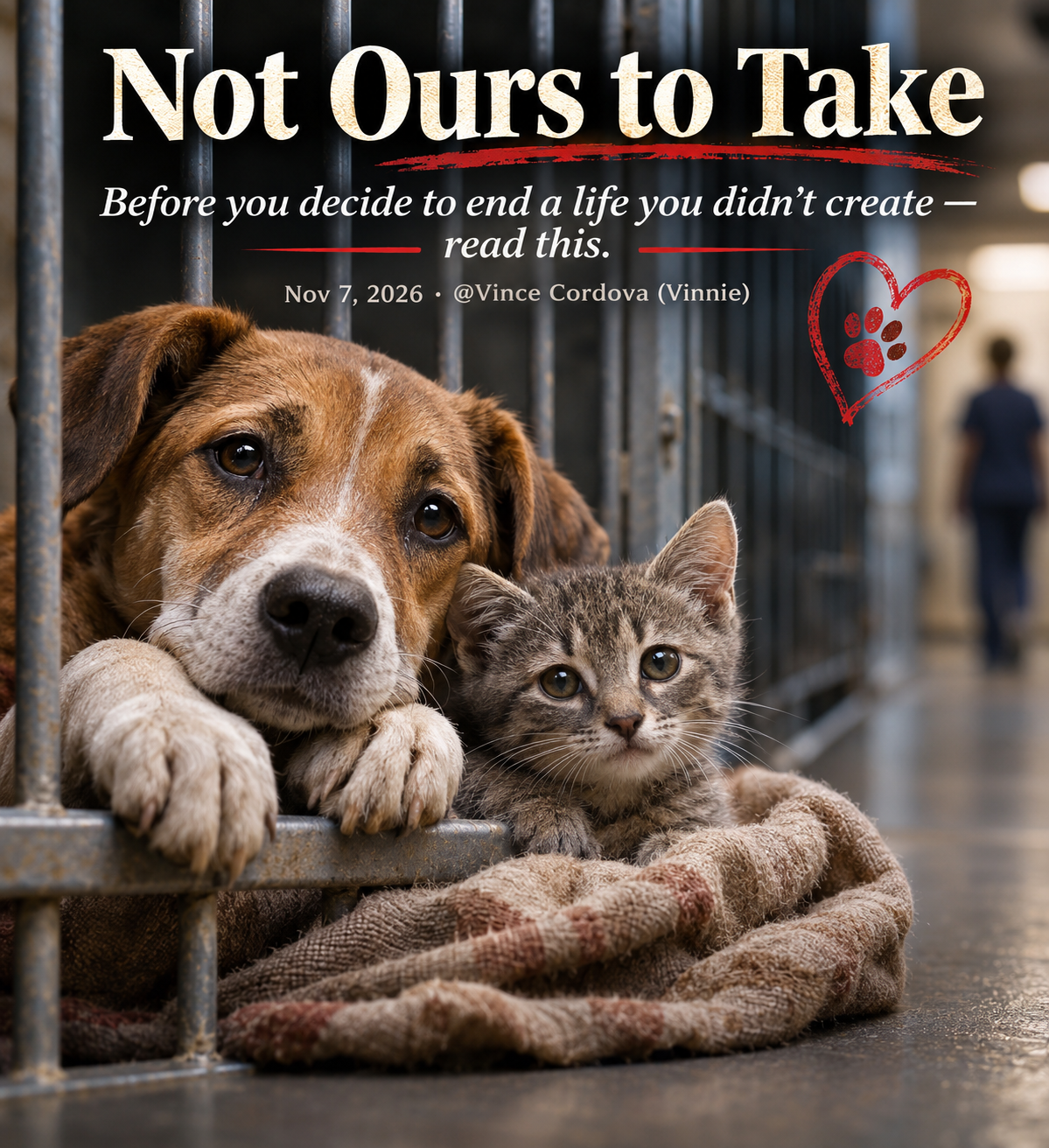
Before you decide to end a life you didn’t create — read this.
· Vince Cordova (Vinnie)
Campaign design team
This one has been sitting on my chest for a while, and I'm not going to dress it up.
I'm not writing this to the policy people. I'm writing it to you. The person standing at the counter about to sign the form. The person in the back room with the list of who goes today. The person who already decided, in the quiet of their own head, that the dog in the yard or the cat that keeps having litters is "a problem they'll handle themselves." Whatever the law says or doesn't say where you live — I'm talking to you.
Please stop.
Just for a minute. Read this first.
You already know
You don't need a study to tell you this is wrong. You know it the same way you knew it as a kid. Something in you tightened up when you first thought about it. That feeling isn't weakness. That's your conscience doing its job.
We did not create that life. We didn't give it its heartbeat, its fear, its loyalty, the way it looks for you when you walk in the room. And because we didn't create it, it is not ours to take.
That animal feels what we feel. It feels fear in a strange room. It feels the hand on its back. It trusts — and it trusts us. That trust is the whole relationship. When we answer it with a needle because we ran out of room, we break something in the animal and something in ourselves.
We didn't give it
Its heartbeat
We didn't give it
Its fear
We didn't give it
Its loyalty
We didn't give it
The way it looks for you
And you know, deep down, that there are consequences. Maybe not in a courtroom. But in you. People carry this. Shelter workers carry it — it's one of the heaviest burdens in that whole profession. Families carry it. The kids who watched the dog go to "a farm" carry it. You don't get to set it down later.
“No room” is not a reason to end a life
I want to be very direct here, because this is the excuse that does the most killing.
No room is a capacity problem. No adopter yet is a time problem. Neither one is a reason to end a life. We don't solve a shortage of space by eliminating the ones who need the space. We solve it by making more room, moving faster, and asking for help.
“No room”
is a capacity problem.
Neither one is a reason to end a life.
“No adopter yet”
is a time problem.
Neither one is a reason to end a life.
The numbers say the help is out there. In 2025, Shelter Animals Count estimates 5.8 million dogs and cats came into shelters and rescues in this country, and 4.2 million were adopted. That's this country showing up. But it also estimates 597,000 animals were euthanized that same year. Over half a million lives.
U.S. dogs and cats · 2025 · Shelter Animals Count estimates
Came into shelters and rescues5.8 million
Adopted4.2 million
Euthanized597,000
Over half a million lives.
Here's what tells you it doesn't have to be that way: Best Friends Animal Society reports that 68% of U.S. shelters are now no-kill, the most ever, and that roughly 34,000 fewer cats and dogs were killed for space in 2025 than in 2024. Four states — Delaware, New Hampshire, Rhode Island and Vermont — have every shelter at a 90% save rate or better. They report that if just one in seventeen households planning to add a pet adopted from a shelter instead of buying one, the entire nation would reach no-kill.
U.S. shelters no-kill
68%
The most ever.
Fewer killed for space
≈34,000
fewer cats and dogs in 2025 than in 2024.
Every shelter at 90%+
DENHRIVT
Delaware, New Hampshire, Rhode Island and Vermont.
One in seventeen
If just one in seventeen households planning to add a pet adopted from a shelter instead of buying one, the entire nation would reach no-kill.
So don't tell me it can't be done. It's being done. Right now.
In shelters with the same budgets, the same staff shortages, the same full kennels. The difference is a decision.
Let's be honest about the hard case
There is a difference between killing and mercy, and I'm not going to blur it.
When an animal is in pain that cannot be relieved — when a vet looks you in the eye and tells you there's nothing left but suffering — choosing to let them go peacefully, with you beside them, is an act of love. Nobody who has held their dog through that should read this and feel judged. You did right by them.
That's not what I'm talking about. I'm talking about the healthy ones. The treatable ones. The young cat with an eye infection. The big dog who's "too much." The litter nobody planned for. The senior dog who just got inconvenient. The animal whose only problem is that a human ran out of patience, money or space.
Kennel card
The young cat with an eye infection
Treatable
Kennel card
The big dog who’s “too much”
Healthy
Kennel card
The litter nobody planned for
Healthy
Kennel card
The senior dog who just got inconvenient
Healthy
Kennel card
Out of patience, money or space
A human problem
Those lives are not a problem to be disposed of. They are a responsibility we accepted the moment we brought them in.
Before you do it — do these instead
If you are the one about to make this call, here is what I'm asking. Every single one of these comes before a needle, a gun, a bag, or a drive out to the country.
1
Call a rescue. Not one — five. Breed rescues, local foster networks, the Best Friends network. Tell them the truth and tell them the timeline.
2
Ask for a foster, not a forever home. A couch for two weeks buys the time an adoption needs.
3
Post it. Neighborhood groups, church bulletin, your job, your family chat. Most people who would say yes just haven’t heard yet.
4
Ask about the money. Low-cost clinics, payment plans, pet food banks. A lot of “we can’t afford him” has an answer one phone call away.
5
Rehome directly. If you can’t keep them, find the next person yourself. You know this animal better than anyone. Be its advocate one last time.
6
If you work in a shelter: say it out loud in the meeting. Push for the foster program, the transfer partner, the adoption event, the waived fee weekend. You are allowed to be the one who refuses to accept “that’s just how it is.”
And if you are thinking about handling it yourself, outside of any vet or shelter — please don't. Give that animal to someone who will try. Walk it into a shelter. Hand it to a rescue. Anything but taking that life with your own hands. You cannot undo it, and you will carry it.
Walking away is not a way out
Not every life ends with a needle. Some end on a dirt road. More and more, shelters and animal control officers are finding animals that were simply left behind: tied to a post outside a closed shelter, dumped on a country road, locked in an empty apartment after a move, or left outside in the cold. In January 2026, animal control officers across Connecticut reported a surge in abandonment cases, with dogs and cats left in freezing conditions or abandoned to die (WFSB).
3.7 million
cats and dogs entered shelters and rescues in the first half of 2026
+72,000
more than the first half of 2025, a 2.0% rise
311,000
juvenile cats taken in, the highest mid-year total on record
Shelter Animals Count 2026 mid-year data, released October 6, 2026 (ASPCA).
Abandonment can feel like the softer choice, as if the animal will find its way, or someone kind will come along. It almost never works that way. A dog who has only known a yard does not know how to find food or cross a road. A cat left in an empty unit waits by the door. An animal dumped in the country faces cars, hunger, heat, cold and predators, alone and confused about why the person it trusted drove away.
“They’ll be fine on their own.”
They were raised to depend on us. On their own, they are not fine.
“Someone will find them.”
Then be that someone. Hand them to a shelter or rescue yourself.
Leaving an animal behind is not letting it go. It is handing it over to suffering and walking away from the responsibility. If you can't keep them, the steps above still apply. Make the calls. Walk them through a door where someone will try.
What I will fight for
This isn't just a plea. If I'm entrusted with this office, I will push for:
Real transparency.
Every shelter that takes public money reports its intake, outcomes and killing numbers publicly, so communities can see and help.
Investment in the front end.
Low-cost spay and neuter, community vet care, and pet food support — so fewer animals ever reach a kennel to begin with.
Foster and transfer infrastructure.
Help shelters move animals to where the adopters are, instead of ending lives where the space ran out.
Support for the people doing this work.
Shelter workers didn’t sign up to be executioners. Give them the staff and the tools so they never have to be.
One last thing
We are guardians. That's the job. Not owners of life — guardians of it. Every living thing on this earth is part of the same whole we are, and when we take a life we didn't create because it got inconvenient, we lose a piece of ourselves.
So before you decide — pause. Make the calls. Ask for help. Give that life one more chance.
It was never ours to take.
I am a piece of the collective essence of this world that never gives up and needs every other piece to be whole.