This site is under construction - will be ready soon.
Your Guide to Our Vision

Animal Welfare · Guardianship

Not Built
for a Box

Why We Have to Stop Caging the Animals We Love

Guardians open doors. Wardens lock them.

By Vinnie CordovaCordova 2028: Moving Forward Together
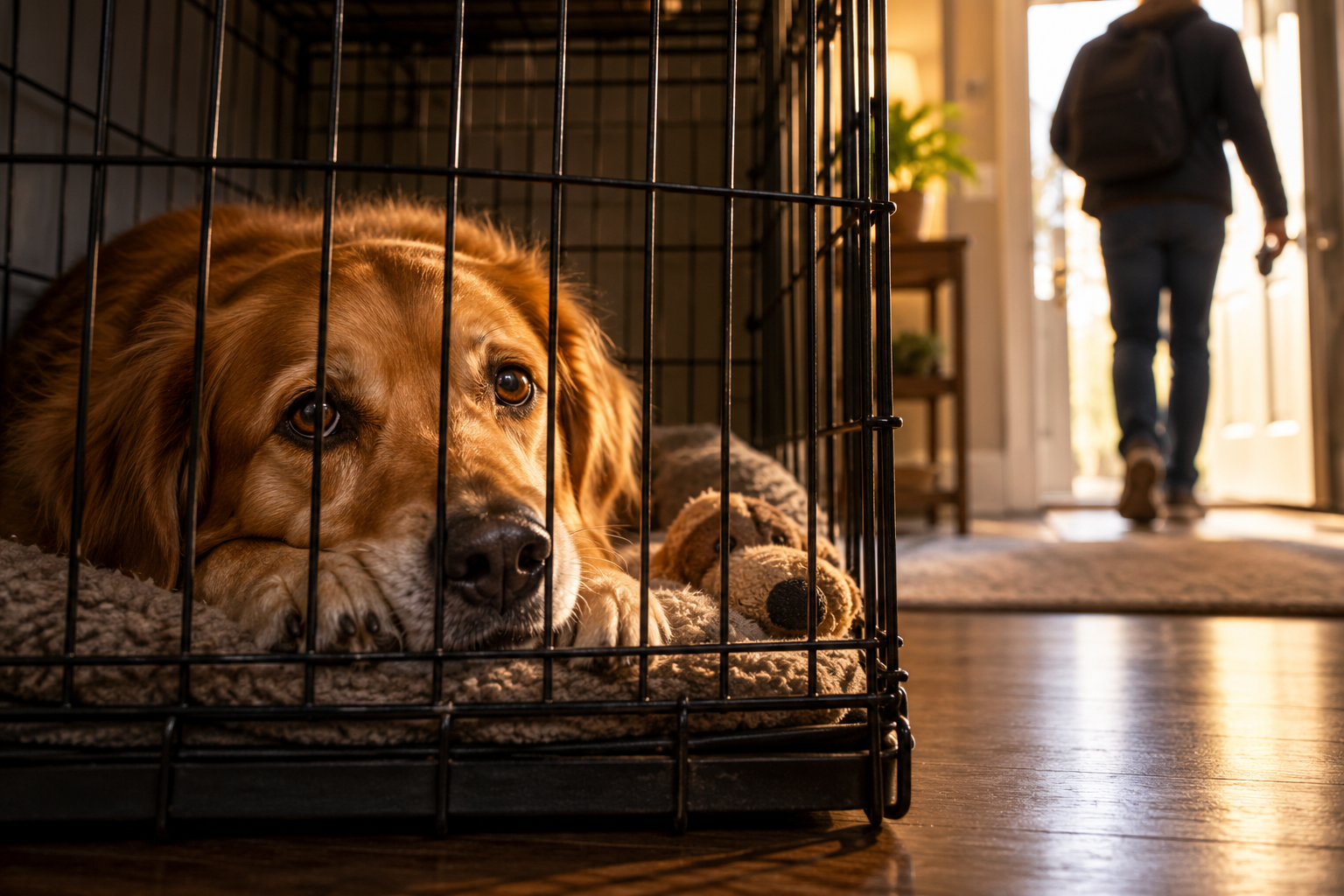
A golden retriever lies on a fleece bed inside a black wire crate beside a stuffed toy, looking out through the bars, while its owner, wearing a backpack, walks out the sunlit front door
Campaign design team

We say we love our dogs. We post their pictures, buy them birthday cakes, call them family. And then, every morning, a lot of us walk them into a wire box, latch the door, and leave for eight, nine, ten hours.

I want to talk honestly about that, because somewhere along the way we stopped seeing it. Caging a dog all day has been sold to us as responsible, as normal, even as kind. It is none of those things. It is a habit we built for our convenience, and the animal pays for it with the only life it gets.

ResponsibleNormalKind

A wall of crates

We Normalized It Without Noticing

Walk into any pet store and you will find a wall of crates sized from “puppy” to “extra large.” Training videos tell you a dog sees its crate as a “den.” Apartment listings, busy schedules, and new furniture all point the same direction: put the dog in the box, and the problem goes away.

A den

A place an animal chooses to go and is free to leave.

A locked crate

For a full workday. That is confinement.

But a den is a place an animal chooses to go and is free to leave. A locked crate for a full workday is not a den. It is confinement. Calling it something softer doesn’t change what the dog experiences on the other side of that door.

When something becomes normal, we stop asking whether it’s right. So let’s ask.

The fair question

“Isn’t a House Just a Bigger Cage?”

This is the fair question, and I’m not going to dodge it. If we keep animals in our homes at all, aren’t we already limiting them?

Yes, to a degree. That’s exactly why the difference matters.

In a home, a dog can stand up and walk to the window. It can follow the sun across the floor, pick a cool spot on the tile in summer, carry a toy from one room to another, stretch out fully, choose where to rest and when to move. It can respond to a sound, investigate a smell, go get a drink of water. Those small choices are what a life is made of.

In a crate, a dog can turn around and lie down. That’s the design standard: just big enough to stand, turn, and lie. Every other choice is gone.

In a home, a dog can

  • Walk to the window
  • Follow the sun across the floor
  • Pick a cool spot on the tile
  • Carry a toy to another room
  • Stretch out fully
  • Choose where to rest
  • Investigate a smell
  • Go get a drink of water

In a crate, a dog can

  • Turn around
  • Lie down

Every other choice is gone.

The house is a compromise we make to share our lives with animals.

The cage is the elimination of choice altogether.

The house is a compromise we make to share our lives with animals. The cage is the elimination of choice altogether. Those are not the same thing, and anyone who’s honest about it knows it.

We don’t need a lab to tell us this

They Feel What We Feel

We don’t need a lab to tell us this. Anyone who has lived with a dog has seen it. They protect their young. They cry out when they’re hurt. They grieve. They light up when you walk through the door, and they wilt when you leave.

But the science backs up what we already know. Brain-imaging studies of awake dogs have found that the same reward centers that light up in human brains respond in dogs to the scent and presence of the people they love. Researchers have shown that when dogs and their humans gaze at each other, oxytocin, the bonding hormone, rises in both. Dogs feel fear, frustration, boredom, attachment, and joy. They are social animals, built over thousands of years to live alongside us, not apart from us behind bars.

FearFrustrationBoredomAttachmentJoy

Sit with this

How would you feel if you were put in a box just big enough to turn around in, every single day, while the world went on without you? Not as punishment. Just because it was easier for someone else.

You’d feel it. So do they.

Hear what your dog is telling you

Behavior Is a Message, Not a Sentence

I understand why people crate. The dog chews the couch. It has accidents. It gets anxious and destructive when left alone. Those are real problems, and I’m not dismissing anyone who’s dealing with them.

But behavior is communication. A dog that destroys a room when it’s alone is telling you it’s bored, under-exercised, anxious, or lonely. Locking it in a cage doesn’t answer that message. It just stops you from having to hear it.

There are better answers, and most of them ask more of us, not less:

Exercise before you leave.

A tired dog is a calm dog. A real walk in the morning changes the whole day.

Dog-proof a room instead of caging the dog.

A gated kitchen or a cleared-out room gives freedom of movement while protecting what you need protected.

Break up the day.

A midday walker, a neighbor, a family member, or doggy daycare. No social animal should spend nine hours alone.

Give their minds work.

Puzzle feeders, chews, scent games. Boredom drives most destruction.

Train, don’t contain.

Real training with a qualified trainer solves the problem at the root. A cage just hides it until you open the door.

Treat anxiety as what it is.

Separation anxiety is a genuine condition. A veterinarian or behaviorist can help. A cage often makes it worse.

Short, purposeful, temporary

Safe travel in a carA vet visitRecovery after surgery

There are moments a crate makes sense: safe travel in a car, a vet visit, recovery after surgery when a dog has to stay still. Short, purposeful, temporary. That’s not what I’m talking about. I’m talking about the cage as a lifestyle, the cage as the default, the cage as the place a dog spends most of its waking life.

Not a radical idea

The Rest of the World Has Already Drawn This Line

This isn’t a radical idea. Sweden, which has some of the strongest animal welfare laws on earth, does not allow dogs to be kept in cages as a way of housing them. Cages are permitted in connection with things like transport, not as the place a dog lives. Swedish rules also require that dogs get daily contact with people and real opportunity to move.

No cages

as a way of housing a dog

Daily contact

with people

Real opportunity

to move

A whole country looked at this question and decided that a dog’s need to move and to be with others isn’t optional. It’s the baseline. Meanwhile, here at home, we’ve built an entire industry around making confinement look like care.

“My dog likes its crate”

Getting Used to It Is Not the Same as Being Okay

People will tell you their dog “likes” its crate. That it walks right in. That it’s calm in there.

Maybe. But animals, like people, can become accustomed to almost anything. A person kept in a small room long enough will adapt to it. That doesn’t mean the room was good for them. It means they stopped expecting anything better.

Adaptation is survival, not consent.

Adaptation is survival, not consent. A dog that has learned the cage is its life will accept the cage. That should break our hearts, not reassure us.

An open door

Guardians, Not Wardens

We didn’t create these animals to lock them away. We bred them, over thousands of years, to walk beside us. To work with us, protect us, and keep us company. That relationship came with a responsibility, and we’ve been quietly walking away from it.

An animal in your home is a gift. It’s a life that shares this world with you for a short time, a life that experiences every hour the same way you do, with no way to spend it except the way you allow. Be mindful of that. Every hour in a cage is an hour of its one life it doesn’t get back.

We are not owners of property. We are guardians of living beings.

Guardians open doors.

Wardens lock them.

So if your dog spends its days in a box, I’m not asking you to feel guilty. I’m asking you to look again. Look at what your dog is telling you. Look at what you would want if you were the one behind the wire. And then make the change, one room, one walk, one open door at a time.

I am a piece of the collective essence of this world that never gives up and needs every other piece to be whole.

Vinnie Cordova
Cordova 2028: Moving Forward Together
cordova2028.com

Community Comments

Community Comments

Share a public response to this post. Submissions are reviewed before they appear.

0 approved comments

Loading comments...

Comments are moderated for spam, abuse, and off-topic submissions.

Your age, area, and IP address are collected for moderation and internal reporting only.