This site is under construction - will be ready soon.
Your Guide to Our Vision

Animals · Conscience · Guardianship

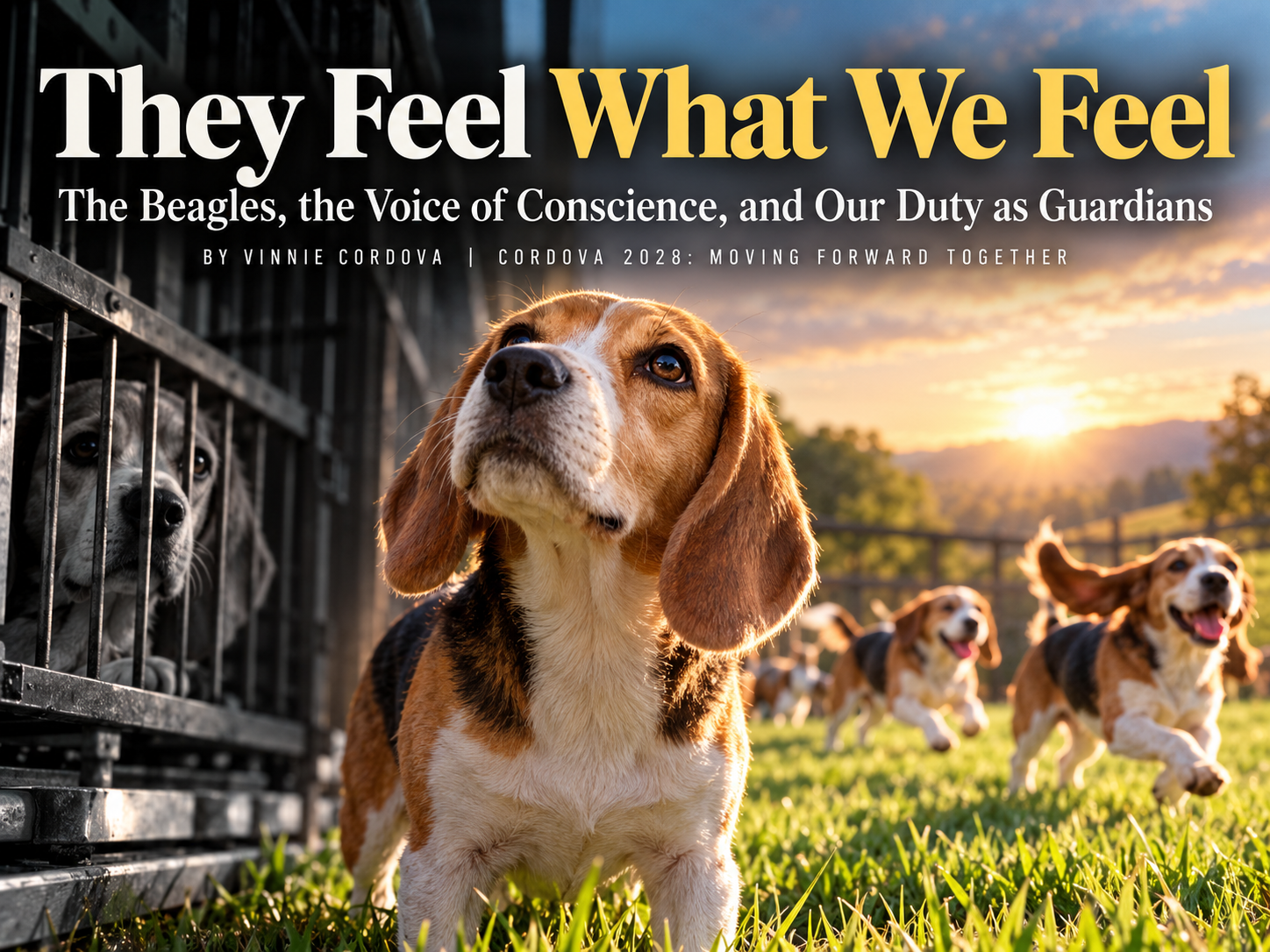
They Feel What We Feel

The Beagles, the Voice of Conscience, and Our Duty as Guardians

By Vinnie CordovaCordova 2028: Moving Forward Together
Poster titled They Feel What We Feel: The Beagles, the Voice of Conscience, and Our Duty as Guardians. On the left, a gray beagle looks out from behind black cage bars; in the center, a beagle stands on grass gazing up into warm sunrise light; on the right, beagles run happily across a green meadow toward the rising sun
Campaign design team

On August 12, 2026, the last beagles walked out of Ridglan Farms in Blue Mounds, Wisconsin. There were 155 of them, 14 adults and 141 puppies, some only three or four months old. They were driven to a few small farms nearby for medical checks. Then, for the first time in their lives, they stood on grass.

155

beagles walked out on August 12, 2026

14

adults

141

puppies, some only three or four months old

Think about that. A dog, an animal whose whole being is built to run, sniff, dig, and play, lived its entire life without ever touching the ground. It wasn’t an accident or a case of neglect slipping through the cracks. That was the design. Those dogs were bred for one purpose: to be sold to laboratories, tested on, and in most cases killed at the end so their organs could be examined.

A whole life

without ever touching the ground.

August 12, 2026

For the first time in their lives, they stood on grass.

More than 2,100 beagles came out of Ridglan before it closed. Tens of thousands more are still in American laboratories today.

I want to talk about who those dogs are. Not what they’re “used for,” but who they are. Once you understand that, the question of whether we protect them answers itself.

Chosen for Their Goodness

Start with the most damning fact in this entire story.

Beagles aren’t the most common lab dog because of some special scientific property. They’re chosen because they’re small, gentle, trusting, and forgiving. They’re calm. They don’t bite. They let a technician handle them, even during a painful procedure. They look up at the person hurting them and wag their tails anyway.

In other words, the beagle’s virtue is what made it a target.

Every quality that makes a beagle a wonderful family dog (the loyalty, the patience, the eagerness to please, the refusal to hold a grudge) has been turned into a production specification. An industry looked at one of the kindest creatures on earth and saw convenience.

A family dog

A production specification

Loyalty

✓ loyalty

Patience

✓ patience

Eagerness to please

✓ eagerness to please

Refusal to hold a grudge

✓ refusal to hold a grudge

If that doesn’t move you, nothing in this post will. But I think it does move you. I think it moves almost everyone, which is exactly why the industry works so hard to keep these dogs out of sight.

We Already Know

We don’t need a study to tell us this is wrong.

Anyone who has ever come home to a dog knows. You walk through the door and that dog’s whole body tells you what you mean to it. Anyone who has stepped on a dog’s paw by accident has heard the yelp, seen it flinch, and felt their own heart drop. Anyone who has sat with a sick dog at the end of its life has seen the fear, the trust, and the looking up at you for help. None of us needed a scientist to explain any of that. We felt it, because we feel the same things.

Anyone who has ever come home to a dog knows. You walk through the door and that dog’s whole body tells you what you mean to it.
Anyone who has stepped on a dog’s paw by accident has heard the yelp, seen it flinch, and felt their own heart drop.
Anyone who has sat with a sick dog at the end of its life has seen the fear, the trust, and the looking up at you for help.

That knowing comes from somewhere deeper than data. It’s the same voice inside every one of us that says a child should not go hungry, that an elder should not die alone, and that you don’t hurt something that trusts you. It’s conscience. And conscience has been right about this the whole time.

Look within and ask yourself honestly: if you saw someone in your own neighborhood doing to a beagle what is done every day inside these facilities, would you need a peer-reviewed paper before you called it cruelty? Of course not. You’d know in an instant. So would your neighbors. So would your kids.

The only thing that makes it “acceptable” is distance. It happens behind fences, inside windowless barns, under corporate names, filed as paperwork. The system works hard to keep it out of sight because it knows what we would feel if we saw it. The secrecy itself is the confession. You don’t hide what you believe is right.

The secrecy itself is the confession.

You don’t hide what you believe is right.

So let’s stop pretending this is a hard question. It’s not complicated. A dog feels joy and fear and pain and love. It bonds with us. It suffers when it’s hurt. We know this the same way we know anything that matters: we know it in our bones.

The science only confirms what our conscience already told us

For the people who demand proof anyway, the proof is there. Brain-imaging research has found that the parts of a dog’s brain tied to anticipation and attachment respond to the people it loves much the way ours do. Studies have shown that when a dog and its person look into each other’s eyes, the bonding hormone that ties parents to newborns rises in both of them. Dogs’ eyes even well up with tears when they’re reunited with the people they love. And the scientific community has formally declared that mammals, dogs included, have the foundations of conscious experience.

Brain imaging

The parts of a dog’s brain tied to anticipation and attachment respond to the people it loves much the way ours do.

The gaze

When a dog and its person look into each other’s eyes, the bonding hormone that ties parents to newborns rises in both of them.

Tears

Dogs’ eyes even well up with tears when they’re reunited with the people they love.

Consciousness

The scientific community has formally declared that mammals, dogs included, have the foundations of conscious experience.

But understand what that research really is. It’s science catching up to what every child with a puppy already knew. The studies didn’t discover that dogs feel. They discovered that we were right.

A beagle’s pain is not a metaphor. It’s pain.And we’ve always known it.

The Contradiction at the Heart of the Lab

Here’s the argument the testing industry can’t escape.

Why test drugs and chemicals on dogs at all? Because, the industry says, a dog’s body is similar enough to a human body to tell us something about how we will react: our organs, our blood, our nervous system, our pain.

So which is it?

If similar enough

If a beagle is similar enough to us that its suffering predicts ours, then it is similar enough to suffer like us. Testing on it is inflicting human-like pain on a creature that can’t consent, can’t understand, and can’t escape.

If not similar enough

If a beagle is not similar enough to feel what we feel, then it isn’t similar enough to be a reliable model for human medicine, and the experiments fail on their own terms.

You can’t have it both ways. You can’t say the dog is close enough to us to justify the experiment, and far enough from us to justify ignoring the pain.

And even on its own terms, the case is collapsing. Most drugs that pass animal testing go on to fail when they’re tested in people. Federal agencies are now openly moving toward human-relevant methods: human cells and tissues, organ-on-a-chip systems, and computer modeling. In April 2025 the FDA released a roadmap to phase out animal testing requirements for drugs. NIH closed its in-house beagle lab. If the people who run federal science are saying there are better ways, then “we have no choice” is no longer an argument. It’s a habit, and for some, a business.

What the Law Calls Them

Under American law, a beagle in a breeding facility is property. Inventory. A product with a price.

PropertyInventoryA product with a price

The Animal Welfare Act of 1966, the main federal law covering animals in research, sets basic standards for housing, food, and record-keeping. It explicitly does not regulate the design or conduct of the experiments themselves. USDA’s own reporting system includes a pain category for animals subjected to pain or distress without any relief, permitted whenever a researcher justifies it on paper.

The law regulates

How big a cage must be

The law does not regulate

What happens to the dog inside the experiment

So the law will tell a breeder how big a cage must be, but not whether what happens to the dog inside the experiment is acceptable. It protects the dog’s container, not the dog.

And when the system is confronted, look at how it behaves. In January 2025, a Wisconsin judge found probable cause that Ridglan Farms had committed animal cruelty. Ridglan has always denied mistreating its dogs. A special prosecutor declined to file charges. Instead, Ridglan reached a settlement letting it avoid prosecution by giving up its state breeding license. The dogs finally came out after years of public pressure and a negotiated rescue, not because the law demanded it.

Meanwhile, the largest beagle breeder in the country, Marshall BioResources in New York, is reported to be eight times the size of Ridglan, and it is still operating.

Guardians, Not Owners

Here’s what I believe, and I’ll say it plainly.

Our intelligence is not a license. It’s an obligation.

Humans can understand what a dog feels. We can read the science, look into the eyes of the dog on our couch, and recognize that something is looking back. We can understand pain we aren’t feeling ourselves. That capacity is one of the best things about us. And it comes with a responsibility: when you are powerful enough to understand another being’s suffering, and powerful enough to prevent it, you are responsible for it.

That is what it means to be a guardian.

A guardian doesn’t own a life. A guardian is entrusted with one. Parents are guardians of their children. Communities are guardians of their elders. A nation is supposed to be a guardian of its people. And humanity, the only species able to understand what’s happening in a laboratory and choose to stop it, is the guardian of the creatures who can’t speak for themselves.

A guardian is entrusted with a life

  • Parents→ their children
  • Communities→ their elders
  • A nation→ its people
  • Humanity→ the creatures who can’t speak for themselves

The beagle cannot write a letter to Congress. It cannot hire a lawyer or file a complaint. It cannot even bark loud enough to be heard outside the barn. Its only protection is us: whether we decide that its life has value, and whether we act on that decision.

So the question isn’t really about dogs. It’s about us. What kind of people are we? Are we the kind who let a corporation turn trust into a production spec and pain into a line item? Or are we the kind who look at the most defenseless among us and say: not on our watch?

I know which country I want to lead.

The Guardian Commitments

Feelings are where this starts. Law is where it has to land, because a promise that isn’t written into law can be taken back with a single memo. As president, I will fight for a Guardian Act for Companion Animals in Research built on these commitments:

Cordova 2028

Guardian Act for Companion Animals in Research

  1. 1

    End federal funding for experiments on dogs and cats on a firm statutory timeline, and redirect that money into human-relevant research methods that work better for people.

  2. 2

    Write the phase-out into law. The FDA, NIH, EPA, and Defense Department commitments to reduce animal testing become binding federal statute with fixed deadlines, enforcement, and public reporting, so no future administration can quietly reverse them.

  3. 3

    Abolish pain without relief. No federally funded or federally required experiment may subject an animal to pain or distress without relief. No exceptions written in for paperwork justifications.

  4. 4

    Regulate what happens in the experiment, not just the cage. Close the Animal Welfare Act’s hands-off clause so that the treatment of the animal during research falls under federal protection.

  5. 5

    Shut repeat violators out. Any breeder or lab with documented federal welfare violations loses the right to sell to, or receive money from, any federally funded program.

  6. 6

    A right to a life after the lab. Every dog and cat that survives research must be released for adoption instead of being destroyed.

  7. 7

    Full public transparency. Every federally funded animal experiment, the species involved, and its pain category go into a public, searchable database. Taxpayers have a right to know exactly what they are paying for.

  8. 8

    Protect the people who tell the truth. Lab workers, inspectors, and investigators who expose abuse get whistleblower protection, so exposing cruelty never carries more legal risk than committing it.

None of this is radical. Large majorities of Americans across both parties already support phasing out animal testing. Republicans and Democrats in Congress have both pushed to end painful experiments on dogs. This isn’t a left issue or a right issue. It’s a moral one. It just needs someone willing to finish the job.

What You Can Do Right Now

You don’t have to wait for an election to act as a guardian.

Adopt.

Rescue groups across the country are placing former laboratory beagles in homes right now. These dogs often have to learn everything from scratch, including stairs, grass, and how to be loved. Few things will change your life more.

Speak up.

Call your representatives and senators. Ask them one question: Will you vote to end federal funding for experiments on dogs and cats, and write it into law? Make them answer on the record.

Follow the money.

Ask where your state universities and local research institutions get their dogs, and what happens to those dogs afterward.

Tell the story.

The industry survives on invisibility. Every time you share what happened at Ridglan or Envigo, you make the next one harder to hide.

Closing: The Measure of Us

There’s an old idea that you can judge a society by how it treats its most vulnerable. Usually we apply that to people, and we should. But it doesn’t stop at the edge of our species.

A beagle doesn’t know what a drug trial is. It doesn’t know what a quarterly report is. All it knows is the cage, the hands that reach in, and whether those hands bring comfort or pain. It will trust those hands either way. That’s who it is.

The only question is who we are.

Those 155 beagles who touched grass for the first time this August weren’t saved by a law. They were saved by people who refused to look away. Let’s make sure the next ones don’t have to wait for a rescue. Let’s make sure there are no next ones.

They feel what we feel. It’s time we acted like it.

I am a piece of the collective essence of this world that never gives up and needs every other piece to be whole.

Vinnie Cordova
Cordova 2028: Moving Forward Together
cordova2028.com | info@cordova2028.com

Community Comments

Community Comments

Share a public response to this post. Submissions are reviewed before they appear.

0 approved comments

Loading comments...

Comments are moderated for spam, abuse, and off-topic submissions.

Your age, area, and IP address are collected for moderation and internal reporting only.