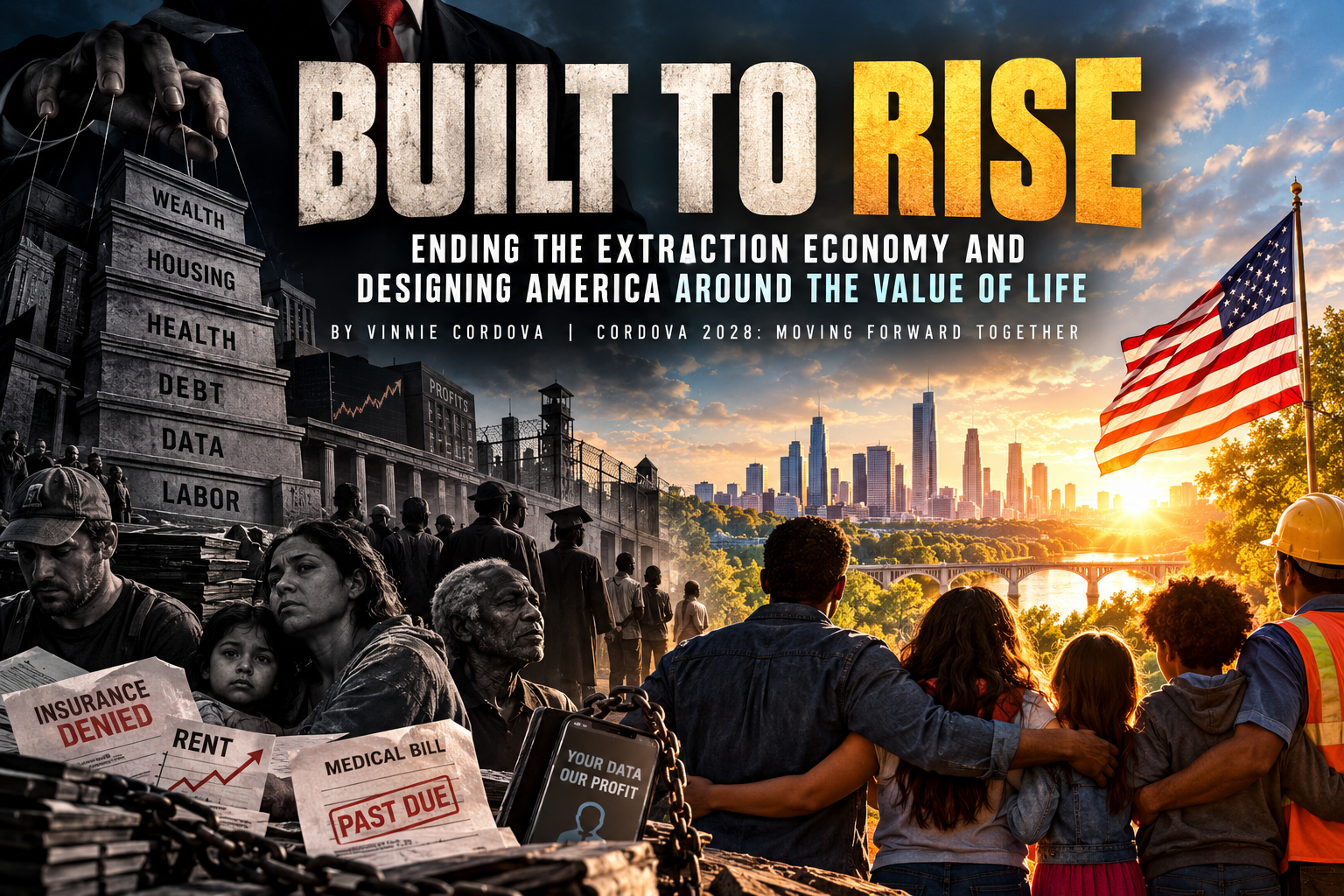
Let me start with a question nobody in Washington asks out loud:
What is a human life worth inside the systems we live under right now?
Not what it’s worth in a eulogy. Not what it’s worth in a campaign ad. What it’s worth on paper, in the actual machinery: in the billing code, the rent ledger, the insurance denial, the quarterly earnings call.
Answer that honestly and you’ll see the problem. Under the systems we have today, a human life is mostly worth what can be taken from it. Your labor gets taken at a discount. Your time gets taken by a second job. Your health is a revenue stream until it becomes a liability. Then it gets denied. Your data is harvested while you sleep. Your housing is someone else’s yield. Your debt is someone else’s asset.
Your labor gets taken at a discount.
Your time gets taken by a second job.
Your health is a revenue stream until it becomes a liability. Then it gets denied.
Your data is harvested while you sleep.
Your housing is someone else's yield.
Your debt is someone else's asset.
That isn’t an economy built around life. It’s an economy built around extraction. And we’ve lived inside it so long that most of us have stopped feeling what it costs.
This post is about feeling it again. It’s also about what we build once we do.
Part I
We Have Been Taught to Feel Less
There is a kind of numbness that sets in when you’ve been squeezed long enough.
You stop expecting the rent to stay the same. You stop expecting a doctor’s visit to be affordable. You stop expecting your kids to do better than you did. You start calling exhaustion “the grind” and calling survival “success.” When a neighbor loses their house or their health or their job, you feel bad for a minute, and then you go back to holding on to your own piece, because that’s all you think you can afford to do.
That numbness is not an accident. It’s a design feature.
A system that takes from people has to keep them from feeling the full weight of what’s being taken. If we felt it fully, we would stop it. So the system teaches us to feel less. It teaches us that struggle is normal, that hardship is personal failure, and that someone always has to be on the bottom. It teaches us to look down at the person below us instead of up at the structure pressing on both of us.
I’ve called this the Ladder of Neglect. Everyone is taught to fear the rung beneath them. The worker fears the unemployed. The unemployed fear the unhoused. The unhoused fear the incarcerated. And while everyone is busy looking down, almost nobody looks up at who built the ladder, who profits from every rung, and who never has to climb it at all.
Look up
Who built the ladder · who profits from every rung · who never has to climb it
The worker
fears ↓
The unemployed
fears ↓
The unhoused
fears ↓
The incarcerated
So when I say we have to feel more than what life is today, I mean it literally. We have to recover the feeling that a human life is sacred. That a child’s potential is not a line item. That an elder’s dignity is not negotiable. That a worker’s body is not a consumable. We have to feel the loss of every person the system was designed to keep down, because that feeling is where the will to change everything comes from.