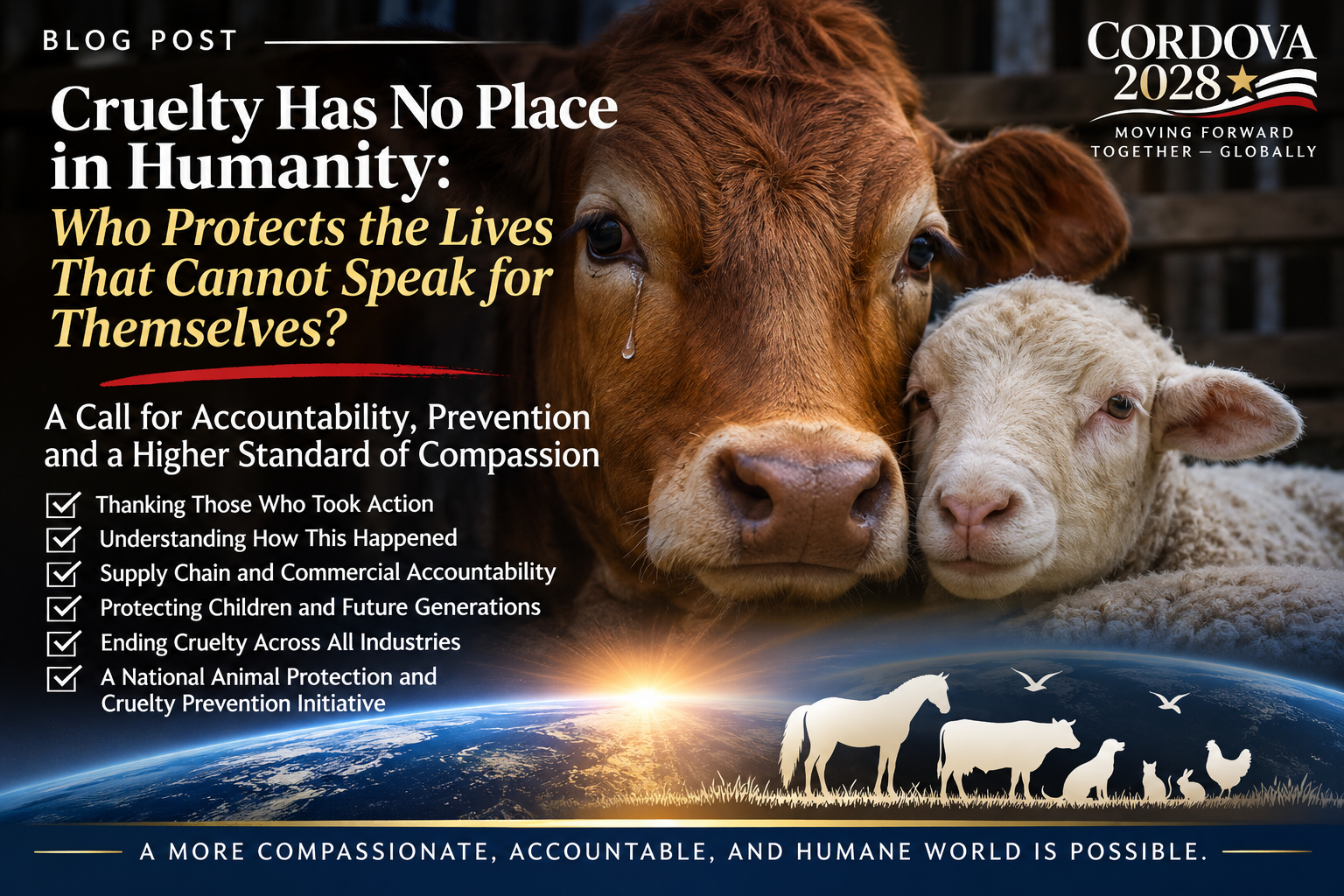
Official Statement: On Animal Cruelty, Supply Chain Accountability, and Our Responsibility to Protect Life
The signed five-page statement, dated Tuesday, November 24, 2026. A full HTML transcript appears below the PDF for search and accessibility.
Full HTML Transcript
OFFICIAL STATEMENT — On Animal Cruelty, Supply Chain Accountability, and Our Responsibility to Protect Life
Cordova for President 2028 · Official Statement
Tuesday, November 24, 2026
www.vincentcordova.com | info@cordova2028.com | (350) 229-1046 | MANTECA, CA 95336
I am deeply disturbed by the allegations of animal cruelty at Ali Meat International in Orlando, Florida.
I extend my appreciation to Florida Attorney General James Uthmeier, the investigators, law enforcement personnel, Animal Outlook, and those who brought this alleged cruelty to the attention of authorities.
I unequivocally condemn animal cruelty in all its forms. If found guilty through due process, those responsible should face meaningful criminal consequences, including imprisonment where legally appropriate.
No financial interest, business practice, cultural tradition, religious affiliation or institutional authority should excuse unlawful cruelty toward another living being.
Our responsibility, however, must extend beyond prosecuting those directly responsible. We must examine how such conduct was allowed to occur, how long it may have continued, whether existing oversight mechanisms were sufficient, and what changes are necessary to prevent further suffering.
We must also ask ourselves how many other living beings may be experiencing similar treatment in establishments where no one has come forward.
The absence of documented cruelty does not establish the absence of cruelty.
Supply Chain Accountability and Commercial Responsibility
I believe this investigation must extend beyond the physical establishment and examine its entire commercial supply chain, both domestically and internationally.
We must establish who purchased meat products from this facility, where those products were distributed, whether they entered international markets, and what oversight and due diligence were exercised by the businesses that sourced products from this establishment.
We must determine whether any purchasers, distributors, wholesalers, retailers, restaurants, exporters or other commercial partners knew, or reasonably should have known, about the conditions under which these animals were treated.
Did these businesses conduct independent inspections? Were animal welfare standards incorporated into their purchasing agreements? Were previous complaints or warning signs overlooked? Did financial incentives or production demands contribute to conditions that permitted unlawful cruelty?
We must also examine whether consumers had access to sufficient information about where their food originated and the conditions under which it was produced.
Businesses must not be permitted to knowingly benefit from unlawful animal cruelty simply because the suffering occurs outside their own facilities or is carried out by a third-party supplier.
Where international distribution is identified, I support appropriate cooperation with foreign governments and regulatory authorities to establish the full extent of the supply chain and determine whether applicable laws were violated.
Any determination of legal responsibility must be based on evidence, applicable law and due process. A commercial relationship alone does not establish complicity or wrongdoing.
Outsourcing an operation must never become a means of outsourcing moral responsibility.
Religious Neutrality and Equal Accountability
While I appreciate the Attorney General’s enforcement action, I also express serious concern regarding the use of the phrase “this Muslim slaughterhouse” in announcing these allegations.
Public officials have a responsibility to ensure that their words do not encourage hostility toward entire communities.
The alleged actions of these individuals do not represent the Muslim community or any other religious population. No group of people should be collectively blamed for the unlawful conduct of individuals who share their religious beliefs, nationality or cultural background.
We must be capable of condemning animal cruelty without encouraging hatred toward our fellow human beings.
I will not accept the abuse of animals, and I will not accept the suffering of animals being used as a vehicle to manufacture hatred toward human beings.
Justice must be directed at conduct, not identity.
National Animal Protection and Cruelty Prevention Initiative
If God and the public are willing, our administration will remain hypervigilant against animal cruelty, institutional neglect, religious discrimination and the collective targeting of any group of people.
I intend to pursue the development of a National Animal Protection and Cruelty Prevention Initiative, encompassing a comprehensive examination of:
- Existing federal and state animal protection laws, exemptions and enforcement gaps.
- Regulatory oversight, inspection practices and immediate protective intervention.
- Confidential reporting mechanisms and whistleblower protections.
- Individual, institutional and corporate accountability.
- Domestic and international supply chain transparency and traceability.
- Mandatory commercial due diligence and responsible sourcing standards.
- Financial incentives that may undermine animal welfare.
- Consumer access to verified sourcing and animal welfare information.
- Child protection and humane education.
- Scientific alternatives to harmful animal experimentation.
- Religious neutrality and equal enforcement.
- International cooperation to prevent animal cruelty.
- Independent public evaluation of whether these protections are reducing actual animal suffering.
This examination must extend across industries, including commercial slaughterhouses, industrial farming, animal transportation, commercial breeding, animal experimentation, entertainment and other operations responsible for the welfare of living beings.
Where existing authority is insufficient, we will seek legislation from Congress and cooperation from state governments and international partners.
We will seek input from veterinarians, animal welfare organizations, scientists, agricultural workers, legal specialists, religious communities, responsible businesses and members of the public.
Our objective must extend beyond prosecuting cruelty after it occurs. We must establish effective systems capable of preventing it.
Our Responsibility Toward All Life
We must also confront our own moral inconsistencies, including the use of our tax dollars and public resources to support actions that cause unnecessary suffering or the loss of human life, particularly the lives of innocent children.
We must examine the systems we have created that prevent members of our own species from reaching their full potential, obtaining essential necessities and living with dignity.
The suffering of animals does not diminish the suffering of humanity, and the suffering of humanity does not diminish the suffering of animals.
Our compassion must not be selective.
Animals cannot participate in the institutions we have created. They cannot vote, petition their government or demand accountability from those who harm them.
They cannot tell us, in our language, what we have done to them.
Their inability to speak on their own behalf makes our responsibility toward them no less significant.
Our intelligence, financial resources, technological advancement and ability to exercise power over other living beings do not establish a moral right to mistreat them.
We must never become so accustomed to suffering that we stop recognizing it simply because it occurs behind closed doors, generates revenue or has been permitted for generations.
Humanity’s advancement must be measured not only by what we are capable of creating, but also by what we are capable of protecting, nurturing and helping thrive.
We will seek accountability through evidence, law and due process—not hatred, revenge or collective punishment.
We will measure our progress not merely by the number of people prosecuted, but by the suffering we successfully prevent.
Let us never confuse power over life with ownership of life.
Cruelty must never become the price of our advancement.
Letterhead sidebar: The United States Constitution
Article II, Section 1 of the U.S. Constitution imposes only three eligibility requirements on persons serving as president, based on the officeholder’s age, time of residency in the U.S., and citizenship status:
U.S. Constitution – Presidential Candidate Eligibility
"No person except a natural born Citizen, or a Citizen of the United States, at the time of the Adoption of this Constitution, shall be eligible to the Office of President; neither shall any person be eligible to that Office who shall not have attained to the Age of thirty-five Years, and been fourteen Years a Resident within the United States."
Respectfully,
Vincent Cordova
Independent Candidate for President of the United States — 2028
Moving Forward Together — Globally
If the embedded PDF does not load in your browser, use the direct download link.