This site is under construction - will be ready soon.
Your Guide to Our Vision

Homelessness · Companion Animals · Housing

When Having a Pet Means Having Nowhere to Sleep

Two Hearts, One Family, and a Housing System That Must Do Better

By Vincent Cordova · Cordova 2028 ·

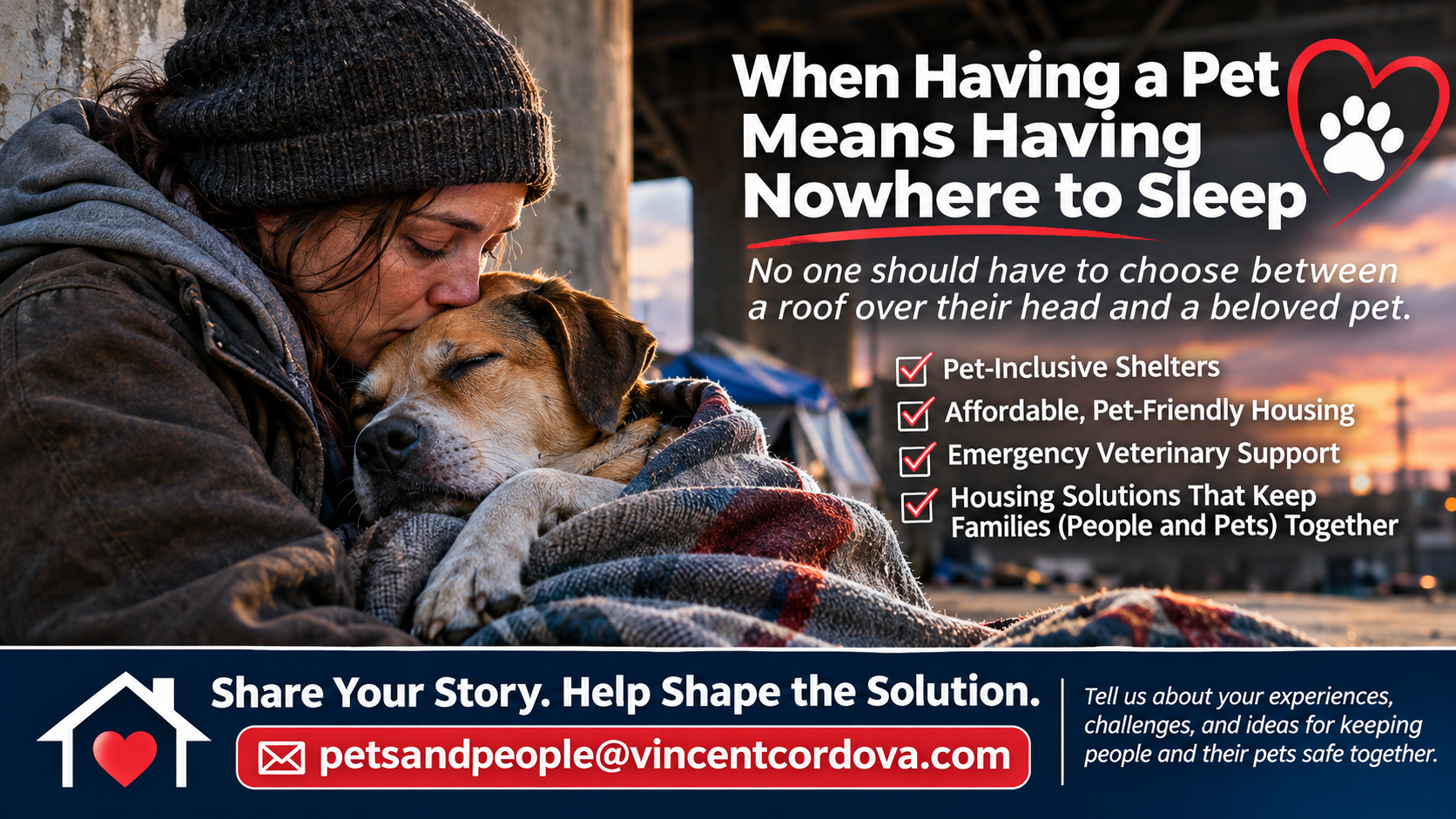
Poster titled “When Having a Pet Means Having Nowhere to Sleep.” Under a concrete bridge at dusk, a woman in a knit hat kisses the head of her dog, who sleeps wrapped in a plaid blanket. A red heart with a white paw print sits beside the title. Text reads: “No one should have to choose between a roof over their head and a beloved pet.” Red checkmarks list Pet-Inclusive Shelters; Affordable, Pet-Friendly Housing; Emergency Veterinary Support; and Housing Solutions That Keep Families (People and Pets) Together. A navy band reads: “Share Your Story. Help Shape the Solution. petsandpeople@vincentcordova.com. Tell us about your experiences, challenges, and ideas for keeping people and their pets safe together.”

Share Your Story. Help Shape the Solution.

petsandpeople@vincentcordova.com

Tell us about your experiences, challenges, and ideas for keeping people and their pets safe together.

Imagine losing your home.

Not because you stopped caring. Not because you stopped trying. But because the cost of simply existing became greater than what you could afford.

Rent

Your wages could no longer keep up with rent.

Medical bills

Your medical bills continued arriving.

Groceries

Groceries became more expensive.

Transportation · utilities · insurance

Transportation, utilities, and insurance consumed what little money remained.

Perhaps you worked two jobs. Perhaps you sacrificed your own health just to keep a roof over your head.

And then, one day, you lost that roof.

But you still had someone who loved you.

Your dog.

The companion who stayed beside you through the difficult days. The one who never asked how much money you made, what kind of job you held, or whether you had a permanent address.

Then you arrive at a shelter seeking safety, and you’re told:

Emergency Shelter · Intake

You can come inside.
But your dog cannot.

You ✓ admitted
Your dog ✕ turned away

Intake card is a visual illustration of the sentence above.

What would you do?

I know what I would do.

If I became homeless and someone told me that I had to abandon my dog to receive shelter, I would find somewhere else to sleep. Under a bridge, in a vehicle, or wherever I could find protection from the elements.

Not because I wanted to be homeless.

Because I would not abandon a member of my family.

And I believe we need to understand that distinction before we judge another human being sleeping on the streets.

Her Story

Day Five of Homelessness — Because She Refuses to Give Up Her Dog

This article was inspired by a TikTok creator who goes by Sammy1.

In a video shared on TikTok, she describes her situation:

12345

“Day 5 being homeless just because I refuse to give away my dog to the streets.”

— Sammy1, on TikTok

She asks viewers to stay and watch her video through to completion, hoping the engagement will help her earn enough to rent an apartment.

“Stay and help me rent an apartment,” she asks.

▶ Watch Sammy1’s TikTok video ↗

Think about what that request represents.

Someone experiencing homelessness is asking strangers to give a few moments of their attention, hoping it might help her secure a safe place to live with her dog.

We should hear her story, understand the circumstances, and recognize the larger problem it raises.

Her account deserves to be heard without assuming facts about her personal circumstances that we have not independently verified.

And she is not the only person facing this kind of choice.

The Pressure

We Are Creating Conditions That Push People Toward Homelessness

Across America, people are working, paying taxes, raising children, caring for aging parents, and trying to build a future.

Yet many are living one emergency away from losing everything.

We have allowed a federal minimum wage of $7.25 per hour to remain unchanged since 2009, even as the cost of housing and other necessities has risen dramatically.

Federal minimum wage

full-time · one year

Hourly wage$7.25
× hours / week40
× weeks / year52
BEFORE TAXES$15,080

Rent · food · transportation · utilities · healthcare: not included

Unchanged since 2009

Receipt drawn from the figures in the text.

At 40 hours a week, 52 weeks a year, that is just $15,080 before taxes.

How do we expect someone to afford housing, food, transportation, utilities, healthcare, and the basic necessities of life on that income?

Even workers earning considerably more can struggle in high-cost communities.

Some people work two jobs and still cannot get ahead. Others live with untreated health conditions because they cannot afford care. Some turn to alcohol or other substances to cope with overwhelming stress, although the causes of substance use and homelessness are complex and cannot be reduced to a single explanation.

And through all this, many find comfort in their animals.

A dog

A dog waiting for them at the end of a difficult shift.

A cat

A cat curling up beside them when the world feels unbearable.

A companion

A companion who offers connection when almost everything else feels uncertain.

Then, when housing is lost, we sometimes demand that people surrender one of the last meaningful relationships they have.

We should be helping people rebuild their lives, not requiring them to surrender the relationships that help them survive.

Two Hearts

Separating a Person From Their Pet Can Break Two Hearts

Animals are not disposable possessions.

They are living beings capable of attachment, stress, fear, and affection.

For many people, their pets are family.

And for some experiencing homelessness, an animal may be their most consistent source of companionship and emotional support.

When a person refuses shelter because it excludes their pet, that does not automatically mean they are refusing help.

It may mean the help being offered fails to accommodate their family.

Of course, shelters face real challenges. Allergies, animal behavior, sanitation, limited space, insurance, and the safety of other residents all matter.

But those challenges should motivate us to develop better solutions.

They should not become an excuse to accept the permanent separation of people and the animals who depend on them.

A compassionate society does not ask which heart matters more. It works to protect both.

The Plan

We Need Shelters That Welcome Families — Including Their Animals

We should begin developing a national approach to pet-inclusive homelessness services.

That means:

  1. 1 of 7

    Pet-inclusive emergency shelters.

    Expand facilities that allow people and their companion animals to remain together, with appropriate safeguards for residents and animals.

  2. 2 of 7

    Emergency veterinary partnerships.

    Work with veterinarians, animal welfare organizations, and local governments to provide vaccinations, basic veterinary care, food, and temporary supplies.

  3. 3 of 7

    Safe temporary animal care.

    When an animal cannot safely stay inside a particular facility, offer voluntary temporary foster care that preserves the owner's ability to reunite with their pet. No one should be coerced into permanent surrender simply to access emergency shelter.

  4. 4 of 7

    Pet-inclusive transitional and permanent housing.

    Expand affordable housing opportunities that recognize responsible pet ownership, while maintaining reasonable health and safety standards.

  5. 5 of 7

    Housing-first approaches.

    Prioritize getting people into stable housing rather than making them satisfy unnecessary conditions before receiving help.

  6. 6 of 7

    Prevent homelessness before it begins.

    Address inadequate wages, unaffordable housing, medical debt, eviction risks, and the economic insecurity that pushes working people toward the streets.

  7. 7 of 7

    Listen to the people living through it.

    Bring people experiencing homelessness with pets, shelter workers, veterinarians, animal welfare advocates, and housing experts directly into the design of these programs.

We do not have to invent compassion.

We have to build systems that put it into practice.

Our Priorities

What Are We Protecting When We Put Profits Before People?

We must also confront the larger economic question.

What is the purpose of an economy if people can work full-time and still struggle to survive?

What does it say about our priorities when housing becomes an investment vehicle while families struggle to find a place to sleep?

When corporations report record profits while workers cannot afford basic necessities, we should be asking whether the benefits of economic growth are reaching the people who create that value.

And when a person must choose between sleeping outside in dangerous conditions or abandoning their beloved animal, something in our approach to human welfare needs to change.

We often speak about foreign adversaries and the threats they pose to our country.

But consider this:

What greater advantage could an adversary hope for than to watch a nation weaken itself from within — allowing economic insecurity, homelessness, isolation, and the erosion of human dignity to tear apart its communities?

That is not an allegation that foreign adversaries caused this particular crisis.

It is a question about our own priorities.

We should not need an outside enemy to remind us that a nation becomes stronger when its people are healthy, housed, secure, educated, and able to care for those they love.

Our strength is not measured only by corporate valuations, military capabilities, or economic output.

It is also measured by how we treat the most vulnerable members of our society.

Including the animals who depend on us.

The Future

We Are One Species. We Must Start Acting Like It.

I want us to imagine a different future.

  • A future where losing your job does not automatically mean losing your home.
  • Where becoming ill does not mean falling into financial ruin.
  • Where a full-time worker can afford a dignified life.
  • Where shelters are designed around the real needs of the people they serve.
  • And where someone seeking protection from freezing temperatures is not forced to leave a beloved companion behind.

This is not an impossible vision.

It requires priorities, funding, thoughtful policy, and a willingness to listen.

It requires us to recognize that a human being sleeping under a bridge is not a failure of humanity.

They are a member of our species who deserves dignity, opportunity, and a genuine path toward stability.

And the animal beside them deserves care and protection too.

Build for

We must build for the next seven generations, not simply the next quarterly earnings report.

A Letter

To Sammy1, and Everyone Facing This Choice

I hope you and your dog find safety, stability, and a home where you can remain together.

And to everyone else who is sleeping in a vehicle, beneath a bridge, or somewhere unsafe because the available shelter would separate you from your pet:

We need to hear from you.

1What happened when you sought shelter?
2What assistance were you offered?
3What would have helped you and your animal remain safe together?
4What needs to change?

Your experiences must help shape the solutions.

Because policies should not be written only by people who have never experienced the conditions those policies are supposed to address.

And to our shelter operators, animal rescuers, veterinarians, and housing professionals: we need to hear from you as well.

Tell us what resources, protections, partnerships, and changes would make pet-inclusive sheltering possible.

Share Your Story. Help Shape the Solution.

petsandpeople@vincentcordova.com

Nobody should have to choose between surviving the night and abandoning someone they love.

Not a child. · Not a partner. · Not a companion animal.

We can build a society that understands that.

And we should.

Vincent Cordova

Independent Candidate for President of the United States — 2028

Moving Forward Together

www.cordova2028.com

Community Comments

Community Comments

Share a public response to this post. Submissions are reviewed before they appear.

0 approved comments

Loading comments...

Comments are moderated for spam, abuse, and off-topic submissions.

Your age, area, and IP address are collected for moderation and internal reporting only.