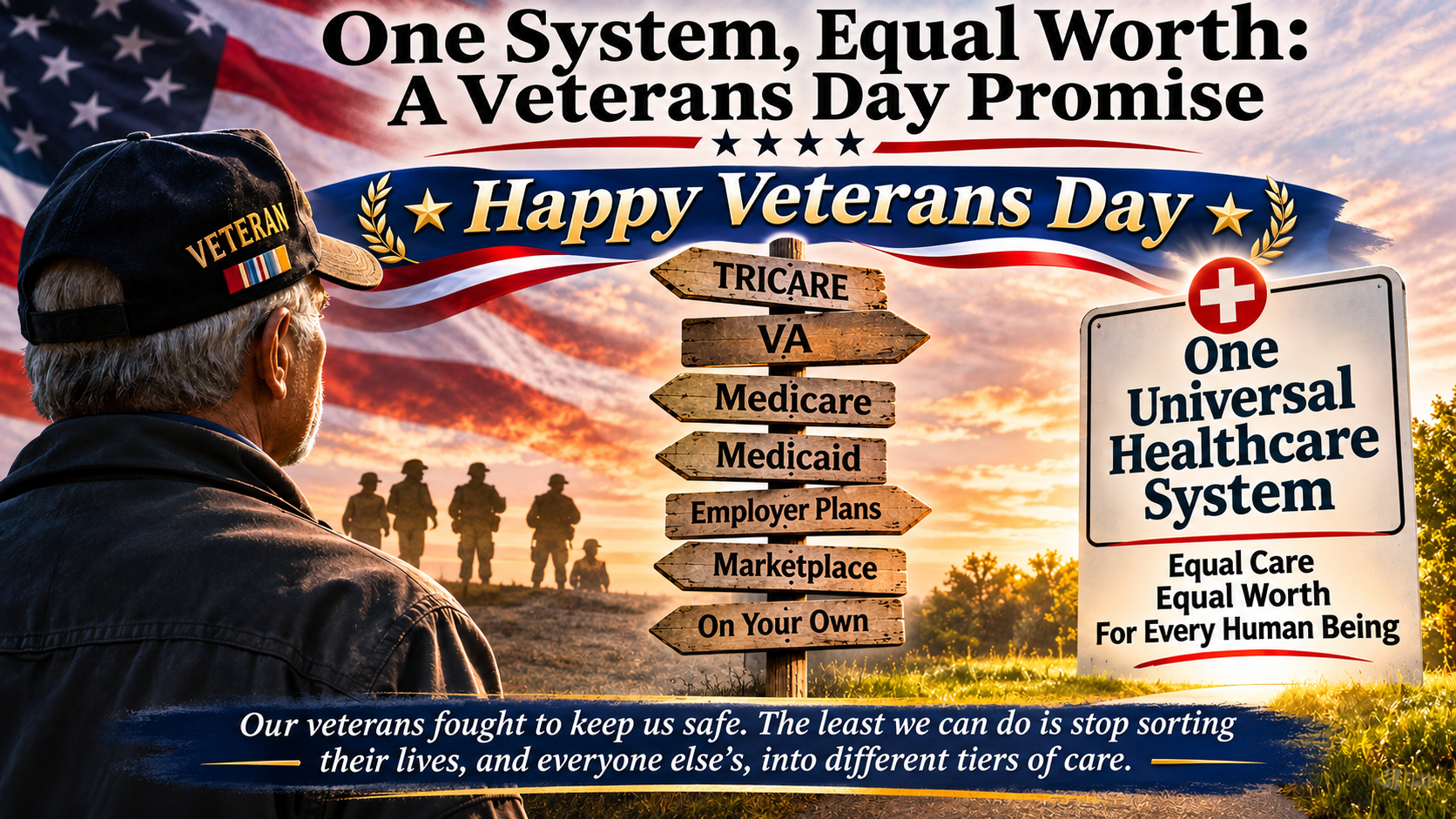
Our veterans fought to keep us safe. The least we can do is stop sorting their lives, and everyone else’s, into different tiers of care.
By Vincent Cordova ·
Cordova 2028: Moving Forward Together
Campaign design team
My Commitment to Our Veterans and Every American
I will not promise what one person, even the President of the United States, cannot accomplish alone.
What I can promise is that I will never stop working toward a healthcare system that recognizes the equal worth of every human being.
As President, I would use every lawful authority available to advance that goal, work with Congress to establish the necessary legislation, and invite veterans, military families, caregivers, healthcare professionals, and the American people to help shape the system we build.
Our veterans deserve more than words of gratitude. They deserve meaningful action, transparency, and a government willing to be held accountable for its progress.
I cannot promise that Congress will agree. I can promise that the effort, the honesty, and the accountability will never be absent from my leadership.
That is my commitment this Veterans Day.
Today we honor the men and women who served this country.
They left their families. They carried burdens most of us will never fully understand. Many came home with wounds you can see, and many more with wounds you can’t. They fought, and many are still fighting, to keep the rest of us safe.
To every veteran
thank you.
So let me start with the simplest thing I can say: thank you. You matter. Your life matters. Not because of what you did in uniform, but because you are a human being, and every human being carries inherent value.
That last part is what this day made me realize.
The sorting machine
A Country of Separate Doors
Look at how this country delivers healthcare.
If you’re active duty, you’re in one system. When you leave the service, you might qualify for the VA, or you might not, depending on when and where you served, your discharge status, your disability rating, and sometimes your income. If you’re over 65, you’re in Medicare. If you’re poor enough, Medicaid. If your employer offers it, you’re in their plan, until you lose the job. If none of those fit, you’re on the marketplace, or you’re on your own.
TRICARE
VA
Medicare
Medicaid
Employer Plans
Marketplace
On Your Own
Seven doors · seven sets of rules
Even inside the VA, care is sorted. According to the VA, only about 26% of enrolled veterans are eligible for VA dental benefits, because dental coverage largely depends on things like disability rating or former POW status (GAO, September 2026). Same service. Same oath. Different access to care.
VA dental eligibility
~26%
of enrolled veterans are eligible
Same service. Same oath. Different access to care.
VA healthcare enrollment
9 million+
veterans enrolled
Nearly half of the veterans in this country are not.
And there are more than 9 million veterans enrolled in VA healthcare (Stars and Stripes), which means nearly half of the veterans in this country are not (Mission Roll Call). Many never knew they qualified. Many were told they didn’t. Many gave up on the paperwork.
And it doesn’t stop with the veteran. Spouses and children move between TRICARE, employer plans, Medicaid, and the marketplace every time orders, jobs, or discharge status change. The family members who become full-time caregivers, often leaving their own jobs to do it, can find themselves without coverage of their own. The people who served alongside our service members at home get sorted too.
Every one of those doors sends the same quiet message: your care depends on which category you fit into.
That’s not a healthcare system.
That’s a sorting machine.
And whether we mean it to or not, a sorting machine assigns different values to different lives.
Inside or outside
When Care Is Out of Reach, People Pay With Their Lives
This isn’t abstract.
The VA’s own data shows what happens when veterans are connected to care and when they aren’t. Between 2001 and 2024, the suicide rate among veterans enrolled in VA healthcare declined 2.2%, while the rate among veterans outside the system rose 70.8% (VA data, via MyChesCo).
Change in veteran suicide rate · 2001 to 2024
Enrolled in VA care
−2.2%
declined
Outside the system
+70.8%
rose
Read that again. The difference between being inside a system of care and being left outside it can be the difference between life and death.
And when veterans are inside it, care works. VA research consistently shows that enrolled veterans have better health outcomes than veterans who aren’t enrolled, and VA hospitals have outperformed non-VA hospitals in quality ratings and patient satisfaction (Military.com). The lesson isn’t to tear down a system that works. It’s to stop leaving people outside of one.
And the system veterans do have is under strain. The VA lost more than 40,000 employees in fiscal 2025, with 88% of them coming from the Veterans Health Administration, according to a Senate Veterans’ Affairs Committee minority report (Government Executive). That report found average waits for new mental health appointments had grown to 35 days. The VA disputes that finding. But a veteran waiting for help shouldn’t have to wonder whose numbers are right.
40,000+
VA employees lost in fiscal 2025
88%
of them from the Veterans Health Administration
35 days
average wait for a new mental health appointment, per the minority report
Honor them honestly
No More Wars and Death for Profit
We can’t honor veterans honestly without saying this too.
Too many of our service members have been sent into wars that made a small number of people very rich and left families with empty chairs at the table. Contractors profit. Weapons manufacturers profit. And the people who carry the cost are the service members, their families, and the civilians on the other side who are human beings too.
No more wars and death for profit.
No more wars and death for profit. Honoring our veterans means refusing to create more veterans through conflicts built on someone’s balance sheet. It means valuing the lives of those who serve enough to protect them from needless wars in the first place.
So here is what a Cordova Administration will do:
1
Open the books. Every defense contractor’s profit on every war-related contract will be publicly disclosed. If someone is getting rich off a war, the American people will know who and how much.
2
Make war profiteering a crime with real consequences. Price gouging and profiteering on wartime contracts will carry criminal penalties, not just fines that get written off as a cost of doing business.
3
Hold war crimes accountable, no matter who commits them.Executive Order 2029-01 commits this administration to extradition for war crimes, with no exemption for any office or any administration.
Equal inherent value
We Are One Species
Here’s what I keep coming back to.
99.9%
of our DNA, shared
We are one species. We share about 99.9% of our DNA. The veteran who served three tours, the child born this morning, the elderly woman living on a fixed income, the man sleeping outside with nothing at all: none of them is worth more than the others. None of them is worth less.
The veteran who served three tours
Equal worth
The child born this morning
Equal worth
The elderly woman on a fixed income
Equal worth
The man sleeping outside
Equal worth
I want every veteran to know how important you are. And I want the person who has nothing to know exactly the same thing. That’s not a contradiction. That’s the whole point.
When we finally see equal inherent value in one another, this world gets better. Not a little better. Fundamentally better.
From the start
One System. From the Start.
We don’t need a dozen separate healthcare systems, each with its own rules, its own paperwork, and its own way of deciding who qualifies.
We need one system of universal healthcare that makes you and your health a priority from the very start, from your first breath to your last, whether you served or not, whether you’re working or not, whether you have money or not.
One Universal Healthcare System
For veterans, that means
No more coverage gaps between leaving the service and getting care. You’re covered the day you come home, because you were already covered.
No more fighting for eligibility. Your discharge papers, your rating, and your income should never decide whether you can see a doctor.
Mental healthcare, dental care, and long-term care included, not rationed by category.
Care that follows you, not care that depends on which door you walked through.
Your family covered too, including spouses, children, and the caregivers who give up their own careers to care for you.
Closing the loophole
And let me close the loophole before anyone tries to open it: no veteran will lose a single benefit, disability rating, or service-connected protection they have today.
One system adds care. It never takes it away.
And the VA’s experience and expertise in areas like trauma, prosthetics, and service-connected conditions shouldn’t disappear. It should be protected, fully staffed, and built into one universal system, so no veteran loses specialized care while finally gaining care for everything else.
That’s the vision behind my plan for a nonprofit healthcare system: no claim denials, no copays, no private equity, and no one left outside the door.
No claim denials
No copays
No private equity
No one left outside the door
A Promise on Veterans Day
To every veteran: you kept us safe. Now let us make sure you never have to fight for your health, and that no one else does either.
To every American: honoring veterans one day a year isn’t enough. We honor them by building a country worth what they sacrificed, one where every life is valued equally, every day.
We are one. And when we act like it, everything changes.
Together.
Your story
Veterans: Tell Us What It Took
If you’re a veteran, a military spouse, or a caregiver, I want to hear what it took for you to get care: the denied claim, the wait that went on too long, the gap after discharge, the paperwork that never ended. Your story shows exactly where the system breaks, and with your permission, it will help shape the plan that fixes it.