To every person who earned the trust of voters last week: congratulations.
Now here’s the harder part. Winning an election is not what defines your leadership. What you do with the responsibility you’ve been handed is what defines your service to humanity.
This country doesn’t need more elected officials. It needs strong, compassionate people who understand the value of human life, recognize our shared humanity, and have the courage to challenge systems that have let preventable suffering go on for generations.
Government exists to serve people. Not the other way around.
And it’s fitting that I’m writing this on Veterans Day. Millions of Americans put their lives on the line for this country, and too many of them come home to fight a second battle: against wait times, denied claims, and paperwork, just to get the care they were promised. If we can’t guarantee care to the people who served, we haven’t understood what service means. Every newly elected official should carry that thought into office.
Leadership That Puts Humanity First
On November 3, Abdul El-Sayed defeated former Congressman Mike Rogers in Michigan’s U.S. Senate race (Michigan Public; Decision Desk HQ results). When he takes office in January, he will be the first Muslim ever to serve in the United States Senate.
That is a historic milestone in American representation. But it’s also worth looking at what he ran on: universal healthcare, and reducing the influence of outside money in our elections.
His win shows that a candidate can challenge powerful interests, call healthcare a human right, and still earn the trust of voters in a battleground state. It should remind every elected official that leadership isn’t about preserving existing systems. It’s about having the courage to examine those systems and fix them when they fail the people they were built to serve.
What stands out to me about his advocacy is a simple recognition: access to healthcare should never depend on someone’s wealth, their job, their social standing, or their ability to navigate an insurance maze.
That reflects a principle a Cordova Administration stands behind completely:
Comprehensive, cradle-to-grave healthcare for every human being.
Let me be clear about why I’m saying this. I’m an independent. I’m not here to praise a party. I’m here to recognize an idea. I’d say the same thing about anyone, from any party, who stood up for healthcare as a human right and won.
We come from different backgrounds. We’re on different political paths. We may disagree on individual policies. But when someone is fighting to improve the human condition, we should have the integrity to say so out loud.
That’s what leadership looks like.
A Cordova Administration will not judge an idea by the party that introduced it. We will judge it by what it does for the people whose lives it touches. If an idea reduces suffering, expands opportunity, protects human dignity, and strengthens our shared future, it deserves serious consideration, no matter whose name is on it.
Humanity should never be a partisan issue.
Healthcare Is Not a Privilege. It’s the Foundation.
Think about what it means to bring a child into this world.
From the first breath, that child depends on other human beings for protection, nourishment, education, medical care, and the chance to grow.
No child chooses the financial circumstances of their birth. No child chooses whether their parents have insurance. No child chooses whether they’re born near an excellent hospital or in a community where families struggle to get basic treatment.
And yet our systems let those circumstances shape a person’s opportunities for the rest of their life.
Why?
We are one species. We share about 99.9% of our DNA. We are biologically connected, socially interdependent, and capable of extraordinary things when we work together. If we know that healthcare protects life, supports development, prevents suffering, and lets people take part in society, why would we ever build a system that puts a price tag between a human being and the care they need?
A species that understands survival, development, and cooperation should never accept preventable suffering as the cost of living in society.
Healthcare isn’t just treating illness. It’s giving every person the strongest possible foundation for life. That means:
- Prenatal care and healthy childhood development
- Preventive medicine and mental healthcare
- Disability support and emergency treatment
- Rehabilitation and long-term care
- Dignified support at the end of life
That is what cradle-to-grave means. It means we value human life at every stage, not just when someone is healthy enough to work or wealthy enough to pay.
Education and Healthcare Rise Together
You can’t talk about the future of healthcare without talking about education. They are inseparable.
A child with an untreated illness struggles to learn. A parent who can’t afford treatment faces financial instability that ripples through the whole family. A student without proper nutrition, mental healthcare, or a safe place to live may never get a fair shot at showing what they can do.
And when education is out of reach, all of us lose the scientists, physicians, engineers, teachers, artists, and community leaders those people could have become.
Imagine the discoveries we’ve never made because someone was denied the chance to learn.
Imagine the lives we could have saved if more people could afford to study medicine.
Imagine all the human potential left on the table because we treat healthcare and education as transactions instead of investments in our shared future.
Every child deserves the chance to become everything they’re capable of becoming.
Encouraging words don’t get them there. Systems do: systems that provide the tools, resources, healthcare, education, and stability human development requires.
A truly advanced nation doesn’t just ask whether investing in its people is affordable. It asks what it costs us when we don’t.
And we already know what it costs:
26.7M
People in this country without health insurance for all of 2025
20M
Adults, nearly 1 in 12, carrying significant medical debt
$220B+
What Americans owe in medical debt, at minimum
26.7 million people went without health insurance for all of 2025 (U.S. Census Bureau). 20 million adults carry significant medical debt, and together Americans owe at least $220 billion for the crime of getting sick (KFF / Peterson Health System Tracker).
Those numbers were measured before the enhanced marketplace subsidies expired at the end of 2025 (Texas Public Radio). Next year’s numbers will likely be worse.
That’s not a budget line. That’s millions of families skipping care, draining savings, and carrying debt that follows them for years. We are already paying for a broken system. We’re just paying in human lives instead of in results.
Stop Confusing Productivity With Human Worth
One of the most damaging ideas built into modern society is that a person’s value is measured by their economic output.
We’ve built systems that ask what someone can contribute financially before asking what that person needs to live and thrive.
But a newborn has value before producing anything. A person living with a disability has value regardless of employment. An elderly person has value long after retirement. Someone experiencing homelessness, illness, or unemployment does not become less human because their circumstances changed.
Human worth is inherent.
It is not earned through a paycheck, an insurance policy, or a position in society.
Start there, and our responsibilities become clear.
We don’t abandon people because they get sick. We don’t deny children opportunity because their families are struggling. We don’t treat older adults as burdens. We don’t force anyone to choose between medical treatment and a roof over their head.
We recognize every human being as part of our collective future, and we build accordingly.
What a Cordova Administration Stands For
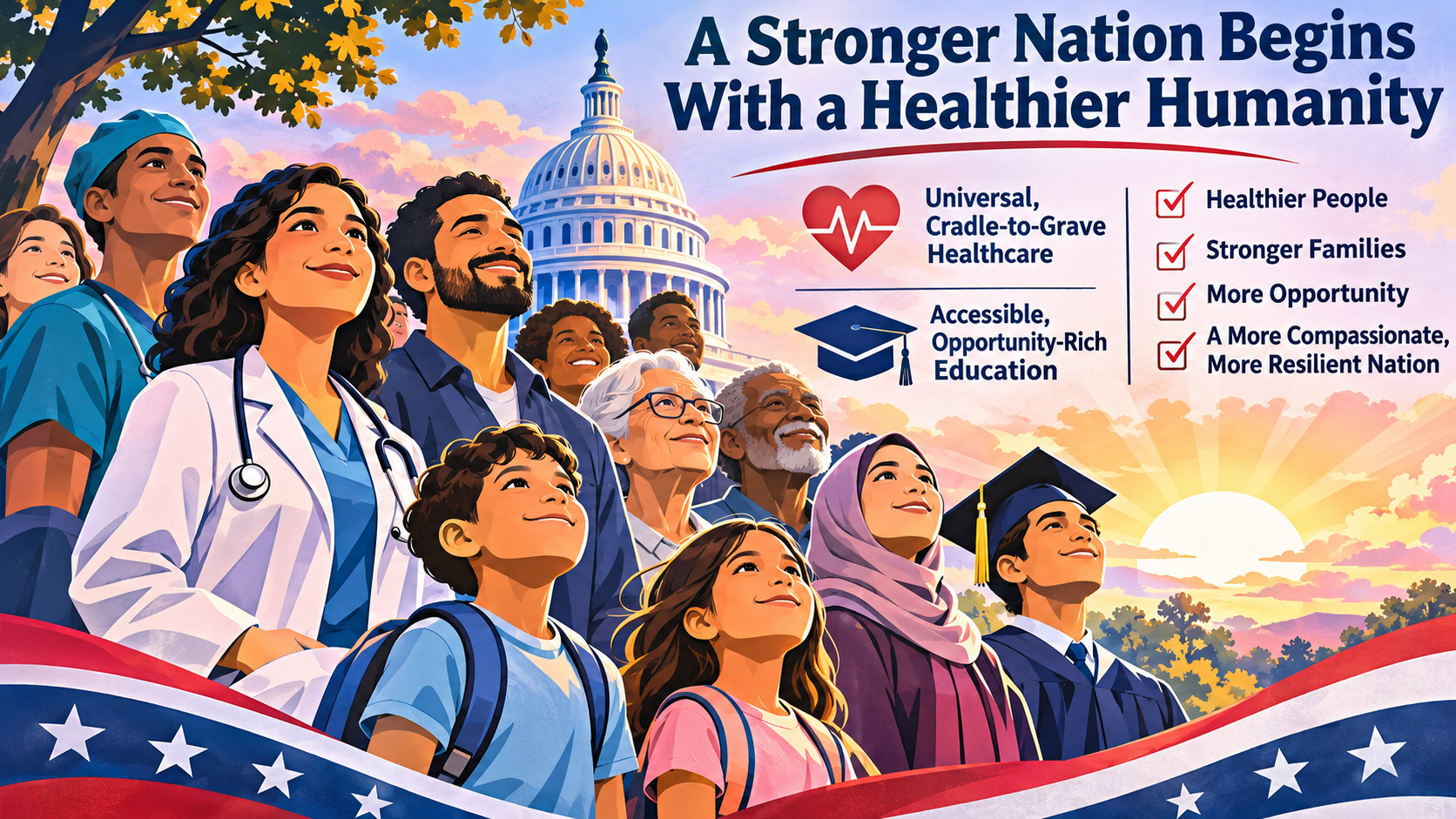
A Cordova Administration will fight for a nation where healthcare and education are treated as essential foundations of human development.
Universal, comprehensive healthcare from birth through end of life, with real access to preventive care, mental healthcare, disability services, treatment, rehabilitation, and long-term support.
This isn’t a slogan. My plan builds a nonprofit healthcare system that can’t profit from saying no:
Read the full plan: Transforming Healthcare: A Nonprofit Model for Families, Communities, and Future Generations.
An education system that develops human potential, instead of letting financial circumstances decide who gets opportunity.
A real voice for the people affected. Healthcare professionals, educators, patients, students, families, and communities must help shape the systems that serve them. Policy shouldn’t be written exclusively by people who have never faced the barriers it’s supposed to remove. We will ask the people directly affected what they need, what they envision, what worries them, and what policymakers have missed.
Responsibility beyond borders. Our obligations don’t stop at party lines, state lines, class lines, or national borders. Our future is interconnected.
I’m not asking anyone to take my word for this. I’m building it. Cordova Courier’s vision is centered on its employees — giving them the financial means and the tools to succeed by working together. Not shareholders. Employees. Cordova Courier will be a mission-locked public benefit corporation, legally bound to serve its employees and the public, not extract from them. At a time when most companies put shareholders first, this design puts people first — and that choice compounds for the next generations. If a delivery company can be built to put people first, so can a healthcare system.
When people are healthier, better educated, and equipped to contribute, whole communities get stronger. When we prevent avoidable suffering, we open the door to human progress. When we invest in children, we invest in generations we may never live to see.
A successful government shouldn’t be measured only by the wealth it generates, but by the quality of life, dignity, freedom, and opportunity it makes possible for the people it serves.
To Every Newly Elected Leader: Remember Why You’re There
You’ve been handed an extraordinary responsibility. Behind every vote is a human being:
- A parent worried about their child’s future.
- A worker struggling to afford housing.
- A student hoping for an education.
- A person with a disability who wants independence.
- An older adult worried about healthcare.
- A veteran still fighting for the care they were promised.
- A family trying to build a stable life.
These aren’t statistics to talk about during election season and forget afterward. They are people whose lives are shaped by the decisions you make.
So I’m asking every newly elected official to look past political divisions and ask one question:
Are the decisions I’m making helping human beings live healthier, safer, more fulfilling lives?
If the answer is no, reconsider them.
If someone from another party proposes a policy that genuinely improves people’s lives, work with them.
If a system is producing preventable suffering, have the courage to change it.
And if our institutions are failing to meet basic human needs, don’t defend those failures just because they’ve been around for generations.
Public service is more than holding office. It means listening to the people your decisions affect, measuring the results, admitting mistakes, and correcting course.
Government’s job is not to protect its own reputation. It’s to protect the people it serves.