Printed from: https://www.cordova2028.com/blog/do-you-want-to-end-our-species-or-let-it-prosper
Read, Print or Study Offline
Access this information in the format that works best for you.
Do You Want to End Our Species — Or Let It Prosper?
By Vincent Cordova · November 28, 2026 · Cordova 2028 · Moving Forward Together · Globally
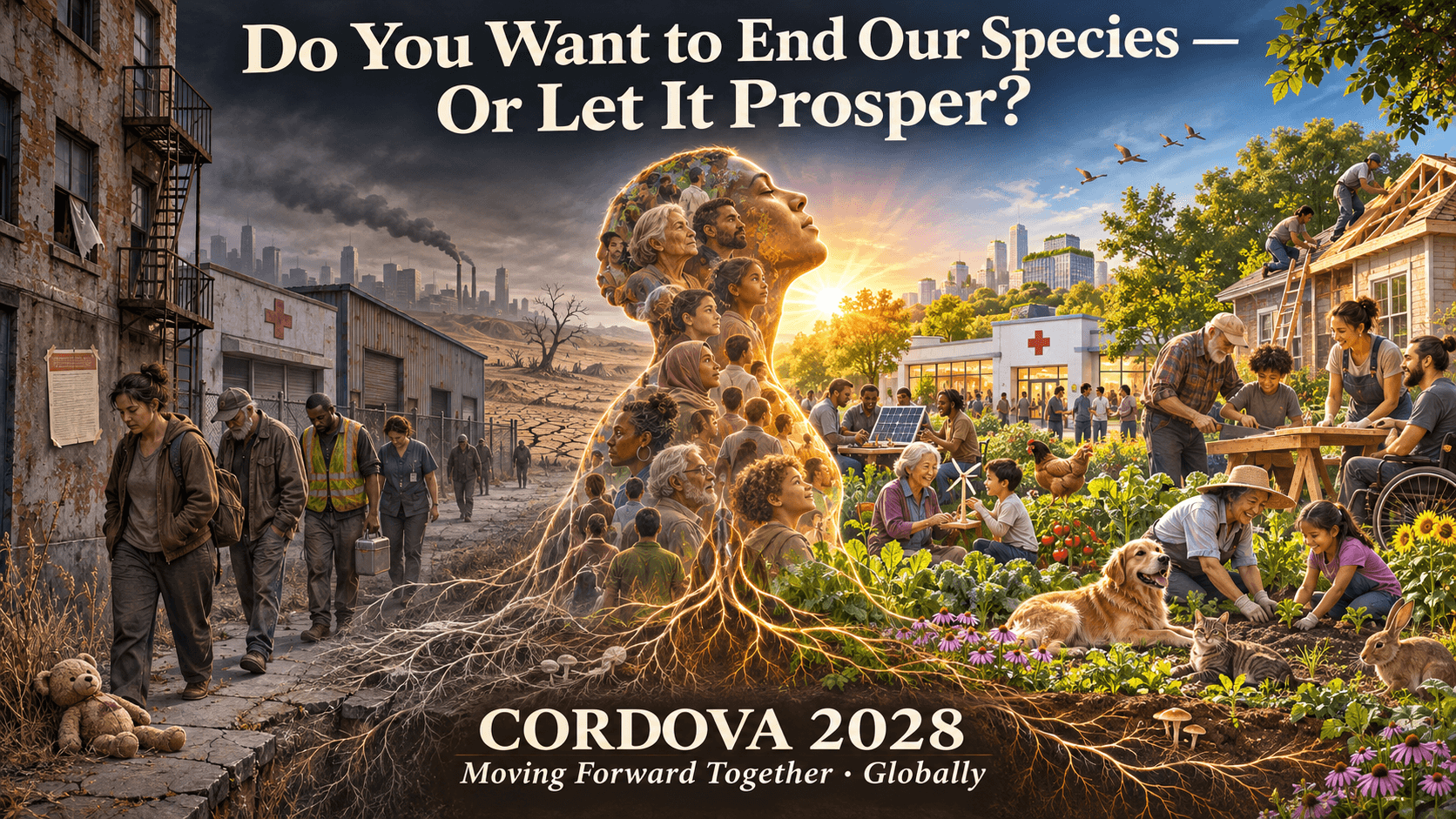
I want to be plain with you, because plain is what this moment requires.
Something is eating itself. You can feel it. The rent doesn't match the walls. The food lasts longer and nourishes less. The paycheck covers less every year while the hours get longer. The town loses its clinic and gains a warehouse. The young can't buy homes, the old can't retire, and the people in between are told to work harder and be grateful.
You are not imagining it. You are not lazy. You are not the problem. And you are not alone in seeing it.
Here's what's actually happening — and what we do about it.
The Ladder
Every extraction system runs the same ladder. It doesn't skip steps. It doesn't stop at the first one.
Raise the price until people can't pay. When they can't pay more, cut what goes into the thing — cheap wood, chemical preservatives, thinner walls, fewer staff, smaller portions. Same package. Same price. Less inside. The cheap wood is the tell. When a system starts cheapening what it sells instead of improving it, it has stopped creating value and started harvesting it.
Then it monetizes what used to be free — your data, your attention, your time, your heated seats, your convenience. The market gets built first; the guardrails come later; and the person whose life became a product never gets a seat at the table. Then it borrows against the future — deferred maintenance, underfunded pensions, debt to make this quarter look fine. Then it eats its own base — sells the assets it needs, strips the inventory, milks the brand. Then it collapses. Toys R Us. Blockbuster. The mall. The pension fund. The landlord who ran the building into the ground and walked away.
Climb the ladder · tap a rung
Rung 2 of 6
Cut what goes inside
Same package, same price, less inside. Or the same product with fewer staff behind it.
On the record
The Bureau of Labor Statistics counts a smaller package at the same price as a price increase (BLS). GAO found that downsizing added less than a tenth of a point to overall inflation from 2019 to 2024, but a much larger share in snacks and household paper goods (GAO). In care work, the cut is in people: Medicare patients in nursing homes bought by private equity firms had about 11 percent higher short-term mortality, which the researchers tied partly to lower nurse staffing (NBER w28474).
The vehicle never stops, because stopping is losing, and losing means being replaced by someone who won't stop. You can be a good person and still drive it. That's the trap. The machine is the condition of staying in the game.
At Whose Expense?
The costs never disappear. They get pushed down the balance sheet — to whoever has the least power to refuse.
The cheap wood is cheaper for the builder and more expensive for the homeowner. The chemicals are cheaper for the manufacturer and more expensive for the body. The deferred maintenance is cheaper for the landlord and more expensive for the tenant. The data sale is cheaper for the company and more expensive for the person whose life is now inventory.
So when I ask "at whose expense?" the answer is specific: the people with the least ability to say no.
And the people sleeping in cars, in tents, on couches, in motels — they are not a separate species. They are what the end of the balance sheet looks like. Most of them worked. Many still do. The line between housed and homeless is not character. It's a buffer. One eviction. One medical bill. One job loss. One bad month. Millions of working people are closer to that line than they want to believe.
How thin the buffer is
37%
of U.S. adults could not cover a $400 emergency with cash or its equivalent in 2025
745,652
people were homeless on a single night in January 2025; 266,320 of them unsheltered
52% · 40%
of sheltered and unsheltered homeless adults had earnings from formal jobs in the year they were counted
Campaign research note · The homelessness count fell about 3 percent from the year before, but chronic homelessness reached a record 155,750. The employment figures come from linking 2010 Census records to tax data. Median earnings among those working were about $8,300 a year. Work alone did not keep a roof overhead.
The bottom is not a moral category. It's a structural one. When the floor gets removed for everyone, the people with the least buffer hit it first — and then get told it was their fault.
The Blame Is the Life Support
When a system can't deliver, it has two choices: change, or change the subject. Changing costs the people at the top. Changing the subject costs nothing.
So it changes the subject — to you.
"Work harder." That is not advice. It's a transfer of responsibility. It moves the failure from the system's ledger to your character. If the problem is your effort, the system is fine and you are the defect.
"When they say sacrifice, finish the sentence." Sacrifice for whom? Whose balance sheet improves when you do? The word is always left unfinished because finishing it dissolves the virtue. Sacrifice has a direction. Ask which way it points.
Finish the sentence
Sacrifice for whom?
Whose balance sheet improves when you do?
The status quo doesn't need to succeed. It only needs to stay. And the cheapest way to stay is to make you believe the cost is your fault, and that nothing can be done. Despair is not the opposite of the status quo. Despair is its preferred mood.
Rome Is a Warning, Not a Prophecy
A society can grow more powerful while many of its people lose security, ownership, and influence over the decisions shaping their lives. Rome did a version of this — growth for the center, insecurity for the many, wealth flowing to those who already held the land. I'm not saying we are Rome. I'm saying Rome is a reason to ask whether today's growth is building shared capacity — or concentrating the means to shape what comes next.
Not in a day
133 BC
Tiberius Gracchus, a tribune, proposes capping how much public land one holder may occupy and returning the rest to small farmers. He is killed by senators and their supporters. Source
121 BC
His brother Gaius pushes the reforms further. He dies in political violence too. Source
The next 600 years
Rome grows larger and richer at the center. The land question is never settled for the many.
AD 476
The last western emperor is deposed. The fall took centuries, one decision at a time.
Campaign research note · Historians still argue over how far large estates actually swallowed Italy’s small farms; the archaeology is mixed. What is not disputed is that the reformers who tried to share the land were killed for it.
Rome didn't fall in a day. It fell one reasonable decision at a time, each one made by someone who benefited from making it.
And here's the part we don't say enough: what comes up doesn't come down on everyone equally. It comes down on whoever is standing at the bottom when it lands. The assets get bailed out. The debt gets foreclosed. The people with the buffer survive the reset. The people without one become the reset.
The Ledger We Don't Talk About
There is no line on your paycheck that says this portion kills children. That's not an accounting accident. The distance is the product. If we had to sign a separate check for it, the arrangement would not survive a week.
Earnings statement
Gross payearned
Federal income taxwithheld
Social Securitywithheld
Medicarewithheld
this portion kills childrennot printed
$2,887 billion
world military spending in 2025, the highest SIPRI has ever recorded
$954 billion
spent by the United States, 33 percent of the world total
11 years
of rising world military spending in a row
Campaign research note · Source: SIPRI, April 27, 2026. U.S. spending fell 7.5 percent in 2025, mostly because no new military aid for Ukraine was approved, and more than $1 trillion has already been approved for U.S. defense in 2026.
The poor fight. The rich fund. The dead are counted somewhere else. That is not ancient history — recruiters don't go to the wealthiest zip codes.
And the deepest contradiction: we pray to the same higher power that made every child on earth — and then pay for the bombs that fall on them. The state doesn't need the faithful to believe in the killing. It only needs them to believe the killing is compatible with their faith. That belief is doing the work.
"America kills" can be deflected with a flag. A weapons transfer with a date and a signature cannot. Name the decision, not the country. The smaller the frame, the harder it is to look away. The child is not a category. The child has a name, a school, and a mother.
 Go deeper · where the ledger beganThe Shareholding System: How the Plantation Ledger Became the American Data ApparatusFrom the 1790 census to the credit score: how a system that once counted people as fractions still decides who absorbs the cost.Read it →
The One Foundation That Can't Be Gamed
Every other foundation has been tried — nation, race, class, creed, party, market, flag. And every one of them created an "us," and every "us" needed a "them" to absorb the cost. That is the ladder. The whole mechanism depends on there being someone below you to hand the bill to.
Tried
- Nationus them
- Raceus them
- Classus them
- Creedus them
- Partyus them
- Marketus them
- Flagus them
Species
No outside. No other. No one below.
The species is the only category with no one below it. No outside. No other. No one left to push the cost onto.
That's not sentiment. It's a design principle — and it's the only one that can't be gamed, because gaming it requires an outsider, and there isn't one.
So here is the test for every system, every policy, every budget line:
The test
Does this treat every person as a member of the same species — with an equal claim to life, dignity, safety, and the chance to build? Or does it move the cost onto someone we've decided doesn't count?
A bomb is not a budget line. A bomb is a choice not to build a clinic.
A border is a line. A child is a person.
A data sale is not a transaction. It's a life turned into inventory.
The moment we decide someone doesn't count, we've built the ladder again — and we will be standing on it until it's our turn at the bottom.
We Have Each Other
Look at the natural world, honestly. No species thrives alone. The forest is a network. The soil is a collaboration. The systems that last are the ones where the parts sustain each other — not the ones where one part extracts until the whole collapses. Extraction is a strategy that works until it doesn't. Cooperation is the strategy that keeps working.
No single root holds the forest up. Every root does.
We are that. We are a species that survived because we built together, shared food, raised each other's children, carried the injured, remembered the dead. Every great thing we have was built by people who never met the people who would use it. That is not nostalgia. That is the actual record of how our species continues.
The system tells you that you are on your own. It tells you that so you won't look around and notice how many of us there are.
Look around. We are many. We outnumber the people who benefit from the arrangement by an enormous margin. And we are not each other's competition. We are each other's only remaining infrastructure.
The Direction We Must Take
- 01
Flip the test. For every policy — data, trade, labor, housing, war — ask first: does this expand ordinary people's ability to create and live with dignity, or does it protect whoever already holds the chair?
- 02
Make the cost visible before it's transferred. Label the cheap wood. Label the chemicals. Label the deferred maintenance. Label the budget line. Transparency is the first form of refusal.
- 03
Put a floor under the people absorbing the cost. Housing, food, energy, healthcare, and data should not be priced at whatever the market will bear while the people bearing it have no alternative.
- 04
Break concentration where it's cheapest to break. Antitrust. Procurement rules. Open standards. Public options. You don't need to seize anything to give people somewhere to stand outside the incumbent.
- 05
Apply the same standard to government buyers as to foreign adversaries. If it's too dangerous for them, it's too dangerous for us without a warrant, a purpose limit, and a sunset.
- 06
Change the scoreboard. If growth is measured by extraction, we get extraction. Measure whether people gain the freedom, resources, and time to build — and whether the land, the animals, and the people are intact.
- 07
Build exits, not just arguments. Worker ownership. Local production. Portable benefits. Open systems. Every exit is a person who can say no.
- 08
Refuse the doom frame. "It's all going to collapse" is the most useful sentence an incumbent can hear, because it tells you to hoard instead of organize. The cycle isn't fate. It's a decision, made over and over, by people who benefit from making it.
So Here Is the Question
The status quo's final argument will be that this is naive. That the species is a slogan. That the world is dangerous. That someone has to be on the bottom. That this is just how things work.
But "this is just how things work" is the same sentence as "work harder" and "nothing can be done" and "sacrifice." It's the sound a system makes when it has run out of arguments and is down to shame and inevitability.
The species as a foundation has never truly been tried at scale. That isn't a reason to abandon it. That is the indictment. We have tried every other foundation — and every one of them ended with someone under the rubble and someone else explaining why it was necessary.
Finish the sentence. Sacrifice for whom? Security for whom? Growth for whom? The answer is always someone who doesn't count. The only way to end that sentence is to decide, in every system we build, that everyone counts.
We are one species. If we cannot make that the foundation of every system we develop and every policy we create, we will continue to fail humanity — not eventually, but now, because every system built on exclusion eventually eats its own base. It has to. The base is the only thing left to consume.
So I'll ask you directly, and I want you to sit with it before you answer:
Do you want to end our species — or allow it to prosper?
Because those are the only two directions on the table. There is no third option, and there never was.
We have each other. That is not the consolation prize. That is the whole point. Every species that lasts, lasts because its members sustain one another. Ours will too — if we decide to.
Build like everyone counts. Or keep failing.
Moving Forward Together. Globally.
— Vincent Cordova
If this reached you, pass it on. Not because it's mine. Because it's ours.
Vincent Cordova
Independent Candidate for President of the United States — 2028
Everyone counts.
Moving Forward Together · Globally
Sources
- GAO-25-107451: product downsizing and consumer prices, 2019–2024 (2025)
- U.S. Bureau of Labor Statistics: “Measuring shrinkflation and its impact on inflation”
- St. Louis Fed: “Beyond Inflation Numbers: Shrinkflation and Skimpflation” (2022)
- Gupta, Howell, Yannelis & Gupta: “Owner Incentives and Performance in Healthcare: Private Equity Investment in Nursing Homes” (NBER w28474; Review of Financial Studies, 2024)
- NBER Digest: “How Patients Fare When Private Equity Funds Acquire Nursing Homes”
- ASCE: 2025 Report Card for America’s Infrastructure
- Fortune: why Toys “R” Us went bankrupt (Mar. 9, 2018)
- NPR: “Game Over For Toys R Us” (Mar. 14, 2018)
- CBS News: Toys “R” Us closing and its workers (2018)
- Federal Reserve: Economic Well-Being of U.S. Households in 2025 (May 2026)
- NLIHC: HUD 2025 Annual Homelessness Assessment Report findings (2026)
- Meyer, Wyse et al.: “Homelessness and the Persistence of Deprivation” (BFI / NBER w32323)
- Britannica: Tiberius Sempronius Gracchus
- World History Encyclopedia: the Gracchi brothers
- SIPRI: world military expenditure in 2025 (Apr. 27, 2026)
- SIPRI Fact Sheet: Trends in World Military Expenditure, 2025
- Council on Foreign Relations: Demographics of the U.S. Military
Related
- The Shareholding System: How the Plantation Ledger Became the American Data Apparatus
- We Are One Species. It Is Time Our Laws Said So.
- The Same-Species Test
- The Playbook of Extraction
- The Choice Is Ours: Do We Fix What Is Hurting Humanity?
- When a Feature Is Already in the Car, It Should Not Be Held Behind a Subscription
- The One Species Compact
The ladder explorer, buffer figures, Rome timeline, military-spending figures, the “What the data show” box and the other boxes marked “Campaign research note” were added by the campaign team with sources. The balance sheet, pay stub, foundations diagram, root network and the “Finish the sentence” card illustrate the author’s own lines. Everything else is the author’s text, word for word.
Browser-generated copy of a web page. It is not a separately issued official policy publication. Official publications, where they exist, are listed on the page with their version and date.
Printed from: https://www.cordova2028.com/blog/do-you-want-to-end-our-species-or-let-it-prosper