Government Accountability
When the People Become the Plaintiffs: A National Mass Tort for the Future of America
A constitutional mass-tort framework designed to let ordinary people do what captured institutions have refused to do: document systemic harm, assert standing, and force accountability at national scale.
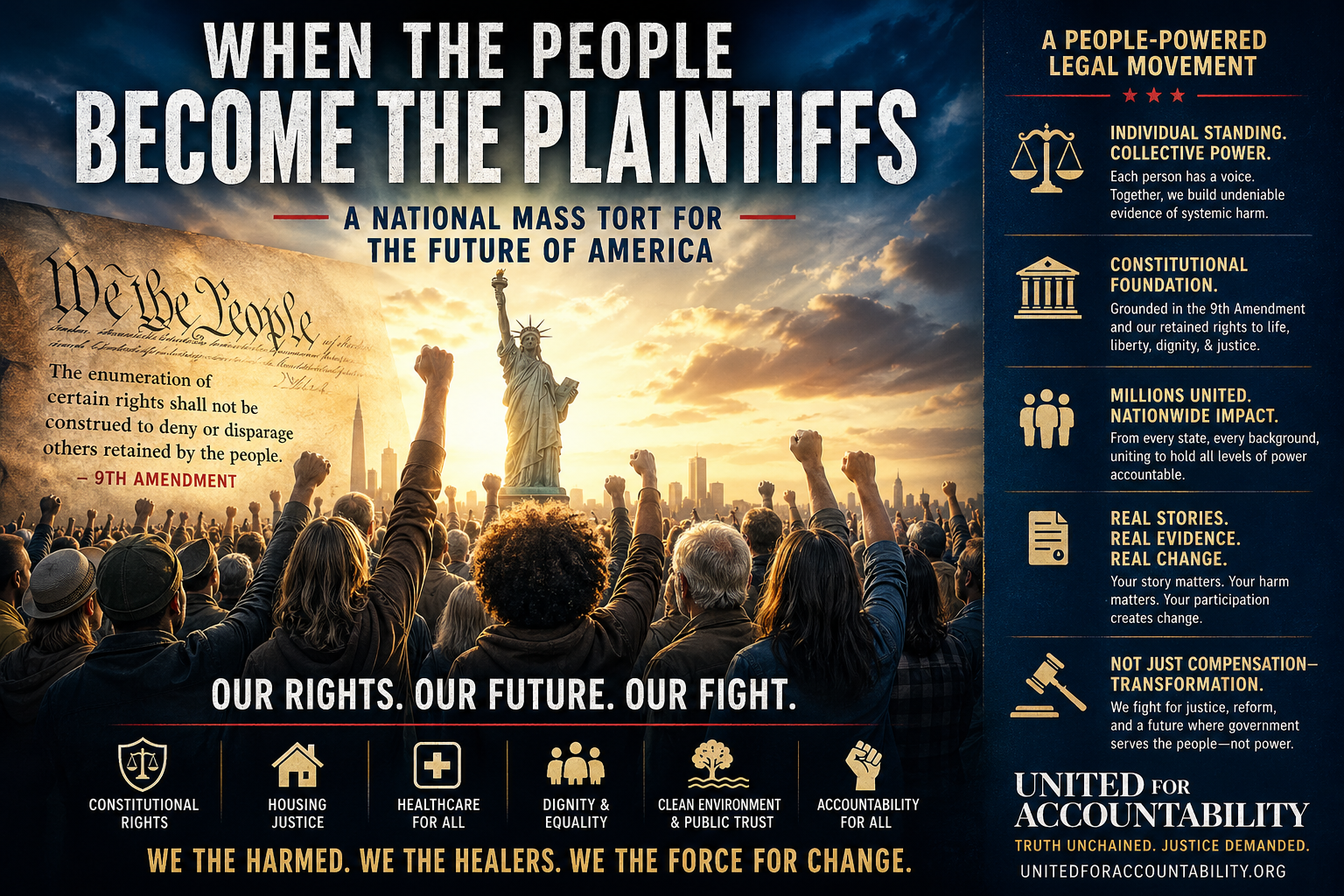
There has never been a legal moment like this. Not in scope. Not in structure. Not in purpose.
What is emerging through United for Accountability is not just another lawsuit, and it is not a class action. It is something far more foundational: a coordinated national mass tort, built on constitutional grounds, designed to allow millions of Americans to assert their rights simultaneously.
This is what it looks like when the people themselves become the legal force.
Core premise
Traditional legal systems were built for isolated disputes. This model is built for structural harm.
Housing becomes unaffordable nationwide.
Healthcare is systematically denied.
Government power is captured by private interests.
Constitutional protections erode across entire populations.
Once harm reaches this level, you no longer have isolated injury. You have a system producing injury. That is where this framework changes everything: it treats structural harm as something that can be challenged with coordinated constitutional force.
How it works
Built to scale without erasing the individual
Individual standing remains intact
Every harmed person can file or participate as an individual plaintiff, maintain their own standing, and add to a larger body of evidence without surrendering control of their claim.
Cases are organized by harm category
Claims can be grouped into fronts such as housing injustice, healthcare denial, institutional abuse, environmental harm, and constitutional violations while still remaining connected.
Every case shares one backbone
The legal architecture ties each filing to civil-rights pathways, due process, equal protection, federal liability frameworks, and the 9th Amendment.
Shared framework
- 42 U.S.C. § 1983 for civil-rights violations
- Due Process and Equal Protection under the 14th Amendment
- Cruel and Unusual Punishment under the 8th Amendment
- Federal liability pathways such as the Federal Tort Claims Act
- The 9th Amendment as a living constitutional lever
Why the 9th Amendment matters
“The enumeration of certain rights shall not be construed to deny or disparage others retained by the people.”
Most legal fights begin and end with rights that institutions already agree to recognize. This movement does something more ambitious. It activates rights that were never fully written down, but were always retained by the people.
The right to housing stability
The right to bodily integrity and care
The right to economic survival
The right to truthful governance
The right to dignity
That is the real shift. This is no longer about asking institutions what rights exist. It is about the people asserting those rights at scale and forcing institutions to answer to them.
From thousands to millions
Collective standing without dilution
Because this is not a class action, there is no cap on participation, no forced grouping of claims, and no requirement that people surrender the specificity of their own harm. Every person adds something the system cannot easily dismiss.
Adds
Evidence
Adds
Legal weight
Adds
Pattern recognition
Adds
National visibility
Policy failures become constitutional violations.
Negligence becomes civil conspiracy.
Disparate harm becomes undeniable proof.
What this targets
Housing and homelessness
- Criminalization of the unhoused
- Corporate ownership driving displacement
- Denial of basic shelter and stability
Healthcare and medical neglect
- Denial of coverage or treatment
- Profit-driven care decisions
- Disparities in access and outcomes
Government and institutional abuse
- Over-policing and unlawful detention
- Suppression of protest
- Surveillance of citizens
Economic disenfranchisement
- Wage stagnation against cost inflation
- Debt cycles and financial control
- Loss of generational wealth
None of these are framed as mere policy disagreements. Under this model, they become constitutional questions with standing attached to lived harm.
Why this is structural
Not about payouts. About restoration.
- Injunctive relief that forces policy change
- Structural reform that ends harmful systems
- Public accountability across institutions
- Recovered resources redirected into housing, healthcare, legal access, and community rebuilding
A constitutional reversal of power
The Constitution was written to limit government, not empower it.
The people, not institutions, are the ultimate interpreters of constitutional limits.
Government cannot define the boundaries of its own power.
Rights do not originate from courts. They are retained by the people.
Old model
Government defines rights. People respond.
Emerging model
People assert rights. Government answers.
The future
A legal movement, not a legal moment
Built to continue
- Ongoing case filings
- Continuous story intake
- Expanding legal categories
- Growing national participation
Built to scale
- Public submissions
- Legal coordination
- Evidence aggregation
- National visibility
If half the country participates
- Courts face unprecedented volumes of aligned constitutional claims.
- Patterns of harm become legally undeniable.
- Institutional defenses weaken under consistency of evidence.
- Public pressure and legal pressure converge.
At that point, this is no longer theoretical. It becomes a constitutional stress test of the system itself.
Final thought
This is the people's case
This is not about ideology. It is about structure.
It is about whether rights are real or conditional.
It is about whether government serves people or power.
It is about whether harm can be normalized or challenged.
This mass tort answers those questions with action, not by asking for permission, but by asserting standing at scale.
We the Harmed.
We the Healers.
We the Force for Change.