This site is under construction - will be ready soon.

News Credit: TikTok- ghggvv @ghggvv374
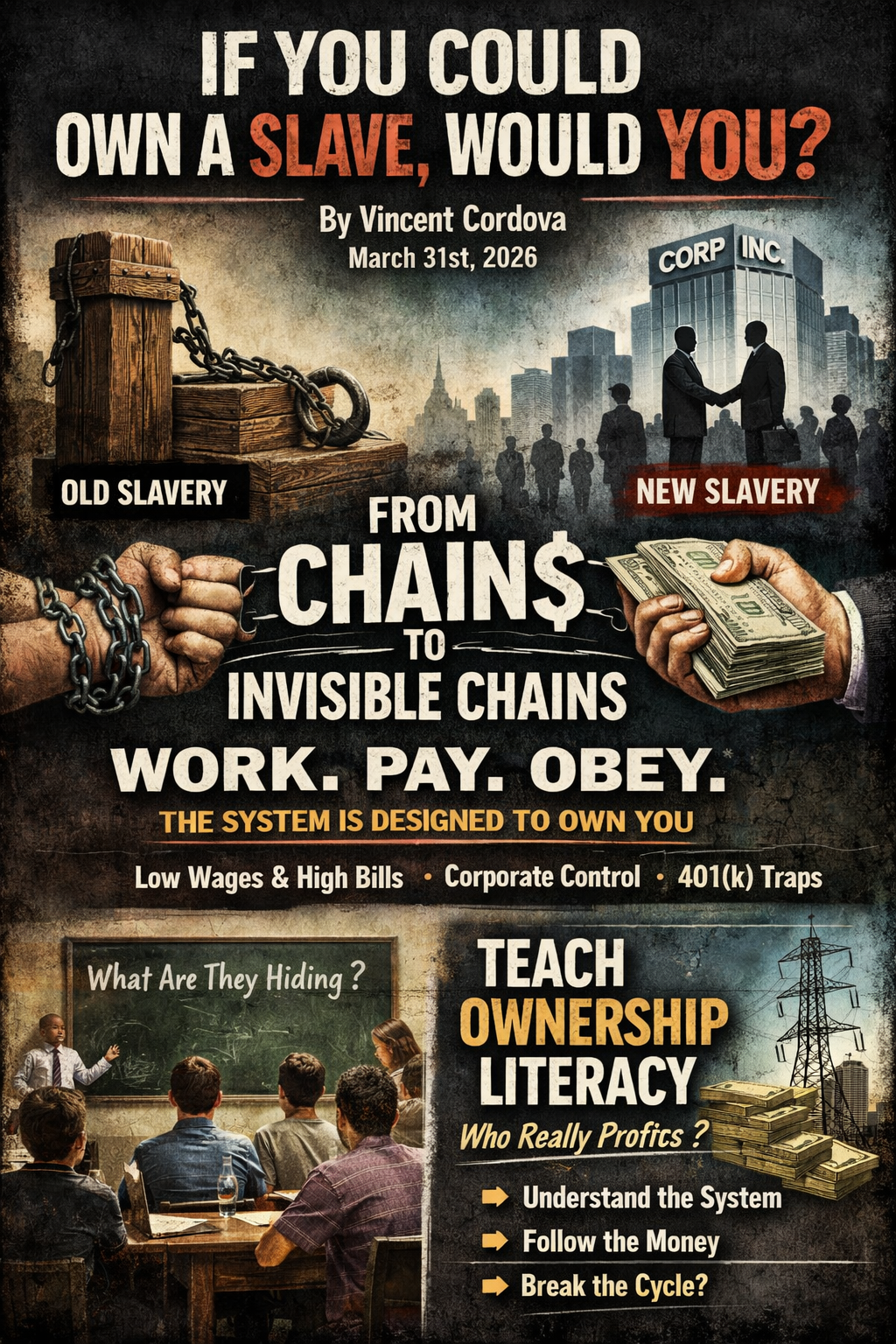
If You Could Own a Slave, Would You?
By Vincent Cordova · March 31st, 2026
That’s the question I want to start with.
If you could legally own another human being—control their labor, their body, their future, their rent, their groceries, their lights, their banks, the air they breathe (do you actually own the person already)—would you own them for you or for them or their safety?
And if you did, what would they look like? Would you let yourself see them as a whole person? Or would you have to convince yourself they were less than human to live with what you were doing? Can “you” even see a whole human in the conditions you are living in now? Are the conditions for your benefit? If you were looking at yourself from the outside, as you are today—is life built for you or to own everything you do—basically owning you? Should we change this?
I ask this because I see modern America with invisible chains—and those chains never benefit you, just extract from you. Just like labor was extracted from slaves. Are these people that want to own slaves around us today? Do you think it is important to teach our students how the shareholder system works? The chains are gone—but the system of invisible chains is still intact – same people, different names. The auction blocks are museums—now it is corporations on that block that dictate every move you basically make, managed through PE firms or institutional holdings.
But I ask it because the people who did own slaves didn’t stop existing when slavery ended. Did they? They didn’t wake up in 1865 with a sudden moral awakening. They adapted. They found new ways to own, to control, to extract—without the legal burden of calling it slavery.
(I see my fellow human working for wages that cannot support life. I see food with harmful chemicals just so it will last on a shelf longer. I see corporations making billions while people can barely keep the lights on. I see those chains, that foot on their neck, and I want them removed—you have one life to live. Do you want that foot off my neck – or do you want to apply more pressure?)
That doesn’t mean we become irresponsible and tear things down, unless necessary—that means we find, change, or create new ways so you can thrive in this one life. We do that for each other—but it does require you seeing a whole human.
I remember learning about slavery in school. I watched the videos. I read the books. I felt the horror. But I never once connected the dots that the slaveholders didn’t change—and that I was living in a new system designed by them. Designed by them. Designed by them…
That’s the part they never taught me. That’s the part they never teach any of us.
The New System: A Case Study
I spent weeks digging into one piece of that system: the electric grid. I wanted to understand how ownership works when the thing being owned is a basic necessity of life.
Take California’s biggest utility: PG&E.
• 2024 profit: $2.48 billion
• 2025 profit: $2.59 billion
• 2024 dividends to shareholders: $86 million
• 2025 dividends: $317 million (and rising to 20% of profit by 2028)
At the same time, they’ve been cutting operations and maintenance spending—down $116 million in 2024, down another $459 million in 2025. They call it “operational efficiency.” The CEO said: “Performance is power.”
Translation: cut costs, boost profit, reward shareholders.
But wait—aren’t they spending billions on the grid? Yes. PG&E announced a $73 billion capital investment plan for 2026–2030. Sounds like they’re pouring money into repairs, right?
Here’s what they don’t tell you: that money isn’t coming from profit. It’s coming from you.
Under the “cost-plus” model, every dollar PG&E spends on infrastructure gets added to something called the rate base. Regulators then allow them to earn a guaranteed return on that rate base—around 10%—which they collect from your monthly electric bill.
So the cycle is:
1. PG&E borrows money or raises rates.
2. They spend on capital projects.
3. You pay for it through higher bills.
4. They earn a profit on top of what you already paid.
5. That profit goes to shareholders, not back into repairs.
The repairs are funded separately. The profits are extracted separately.
And while they’re telling you about all the money they’re “investing,” they’re quietly cutting operating expenses—the stuff that actually keeps the lights on—to boost their bottom line.
Where Do Tax Dollars Fit?
Federal grants for the grid exist. In March 2026, the SPARK program awarded $1.9 billion for transmission upgrades nationwide. The GRIP program has handed out about $7.4 billion over the past few years.
But that’s taxpayer money—our money—going to the same companies that are making billions in profit from our monthly bills. And those grants are competitive, one-time awards, not a steady stream. Meanwhile, PG&E’s profit keeps climbing every year, guaranteed.
So the public is double-dipped:
• We pay high rates → they profit.
• We pay taxes → they get grants.
• We get the bill either way.
The Deeper Trap: Your Money Is Working Against You
Most people think the extraction is just in their bills. High utility rates. Rent increases. Taxes.
But it’s deeper than that.
Your 401(k)—the thing they told you would secure your retirement—is heavily invested in the same corporations that profit from your dependency. PG&E stock is in pension funds. Utility bonds are in mutual funds. Private equity firms that own your apartment complex are funded by your bank. Now I believe PE firms can use those funds to by more of the businesses people create, homes that are built, politicians that try to block – all to manage you. Little young & old you. I see a slave in their eyes – yet we are whole humans.
Yet this current system has retirees struggling because the same “private owners” that captured their 401(k) are raising all the prices—basically forcing our retirees into the underclass.
Every dollar you save gets funneled into the same system that extracts from you, your child, your parent, and your future children. You are lending them the capital to buy more of what you need, so they can charge you more, so they can post higher profits, so your 401(k) grows a little—but never enough to actually free you.
It’s a closed loop.
You work. You save. Your savings fund their expansion. Their expansion raises your costs. You work more. You save more. The cycle continues.
They told you this was called “having skin in the game.” But the game is rigged. Your skin is on the line, but they own the table.
Why Wasn’t This Taught in School?
Here’s what I realized: I learned about slavery as a closed chapter. A moral failure we fixed. A thing of the past.
I never learned that the people who owned slaves didn’t disappear. They adapted. They built new structures—corporations, limited liability, shareholder primacy, regulated monopolies—that let them own without appearing to own, control without appearing to control.
They built a system where shareholders come before workers. Where a utility company has a legal duty to maximize returns to investors, even if that means cutting maintenance and raising your bill. Where the people who own the infrastructure never have to look you in the eye.
And they built an education system that keeps most people on the outside looking in.
They taught me how to balance a checkbook—but not how to read a financial statement.
They taught me about the stock market in abstract terms—but not how to open a brokerage account.
They taught me to be a good worker, a good borrower, a good taxpayer—but never how to be an owner.
That’s not an accident. That’s architecture.
What If We Taught the Truth?
Imagine if every middle school student learned:
• The history of chattel slavery and the continuity of power into the shareholder system.
• How regulated monopolies like utilities work—and who profits.
• How to read an annual report and find revenue, profit, executive pay, and dividends.
• How to open a custodial investment account (or simulate it).
• That alternatives exist: co-ops, public utilities, community land trusts.
Imagine if graduating high school required not just civics and algebra, but ownership literacy—the ability to see the system, navigate it, and decide whether to participate, reform, or build something new.
That’s not radical. It’s simply completing what personal finance started. Budgeting and credit scores teach you how to survive the system. Ownership literacy teaches you how to understand it and, if you choose, how to use it.
An Executive Order to Break the Invisible Chains
I’m not waiting for permission. I’m proposing we act.
Below is a draft Executive Order that would establish a federal grant program to fund ownership literacy curricula in every state, and encourage states to make it a graduation requirement.
Because I see a whole human. I have a duty to love them. And that duty means I can’t stay silent while my brothers and sisters are never taught how the system works.
I see a system designed to capture your labor—not just through bills and taxes, but through the very financial tools they taught you to trust. Your 401(k) invests in the utilities that profit from your high rates. Your savings fund the landlords who raise your rent. You are financing your own dependency and calling it security. The system doesn’t need chains. It just needs you to believe you’re building freedom while you’re actually building your cage.
I will not participate in enslaving myself or others, nor will I create any entity to exploit—only to make life better for you and the next generations. You should do the same, but that requires you to see a whole human. Can you? Should you? And will you?
EXECUTIVE ORDER
OWNERSHIP LITERACY FOR ALL STUDENTS
Section 1. Purpose.
Every student deserves to understand the economic systems that shape their lives. The transition from chattel slavery to the modern shareholder economy represents a continuity of power and extraction that is rarely taught in American schools. This order establishes a grant program and graduation requirement to ensure that all secondary students gain proficiency in the history, structure, and navigation of ownership.
Section 2. Definitions.
“Ownership literacy” includes knowledge of:
• Chattel slavery and its economic foundations;
• The development of corporate law, limited liability, and shareholder primacy;
• The operation of regulated monopolies, including investor owned utilities and the cost plus model;
• Basic financial statement analysis, including revenue, profit, executive compensation, and dividend distribution;
• Methods of investing, including custodial accounts, with a focus on long term ownership;
• Alternative ownership models, including cooperatives, public/municipal utilities, and community land trusts.
Section 3. Grant Program.
The Secretary of Education shall establish a competitive grant program to support states, school districts, and nonprofit partners in developing and implementing ownership literacy curricula. Priority shall be given to schools serving low income communities and those with limited existing financial education programs. Grants may be used for:
• Teacher training and professional development;
• Curriculum development and open source materials;
• Technology platforms for simulated investing;
• Field experiences with public utilities, co operatives, or financial institutions.
Section 4. Graduation Requirement.
The Department of Education shall encourage states to adopt, by the 2030–2031 school year, a requirement that all high school graduates demonstrate competency in ownership literacy as defined in Section 2. Competency may be demonstrated through a capstone project, portfolio, examination, or other assessment determined by the state or district.
Section 5. Implementation and Reporting.
The Department of Education shall issue model curricula, instructional standards, and guidance within 12 months of this order. An annual report shall be submitted to the President and Congress detailing program participation, student outcomes, and recommendations for expansion.
Section 6. General Provisions.
Nothing in this order shall be construed to mandate any particular political ideology or to require student investment in private financial products. The goal is literacy, not indoctrination.
Now It’s Up to Us
The system was designed by people who once owned slaves. They didn’t stop wanting to own—they just changed what they owned. They built invisible chains: debt, ignorance, division, and a shareholder first economy that treats people as costs to be minimized.
But chains can be seen. And once seen, they can be broken.
I’m not asking for permission. I’m asking you to join me.
Read the order. Share it. Demand it from your school board, your state representative, your member of Congress. Because the only thing more powerful than a system designed to hide the truth is a generation trained to see it.
I see a whole human. You are my essence. Your growth is our growth. Let’s teach the truth and break the chains.