Agricultural Sovereignty
This Is Happening Everywhere: Jeff Melin's Farm and the National Pattern of Eminent Domain Abuse Against American Farms
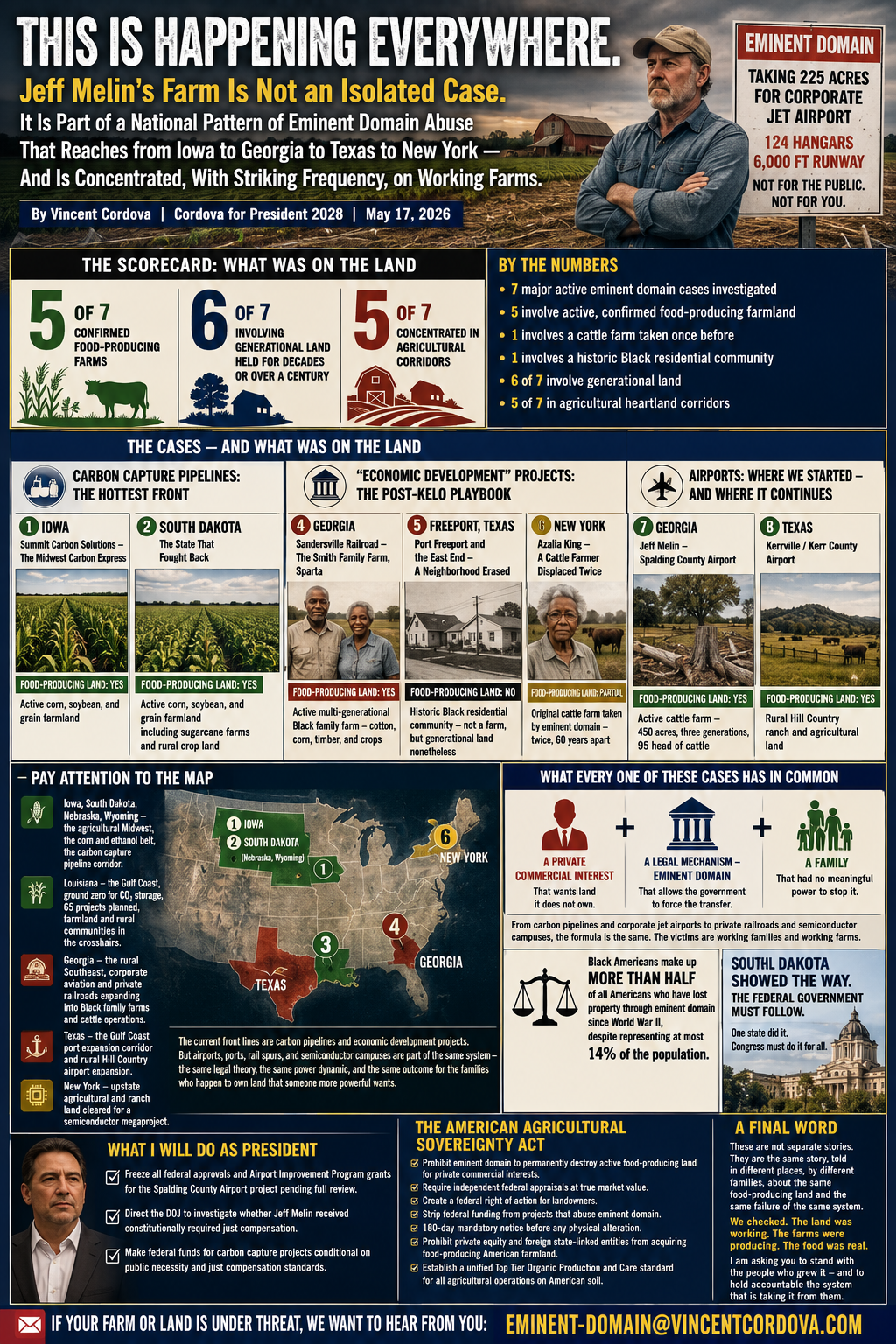
Vincent Cordova argues that the seizure of Jeff Melin's farm in Georgia is part of a broader national pattern in which active food-producing land is repeatedly targeted for corporate projects backed by public power.
Campaign design team
Jeff Melin has worked the same land in Spalding County, Georgia, for his entire life. His father farmed it before him. His family raised cattle there, worked the soil there, and planted pecan trees there across generations. Now half that land is being taken for a corporate-jet airport project.
The agricultural source document behind this page argues that the Melin case is not a strange local exception. It is one visible instance of a broader national pattern in which eminent domain, federal incentives, and private commercial ambition keep converging on active food-producing land.
The question is not whether these stories are identical. They are not. The question is whether the pattern is real. The answer in the campaign's investigation is yes: again and again, the land under pressure is working land.
The Cases and What Was on the Land
Active corn, soybean, and grain farmland
Iowa | Summit Carbon Solutions
The source document identifies the Midwest Carbon Express pipeline as one of the clearest current examples of a federally subsidized corporate project running directly through productive farmland. The farmers in its path are not abstract landowners. They are operating on live agricultural ground.
Active agricultural land in the same corridor
South Dakota | The state that fought back
South Dakota is highlighted as proof that resistance is possible. The state banned eminent domain for CO2 pipelines altogether, demonstrating that farmland protection can be written into policy rather than left to piecemeal appeals.
Sugarcane farms and rural crop land
Louisiana | Carbon capture expansion
The campaign's research points to southwest Louisiana as another front where carbon-capture expansion and eminent-domain pressure collide with active agricultural land. Farmers showed up to oppose the bill's failure because they understood what was at stake.
Multi-generational Black family farm producing crops and timber
Georgia | The Smith family farm
In Sparta, Georgia, the Smith family's century-held land is being cut by a rail spur serving quarry interests. The document treats this as an especially stark example of how Black family land remains vulnerable to public-power transfers justified in the language of development.
Cattle-farm land and long-held agricultural property
New York | Azalia King
Azalia King's story matters because it shows the time scale of the problem. She and her family were displaced from one cattle-farm property decades ago, built life again on other agricultural land, and then faced eminent-domain pressure once more for a semiconductor project.
Active cattle farm with generational equipment and pecan trees
Georgia | Jeff Melin
The Melin case remains the page's anchor because it concentrates the entire pattern into one image: productive land, compressed timelines, trees destroyed before process is complete, and compensation the campaign argues falls well short of true value.
Rural Hill Country ranch and agricultural land
Texas | Kerrville and Kerr County airport
Airport expansion in Texas reinforces the point that the Georgia story is not unique to one county or one state. Different project, same pressure: transportation infrastructure colliding with working land.
What These Cases Have in Common
The source document reduces the recurring structure to three elements: a private commercial interest wants land it does not own, the government provides the mechanism that can force transfer, and a family or local community lacks the power to stop it on equal terms.
It also makes an important distinction: not every case is a farm. Freeport's East End was a historic Black residential community, not food-producing land. But even that case reinforces the same deeper warning about public power being used to clear generational ground for projects whose public necessity is weak or post-hoc.
The result is a policy landscape where working farmland can disappear while agencies still talk as though the main issue is technical compliance. The campaign argues that this is exactly backwards. Food-producing land is itself a public-interest asset.
- Corporate projects keep receiving public leverage even when they permanently destroy active agricultural land.
- Farm families are routinely forced into asymmetrical negotiations over time, valuation, and legal process.
- Federal money, tax benefits, approvals, or regulatory deference often sit behind the projects driving the land loss.
- The burden of proving why the land should be preserved is repeatedly placed on the people already living and producing there.
What a Cordova Administration Would Do
The agricultural source text says the federal government must stop pretending these are isolated local land fights and start treating them as national food-security questions. That means federal standards tied to federal approvals, funding, and tax-subsidy structures.
The document specifically calls for immediate review of the Spalding County Airport project and for a broader American Agricultural Sovereignty Act that would make active food-producing land far harder to seize or convert for primarily private commercial purposes.
- Freeze federal approvals and Airport Improvement Program support for the Spalding County airport project pending review.
- Require independent federal appraisals at true market value before agricultural takings are finalized.
- Create a federal right of action for landowners paid below market value.
- Strip federal funding from projects that use eminent domain against agricultural land without genuine public necessity and just compensation.
- Require a 180-day notice period before any physical alteration of taken agricultural property.
- Pair eminent-domain reform with broader farmland protections against private-equity capture and foreign state-linked control.
A Final Word
The Iowa farmer watching drainage systems threatened by a carbon pipeline, the Louisiana families who drove to testify and watched their protection bill fail, the Smith family in Georgia, Azalia King in New York, and Jeff Melin in Spalding County are not living unrelated stories. They are living regional expressions of the same structural failure.
The source document closes on a simple point: the land was working, the farms were producing, and the food was real. That should be enough to change how the country thinks about public necessity.
If your farm or land is under threat, contact the campaign at eminent-domain@vincentcordova.com.
Related agricultural documents