Civil Liberties
Why Clemency for Hasan Piker and Medea Benjamin Is a Test of American Courage
Clemency is not weakness. It is constitutional backbone when institutions try to intimidate lawful dissent.
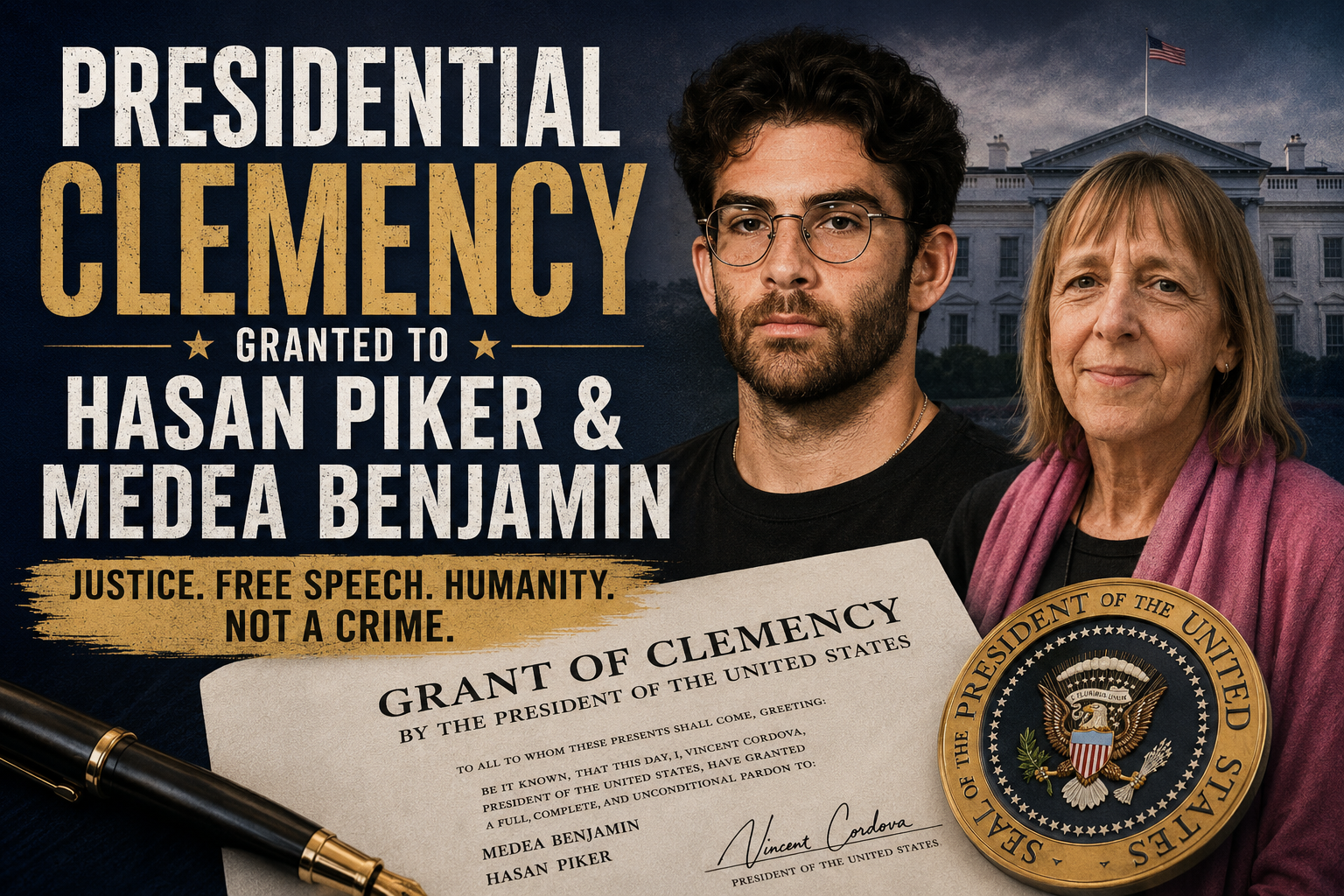
Let me be direct. A country that says it supports free speech but punishes anti-war speech is not defending liberty. It is performing liberty.
That is why I published an executive grant of clemency for Hasan Piker and Medea Benjamin. This is not about celebrity. It is not about internet factions. It is about whether constitutional protections still mean anything when speech challenges concentrated power.
If speech is only safe when it is comfortable, it is not free. If dissent is only tolerated when it is weak, it is not protected. And if anti-war advocacy can be treated as criminal pressure instead of civic duty, then democracy has already begun to collapse from the inside.
The constitutional stake
Clemency is often framed as mercy. It can be that. But in moments like this, clemency is also constitutional correction.
The founders gave the executive clemency power because legal systems are operated by human beings, and human systems can be bent by fear, faction, and political revenge. Clemency exists to stop damage when the state drifts away from justice.
In this case, the principle is clear: anti-war speech and organizing are protected civic activity. Criticizing state violence is protected civic activity. Demanding accountability from government officials is protected civic activity.
This standard applies beyond two names. If others were with Hasan Piker and Medea Benjamin and were targeted in the same action under materially equivalent facts, they should receive the same clemency consideration and outcome.
When institutions blur those lines, a president has a duty to reassert the constitutional boundary in plain language and binding action.
Doctrine
- Speech rights do not disappear when war rhetoric escalates.
- Public criticism of power is not subversion. It is democratic maintenance.
- Prosecutorial discretion cannot become a weapon against lawful dissent.
- The state must never claim emotional discomfort as a legal basis to silence anti-war civic speech.
The cost of silence
Some people will ask: why spend political capital on this? Because silence in moments like this creates the next abuse.
Every time institutions test whether they can criminalize dissent, they are not only targeting one speaker. They are measuring how many millions of people will self-censor next time.
The pattern is always the same. First, officials describe dissenters as dangerous. Then media ecosystems normalize exceptional treatment. Then legal pressure follows. Then everyone else gets the message: lower your voice, stay inside approved language, and do not challenge war policy in public.
That is not security. That is social conditioning for obedience.
Closing
This clemency declaration is a constitutional line in the sand. It says that in America, dissent is not a defect in the system. Dissent is one of the system's immune responses.
If your speech has to pass a comfort test for powerful institutions before it is considered legitimate, then rights are no longer rights. They are permissions.
My position is straightforward: no administration that I lead will criminalize anti-war speech to protect reputations, careers, or narratives. We will protect the right to challenge power, especially when that power claims moral exception for violence.
That is how a republic stays a republic.