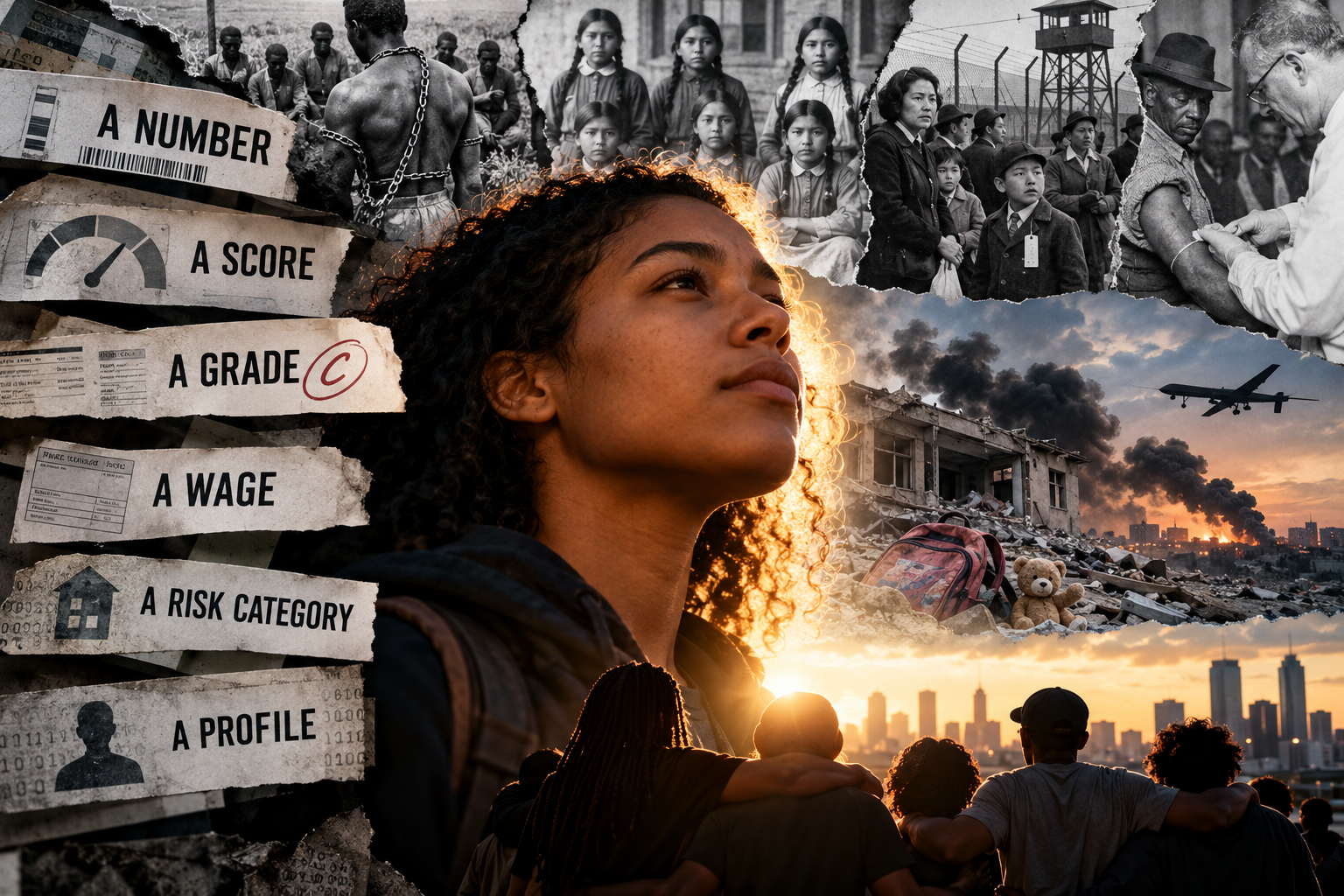
A number, a score, a grade, a wage, a risk category, a profile. None of them were ever you.
By Vinnie Cordova••Cordova 2028: Moving Forward Together
A number
A score
A grade
A wage
A risk category
A profile
Campaign design team
Before you ever got the chance to ask who you are, someone else had already answered.
A hospital
A number
A bank
A score
A school
A grade
An employer
A wage
A landlord
A risk category
An algorithm
A profile
A hospital assigned you a number. A bank assigned you a score. A school assigned you a grade, an employer assigned you a wage, a landlord assigned you a risk category, and an algorithm you will never see assigned you a profile it sells by the thousandth of a cent. By the time most of us are grown, we have been described so many times by so many systems that we start repeating their answers back to ourselves.
I’m a renter.
I’m in debt.
I’m just a driver.
I’m nobody important.
This piece is about taking the question back. Not with slogans. With history, with honesty, and with a plain look at what you actually are when every label is peeled off.
Peel them off
The Labels Were Never You
Your job title describes a contract, not a person. It tells someone what you agreed to do between certain hours for a certain price. It says nothing about why you get up, who you’d die for, or what you’d build if nobody was charging you rent to exist.
Your credit score describes how reliably you’ve paid lenders. It does not measure your honesty, your discipline, or your worth. Plenty of people with perfect scores have never kept a promise to another human being. Plenty of people with ruined scores kept every promise that mattered and went broke doing it.
Your bank balance describes a moment. Your zip code describes where you could afford to land. Your diploma, or the lack of one, describes which doors were open to you at eighteen.
Job titledescribes a contract
Credit scoredescribes how reliably you’ve paid lenders
Bank balancedescribes a moment
Zip codedescribes where you could afford to land
Diplomadescribes which doors were open to you at eighteen
None of these are lies. They’re just small.
None of these are lies. They’re just small. Each one measures your usefulness to some institution. Not one of them was designed to tell you who you are, because no institution has ever had an interest in you knowing that.
A person who knows who they are is harder to…
underpayfrightensell todivide from their neighbors
A person who knows who they are is harder to underpay, harder to frighten, harder to sell to, and harder to divide from their neighbors. That’s not a side effect. That’s the whole reason the question gets answered for you so early.
The definition comes first
History’s Oldest Trick: Deciding Who Counts
Every great injustice in this country’s history began the same way. Someone with power decided what a group of people were, and then wrote that definition into law.
Enslaved people
Defined as: Property
The Constitution counted them as three-fifths of a person for the purpose of giving their enslavers more seats in Congress. The definition came first. The whip, the auction block, and the broken families followed from it.
Native children
Defined as: Problems to be corrected
Federal boarding schools took them from their families, cut their hair, changed their names, and punished them for speaking their own languages. The founder of the Carlisle school summed up the mission as “kill the Indian in him, and save the man.” Erase who they were, and they become whatever the government needs.
Japanese Americans
Defined as: Threats
In 1942, roughly 120,000 people, most of them U.S. citizens, were forced from their homes into camps. No individual evidence. Their ancestry was the accusation.
Black men in Tuskegee
Defined as: Research material
For forty years, the U.S. Public Health Service watched them suffer from syphilis and withheld treatment that existed, because to the study they were data points, not patients.
Look at the pattern. The violence never starts with the violence. It starts with a definition. Somebody gets to say who you are, and once that’s settled, everything done to you looks like administration.
The violence never starts with the violence.It starts with a definition.
The same logic still runs today. When a strike kills children in a school and the official word is “collateral,” a definition has been applied. When a worker injured on the job becomes a “liability,” a definition has been applied. When a family becomes a “unit” and a neighborhood becomes a “market,” a definition has been applied.
A child killed in a school→“Collateral”
A worker injured on the job→“Liability”
A family→“Unit”
A neighborhood→“Market”
The people who survived all of this, and resisted it, held onto one thing the definitions could never take: their own knowledge of who they were. The languages hidden in the boarding schools. The songs carried through slavery. The families who came home from the camps and rebuilt. That inner knowledge is not soft. It is the hardest thing a human being owns.
Newest first
The Record We Were Never Taught
Most of us graduated without ever seeing this list in one place. Some of it got a paragraph in a textbook. Most of it got nothing. Here it is, newest first, because the pattern only becomes visible when you stop reading it one event at a time.
Feb 28, 2026
Defined as less: Iranian children
U.S. Tomahawk missiles struck the Shajareh Tayyebeh girls’ primary school in Minab, Iran. Iranian officials report more than 150 killed, around 120 of them schoolchildren. In September a UN fact-finding mission found reasonable grounds that U.S. forces were responsible and called it an indiscriminate attack amounting to a war crime. The White House rejected the report.
Feb 28, 2026
Defined as less: Iranian civilians
Strike on a sports complex in Lamerd, Iran; the same UN mission found it indiscriminate, with 22 civilians killed or injured.
2021
Defined as less: Afghan families
Kabul drone strike killed 10 civilians, seven of them children, after a misidentified threat.
2015
Defined as less: Patients and doctors
U.S. aircraft struck a Doctors Without Borders hospital in Kunduz, Afghanistan, killing 42.
2003–2004
Defined as less: Iraqi prisoners
Torture and sexual humiliation of detainees at Abu Ghraib, confirmed by the Army’s own investigations.
2002–present
Defined as less: “Enemy combatants”
Indefinite detention without trial at Guantánamo Bay; CIA rendition to secret sites.
1988
Defined as less: Civilian passengers
USS Vincennes shot down Iran Air Flight 655, killing all 290 aboard.
1980s
Defined as less: Central American villagers
U.S. military aid to Salvadoran forces implicated in massacres, including El Mozote; backing of the Nicaraguan Contras.
1964–1973
Defined as less: Rural farmers
Massive bombing of Laos and Cambodia; unexploded cluster munitions still kill people today.
1968
Defined as less: Vietnamese villagers
My Lai: U.S. soldiers murdered hundreds of unarmed Vietnamese women, children, and elders.
1953–1973
Defined as less: Foreign voters
CIA-backed coups or destabilization in Iran, Guatemala, and Chile.
1950
Defined as less: Refugees
U.S. soldiers killed South Korean refugees at No Gun Ri.
1945
Defined as less: Japanese civilians
Firebombing of Tokyo; atomic bombings of Hiroshima and Nagasaki. Their justification is still debated; their civilian toll is not.
1942–1945
Defined as less: Citizens of the “wrong” ancestry
About 120,000 Japanese Americans forcibly incarcerated.
1932–1972
Defined as less: Black patients
Tuskegee: Black men denied available syphilis treatment for decades.
1921
Defined as less: Black property owners
Tulsa: white mobs destroyed the Greenwood district while authorities failed to protect it.
1899–1902
Defined as less: Filipinos
Philippine-American War: torture, village burnings, and the 1906 Bud Dajo massacre.
1864–1890
Defined as less: Native nations
Sand Creek and Wounded Knee massacres; destruction of Plains nations.
1830s–1850s
Defined as less: Native families
Trail of Tears: forced removal of Native nations; thousands died.
1776 onward
Defined as less: Enslaved Africans and their descendants
Chattel slavery written into law.
At home the list keeps going: lynching and Jim Crow, forced sterilizations, COINTELPRO’s war on civil rights groups, MKULTRA’s human experiments, children separated from parents at the border in 2018, and the poisoned water of Flint.
Not every death on this list is legally a war crime, and accidents are not the same as deliberate targeting. That’s exactly why every one of them deserves the same five questions:
1
Responsibility.
Who ordered, carried out, paid for, or knowingly enabled it?
2
Knowledge.
What did the decision-makers know about the harm to civilians?
3
Legality.
Did it break our law or international law?
4
Accountability.
Was anyone investigated, prosecuted, or forced to reform?
5
Remedy.
Were survivors and families acknowledged and made whole?
For almost every row above, the honest answer to the last two questions is no. And none of this indicts ordinary Americans. Americans exposed My Lai. Americans leaked the Abu Ghraib photos. Americans marched against every one of these wars. Knowing the record is not hating your country. It’s refusing to let your country be defined by the people who did this in your name.
Written in spreadsheets
What the Economy Says You Are
Today the definitions are rarely written in law. They’re written in spreadsheets.
To…you are
The company that employs you
a line item that looks better when it shrinks
Labor cost
The private equity firm that bought that company
in a return model with a five-year exit
A variable
The platforms on your phone
your attention and your data are what they sell
Inventory
Your insurer
Risk
Your landlord’s investment fund
Yield
To the company that employs you, you are a labor cost, a line item that looks better when it shrinks. To the private equity firm that bought that company, you are a variable in a return model with a five-year exit. To the platforms on your phone, you are inventory: your attention and your data are what they sell. To your insurer, you are a risk. To your landlord’s investment fund, you are yield.
Notice what each of these has in common. In every one, you are the thing being used, and someone else is the one deciding.
That is the quiet shift of the last fifty years. Ownership moved further and further away from the people doing the work. The owner used to be the person down the street with their name on the sign. Now the owner is an institution, the board answers to the institution, and the worker who actually creates the value has no seat at any table where the value gets divided.
When you live long enough inside a system like that, you can start to believe its description of you. You start to feel like a cost. You apologize for needing healthcare. You feel guilty for wanting a day off. You measure your life by what it produces for somebody else.
I want to say this as plainly as I can:
that description is wrong.
It isn’t just unfair. It is factually wrong about what you are.
When every label is peeled off
What You Actually Are: Five Truths
1
You are a source, not a resource.
A resource is something extracted. A source is where things come from. Every product on every shelf, every road, every building, every line of code, every meal served and package delivered started with a human being deciding to make it happen. Capital doesn’t build anything. Money sitting in an account has never laid a brick. People do the building. You are where value comes from, not a cost subtracted from it.
2
You are an inheritor.
You didn’t start from zero. You are carrying the survival of everyone who came before you: people who crossed oceans, walked trails they were forced onto, worked fields they didn’t own, organized when organizing got you killed, and still managed to raise children who raised children who raised you. The forty-hour week, the weekend, the right to vote, the end of child labor, none of it was given. It was won by ordinary people who knew who they were. That inheritance is yours, and so is the obligation to add to it.
3
You are a sovereign.
In this country, power is supposed to flow up from the people, not down onto them. That isn’t a metaphor. It’s the founding claim of the whole arrangement. Governments, corporations, and courts exist because people allowed them to exist. Your body, your mind, your data, your vote, and your labor are yours first. Anyone who wants them has to ask, and you are allowed to say no.
4
You are unfinished.
Who you are is not a verdict already handed down. It’s a direction you’re still choosing. The worst day of your life does not define you, and neither does the best. People who have done terrible things have turned around. People who started with nothing have built something lasting. You are not your past. You are what you decide to do with it next.
5
You are a piece of something larger.
This is the one the systems most want you to forget. You were never meant to be a self-sufficient unit competing against everyone else. No human being in history has survived alone. You were fed by farmers you’ll never meet, taught by people who never got rich teaching, protected by strangers, and carried by community at every stage of your life. Your strength has always been borrowed and lent.
Why I close with it
The Piece and the Whole
I close everything I write with the same line, and I want to explain why:
I am a piece of the collective essence of this world that never gives up and needs every other piece to be whole.
That sentence is my answer to the question of who I am. Every part of it is deliberate.
A piece.
Not the whole. Not the center. Not above anyone. One part, the same as you.
Of the collective essence of this world.
Whatever makes a human being human, the capacity to love, to build, to grieve, to imagine, to refuse, it isn’t owned by any one of us. It runs through all of us. When a child dies in a school halfway around the world, something of us dies too, whether we feel it or not.
That never gives up.
That’s the inheritance. That’s the trail survivors, the people who came home from the camps, the workers who kept striking. Giving up is the one thing the human story has never fully done.
And needs every other piece to be whole.
This is the part people skip. My wholeness depends on yours. I can’t be fully free while my neighbor is owned by their debt. I can’t be fully safe while someone else’s children are called collateral. Your wellbeing is not charity I extend to you. It is a condition of my own.
That is the opposite of what the extraction economy teaches. It teaches that your gain is my loss. The truth is that the whole only works when every piece is cared for. A body doesn’t survive by letting its hands starve.
Financialized capitalism
The Design of Our System, and How It Runs Through Every American
None of what’s on that record happened outside the system we live in every day. It happened through it. And every American is wired into that system, whether we chose it or not.
Start with what kind of system it is. Roughly 180 to 190 countries run some form of market economy, but they don’t all run it the same way. Ours is best described as financialized capitalism: an economy where finance, asset prices, and investment returns steer what gets built, who gets hired, and what things cost. In much of it, the owners aren’t the founder down the street anymore. They’re private equity firms, asset managers, and institutional investors. They elect or designate the board. The board picks the CEO. The CEO sets the wages, the staffing, and the prices. The workers who actually produce the value sit at the bottom of that chain with no vote at all. Economists call that arrangement shareholder primacy with concentrated control.
Capitalism doesn’t require exploitation. A business can pay well, share ownership, and serve the public. Cordova Courier is built that way on purpose. But when the only legal duty running up the chain is return on capital, everything below it, including you, gets measured as cost.
The results are on the books. The Federal Reserve’s 2025 survey puts the typical American family’s net worth at $215,900, while the average is $1.24 million. That gap exists because a small number of families hold so much. The Congressional Budget Office found that in 2022 the top 10% of families held 60% of all wealth, and the bottom half held 6%, the same 6% they held in 1989. More than thirty years of work, and the bottom half of the country didn’t move.
Family net worth · Fed 2025 survey
$215,900
typical (median)
$1.24M
average
Share of all wealth, 2022 · CBO
Top 10% · 60%
6%
Bottom half: 6% in 2022, the same 6% they held in 1989.
Now here is how that system reaches every single American, not just the poor, not just the powerful:
Your taxes.
Every paycheck funds the federal budget, and that budget buys the missiles. The Tomahawk that hit the school in Minab was paid for by American workers. You didn’t choose the target. You did pay for it.
Your retirement.
If you have a 401(k) or a pension, your savings sit inside the same asset managers that own defense contractors, rental portfolios, insurers, and the company that sets your wage. You are, quietly, one of the owners at the top of the chain and one of the workers at the bottom of it.
Your labor.
The value you produce flows up the chain. The decisions about you flow down it.
Your data.
Everything you search, buy, and say online is sold to build the profiles that price your insurance, your loans, and your rent.
Your vote.
Every one of these wars, budgets, and laws was carried out in the name of the American people. That means you and me.
Your education.
The schools that taught you to rank yourself, the next section, are what keep the whole arrangement feeling normal.
That’s the hard truth and the hopeful one at the same time. If the chain runs through every American, then every American is a place the chain can be broken.
Every American is wired into the same chain
The chain as designed
Institutional owners
asset managers, private equity
↓ decisions down · ↑ value up
Board of directors
elected or picked by the owners
↓ decisions down · ↑ value up
Executives
set wages, staffing, and prices
↓ decisions down · ↑ value up
Workers
produce the value; no seat, no vote
Every American is tied in
Your taxes→buy the missiles used in your name
Your savings→sits with the funds at the top
Your labor→is the value flowing up the chain
Your data→is sold to price your life
Your vote→authorizes all of it
↓ what the chain teaches us to forget
The Species Foundation
One species, 99.9% shared DNA, survival through cooperation, every piece needed
The chain sorts people top to bottom; the foundation underneath it is the one thing every person on both sides of the picture shares.
The first lesson we never got
What Our Schools Never Taught Us
We spent twelve years or more in classrooms and most of us were never taught the single most important fact about ourselves: we are one species.
99.9%
DNA shared by any two human beings
1
family tree, from the same ancestral populations in Africa
Cooperation
our survival strategy
Not a metaphor. Biology. Any two human beings on this planet share about 99.9% of their DNA. Every person alive descends from the same ancestral populations in Africa. Race is a social category people invented and enforced with law and violence, not a biological dividing line in our species. And the reason humans survived at all, slower and weaker than the animals around us, is that we cooperated. We shared food, raised each other’s children, cared for the sick, and passed knowledge down. Cooperation isn’t a nice value. It is our survival strategy.
That should have been the first lesson. Instead, school taught us to sort.
What we were taught to measureWhat it trained us to believeWhat we should have been taught
Grades, class rank, test scores
Your worth is a number someone else assigns
Every mind has value; learning is shared work
Tracking into “gifted” and “remedial”
Some people are built to lead, others to serve
Ability grows with opportunity and care
History as heroes and victories
Our country’s record is mostly glory
The full record, with the same five questions applied to it
Race as a box on every form
Humans come in separate kinds
One species, one family tree
Wealth as proof of merit
The rich earned it; the poor failed
Who owns what, how they got it, and who did the work
“Personal finance”
Your job is to manage your debt
Who writes the rules for debt, wages, and ownership
Civics as three branches on a chart
Power lives far away in Washington
Power starts with you and is only borrowed by them
This is not an accident and it’s not one bad teacher. A system built on ranking people needs schools that make ranking feel natural. A child taught that they’re a 2.1 GPA from a bad zip code grows up to accept being a labor cost. A child taught that other races or other nations are different kinds of people grows up to accept the word “collateral.” The sorting in the classroom and the sorting on the battlefield are the same lesson, taught at different ages.
The sorting in the classroom and the sorting on the battlefield are the same lesson, taught at different ages.
Teachers didn’t design this. Most of them fight it every day with what little they’re given. The design came from the same place everything else on this list came from: people with power deciding what the rest of us needed to know, and what we didn’t.
Imagine a single generation of kids who learned the species foundation first. Who learned that the girl in Minab and the girl in Manteca have the same blood, the same ancestors, and the same right to grow up. That generation could not be talked into most of the record above. That’s why it has never been allowed to exist.
A practice, not a feeling
What Knowing Who You Are Demands of You
Knowing who you are isn’t a feeling you have once. It’s a practice. Here is what it looks like in real life.
1
Catch the borrowed language.
When you hear yourself say “I’m just a…” stop and finish the sentence honestly. You are not just anything. Notice which words about you came from a boss, a bill, or a feed, and decide whether you actually agree with them.
2
Name your own worth before you negotiate.
Walk into every job, every lease, every contract knowing what you bring. The other side already did their math. Do yours.
3
Refuse to define anyone else the way you were defined.
The moment you call a group of people “those people,” “illegals,” “thugs,” or “collateral,” you are using the exact tool that was used on your ancestors. Don’t pick it up.
4
Ask the five questions about power.
When something harms people, ask: Who decided this? What did they know? Was it legal? Was anyone held accountable? Were the people harmed made whole? Those questions work on a war, a layoff, or a rent hike.
5
Find your other pieces.
Join something. A union, a church, a tenants’ association, a neighborhood group, a mutual aid network, a campaign. Identity is not discovered alone in a room. It’s confirmed in the company of people who need you and whom you need.
6
Build something that outlasts you.
A business that answers to its workers. A garden that feeds the block. A kid who knows their history. Who you are is finally proven by what you leave behind for the other pieces.
A letter
To Whoever Is Reading This
Maybe you’re reading this on a break in a warehouse. Maybe in a car between deliveries, or late at night after the kids are down, or in a hospital waiting room, or in a cell. Maybe you feel like you’ve been described so many times you’ve forgotten what you sounded like before.
Here is who you are.
You are a human being with a value no market can set and no algorithm can calculate. You are the descendant of people who refused to disappear. You are the source of the work this whole economy runs on. You are a sovereign citizen of a country that is supposed to answer to you. You are unfinished, which means you are still free. And you are a piece of something enormous that is incomplete without you.
Nobody gets to take that from you. Not a boss, not a bank, not a government, not a candidate. Including me.
I’m not asking you to believe in a campaign. I’m asking you to believe what is already true about yourself, and then to go find the people who need you.
We are moving forward together, or we are not moving at all.
I am a piece of the collective essence of this world that never gives up and needs every other piece to be whole.
Vinnie Cordova Cordova 2028: Moving Forward Together cordova2028.com