Before there were corporations, currencies, stock markets, property deeds, or governments, there was life.
Human beings existed. Other species existed. The natural world existed.
Life
The foundation everything else depends on
Everything we have built since depends on that foundation. Money means nothing without the people who agree it has value. A corporation cannot run a single day without people. Property only matters because living beings create and honor the idea of ownership.
We built the systems. The systems did not build us.
So here is the question this country has to face: How did the things we created become more valuable than the lives that created them?
What Are You Worth?
We measure corporate profit to the penny. We price buildings, vehicles, stocks, patents, and commodities. We put a market value on nearly everything.
So what is a human being worth?
Is it $7.25 an hour?
Is it whatever an employer is willing to pay?
The number of hours you can work before your body or mind breaks?
Your productivity, your purchasing power, your ability to produce returns for someone else?
I reject every one of those answers.
You are not valuable because you are economically useful.
You are valuable because you exist.
Not more valuable than the person next to you. Not less. Equal.
That is the foundation everything else in this post stands on. If you take one thing away, take this: no paycheck, credit score, zip code, title, diagnosis, or circumstance has ever measured what you are worth. Those things measure economic relationships. They do not measure you.
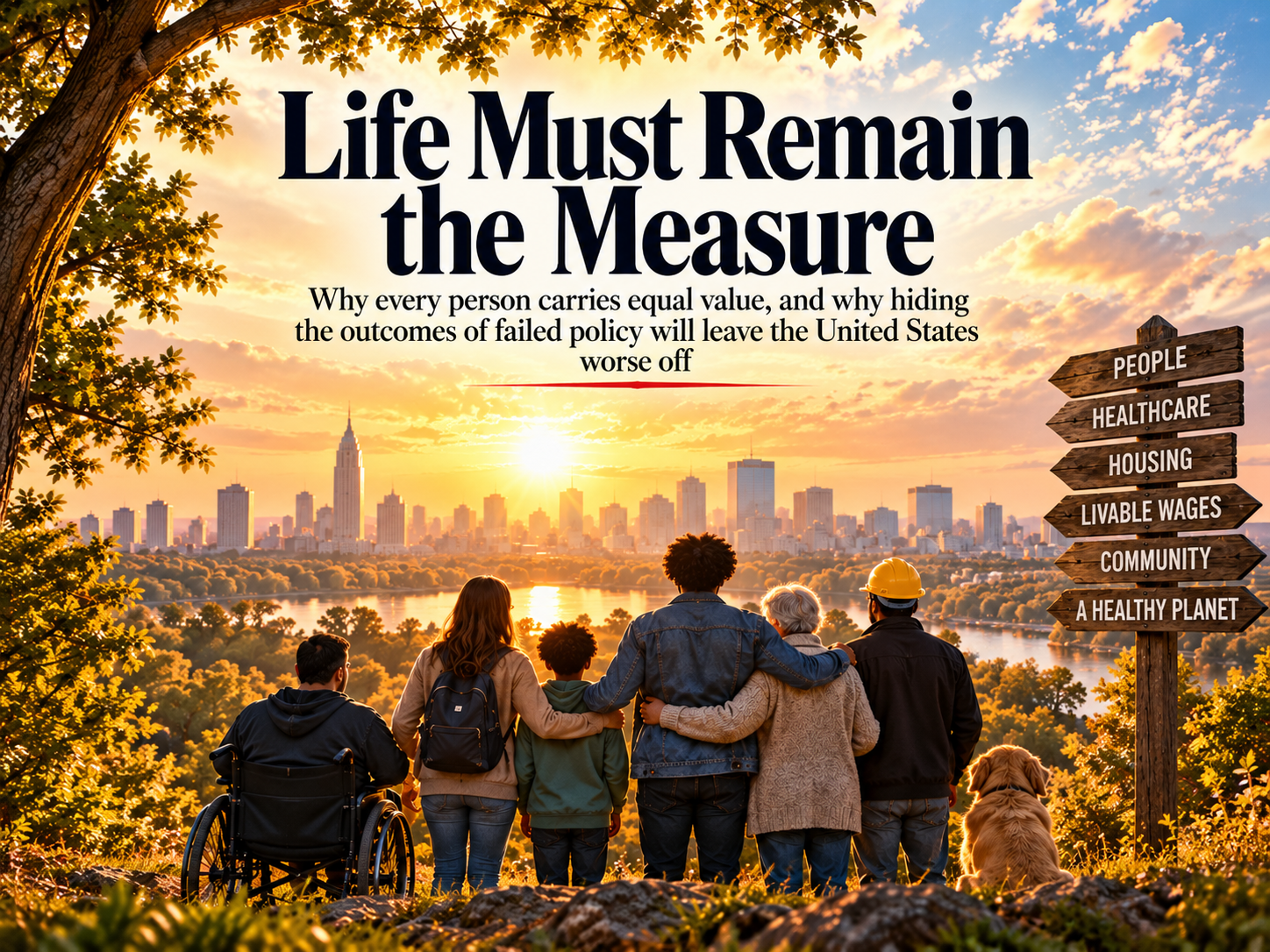
Look at the family on the hill in the image above: a man in a wheelchair, a mother, a child, a grandmother, a construction worker, and the dog who loves them all. None of them is worth more than the others. None of them can be ranked by income, by usefulness, or by how comfortable they make a city council feel.
The person on the sidewalk
1
equal life
The person in the boardroom
1
equal life
The person in the hospital bed
1
equal life
This country was founded on the claim that “all men are created equal” and endowed with an unalienable right to life. We have spent nearly 250 years widening that promise to include the people it first left out. It was never meant to stop at the edge of a tent, a hospital bed, or a jail cell.
The $7.25 Message
The federal minimum wage has been $7.25 an hour since July 24, 2009. Congress has not raised it in more than sixteen years, while inflation has steadily eaten away its buying power.
$7.25
per hour, since July 24, 2009
16+
years without a raise from Congress
$15,080
a full year of full-time work, before taxes
Work full time, 40 hours a week, every week of the year, and that floor produces $15,080 before taxes.
Many states and cities have raised their own wages above that. But roughly 20 states still sit at the federal floor.
The minimum wage was created as a protection, not a price tag on a life. But look at what that floor communicates. A person can give their full working week to a productive business and still be unable to afford rent, nutritious food, transportation, or healthcare.
Economists argue over how wage increases affect hiring and prices, and those questions deserve honest study. But they do not erase the moral question underneath:
Should a full week of work give a person a real chance at a stable life?
If the answer is yes, then wages cannot be judged only by what they cost employers. They must be judged by whether the people earning them can live.
When a Person Becomes an Expense
On a balance sheet, workers are recorded as an expense. That's an accounting tool, and it has a purpose.
The danger comes when an accounting category starts shaping how we see the people behind it.
A worker is not a cost to be minimized. A worker is a human being with children, aging parents, dreams, relationships, and a body that wears out. Their time is finite. Their years cannot be bought back.
When a system rewards cutting the cost of people above everything else, and nothing protects them, you get wages that cannot sustain life, hours that grind people down, and families one emergency from collapse.
A corporation
is a legal structure.
Created to organize economic activity.
A human being
is a living organism.
Has a life no balance sheet can measure.
We should never confuse which one matters more.
When Ownership Outranks Existence
Ownership has a place. Property rights can bring stability, encourage investment, and support innovation.
But ownership is not an unlimited moral claim.
When housing is treated only as an investment,
→ its purpose as shelter slips into second place.
When healthcare is judged mainly by financial return,
→ the patient competes with the profit.
When land, water, and forests are valued only for what they can sell,
→ the species living there disappear from the ledger.
When labor is just a commodity,
→ the human doing the work becomes secondary to the transaction.
This is not an argument against commerce. It is an argument about order. We created economic institutions to serve life. We have to ask, honestly, whether life is now being made to serve them.
When Financial Extraction Depends on Human Vulnerability
That brings us to private equity, institutional ownership, and the financialization of the things people need to live.
When an institution extracts financial value from something people cannot reasonably live without, where does that value come from?
If it comes from
better productivity, real innovation, improved services, or genuine economic development,
then investors and society can rise together.
But if it comes from
higher charges for necessities, lower pay for workers, thinner services, or exploiting the fact that people have nowhere else to go,
then we have to name what's happening.
Financial value is being captured while human well-being is being drained.
The deeper danger is that we get conditioned to accept it as normal.
We start treating housing as an investment asset instead of a human necessity.
We start treating healthcare as a revenue opportunity instead of an essential service.
We start treating workers as labor costs instead of human beings whose time, health, and lives make every economic activity possible.
And eventually, the financial performance of institutions gets more protection than the people who sustain them.
The system never has to announce that human beings are worth less. It only has to keep making decisions in which their well-being counts for less.
That is the collective devaluation I'm warning about.
Not that every investor intends harm. Not that every corporation exploits its employees. Not that all investment is destructive.
But that our economic structures can reward extracting returns even when those returns come with worsening conditions for workers, families, communities, and the other species we share this planet with.
So we have to ask whether the gains we celebrate are real improvements in human life, or just successful transfers of wealth and bargaining power from those who have the least choice to those who have the most.
A society that keeps rewarding the accumulation of assets while accepting the decline of human living conditions has forgotten the purpose of its own economy.
Human beings created financial institutions.
Human beings created corporations.
Human beings created systems of ownership.
None of these were created by nature, and none of them hold any moral standing above the living beings affected by their decisions.
We should never have to lower the value of life to raise the value of something we made.
If a business model cannot produce acceptable returns without compromising human dignity, access to necessities, or basic economic security, then question the business model, not the worth of the people it affects.
Hiding the Outcome Instead of Fixing the Cause
Here is where the stakes become concrete.
On July 24, 2025, the President signed an executive order titled “Ending Crime and Disorder on America's Streets.” It pushes to expand civil commitment, meaning involuntary institutional treatment, for people experiencing homelessness with serious mental illness or addiction. It directs federal agencies to seek reversal of court decisions that limit commitment, ends federal support for Housing First programs, ties homelessness aid to mandatory treatment, supports encampment removal, and allows data from homelessness programs to be shared with law enforcement.
Supporters argue this restores public order and gets people who cannot care for themselves into treatment. Some people truly do need intensive care, and families who have watched a loved one deteriorate on the street understand that pain.
But look at what the order actually does to the visible outcome versus the underlying cause.
The visible outcome
People on the street, moved out of sight through commitment, encampment removal, and conditions on aid.
The order acts here.
The underlying cause
Wages that stopped tracking the cost of living. Housing as an investment instead of a home. Healthcare and mental health care rationed by price.
The order does not touch it.
The cause is a country where wages stopped tracking the cost of living, where housing became an investment instead of a home, where healthcare and mental health care are rationed by price. The order does not touch wages. It does not build housing. It arrives alongside deep Medicaid cuts that shrink the very treatment it promises. Mental health and civil rights advocates warn it will lead to more policing, more institutionalization, and less access to housing, and that it moves away from Housing First models with strong evidence behind them.
In other words: the evidence of failure gets moved out of sight, while the machine that produces it keeps running.
A society can become extremely efficient at managing hardship without becoming any better at preventing it.
The Wrong Measuring Stick
Here is how you can tell when a government has started measuring the wrong thing. Ask what it celebrates.
What failed policy celebrates
- How fast the market went up
- How many tents were cleared
- How many people were removed from the count
- How good the press release sounded
What life-centered policy counts
- How many people have a home a year later
- How many children are healthy and in school
- How many families can pay rent and still eat
- How many lives were saved, not just moved
Even the count itself is slipping out of view. The federal report on the January 2025 homelessness count is usually published in December. It came out on May 29, 2026, about five months late, after public pressure. When it arrived, the gender breakdown that past reports included had been removed, and the press release credited the decline to “sanctuary cities,” a phrase the full report itself never used.
Whatever you think about homelessness policy, that should concern you. Data that is late, trimmed, or spun cannot guide anyone. A cleared encampment is not a housed person. A shorter list is not a healthier nation.
Why Hiding Outcomes Makes a Worse United States
This is not only a question of compassion. It is a question of what kind of country we become.
You cannot fix what you refuse to see.
People sleeping on sidewalks are the warning light on the dashboard. Pull the bulb and the engine is still failing. The next family priced out, the next worker who can’t make rent, the next person whose illness goes untreated, all keep coming, because nothing upstream changed.
The costs don’t disappear. They move.
Jails, emergency rooms, and institutions are among the most expensive places to hold a human being. Taxpayers pay more to manage the outcome than they would have paid to prevent it.
It teaches us that some lives are disposable.
Once a nation accepts that people who fall can be removed from view, the line of who is “removable” only moves in one direction. Today it’s the person in the encampment. Tomorrow it can be anyone who loses a job, gets sick, ages out of usefulness, or simply can’t keep up.
It erodes the rights that protect all of us.
Court protections against arbitrary confinement exist for everyone. Weakening them for the most vulnerable weakens them for every American.
It breaks trust.
When government’s answer to its own failures is to hide them, people stop believing the system will ever be honest with them. A country that cannot trust its own institutions cannot hold together.
A nation that hides its outcomes is a nation that has stopped correcting itself. And a nation that cannot correct itself declines.
The Other Lives We Share This Planet With
Our responsibility doesn't end with humanity.
Animals experience the world in their own ways. Ecosystems hold together intricate webs of life. Their existence matters beyond what they're worth to commerce.
Every economy depends on a living planet. Human survival depends on it. A society that accepts the destruction of living systems whenever the revenue is high enough is making a moral choice about what it values. We should be willing to look that choice in the eye.
Equal Value Is Not a Slogan. It's a Standard.
Hold every policy up to this:
- =A person who cannot work is not worth less than a person who can.
- =A person without a home is not worth less than a homeowner.
- =A person living with a disability is not worth less than someone without one.
- =A person struggling with addiction or mental illness has not lost their humanity.
- =The species that share this Earth do not become meaningless because they can’t be turned into profit.
Not every harm was deliberately designed. Policies have unintended consequences. Institutions chase legitimate goals and miss the damage. But once the harm is visible, continuing without fixing it is a choice. And choosing to hide it is a worse one.
So we must judge our systems not by what they promise, but by what they produce:
- Do they create independence?
- Do they protect health?
- Do they let people grow into their full abilities?
- Do they preserve the natural world?
- Do they respect human dignity?
Or do they demand that people give up their health, time, security, and freedom to keep alive institutions that were built to serve them?
The Signposts Home
In the image, a wooden signpost points toward the things that actually make a nation strong. These are not slogans. They are the directions we have to walk if life is our measure.
People
Every person counts, with no exceptions and no ranking.
Healthcare
Care when you need it, not when you can afford it.
Housing
A door that locks is the foundation of every other recovery.
Livable wages
A full week of work should pay for a full life.
Community
Neighbors who know each other keep each other safe.
A healthy planet
Clean air and water are not luxuries for the next generation.
Each of these can be measured honestly. How many people are housed. How many can see a doctor. How many workers can live on what they earn. How clean our water is. If we publish those numbers every year, on time and in full, Americans will be able to see exactly who is keeping their promises.
My Commitment
As President, I will hold my own administration to the measure I am asking you to hold everyone to:
- ✓Publish every federal count of human need on schedule and in full, with no trimmed categories and no political spin in the release.
- ✓Judge every program by whether people’s lives got better, not by whether a problem was moved out of view.
- ✓Treat housing, healthcare, and a livable wage as the foundation of public safety, not as rewards for compliance.
- ✓Refuse to sign any policy that treats a human being as a problem to be removed.
Remember Which Serves Which
You are not the property of an economy.
You are not the labor supply of a corporation.
You are not an administrative problem to be moved from one institution to another.
You are a living being, of equal worth to every other. So is the person you pass on the street. So is the person you were taught to look past.
We created the systems. The systems did not create our worth.
It's time we built a country that remembers which is supposed to serve the other.
Look toward the horizon together.
Not every person on that hill had the same road to get there. All of them deserve to see the sunrise. That is the country I am asking you to build with me.
I am a piece of the collective essence of this world that never gives up and needs every other piece to be whole.
— Vinnie Cordova
Cordova 2028: Moving Forward Together
Sources
- NCSL / Stateline: Dozens of cities, states raising minimum wages in 2026 amid federal inaction
- OnTheClock: Minimum wage by state, 2026
- KFF: A look at the new executive order and the intersection of homelessness and mental illness
- Health Management Associates: The federal shift toward institutionalization
- NBCC: New executive order targets homelessness through expanded civil commitment
- Courthouse News: Trump signs executive order pushing to institutionalize homeless people
- Los Angeles Times contributor (via Yahoo): Executive order to institutionalize homeless people defies data
- The White House: Executive Order 14321, “Ending Crime and Disorder on America’s Streets”
- CalMatters: Where does California rank in homelessness? The federal report that could tell us has been delayed for months
- CalMatters: New point-in-time count shows homelessness declined in California
- HUD: 2025 Annual Homelessness Assessment Report to Congress
- National Archives: The Declaration of Independence, transcription