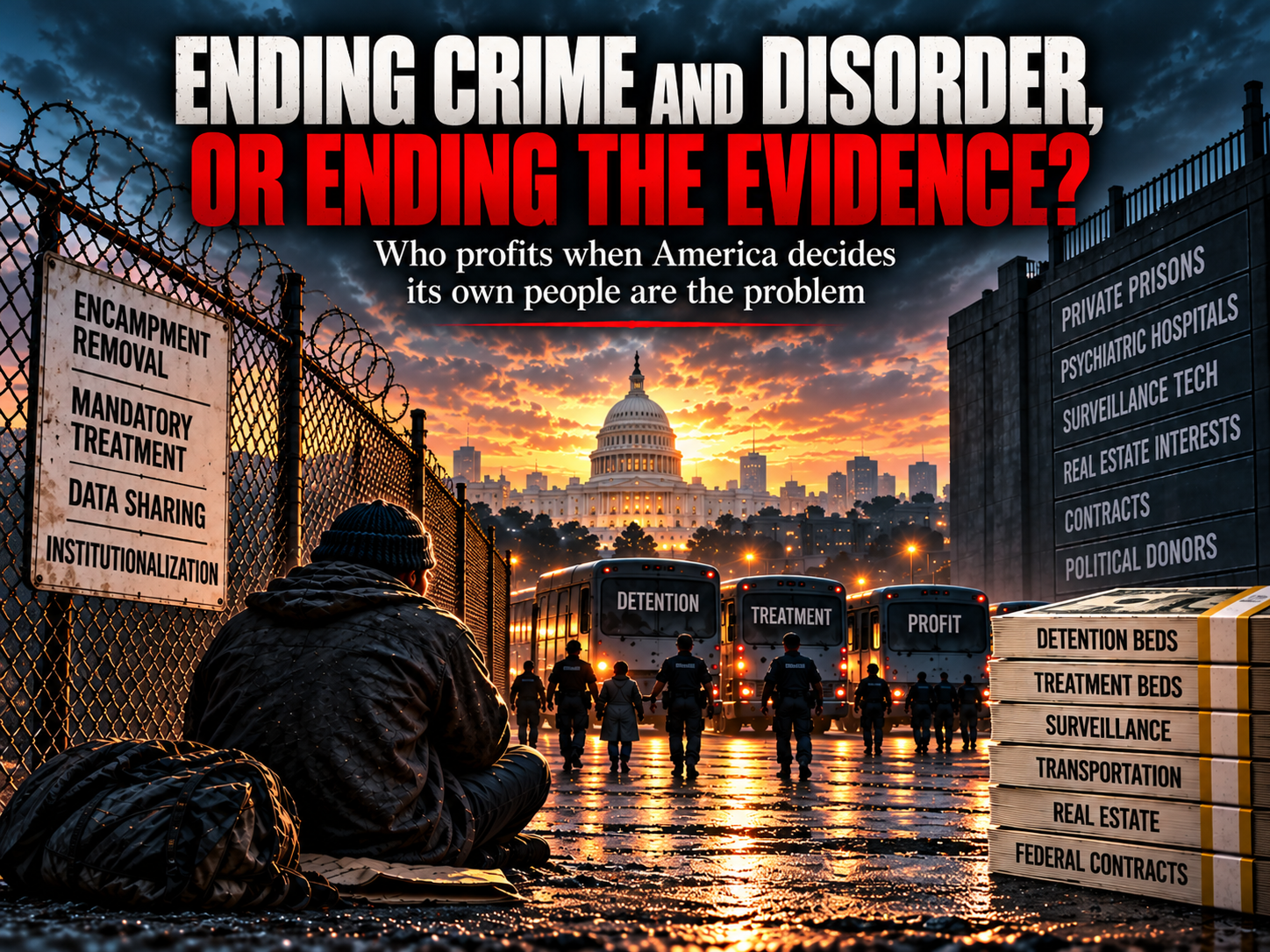
On July 24, 2025, the President signed Executive Order 14321, “Ending Crime and Disorder on America's Streets.”
It opens with a number:
274,224
people living on America's streets on a single night, the highest ever recorded.
That number should have been a call to build homes, fix wages, and heal people. Instead, the order treats those 274,224 human beings as a public order problem to be removed.
This post is about more than one executive order. It's about the web of laws and policies around it that slowly teach a nation to see its own people as worthless. And it's about following the money to see who benefits when we do.
01What the Order Actually Does
Read the order yourself. Here is what it directs:
Exhibit A
Expand civil commitment.
Push states toward “maximally flexible” standards to involuntarily commit people with mental illness or addiction who are “living on the streets.”
Exhibit B
Attack the courts that protect people.
Direct the Attorney General to seek reversal of court precedents and end consent decrees that limit involuntary commitment.
Exhibit C
End Housing First.
Cut federal support for programs that give people housing without preconditions, plus harm reduction programs.
Exhibit D
Tie aid to compliance.
Condition homelessness assistance on mandatory treatment.
Exhibit E
Fund encampment removal.
Make federal dollars available to clear camps.
Exhibit F
Share data with police.
Allow information from homelessness assistance programs to be shared with law enforcement.
The order calls itself “humane.” But notice what's missing. There is nothing in it that raises a wage, builds a home, or lowers the cost of care.
02The Web Around It
No single policy devalues a people. It takes a system. Look at what surrounds this order:
2024
Camping bans become legal.
In City of Grants Pass v. Johnson, the Supreme Court ruled 6-3 that cities can punish people for sleeping outside, even when there is no shelter available. Being homeless in public can now be treated as an offense.
July 2025
Healthcare is cut.
The One Big Beautiful Bill Act cut nearly $1 trillion from federal Medicaid spending over ten years. The Congressional Budget Office projects about 10 million more Americans will be uninsured by 2034. Medicaid is the main way people with serious mental illness get treatment. So the same government promising “treatment” for people on the street cut the program that pays for it.
Late 2025 – 2026
Permanent housing is defunded.
HUD moved to cap permanent housing in its Continuum of Care program at 30% of funds, down from roughly 90%. A coalition of states sued, and a federal court blocked it. HUD tried again with a 2026 notice that set aside about $1.3 billion for transitional and service-only projects instead. The National Alliance to End Homelessness estimates at least 97,000 people living in federally funded permanent housing could lose their homes. That notice was also challenged in court and, according to reporting, vacated in August 2026.
Think about that. People who already escaped the street, already housed, already rebuilding, put at risk of being pushed back onto it.
June 18, 2026
Disability rights are reinterpreted.
The Justice Department's Office of Legal Counsel issued an opinion reinterpreting Olmstead v. L.C., the 1999 Supreme Court decision that said people with disabilities have a right to live in their communities instead of institutions when that's appropriate. The new opinion argues there is no mandate to provide care in the most integrated setting, and blames community care for rising homelessness. DOJ then said it would stop relying on its prior enforcement guidance.
2009 – today
Wages frozen.
The federal minimum wage has been $7.25 an hour for more than sixteen years.
Put it together:
- 1.Freeze wages.
- 2.Let housing costs soar.
- 3.Cut the healthcare that treats mental illness and addiction.
- 4.Defund the housing that gets people off the street.
- 5.Make sleeping outside punishable.
- 6.Weaken the legal rights that keep people out of institutions.
- 7.Then institutionalize the people this produces, and call it compassion.
That is not a homelessness policy.
That is a pipeline.
03Follow the Money
Whenever people are converted from citizens into “beds,” someone gets paid per bed.
Private prison and detention companies
DetentionThe GEO Group reported 2025 net income of about $254 million, up from about $32 million in 2024. To be fair, much of that jump came from a one-time asset sale. Its adjusted net income still rose, from about $101 million to about $120 million. Its CEO called 2025 the company’s most successful year ever for new contracts. GEO expects up to $3.1 billion in revenue in 2026. Beyond detention, GEO sells electronic monitoring and secure transportation, exactly the services a system built on surveillance and confinement needs. And on day one of this administration, the President revoked the order that had been phasing out federal private prison contracts.
For-profit psychiatric hospital chains
Treatment bedsInvoluntary commitment needs beds, and beds are billed by the day. In 2024, a New York Times investigation reported that Acadia Healthcare, one of the country’s largest psychiatric hospital chains, held patients against their will even when it wasn’t medically necessary, sometimes until their insurance ran out. Acadia denies systematically holding patients longer than necessary. The same month, it paid $19.85 million to settle federal allegations that it billed for medically unnecessary services and that understaffing led to assaults and suicides, without admitting wrongdoing. Now imagine that business model with “maximally flexible” commitment laws.
The policy pipeline
Political influenceGroups like the Cicero Institute, a Texas think tank founded by tech investor Joe Lonsdale, have pushed states to adopt camping bans and civil commitment, and now publish state-by-state plans telling states how to comply with the order. States that don’t comply are warned they could lose tens of millions of dollars in federal grants.
Look at the poster for this post. A man sits against a fence with everything he owns beside him. Down the road, buses wait, labeled Detention, Treatment, and Profit. That is a picture of how the pieces connect.
STEP 1
The sidewalk
A person with nowhere to go.
STEP 2
The sweep
Belongings cleared, camp removed.
STEP 3
The bus
Moved out of sight.
STEP 4
The bed
Detention, commitment, or a cell.
STEP 5
The invoice
Someone bills for every step.
At each step, someone gets paid. The only person in this pipeline who never sees a dollar is the person being moved through it.
The ledger
Who gets paid| Line item | Who collects |
|---|---|
| Detention beds | Private prison and detention operators |
| Treatment beds | Institutional and psychiatric facility operators |
| Surveillance | Data, tracking, and electronic monitoring vendors |
| Transportation | Secure transport contractors |
| Real estate | Developers who want the land the poor were standing on |
| Federal contracts | Firms with lobbyists and donors close to power |
| The person | $0 |
I'm not claiming every one of these companies wrote this order. I'm saying the system is arranged so that when a human being loses their home, their health, or their freedom, someone else's revenue goes up. That's the design, and it's worth asking who it serves.
04What Would a Foreign Adversary Do?
Imagine a foreign power that wanted to weaken the United States without firing a shot. What would its playbook look like?
The playbook
- Divide the people so they blame each other instead of the system.
- Exhaust them with wages that can’t support a life.
- Make them sick and cut their access to care.
- Take their homes and make shelter a luxury.
- Criminalize their suffering so the weakest are punished for being weak.
- Strip their rights one court ruling at a time.
- Profit from their captivity and extract value from every bed.
- Watch them by turning aid into surveillance.
- Hide the damage so no one sees the country decaying.
Now read that list again and compare it to the last ten years of American policy.
These corporations and policymakers are not foreign agents. That's what makes it worse. We are doing to ourselves exactly what an enemy would wish on us, and some are getting rich from it.
05How a People Learns to Hurt Its Own
No one wakes up wanting to cage a sick neighbor. A society has to be taught to accept it.
It starts with words. The order calls people “vagrants” and their existence “disorder.” Language like that turns a person into a problem, a problem into a nuisance, and a nuisance into something to be removed.
Then the system makes it convenient not to look. The encampment is cleared. The person disappears into a facility. The street looks clean. And the citizen walking by feels relief instead of grief, without ever learning what happened to the human being who was there.
That is how ordinary people come to support harming their own. Not through hatred, but through invisibility.
When you can no longer see someone's suffering, you can no longer see their value.
And make no mistake: the line of who is “removable” never stops moving.
- Todaythe person in the tent
- Tomorrowthe worker who lost a job
- the veteran who can’t sleep
- the elder who outlived their savings
- the young person whose illness went untreated because the clinic closed
Any of us is one bad year away from being called “disorder.”
06Ending the Evidence
Policy only gets better when we can see whether it works. And right now, the evidence is getting harder to see.
The federal government's annual homelessness report is normally released in December. The report on the January 2025 count came out on May 29, 2026, roughly five months late. Advocates called it the latest a national count has ever been released. When it finally came out, the breakdown by gender that past reports included was gone.
What disappears when people are moved out of sight
- The count of people living on the street
- The rent increases that put them there
- The wages that never covered the rent
- The hospitals and clinics that closed
- The record of what happened to each person after the sweep
When you remove an encampment, you also remove the most visible proof that rent, wages, and healthcare have failed. When you commit a person instead of housing them, they leave the street count and enter a facility count that few people ever read. When health records flow to police, people stop going to the doctor, and the illnesses that were never treated stop showing up in any chart.
The streets look cleaner. The numbers look better. Nothing has been solved.
Case not closedYou cannot end a crisis by ending the count. You can only end the public's ability to hold anyone responsible for it.
07The Honest Counterpoint
Some people on our streets are profoundly ill and cannot care for themselves. Their families have watched them deteriorate, sometimes for years, and feel the system failed them. That pain is real. Many experts agree civil commitment can be a valid tool in rare cases, when someone is an immediate danger to themselves or others. Even some Democratic leaders have moved to modestly expand it.
But a tool for rare emergencies is not a national strategy. And you cannot claim to want treatment while cutting the healthcare that pays for it, defunding the housing that stabilizes people, and handing confinement to companies that profit by the day.
08What Works, and What We Build Instead
We know what works. Since 2010, veteran homelessness has dropped by more than half, largely through Housing First approaches. Communities that pair stable housing with voluntary treatment get people healthy, working, and whole.
So here is the alternative:
- ✓Housing first, treatment always available. A stable home is the foundation of recovery, not a reward for it.
- ✓No profit from confinement. No company should earn a dollar from a human being’s loss of freedom. That’s the purpose of the End For-Profit Incarceration Act, and it must cover psychiatric detention as well as prisons.
- ✓Healthcare that can’t be cut out from under the sick. A nonprofit system where care is paid when a doctor says it’s needed.
- ✓Protect the rights that protect us all. Olmstead belongs to every American who may one day be disabled, which is nearly all of us.
- ✓Wages that support a life, so fewer people ever reach the street.
- ✓Aid is not surveillance. Asking for help should never put you in a police database.
Judge any policy on homelessness by one test: a year later, does the person have a home? If the answer is “we don't know,” the policy wasn't built to help them.
09The Question
The order is called “Ending Crime and Disorder on America's Streets.”
But when you freeze wages, cut healthcare, defund housing, criminalize sleeping, weaken civil rights, and pay companies to hold the people this creates, what are you really ending?
Not the crisis. Just the evidence of it.
So ask yourself honestly:
If a foreign enemy designed a system to make Americans give up on each other, would it look any different from this?
And if the answer is no, then the next question belongs to all of us: what are we going to do about it?
A government that hides its people has already decided they don't count. A government that counts every one of them can begin to bring them home.
I am a piece of the collective essence of this world that never gives up and needs every other piece to be whole.
So is every person on that street.
— Vinnie Cordova
Cordova 2028: Moving Forward Together
Sources
The order
Surrounding policy
- Planetizen/Politico: HUD’s 30% permanent housing cap and lawsuits
- California Attorney General: Lawsuit over HUD’s 2026 Continuum of Care notice
- Report on the August 2026 vacatur of HUD’s 2026 notice
- Network for Public Health Law: DOJ’s June 2026 Olmstead opinion
- Center for American Progress: CBO projections on the One Big Beautiful Bill Act
- Cicero Institute: States must respond to the President’s homelessness executive order
The evidence
Who profits
- GEO Group full-year 2025 results
- Market Chameleon: GEO 2025 performance and adjusted income
- The American Prospect: GEO Group net income rose 800% in 2025
- KFF Health News: NYT investigation of Acadia Healthcare
- Behavioral Health Business: Acadia’s $19.85M settlement
- Becker’s: Acadia’s response to the investigation