By Vincent Cordova · Independent Presidential Candidate, 2028 · November 17, 2026
Home Health Aide
Three hands on one rent check
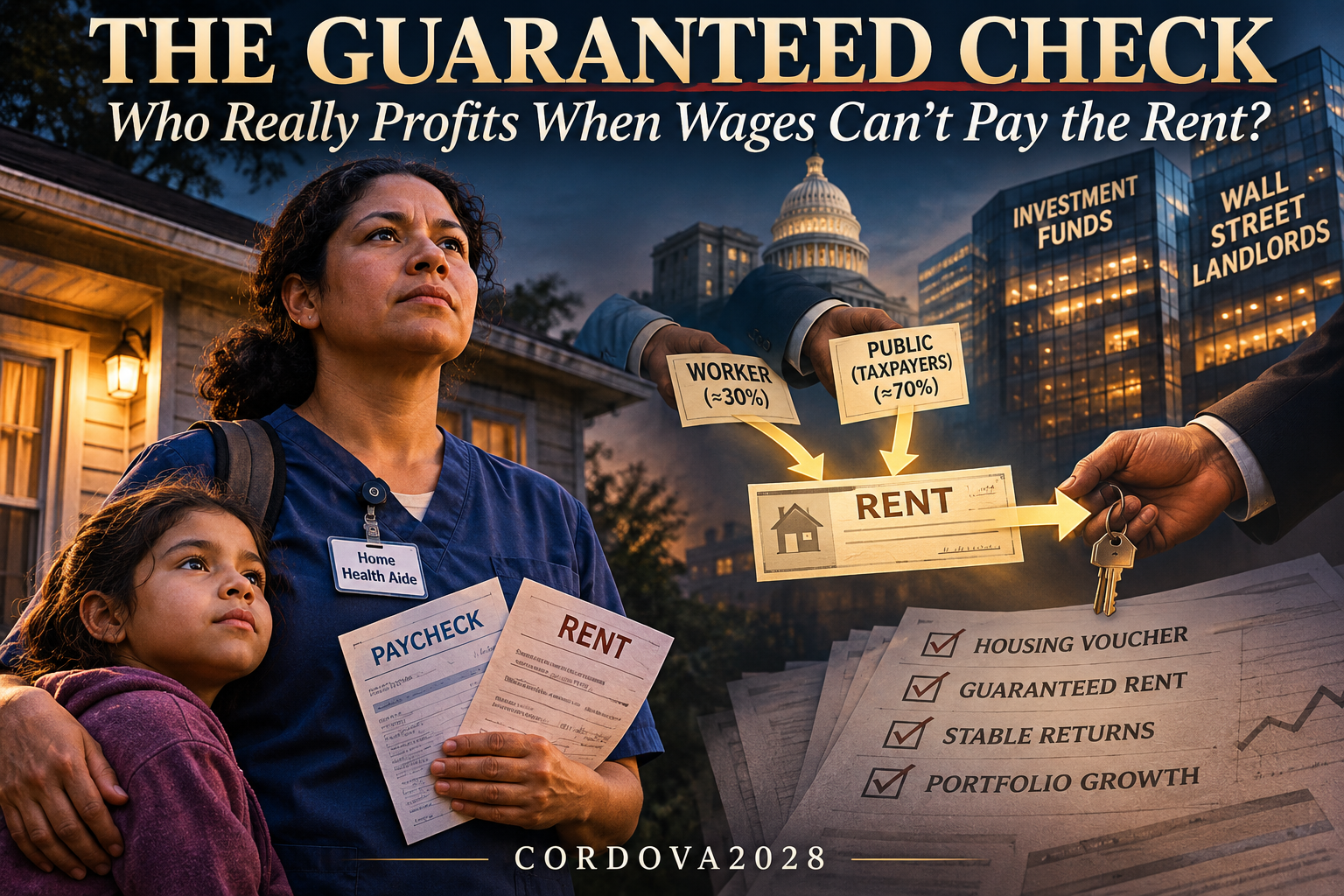
Picture a home health aide. She works full time at $18 an hour. That comes to about $3,120 a month before taxes.
She finds a modest two-bedroom at the national average fair market rent of $1,806. Under a housing voucher, she pays roughly 30% of her income, about $936. Taxpayers pay the other $870 or so. The landlord gets the full $1,806, on time, every month.
Worker
$936
about 30% of income
Public (taxpayers)
$870
the gap the wage left open
Rent
Due the 1st · every month Guaranteed
Pay to the order of
The Owner
$1,806.00
Worker 52%Public 48%
Memo: national average fair market rent, modest two-bedroom
$12$36
Full-time pay: $3,120/month. The owner still receives $1,806. Only who pays it changes.
Illustration added by the campaign: 2,080 hours a year and the 30%-of-income rule, simplified. Real voucher math uses adjusted income and each housing authority’s payment standard.
Three hands touch that rent check. One belongs to a worker who cannot get ahead. One belongs to the public, covering a gap the employer left open. The third belongs to an owner who gets a payment guaranteed by the federal government.
Only one of those three builds wealth. It isn’t her.
This post is not an attack on the families who rely on vouchers. A voucher is the reason millions of people have a roof tonight. It is an attack on a system that has turned their struggle into someone else’s safest investment, and it asks a question we have avoided for fifty years: at what point do we consider the life of the person living inside this system?
1974
1974: the year we stopped building and started paying
In January 1973, President Nixon froze approvals for federally subsidized housing for 18 months HUD ↗. The Housing and Community Development Act of 1974 ended that freeze and created Section 8 CRS ↗.
The new idea was simple. Instead of building and owning homes, the government would pay private owners to house low-income families.
Jan 1973
Nixon freezes approvals for federally subsidized housing for 18 months.
1974
The Housing and Community Development Act ends the freeze and creates Section 8.
1974 → today
The government pays private owners to house families instead of building and owning homes.
2025
Pretium Partners, a $60 billion asset manager, raises its first fund to buy homes and rent them to voucher holders.
2026
A full-time worker needs $34.73 an hour for a modest two-bedroom.
Private equity did not write that law. The modern Wall Street landlord barely existed in 1974. But the law created something that would eventually draw Wall Street in: a rent payment backed by the United States Treasury that does not depend on whether the tenant’s paycheck stretches far enough.
The system was not designed by private equity. It was designed in a way private equity can harvest. That is worse, because it happened in the open, and we let it stand.
We have seen this design before. After slavery ended, sharecropping kept families working land they would never own, bound by debts they could never pay off. Company towns paid workers wages too low to live on, then took those wages back as rent for houses the company owned. The names changed. The pattern did not: keep wages low, control the housing, and make sure the people inside the system can never earn their way out of it.
We are not saying families who use vouchers are in chains, or that every landlord is a villain. The voucher keeps millions of people housed, and we will protect it. We are saying the system around it follows an old blueprint, one built so that someone else profits from a family’s inability to get ahead. Recognizing that blueprint is the first step to tearing it down.
Follow the money
The voucher is a wage subsidy that gets paid to landlords
In 2026, a full-time worker needs $34.73 an hour to afford a modest two-bedroom. The average renter earns $24.84. That is a gap of nearly $10 an hour NLIHC, Out of Reach 2026 ↗. Of the 25 most common jobs in America, 17 pay median wages below what a one-bedroom costs Texas Housers ↗.
Hourly wage · full-time · 2026
Home health aide in this story$18.00
Average renter earns$24.84
Needed for a modest two-bedroom$34.73
A gap of nearly $10 an hour for the average renter.
Follow the money:
1
An employer pays less than it costs to live.
2
The worker cannot cover rent, so the public covers the difference.
3
The owner collects full rent, guaranteed.
Every month, taxpayers make up for wages that employers refuse to pay. The employer keeps the savings. The owner keeps the guarantee. The worker keeps the struggle.
Here is what most people miss. Under a voucher, the tenant pays about 30% of income, and the government pays the rest NLIHC ↗. If wages rose to a livable floor, the tenant would pay more and the government would pay less. The owner’s rent would not drop a dollar.
So what would the owner lose? The guarantee. A worker paying their own rent can miss a month. The Treasury does not. A worker with a real wage can also negotiate, move, or buy a home of their own. A voucher holder has far fewer doors, because many landlords still refuse vouchers outright.
A living wage does not take the rent away. It takes away the captive tenant.
Wall Street Landlords
Wall Street found the guaranteed check
The investment world is not shy about it. Investor guides call voucher homes recession-proof and describe the federal payment as insurance against the ups and downs of the labor market. In 2025, Pretium Partners, a $60 billion asset manager, began raising its first fund to buy single-family homes, renovate them, and rent them to voucher holders The Real Deal ↗ResiClub ↗.
The investor’s checklist
Housing Voucher
Guaranteed Rent
Stable Returns
Portfolio Growth
The worker’s checklist
Savings
A raise
Freedom to move
A home of her own
Only one of those three builds wealth. It isn’t her.
The public pays for it, and sometimes pays extra:
$51–$68
More per month charged to Milwaukee voucher households
than unassisted renters in comparable homes
$3.8M
A year in taxpayer overcharges
Desmond and Perkins, 2016
620
More families that money could house
In Milwaukee, voucher households were charged $51 to $68 more per month than unassisted renters in comparable homes. That overcharge cost taxpayers about $3.8 million a year, enough to house 620 more families Desmond and Perkins, 2016 ↗.
University of Chicago researchers found that making vouchers more generous across a metro area mainly benefits landlords through higher rents, with little improvement in the homes themselves BFI ↗.
Now add up what happens when the largest buyers of modest homes are funds backed by guaranteed federal income. The family trying to buy its first home is bidding against a buyer whose returns the taxpayer underwrites. Every home a fund takes off the market is one fewer path to ownership. And the fewer paths there are, the more families need a voucher, and the more the public pays.
That is a loop. It feeds itself. And it runs on public money.
The market
Is the voucher pushing rents up?
Renters are drowning. A record 22.7 million renter households spend more than 30% of their income on rent. That is up 2.3 million since 2019. Some 11 million extremely low-income households are competing for just 3.8 million homes they can afford Multifamily Dive, on Harvard JCHS 2026 ↗.
22.7M
Renter households paying over 30% of income
A record
+2.3M
Since 2019
11M : 3.8M
Extremely low-income households vs. homes they can afford
When the government becomes the only thing standing between a family and the street, we have to ask whether the system is helping or feeding the problem. The honest answer is that it does some of both.
Where the voucher adds to the pressure
One study of the 90 largest metro areas found that places with more vouchers saw faster rent increases for low-income households, about 16% on average Susin, Journal of Public Economics ↗. Other researchers dispute how large that effect really is.
When voucher rent limits went up across a county, rents at the same addresses rose 13 to 20 cents for every extra dollar allowed, with little improvement in the homes Collinson and Ganong ↗.
Voucher limits are set from local market rents. When the market climbs, the limit climbs with it. The public pays more instead of putting a brake on the climb.
Where the voucher is not the main cause
Most research finds vouchers have little overall effect on market rents, and the program caps what landlords can charge CBPP ↗.
The deeper causes are a shortage of homes people can afford, wages that have not kept up, and pricing power held by the largest landlords.
That pricing power is the greed we have to name. The Justice Department sued RealPage, whose software recommends rents to major landlords, accusing it of using competitors’ private data to keep rents high. RealPage settled with no admission of guilt and no financial penalty Real Estate News ↗. In renters’ class actions, eleven landlords have paid more than $218 million The Real Deal, via Pulse ↗.
The voucher did not cause the housing crisis. But it was built to follow the market wherever it goes. When the market is driven by shortage and coordinated pricing, the voucher turns that greed into a public bill.
What we propose
1
Rent reasonableness with teeth.
A voucher home cannot rent for more than comparable unassisted homes nearby. Overcharges are paid back.
2
A brake on voucher rent increases.
Annual increases on voucher homes are capped. The public will not underwrite runaway rents.
3
End coordinated rent-setting.
Ban software or services that use competitors’ private rent data to recommend prices, with financial penalties and personal liability for executives who keep using them.
4
Build what the market will not.
Mission-locked public benefit housing that stays affordable permanently, so families have somewhere to go that is not ruled by the next rent hike.
5
Raise the floor.
A wage tied to what housing actually costs where people live. A family that can pay its own rent is not at the mercy of a landlord or a housing authority.
Investment Funds
The vehicle does what it was built to do
We have to be clear about something. The problem is not that the people running these funds are uniquely greedy. The problem is what these vehicles are.
A private equity fund, an institutional holder, or any investment vehicle exists for one purpose: to return more money to its investors than they put in. That is its essence. Its managers are paid on performance. Many funds have a set lifespan and must sell what they bought to cash out. Every year, the numbers have to go up.
In housing, there are only a few ways to make the numbers go up:
Raise the rent.
Add fees.
Spend less on repairs.
Sell to the next buyer, who has to do the same thing.
The industry says this out loud. A 2025 report found investor materials describing working-class housing as a way to quickly increase cash flow, even in hard times PESP ↗. In Phoenix, a California private equity firm bought a complex that accepted vouchers, and at least 25 people faced losing their Section 8 housing Phoenix New Times ↗. In 2021, the U.S. Senate held a hearing titled “How Private Equity Landlords Are Changing the Housing Market” GovInfo ↗.
You cannot ask a vehicle to act against its own purpose. A fund that chose its tenants over its returns would be breaking its promise to its investors. Asking it to be kind is asking it to fail. So appeals to conscience will never be enough here.
The answer is to change what is allowed to own the roof over a family’s head.
What we propose
1
Housing is an essential service, not a commodity.
Like water and power, a home is something people cannot live without. It should be governed by anti-extraction rules, not by the next quarter’s targets.
2
No new institutional ownership of family homes.
Covered entities may not buy one-to-four-unit homes to rent, voucher or not. The same look-through ownership rules apply, so no nominee LLC, trust, or master lease gets around it.
3
Existing holdings come home over time.
Homes already held by covered entities are transitioned on a set schedule. The tenant gets the first right to buy, then nonprofits, community land trusts, and mission-locked housing institutions.
4
Where institutions still own apartments, extraction has limits.
Rent increases tied to real operating costs. Full disclosure of fees and margins. Repair money held in reserve, not paid out to investors. No eviction just to raise the rent.
5
Capital is welcome. Extraction is not.
Anyone can still invest in housing through mission-locked vehicles with capped returns and permanent affordability. Your money can earn a fair return. It cannot earn it by pushing a family out.
“But investors fix up run-down homes.”
We will hear this. So ask the next question: why are so many homes in need of fixing in the first place?
Too many homes are built to be sold, not to last. Families pay half a million dollars for homes built fast and cheap with materials that hold up only as long as nothing goes wrong. Oriented strand board, the panel sheathing used across much of new construction, does its job when it stays dry, but it is far less forgiving of water than solid wood. A leak that goes unnoticed can turn into a costly repair. Buyers are handed a home that is already on its way to needing work.
Then, when that home wears out, the same system says only a fund with deep pockets can afford to save it. We built the problem into the walls and then sold the fix back to us.
There is a better answer on both ends:
Build homes to last. Raise construction standards so a family’s biggest purchase is not designed to need rescue in twenty years.
Pay people enough to care for their own homes. A family with a real wage can fix its own roof, replace its own siding, and keep its own home. It does not need a fund to do it, and it does not have to hand over the deed for the privilege.
The repair argument is not a reason to let funds take our homes. It is proof that cheap building and low wages work together, and that the families living inside them are the ones who pay.
A system whose essence is the bottom line will always find the family as the cost to be cut. If we want homes that keep people housed, we have to build vehicles whose essence is the home.
Conscience
Would they ever fight to end it?
Ask the hard question honestly. If you became rich on a guaranteed government check, would you use that wealth to fight for a wage floor that ends the guarantee?
Some would. Plenty of people who rent to voucher holders are small owners with one or two homes, and many of them care about their tenants. Conscience is real.
But no system should depend on the conscience of the people it enriches. History tells us that structures rarely dismantle themselves. Slavery did not end because enslavers chose to give up their profits. Child labor did not end because factory owners felt generous. Each ended because the public drew a line and wrote it into law.
So the question is not whether the people at the top will choose to change. The question is whether we will build a system where their choice no longer decides the outcome.
So this question is for every person who owns a home and rents it to a family who is struggling:
If raising wages meant your tenant paid their own rent, and the guaranteed check from the government got smaller, would you still stand up and fight for that raise?
Your rent would not change. What would change is that the family living in your home would no longer need permission from a housing authority to survive. They could save. They could leave if they wanted to. Someday they could buy a home of their own, maybe even yours.
If your answer is yes, you are the kind of owner this country needs, and we want you at this table. If your answer is no, then ask yourself what you are really being paid for. Is it the home you provide, or the hardship that keeps your tenant from ever needing you less?
Closed doors
The tenants no one will rent to: where do they go?
We hear it all the time: “I don’t rent to Section 8.” Then where are those families supposed to go?
The refusals are measurable. In a Cleveland Federal Reserve field experiment, landlords in higher-opportunity neighborhoods responded far less often to voucher holders than to tenants paying cash. That penalty held even after voucher payment limits rose by about $450 a month Cleveland Fed ↗. Milwaukee County banned landlords from rejecting voucher holders outright in 2018, and families still report being turned away PRRAC ↗.
Search deadline
The voucher clock starts
Door after door
“I don’t rent to Section 8.”
The few who say yes
High-poverty neighborhoods
Voucher lost
Doubled up, a car, a shelter, the waiting list
A voucher comes with a search deadline. When every door closes, the family can lose the voucher it may have waited years to receive. The ones who keep it often end up where someone will take it: the same few high-poverty neighborhoods where landlords make the most from voucher rents Harvard JCHS ↗. The ones who lose it end up doubled up with family, in a car, in a shelter, or back at the bottom of a waiting list.
That is the other half of this system. The families who are accepted become a guaranteed income for someone else. The families who are refused just disappear from the numbers. Neither group gets to build a life.
What we owe them:
A national ban on refusing tenants because of how they pay rent, with real enforcement, testing, and penalties, so the protection exists in practice and not just on paper.
More time to search, and help doing it, so a closed door does not cost a family its only lifeline.
A wage that makes the voucher unnecessary. The surest way to end voucher discrimination is to make sure fewer families ever need a voucher.
The label
“Bad tenants”: screened out, and then what?
There is another door that closes, and this one may stay closed for years. Landlords screen for “bad tenants.” Before we accept that label, we have to ask how someone earns it, and where they go once they have it.
How a person becomes a “bad tenant”
Most evictions are filed for one reason: the rent was not paid Propmodo ↗. Behind that are a lost job, a cut in hours, a medical bill, a car that broke down, or a rent increase their wages could not match. The label says something is wrong with the person. Most of the time, the math was wrong.
Some never did anything at all. Tenants living in unsafe or unsanitary homes often end up defending an eviction for withholding rent and come out with a filing on their record anyway Network for Public Health Law ↗. Others are rejected for cases that were withdrawn, dismissed, or settled. A filing alone can lock people out of good housing for years, even when they were never evicted Planetizen ↗.
The record is often wrong
Tenant screening reportSent to landlord · not to applicant
Denied
22%
of state eviction cases in 3.6 million court records were ambiguous or false
~65%
of about 26,700 tenant screening complaints to the CFPB (2019–2022) were about incorrect information
$15M
paid by TransUnion’s tenant screening arm over dismissed, duplicated and sealed records
7 yrs
that screening companies can report eviction records; courts and private databases can keep them longer
One study of 3.6 million eviction court records, cited by the Consumer Financial Protection Bureau, found 22% of state eviction cases were ambiguous or false Troutman Pepper, on the CFPB report ↗.
Between January 2019 and September 2022, the CFPB received about 26,700 tenant screening complaints. About 65% were about incorrect information NBC New York ↗.
Federal regulators made TransUnion’s tenant screening arm pay $15 million. Its reports had left out that evictions were dismissed, listed the same case more than once, and included sealed records Goodwin ↗FTC ↗.
Most tenants never see the report. It goes to the landlord, and the family is simply told no NBC New York ↗.
Barred for life?
Not on paper, but close. Screening companies can report eviction records for seven years. Courts and private databases can keep them much longer, sometimes permanently Network for Public Health Law ↗. Seven years is a child’s whole time in elementary school spent moving from couch to couch.
Where do they go?
When every application comes back no, people pay fee after fee for applications that go nowhere. They move into substandard homes that ask no questions. Some end up homeless Propmodo ↗. Eviction has been called the top driver of homelessness and a root cause of poverty Network for Public Health Law ↗.
A system that underpays people, raises their rent, labels them when they fall behind, and then shuts every door does not have a bad tenant problem. It has a bad design problem. And it keeps producing the people it then refuses to house.
What we propose
1
Only a final judgment counts.
A filing is not an eviction. Cases that were dismissed, withdrawn, settled, or won by the tenant are sealed automatically and can never be reported or used.
2
A shorter shadow.
Eviction judgments for unpaid rent expire from screening after a short, fixed period. Courts seal them on the same clock. Private databases may not keep what the courts have sealed.
3
No secret reports.
Every applicant gets a free copy of any report used against them, the name of the company that made it, and a fast way to fix errors before the decision is final.
4
Screening companies pay for their mistakes.
Each inaccurate record that costs someone a home carries damages owed to that person.
5
No blanket bans.
Landlords may not refuse every applicant with any past eviction. They have to look at the person, what happened, and what has changed since.
6
A path back.
A set period of paying rent on time in any housing, including transitional or nonprofit housing, clears the way to rent again.
7
Fix the cause.
Emergency rent help before a filing, not after. And a wage that lets people pay their rent in the first place.
No one should be thrown away over one bad year. Most so-called bad tenants are people who were failed first.
The proposal
The proposal: no Wall Street landlords on the public’s dime
We propose to ban private equity from buying homes to rent through federal housing vouchers. Public housing money should house people. It should not guarantee returns for investment funds.
A ban only works if it closes the side doors. These are the terms:
Proposed terms
No Wall Street Landlords on the Public’s Dime
§1
Who is covered. Any private equity fund, hedge fund, or institutional investment vehicle. That includes every affiliate, subsidiary, nominee LLC, trust, joint venture, and REIT it controls or advises. Ownership is traced through every layer to the real beneficial owner.
§2
What is banned. No covered entity may sign a new voucher contract on a one-to-four-unit home it acquires after the effective date. That applies whether it owns the home directly or through a master lease, a sale-leaseback, a management agreement, or any arrangement that sends voucher rent to a covered entity.
§3
Disclosure. Every owner who receives voucher payments must certify its full beneficial ownership to the housing authority every year. A false certification is fraud against the United States.
§4
Tenants are protected first. No family loses its voucher or its home because of this law. Current leases continue. No eviction may be used to avoid the ban.
§5
A path home, not a fire sale. Homes held by covered entities are transitioned over time. The tenant gets the first right to buy, with the voucher converted to homeownership assistance. Next in line are nonprofits, community land trusts, and mission-locked public benefit housing institutions.
§6
Penalties with teeth. Any voucher payments collected in violation are returned in full, plus damages. The money goes back into housing assistance.
§7
Small owners are not the target. Individuals and families who own a few homes and rent to voucher holders are not affected.
The ban is half the answer. The other half is a wage floor tied to what housing actually costs where people live. A family earning a real wage does not need the public to make up the difference. Every dollar we stop sending to fund returns is a dollar we can use to house another family, or to help a family own the home it already lives in.
Small owners
Small owners deserve a process that works
If we want everyday owners to keep renting to voucher holders, we have to make it workable. Today, owners describe extra paperwork, inspections, waiting for the first payment, and housing authorities that are hard to reach when something goes wrong ResiClub ↗NLIHC ↗. Large funds can hire staff to handle that. A family that owns three homes cannot. When the process is this heavy, it pushes the voucher market toward the very institutions this proposal keeps out.
Simplify the process, never the standards:
One application.
A single national online enrollment for owners, used by every housing authority.
Inspections on a clock.
A set deadline for every inspection. Safety standards stay. The waiting does not.
Paid on time, or the authority pays the penalty.
Direct deposit on a fixed date, with a late fee owed to the owner when the public side is late.
One named contact.
Every owner gets a real person at the housing authority who answers, and help when a dispute comes up.
These are starting points. The owners who live this process every day know where it breaks better than anyone. We want to hear from them.
One table
The door is open
This is not a finished answer. It is an invitation. We want to hear from voucher holders, from small landlords, from housing authority staff, and from workers who are one rent increase away from needing help.
If you rent with a voucher, what would a living wage change for you?
If you are a small owner, which part of the paperwork or process stands in your way?
What loophole do you see that we missed?
Write to us at housingtable@vincentcordova.com. Tenants, owners, housing authority workers, and neighbors are all welcome at the same table. Every message will be read, and what we learn will shape this plan.
Before you close this page, sit with one question: how do we move forward when so many people are left behind in a system built to keep them there?
Low wages are not an accident of the market. They are a choice that gets made again every year it goes unchallenged. A voucher softens the fall, but it never lifts anyone out. If the people who benefit most from that design will not change it, then the rest of us have to.
We can keep paying people pennies and sending the difference to Wall Street. Or we can decide that the life of the person living inside this system matters more than the return on someone else’s portfolio. Our children will inherit whichever one we choose.
Take any part of this plan that makes sense and build on it. It belongs to everyone.
I am a piece of the collective essence of this world that never gives up and needs every other piece to be whole.