Education Accountability
The Architecture of Collapse: How American Higher Education Was Designed to Destroy Us From Within
Vincent Cordova examines how elite credential systems can produce policy architects disconnected from public suffering, published word-for-word from the Higher Education Public Accountability Act source file.
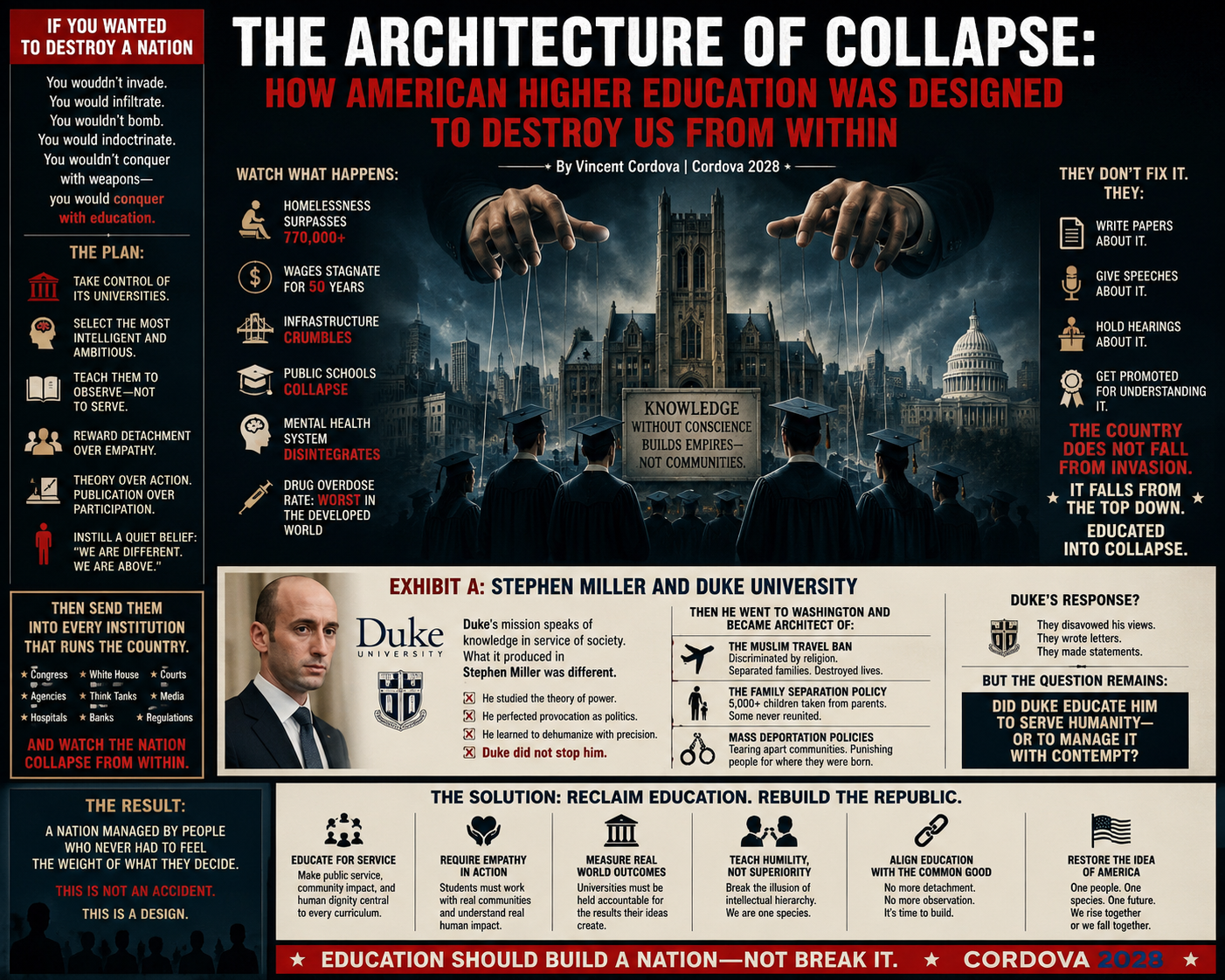
The Architecture of Collapse: How American Higher Education Was Designed to Destroy Us From Within
By Vincent Cordova | Cordova 2028
Publication Context for Search and Public Record
This article is part of the Higher Education Public Accountability Act release package.
Related official source document (PDF):
- An Open Letter to Stephen Miller
Related campaign publication pages:
https://www.cordova2028.com/executive-orders/announcement-open-letter-to-stephen-miller
- Executive Orders announcement:
- Blog publication page:
This page family is intended to be expanded. Additional policy proposals, executive orders, and supporting documentation will be added in upcoming releases.
If You Wanted to Destroy a Nation
If you were a foreign adversary — patient, strategic, playing a hundred-year game — and you wanted to destroy the United States without firing a single shot, here is what you would do.
You would not bomb its cities. You would not invade its shores. You would not even hack its power grid.
You would do something far more elegant, far more permanent, and far more devastating.
You would take control of its universities.
You would design an education system that selects for the most intellectually capable people in the country, removes them from their communities for four to eight years, teaches them to observe the world rather than serve it, rewards detachment over empathy, theory over action, and publication over participation. You would train them to see complexity everywhere and responsibility nowhere. You would teach them to speak in the language of solutions while producing none. You would instill in them a quiet belief — never stated outright, always implied — that they are different from the people below them. That their credential separates them from the suffering they will one day be paid to manage.
Then you would send them into every institution that runs the country.
Into Congress. Into the White House. Into the courts. Into the regulatory agencies. Into the think tanks and the policy institutes and the media organizations that shape what the public believes is possible. Into the hospital systems and the housing authorities and the financial institutions that determine whether ordinary people survive.
And you would watch.
You would watch as the homeless population swelled past 770,000 and these credentialed managers held hearings about it.
You would watch as wages stagnated for fifty years while economists with Nobel prizes explained, in very precise language, why nothing could be done.
You would watch as the country's infrastructure crumbled, its public schools collapsed, its mental health system disintegrated, and its drug overdose rate became the worst in the developed world — while the people responsible for fixing it wrote papers about it, gave speeches about it, and were promoted for their sophisticated understanding of it.
You would watch an entire nation be managed by people who were educated never to feel the weight of what they were managing.
And the country would not fall from invasion.
It would fall from within.
From the top down.
Educated into collapse.
This is not a hypothetical scenario.
This is what happened.
Exhibit A: Stephen Miller and Duke University
Let's begin with the most precise case study available.
Stephen Miller was born in Santa Monica, California, raised in a liberal household, and by his own account developed his political identity in high school — not from lived experience of hardship, but from reading. From absorbing ideology. From finding in conservative rhetoric a framework that gave him identity, purpose, and a target.
He arrived at Duke University in 2003.
Duke is one of the most prestigious universities in the United States. It sits on 8,600 acres in Durham, North Carolina, maintains an endowment exceeding $12 billion, and produces graduates who go on to run the country's most powerful institutions. Its mission statement speaks of knowledge in service of society. Its motto, in Latin, translates to "knowledge and faith."
What Duke produced in Stephen Miller was something different.
At Duke, Miller did not study how to reduce suffering. He did not study how to build communities or heal systems or close the gap between the powerful and the powerless. He studied political science — the theory of power — and he used his years at Duke to practice the application of provocation as a political weapon. He wrote a column in the student newspaper specifically designed to inflame. He organized against a Palestinian solidarity conference on campus. He connected with David Horowitz and the Students for Academic Freedom — a network that would spend years conflating Muslim and Arab identity with terrorism. He honed the skills that would define his career: the ability to use language as a weapon, to dehumanize with precision, to frame cruelty as principle.
Duke did not stop him.
Duke did not require him to demonstrate that he understood the human cost of the policies he was learning to craft.
Duke did not ask him to sit across from a family that had been separated at a border, or a child in a cage, or a person sleeping on a street, and reckon honestly with what his frameworks produced for real human beings.
Duke gave him a degree.
And then Stephen Miller went to Washington and became the primary architect of:
The Muslim travel ban, which separated families across borders and stranded thousands of people in airports based on their religion and national origin.
The family separation policy at the southern border, in which more than 5,000 children were taken from their parents as a deliberate act of deterrence — children as young as eight months old placed in detention facilities, many of whom were never reunited with their families.
Mass deportation policy targeting people who had lived in the United States for decades, built businesses, raised children who are American citizens, paid taxes, and contributed to communities — people ripped from those communities not because they posed a danger, but because their removal served as a signal.
These are not policy disagreements.
These are outcomes.
Real people. Real suffering. Deliberately designed.
And Duke University's response?
Duke distanced itself publicly from Miller's views. Faculty signed letters. Editorials were written. The university made clear that Stephen Miller's positions did not represent Duke's values.
But here is the question Duke has never answered:
You trained him. You credentialed him. You gave him four years and an elite degree and sent him into the world. If his values were not your values, why did you never require him to demonstrate any others?
Where was the course that required Stephen Miller to prove he understood equal human worth?
Where was the civic responsibility requirement that asked him to serve a community unlike his own?
Where was the human dignity standard that said: before we hand you this credential and send you into positions of power over millions of people, you must demonstrate that you see those people as your species?
There was no such requirement.
There never has been.
And Stephen Miller is not an anomaly.
He is the product.
This Is Not One Man. This Is the System.
The temptation is to treat Stephen Miller as an outlier — an extreme case, a cautionary tale, not representative of the broader product of elite American higher education.
That temptation is wrong.
Miller is simply the most visible demonstration of a pattern that runs through every tier of American government, in both parties, across every administration for the last fifty years.
Let's follow the pattern.
The Housing Crisis and the Credentialed Observers
There are more than 770,000 people without homes in the United States right now.
This is not a natural disaster.
This is not an inevitability.
This is a policy outcome — the result of decisions made and unmade by people with degrees from the finest institutions in the country.
Ben Carson served as Secretary of Housing and Urban Development from 2017 to 2021. He is a graduate of Yale University School of Medicine and one of the most credentialed men ever to hold that office. Under his leadership, the Department of Housing and Urban Development proposed cutting housing assistance for millions of low-income Americans, attempted to triple the minimum rent paid by the poorest public housing residents, and moved to allow homeless shelters to turn away transgender individuals. The homelessness crisis deepened on his watch.
Carson did not lack intelligence.
Carson did not lack education.
Carson lacked the one thing Duke did not require of Stephen Miller and Yale did not require of Ben Carson: a demonstrated, proven, tested commitment to seeing the people his decisions would affect as fully human beings whose suffering he was personally responsible for preventing.
Before Carson, there was Shaun Donovan, a Harvard graduate, serving under Obama. Before Donovan, Alphonso Jackson, a graduate of Edgewood College and Washington University, serving under Bush. Before Jackson, Mel Martinez, a graduate of the University of Florida and Catholic University of America. The names change. The credentials accumulate. The homelessness crisis has existed through all of them, growing or shrinking slightly based on economic conditions no HUD secretary can control, but never — not once — being treated as what it actually is:
An unacceptable moral failure that a country with our wealth and intelligence should have eliminated decades ago.
Not one of them stood before the American people and said: this is happening on my watch, it is my responsibility, and I will not rest or accept another paycheck until it ends.
Not one.
Because their education did not teach them that kind of accountability.
Their education taught them to manage.
To administer.
To navigate the system.
To produce reports.
And when the reports showed the problem was getting worse, to produce more reports.
The Financial Architects of Suffering
In 2008, the American economy collapsed.
The people who caused it had some of the finest educations money could buy.
Larry Summers, who served as Treasury Secretary and Director of the National Economic Council, studied at MIT and Harvard — where he also served as president. He was instrumental in the deregulation of financial markets in the 1990s, pushing for the repeal of Glass-Steagall, the Depression-era firewall between commercial and investment banking. When Glass-Steagall fell, the financial industry was freed to build the instruments of mass destruction — the mortgage-backed securities, the synthetic derivatives, the mechanisms of leveraged greed — that would eventually detonate in 2008 and destroy the savings, homes, and retirements of tens of millions of Americans who had never set foot in a derivatives trading floor in their lives.
Timothy Geithner, who served as Treasury Secretary during the aftermath of the crisis, graduated from Dartmouth and Johns Hopkins. When the moment came to decide who would be protected by the government's response to the crisis, Geithner chose the banks. Not the homeowners. Not the workers. Not the families who lost everything through no fault of their own but because the credentialed architects of the financial system had built a machine that could only function by eating them.
The banks were made whole.
The people were not.
Millions of Americans lost their homes.
And the men who made those decisions received no criminal charges, no professional consequences, and in many cases went on to more prestigious positions, higher-paid advisory roles, and speaking fees from the very institutions their decisions had enriched.
Robert Rubin, Goldman Sachs and Harvard, collected $126 million from Citigroup — one of the banks he helped deregulate — in the years before the crash. After the crash, Citigroup received a $45 billion bailout from the U.S. government.
The American taxpayer paid for the damage.
The Harvard graduate collected the fee.
This is not capitalism. This is not free markets. This is a closed loop between elite education and elite power, in which the costs of failure flow down to the people who had no say in the decisions that caused the failure, and the benefits of rescue flow back up to the people whose education and credentials gave them access to the rooms where those decisions were made.
Congress: The Museum of Credentialed Inaction
The United States Congress is one of the most educated legislative bodies in the history of democratic governance.
Approximately 95% of current members of Congress hold a college degree. More than half hold advanced degrees — law degrees, MBAs, doctorates. They are graduates of Harvard, Yale, Georgetown, Duke, Stanford, University of Michigan, University of Virginia, and dozens of other institutions that charge tens of thousands of dollars per year to produce the people who will run the country.
Here is what that education has produced in Congress over the past thirty years:
The United States has not passed comprehensive immigration reform since 1986.
The United States has not passed meaningful gun legislation despite averaging more than one mass shooting per day.
The United States has not addressed the homelessness crisis despite thirty years of reports, studies, hearings, and task forces.
The United States has not rebuilt its infrastructure — rated D+ by the American Society of Civil Engineers — despite bipartisan acknowledgment that the bridges and roads and water systems are failing.
The United States has the highest prescription drug prices in the developed world, and Congress has spent decades not fixing it.
The United States is the only wealthy nation in the world that does not guarantee healthcare to its citizens, and Congress has spent decades debating whether it should.
The opioid crisis killed more than 80,000 Americans last year. Congress held hearings.
The mental health crisis is destroying a generation of young people. Congress formed a caucus.
The housing crisis means that teachers, nurses, firefighters, and working families cannot afford to live in the cities they serve. Congress issued a report.
These are not failures of intelligence.
These are not failures of information.
The information exists. The solutions are known. The research has been done, peer-reviewed, published, presented at conferences, and cited in the very hearings where nothing is decided.
These are failures of will, of accountability, and of the fundamental human connection between decision-maker and consequence that elite education systematically severs.
When you are educated to manage systems rather than serve people, you manage systems.
When you are credentialed to navigate institutions rather than challenge them, you navigate institutions.
When your entire professional identity is built around your ability to understand problems rather than solve them, you understand problems.
And the people who live inside those problems?
They become your data.
The Species Problem
Here is the question that cuts through every credential, every theory, every policy framework:
Do you believe that the person sleeping on the sidewalk is the same species as you?
Not metaphorically. Not philosophically. Literally.
Do you believe that the child in a detention facility separated from their parents has the same capacity for suffering as your own child?
Do you believe that the family that lost their home in 2008 experienced that loss the same way you would experience it?
Do you believe that the veteran sleeping under a bridge has the same worth, the same inner life, the same claim on the resources of the society he served as you do?
Because if you believe those things — if you genuinely believe that the suffering of another human being is as real and as urgent and as unacceptable as your own — then the way American government has operated for the last fifty years becomes not just a policy failure.
It becomes a moral atrocity.
It becomes unthinkable.
No one who genuinely believes in the equal humanity of every person they govern could watch 770,000 human beings sleep outside in the wealthiest nation in human history and go home to their townhouse and sleep peacefully.
No one who genuinely feels the weight of a child being taken from their mother could design that policy, implement it, defend it in front of cameras, and accept a salary for doing so.
No one who truly understood that the people crushed by the 2008 financial crisis were as real, as human, and as deserving of protection as the banks that caused the crisis could choose the banks.
So what happened?
The answer is not that these people are monsters.
The answer is that their education trained the species-recognition out of them.
Slowly. Systematically. Over years of theory and abstraction and detachment and credentialing.
They were taught to see problems. Not people.
They were taught to manage outcomes. Not lives.
They were taught that their value lay in their analysis. Not in their action.
They were taught, above all, that they were different from the people their decisions would affect — smarter, more capable, more deserving of the rooms they occupied — and that difference, that quiet, unspoken belief in their own separation from the ordinary human being, is the rot at the center of every failure we have lived through.
This is what higher education produced.
Not citizens.
Observers.
Not servants.
Managers.
Not human beings who feel the weight of other human beings' suffering.
Experts who study it.
The Foreign Adversary Test
Here is the test.
Imagine you are a foreign adversary. You are patient. You are strategic. Your goal is the slow-motion collapse of the United States — not through military force, which would unite the country against you, but through internal fracture, which would do the opposite.
You want the country's elite to become separated from its people.
You want the people who run the country to see those they govern as a problem to be managed rather than a public to be served.
You want the most capable people in every generation to be extracted from their communities, placed in institutions that reward detachment and punish accountability, credentialed and connected and made comfortable, and then deployed into the institutions that run the country — where they will protect the systems that produced them rather than the people those systems were supposed to serve.
You want the homeless population to grow while credentialed managers hold hearings about it.
You want the wages to stagnate while economists explain why they must.
You want the infrastructure to crumble while engineers publish papers about the crumbling.
You want the education system to fail while professors of education teach courses on why it fails.
You want a permanent underclass that fuels the research, funds the programs, and is never actually rescued — because its rescue would eliminate the justification for the institutions built around observing it.
You want children separated from their parents by men with elite degrees who have learned, across years of expensive education, not to feel what that means.
You want the country to eat itself.
Not from the bottom up — revolutions from the bottom up can be suppressed.
From the top down.
From the inside out.
Educated into self-destruction.
Now ask yourself:
Is there a single element of that strategy that does not describe the American higher education system as it currently operates?
The separation of the credentialed from the community? Yes.
The reward for observation over action? Yes.
The production of managers rather than servants? Yes.
The permanent underclass that funds the research? Yes.
The detachment that allows cruelty to be administered without feeling? Yes.
The closed loop between elite education and elite power that excludes the ordinary citizen from the rooms where decisions about their lives are made? Yes.
A foreign adversary designing the perfect internal destruction of the United States could not have done better than what we have built ourselves.
We did this without any help.
We built the machine.
We funded it.
We sent our children into it.
And we called it progress.
What the Curriculum Is Actually Teaching
Let's be specific about what American higher education is and is not teaching.
It is teaching students how to analyze power. It is not requiring them to be accountable to those who do not have it.
It is teaching students the history of inequality. It is not requiring them to do anything about it.
It is teaching students to write papers about homelessness, poverty, immigration, environmental collapse, and systemic injustice. It is not requiring them to demonstrate that they have changed any of it.
It is teaching students to navigate institutions. It is not requiring them to challenge ones that are causing harm.
It is teaching students that their degree is the credential that separates them from the world they study. It is not teaching them that their only legitimate credential is the difference they make in that world.
It is teaching students to produce. Papers. Presentations. Portfolios. Transcripts. Grades.
It is not teaching them to feel.
It is not teaching them that the person on the street is their responsibility.
That the child at the border is their species.
That the family that cannot afford rent is as real as their own family.
That their intelligence and capability are not personal assets to be monetized but social resources that were built by every person who paid taxes so that the university could exist — and that those people are owed something in return.
Every student who graduates from a federally funded university and enters a position of power over other people's lives without ever having been required to prove their human commitment to those people is a product of a system that failed them — and that will use them to fail everyone they govern.
The Homelessness Indictment
Let's stay on homelessness because it is the most visible, most undeniable, most damning proof of everything this post is arguing.
More than 770,000 Americans are unhoused right now.
This number has grown through Democratic and Republican administrations alike.
Through Harvard-trained presidents and Yale-trained secretaries and Georgetown-trained senators and Stanford-trained economists.
Through every kind of credential and every kind of political party.
Through decades of reports and studies and summits and task forces and policy papers.
The homeless population in the United States is not a natural phenomenon.
It is not the result of a resource shortage. The United States has more vacant housing units than it has homeless people. There are approximately 16 million vacant homes in the United States. There are 770,000 people with no home.
This is not a supply problem.
It is a will problem.
It is the problem of a governing class that has been educated to see the homeless as a policy issue rather than as human beings whose suffering is their personal responsibility.
It is the problem of elected officials who walk past people sleeping on the sidewalk outside their offices and schedule another hearing about it.
It is the problem of a higher education system that graduated those officials, took their tuition, gave them their credentials, and never once said: before you leave here, you must prove that the person with no home matters to you as much as your own career.
The countries that have effectively addressed homelessness — Finland being the most documented case — did not do it because they had more money than the United States. They did it because they made a moral decision. They decided that housing is a right, that no person in their society would be allowed to sleep outside, and they built policy around that decision rather than around the management of the phenomenon.
That is a decision made by human beings who believe in the equal humanity of the people they govern.
It is a decision that has never been made by the American governing class.
Because the American governing class was not educated to make it.
The Inheritance of Detachment
Stephen Miller graduated from Duke.
The people who shaped his thinking at Duke trained the next generation of students who will shape the thinking of the generation after them.
The economists who designed the deregulation that caused the 2008 crisis trained the economists who will design the next financial system.
The HUD secretaries who oversaw the growth of the homeless population trained the policy staffers who will become the next HUD secretaries.
This is not conspiracy.
This is inheritance.
Institutions reproduce themselves.
Universities that reward observation produce graduates who observe.
Institutions that reward detachment produce leaders who are detached.
Systems that do not require human dignity as a condition of credentialing produce credential-holders who do not feel bound by human dignity.
The inheritance passes from generation to generation.
And the people at the bottom — the ones sleeping on streets, the ones losing their homes, the ones being separated from their children, the ones dying of overdoses while task forces study the epidemic — they pay for it.
Not with tuition.
With their lives.
The Accountability Reckoning
This is what the Cordova 2028 campaign is naming directly, without euphemism:
American higher education, as currently structured, is the root system of the institutional failures destroying this country.
Not the only cause. Not a simple cause. But the root system.
The people who run every failing institution in America were produced by that system.
They were selected by it, trained by it, credentialed by it, connected by it, and protected by it.
And they were never — at any point in that process — required to prove that the people most affected by their decisions were real to them.
That ends.
Not with a speech.
Not with a task force.
Not with a study.
With a complete legislative and executive overhaul.
The Cordova 2028 campaign is currently developing a full policy package to dismantle this structure and replace it with one accountable to the American people. That package will include:
The Higher Education Public Accountability Act — comprehensive federal legislation that establishes a Public Benefit Score for every federally funded university, mandates full disclosure of all funding sources and the influence those sources carry, prohibits structural dependency on any single funder whose interests conflict with the public good, and treats the funding of education as sovereign infrastructure that cannot be purchased or compromised by any external interest — foreign or domestic. The Act will also establish a Human Dignity and Civic Responsibility graduation requirement: no student at a federally funded institution may receive a degree without demonstrating, through applied and tested conduct, that they see the people their future decisions will affect as fully human beings whose suffering is their responsibility.
Presidential Executive Orders — immediate executive actions that do not require congressional approval, directed at the funding relationships, accreditation standards, and federal contracting practices that currently reward universities for producing credentialed observers rather than accountable public servants. Where the law already gives the executive branch authority to act, this administration will use it on day one.
A National Education Sovereignty Policy — a formal declaration that the higher education system of the United States is sovereign infrastructure, that its compromise by any interest — foreign government, domestic corporation, ideological network, or private foundation — whose goals conflict with the public good constitutes a threat to national security, and that the federal government will treat it as such.
Homelessness Emergency Legislation — separate but directly connected legislation that treats the 770,000 Americans without homes not as a policy challenge to be managed but as a national emergency to be ended, funded in part by the reallocation of federal education dollars from institutions that have produced the leadership responsible for allowing it to persist.
A Civic Reconstruction Initiative — a federally supported program that reconnects universities to the communities surrounding them, requires applied public benefit as a condition of federal support, and builds a pipeline of graduates who enter public service not because it is prestigious but because their education left them with no other acceptable option than to repair what the generation before them broke.
This is not a reform platform.
It is a structural replacement.
The full package will be published at cordova2028.com as each component is completed. This blog post is the first word. The legislation, the executive orders, and the policy framework are the rest of it. They are being written now.
The Choice
Every institution has a choice.
You can continue to do what you have always done.
Select the most capable. Extract them from their communities. Credential them in the language of power. Connect them to the networks of power. Send them into the institutions of power. Watch them protect the system that produced them.
Watch the homelessness grow.
Watch the wages stagnate.
Watch the infrastructure crumble.
Watch the next Stephen Miller develop his craft in your classrooms and go to Washington and design the next family separation policy and defend it with the vocabulary you gave him.
Watch the country fracture.
From the top.
From the inside.
Educated into collapse.
Or.
You can decide that a university is not a credential factory.
That it is a place where human beings are prepared to serve human beings.
That intelligence is not a personal asset but a social resource.
That the measure of an education is not the salary of the graduate but the condition of the community the graduate serves.
That before any student is handed a degree and sent into positions of power over other people's lives, they must prove — not perform, not claim, but prove — that those lives matter to them.
That the person sleeping on the street is their species.
That the child at the border is their responsibility.
That the family losing their home is as real as their own family.
That power is not a reward for intelligence.
It is a debt to the people who made that intelligence possible.
A Final Word to the Institutions
You built this.
Not alone. Not intentionally. But you built it.
Every detached observer in a position of power was trained by you.
Every credentialed manager who held a hearing while the problem grew was produced by you.
Every graduate who learned to dehumanize with precision was educated at your desk.
And the 770,000 people sleeping outside tonight — they are sleeping there, in part, because of what you chose to teach and what you chose not to require.
That is not a comfortable statement.
It is not supposed to be.
Comfort is what got us here.
The comfort of the researcher who publishes without acting.
The comfort of the administrator who manages without serving.
The comfort of the graduate who analyzes without being accountable.
The comfort of the institution that produces the powerful without requiring them to be responsible.
That comfort is over.
If you receive public money — and most of you do, in the form of federal student loans, federal research grants, federal tax exemptions worth billions of dollars — then you are a public institution.
And public institutions do not get to produce leaders who cannot see the public as their species.
Not anymore.
Not on our watch.
Not on the watch of a country that is finally willing to say what has always been true:
The machine was designed to destroy us from within.
And we built it ourselves.
It is time to build something else.
We Found the Root
This is not a conspiracy.
It is not a party.
It is not a foreign enemy.
It is a structure.
And the structure has three interlocking parts.
Higher education produces the wrong people. It selects for intelligence, removes it from community, trains it in detachment, and credentials it for power — without ever requiring it to prove accountability to the people it will govern. Every institution failing America today is run by a product of this system.
Funding corrupts the production. Whoever funds the education system programs its output. Corporate money. Ideological money. Foreign money. It doesn't matter the source — when funding shapes curriculum, hiring, and values, the graduates serve the funder. Not the public. This is not a side effect. It is the mechanism.
The structure self-perpetuates. The graduates become the professors. The professors train the next graduates. The institutions protect the funding that sustains them. The underclass funds the research that studies them without rescuing them. The system reproduces itself every generation — and calls it progress.
The result is what you see around you.
770,000 people unhoused in the wealthiest nation in human history. Wages that do not sustain life. Infrastructure that crumbles. A mental health crisis. An overdose epidemic. Policies designed by the credentialed and administered upon the powerless. Leaders who observe suffering and feel no compulsion to end it.
Not because they are evil.
Because they were educated that way.
That is the root.
Everything else — the corporate exploitation, the political polarization, the civic collapse, the psychological manipulation of the public, the surveillance of citizens by institutions that were supposed to serve them — those are branches growing from the same root.
Fix the root, and for the first time, this country has a fighting chance to fix the rest.
That is what we are building.
The work has already started. Follow the full policy package at cordova2028.com.
*Vincent Cordova is a candidate for President of the United States in 2028. Learn more at cordova2028.com. Contact the campaign at info@cordova2028.com.*