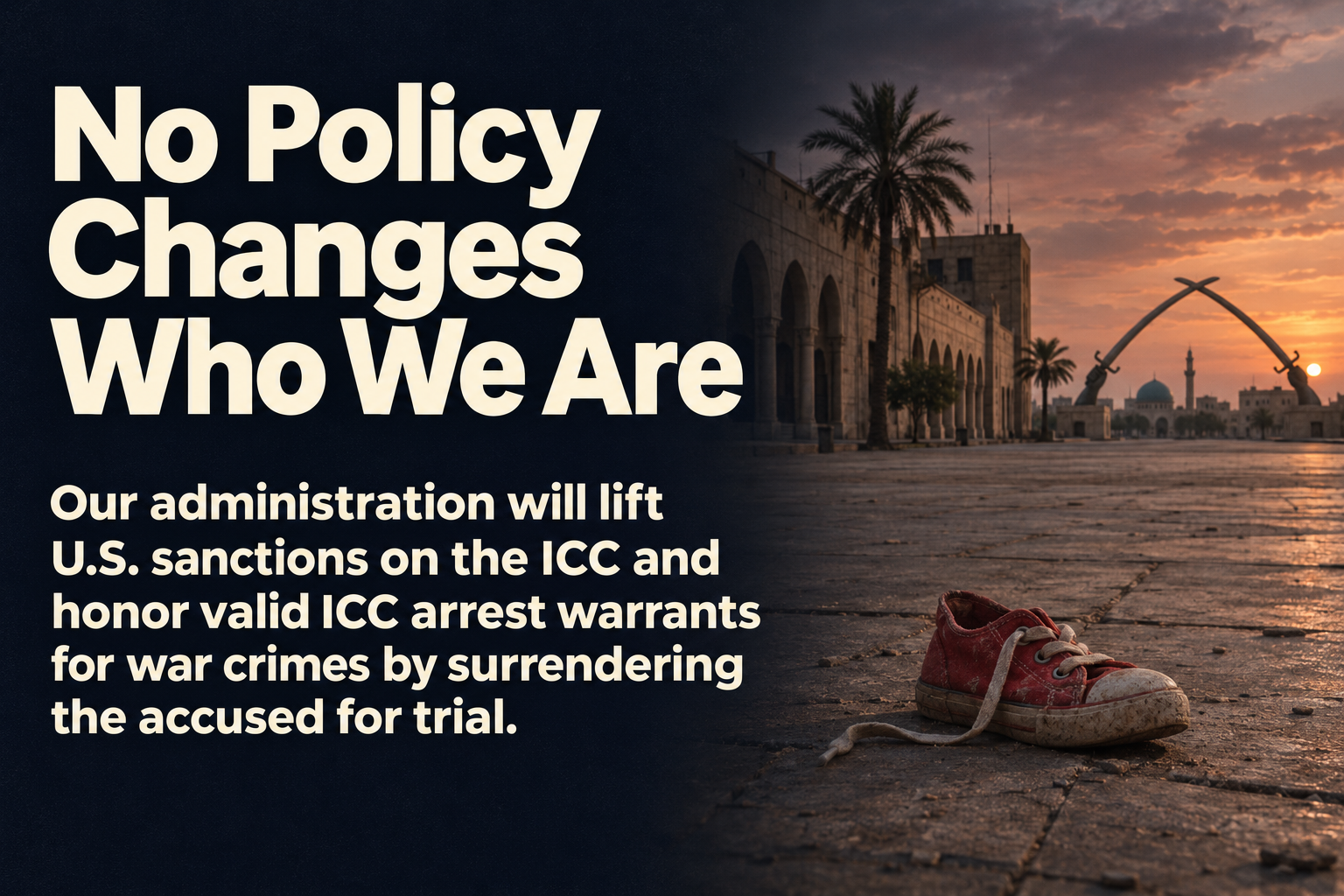
The Direction of Travel
If We Do Nothing
Here is what doing nothing looks like.
The sanctions stay. The court is starved—its judges cut off from the financial system, its prosecutors unable to travel, its witnesses afraid to talk. The cases pile up and go nowhere. The warrants gather dust. The people who gave the orders die in bed.
The next convoy fires into the next crowded square. The next missile hits the next school. The next mass grave is dug and filled and covered over. And there is no court left with the reach and the will to hear the case.
That is not a hypothetical. It is the direction of travel. It is what the sanctions are for.
And it doesn’t stop at the water’s edge. Watch what happens at home.
Another president will take this country to war. Maybe on a Tuesday. Maybe on a holiday weekend, when the news cycle is slow and nobody’s paying attention. There will be a vote—or there won’t be. The Constitution says Congress declares war. Lately Congress has been content to watch. It hands over its power a little at a time and then stands in the chamber and calls that leadership.
We have seen this time after time. Korea. Vietnam. Iraq. Libya. Now Iran. The names change. The pattern doesn’t. One person decides. Millions of people find out afterward. And the people we elected—the ones who swore an oath to check that power—they stand by and watch. Some of them vote to authorize it after the fact. Some of them say they were briefed. Some of them say nothing at all and hope we’ve forgotten by November.
Korea→Vietnam→Iraq→Libya→IranThe names change. The pattern doesn’t.
And when the war goes wrong—when the school is hit, when the wedding party is struck, when the wrong family is wiped out—nobody answers for it. The president finishes his term. The generals retire. The contractors go home. The members of Congress get reelected.
That is what doing nothing protects. Not the country. The arrangement.
The Trained Country
And here is the part that should trouble us most.
If we do nothing, we don’t just stay the same country. We stay the same trained country.
We stay trained to see rank before we see a person. Trained to sort human beings into tiers the moment we look at them—by passport, by skin, by class, by which flag flies over the rubble. Trained to measure a life by where it stands in the order rather than by the fact that it is alive at all. We were taught to see stratification, and we learned it so well that most of us don’t even notice we’re doing it. It feels like eyesight. It feels like common sense. It is neither.
We stay trained to ignore the one thing that was true before any border was drawn and will be true after the last one is erased: that we are the same species. The same blood. The same fear at three in the morning. The same love for a child. The same grief when that child is taken. Every wall we have ever built—every constitution, every treaty, every sanction, every rank—was built on top of that truth and then built to make us forget it.
And here is the hardest part. We already know.
That’s what makes it a choice and not a mistake. We know, because we were children once, and children know. We knew before anyone taught us otherwise. We knew on the playground. We knew the first time we saw someone hurt and felt the pull to help without asking who they were. That knowledge never left us. It is still there, under everything.
We realize it—and then we ignore it. Every day. We realize it when a school is hit and something in us flinches, and then we ignore it when the next headline moves the flinch along. We realize it when we hear “collateral damage” and feel the wrongness of the phrase, and then we ignore it because the alternative is to admit that we have been accepting the unacceptable for a very long time. Realization is uncomfortable. Ignoring it is easier. So we ignore it, and we call that being realistic, and we teach our children to do the same.
That is the real thing we would be protecting by doing nothing. Not a border. Not a budget. Not a court. A habit of looking away from what we already know.
A country can survive a bad policy. It can survive a bad president. It cannot survive generation after generation of people who know we are one species and choose, every day, to act as if we are not.
Doing nothing is not neutral. Doing nothing is a choice—the choice that says: this is fine. The powerful keep their shield. The victims keep their silence. The next family that loses a child to a contractor, a missile, or a militia learns the same lesson we have been teaching for generations: your dead don’t count, because no one with power will ever have to answer for them.
And the message we send to the next generation is even worse. We tell them that accountability is something done to the weak. We tell them that a title is a hiding place. We tell them that if you hold enough power, you can pardon yourself, sanction the court, and call it sovereignty. We tell them that when a president takes them to war, the people who were supposed to stop him will stand by and watch.
If we do nothing, we are not just failing the people already dead. We are teaching the people not yet born how to live with it.