Policy Vision · The Partnership Doctrine
The World Was Designed This Way.
We’re Redesigning It.
A Vision for America That No One Else Is Talking About
By Vincent Cordova· Cordova 2028 · May 19, 2026
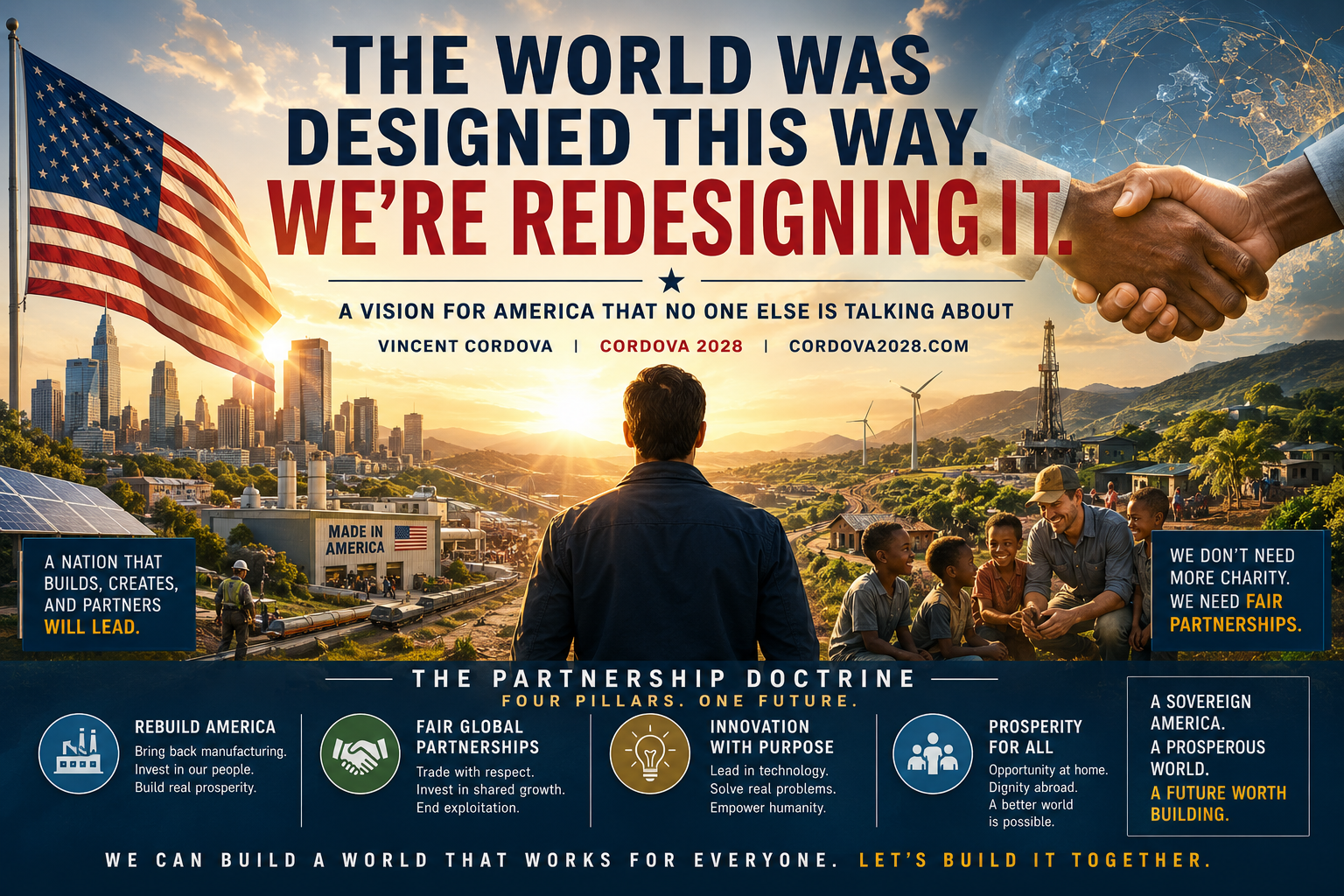
Campaign design team
Let me ask you something.
When was the last time a politician told you something you didn’t already know in your gut?
Not a slogan. Not a talking point polished by a consulting firm. Not a carefully worded promise designed to mean something different to every person who hears it. When was the last time someone running for the highest office in the land stood in front of you and said something true— even when the truth was uncomfortable, even when it named the people responsible, even when it pointed at a system so embedded in how we live that most of us stopped questioning whether it had to be this way?
I’m going to try to do that today.
Because the Partnership Doctrine — the policy vision I’ve spent months building and am now putting before the American people — is not a typical campaign platform. It doesn’t promise to fix the edges of a broken system. It proposes to replace the system. Completely. Permanently. And it does so with a level of specificity that I want to walk you through right now, because vague promises are what got us here and specificity is the only thing that will get us out.
Pull up a chair. This one’s worth your time.
Start With the Honest Question: How Did We Get Here?
America is the wealthiest nation in the history of human civilization. We have more billionaires than any country on earth. We have the largest military. The most influential culture. The most powerful financial system. The reserve currency of the entire global economy.
And yet.
We couldn’t manufacture our own masks during a pandemic. Our pharmaceutical supply chain runs through foreign factories we don’t control. Our semiconductor supply — the component that runs everything from your phone to your car to our military systems — depends on a single island that sits in the middle of a geopolitical conflict zone. Our grocery store shelves emptied when a few container ships got backed up at a port.
How does the most powerful nation in history become that fragile?
The answer is simple and it is ugly: we were sold a lie and we bought it.
The lie was called globalization. The sales pitch was efficiency — why make something here when we can make it cheaper somewhere else? Why pay an American worker a living wage with benefits and safety standards when we can pay someone in Vietnam or Bangladesh or Cambodia a fraction of that?
The pitch worked. The factories closed. The jobs left. The communities that were built around those jobs hollowed out. And the people who made the decision to move the factories? They pocketed the difference. They called it shareholder value. They called it the free market. They called it progress.
What it actually was — was the deliberate deindustrialization of the American working class so that a small number of people could extract a larger share of profit from a larger pool of desperate labor.
A nation that cannot make what it needs is not a sovereign nation. It is a client state with a flag.
We became a nation of consumers. And the people who designed that outcome are counting on us never noticing — or never caring enough to change it.
I noticed. I care. And I’m done being quiet about it.
Now Let’s Talk About Congo
Because this is where the global picture gets impossible to ignore.
The Democratic Republic of Congo has over 70% of the world’s cobalt. Cobalt is the mineral that powers the battery in your smartphone. The battery in your electric vehicle. The battery in your laptop. The battery in the devices that every major technology company on earth sells for hundreds or thousands of dollars a unit.
The average Congolese miner makes two dollars a day.
Sit with that for a moment.
The richest technology companies in history — Apple, Tesla, Samsung, and a hundred others — generate billions in profit annually from what comes out of Congolese ground. The people whose ground it is, whose children mine it with their hands, who live next to the operations that extract it — they see almost none of it.
That is not a tragedy. It is not bad luck. It is not a development gap that just hasn’t been closed yet.
It is a system. A deliberately constructed, carefully maintained system that keeps the price of raw materials low by keeping the people who produce them poor, and keeps those people poor by keeping their governments corruptible and their economic alternatives nonexistent.
Congo is not poor because it lacks wealth. Congo is poor because its wealth is being taken.
And here is the part that most politicians will never say out loud: America has been complicit in this. Not because Americans are evil. Because the people who designed this system made sure Americans never had to look at it directly. Never had to see the mine. Never had to know the miner’s name. Just buy the phone.
I’m asking you to look at it directly. Because once you look, you can’t design policy the same way anymore.
The System Was Designed. It Can Be Redesigned.
That’s the core premise of everything I’m proposing.
Poverty is not natural. It is manufactured. And that matters enormously — because if poverty were natural, we’d be helpless against it. If it’s manufactured, we can build something different.
The global trade system was not designed to create prosperity for all nations. It was designed by Western powers after World War Two — through the IMF, the World Bank, the WTO — to ensure that capital flowed on their terms. Nations that tried to break free were punished. Economically. Politically. Sometimes militarily.
China saw this and built its own version — the Belt and Road Initiative — which presents itself as an alternative. It is not. It is extraction with Chinese characteristics. Debt that converts to Chinese control of ports, roads, and resources when payments default. A new colonialism with different branding.
Neither system serves the people at the bottom. Both systems serve the people who designed them.
We are proposing a third option. Not a tweak of the existing model. Not a new version of the same extraction dressed in better language. A genuinely different architecture built on a foundation that has never governed global trade before:
The One Rule — No Exceptions
“No partnership under this doctrine may create, sustain, or benefit from the poverty of any group of people. Ever. For any reason.”
One rule. No exceptions. For America. For every nation that joins this framework. Forever.
Four Pillars. One Vision.
The Partnership Doctrine is built on four pillars that work together as a single system. Remove any one of them and the structure weakens. Keep all four and you have something that can outlast any single administration, any political shift, any attempt to return to the old ways.
Pillar One: Manufacturing — Getting Our House in Order
Before we can lead the world, we have to rebuild our own capacity to make things.
The American Manufacturing and Partnership Actstarts with a simple premise: every American state has natural advantages. Geography. Climate. Existing workforce. Agricultural capacity. Industrial history. And every state — every single one — is going to use those advantages to produce something real that enters the national supply chain.
We call it One State, One Specialty.
Michigan leads in electric vehicles and battery technology. Iowa in regenerative agriculture and wind energy. Arizona in solar panel manufacturing. Pennsylvania in recycled steel. California in semiconductors and biotech. West Virginia — a state that has been told its economic identity is over — in sustainable building materials and clean energy transition. Every state contributes. No state is left as a pure consumer.
Governing all of it is an Ethical Manufacturing Standard with no exceptions and no carve-outs: living wages, the right to organize, worker ownership options at every manufacturer with more than fifty employees, zero tolerance for toxic discharge, and a pathway to full renewable energy.
The five territories — Puerto Rico, Guam, the US Virgin Islands, American Samoa, and the Northern Mariana Islands — are full participants. Not footnotes. Their people have served this country and built things for this country for generations while being denied the full economic dignity of membership. That ends here.
Pillar Two: Trade — The Mutual Dignity Trade Doctrine
Once our house is in order, we turn outward. Not as an empire. Not as a charity. As a partner.
The Mutual Dignity Trade Doctrine establishes a single operating principle for every trade relationship America holds with every nation on earth:
“Every relationship America holds with another nation must create measurable, equal, and genuine value for the people of both nations — or it does not happen.”
Five core principles govern every partnership: mutual and equal value; no extraction without equal return; sovereign equality; bidirectional flow; and the absolute prohibition. The one rule. No exceptions. Ever.
Partnerships are facilitated through a Global Partnership Exchange — an open, transparent platform where American states and partner nations find each other and negotiate as equals, certified by a Global Partnership Council that is not American controlled.
The architecture is open. Any nation can adopt it. Japan. Germany. Brazil. India. And China — if China chooses to replace debt-trap extraction with genuine mutual dignity — the door is open. The standard applies to China exactly the same way it applies to us.
We extend this invitation explicitly to Cuba. Ninety miles from Florida sits a nation America has blockaded for over sixty years. The Partnership Doctrine ends the embargo — not as a reward for any government, but as a recognition that sixty years of collective punishment is a moral failure. Cuba’s healthcare sector, sustainable agriculture, and extraordinary cultural output make it a natural and powerful partner.
Pillar Three: Partnership — The Architecture of Equal Choosing
Every partnership under this doctrine includes non-negotiable terms. The partner nation holds meaningful equity — minimum 49% — in every manufacturing or processing facility built within its borders. Every partnership includes structured technology transfer so the partner nation can operate, expand, and replicate the technology without American involvement.
Read that again: the measure of a successful partnership is the partner nation’s growing independence— not its growing dependence on America.
Every partnership operates on a five to ten year renewable term. At the end of each term, both sides evaluate honestly. Did both benefit equally? If yes — renew. If either side wants to rotate — they may do so freely.
And here is the piece that changes the power dynamic completely: any nation may initiate a partnership with any American state.America is not the one dispensing partnerships like gifts. Congo can look at Michigan and say — we want Michigan. The initiation coming from them changes everything.
Pillar Four: Education — The Pillar That Makes It Permanent
Every policy can be reversed. A new administration can rewrite a trade agreement. A hostile Congress can defund a partnership program.
There is one thing that cannot be reversed.
A generation of Americans who grew up with a classroom partner in Kinshasa. Who built a water filtration solution with a student in Port-au-Prince over a video call. Who spent a semester living with a family in La Paz. Who speak some Lingala, some Creole, some Quechua. Who know what Haitian cacao tastes like because their school cafeteria served it every week.
You cannot un-know a person. You cannot make someone stop caring about a place where they have a friend.
The Partnership Education Frameworkintegrates the partner nation relationship into core curriculum from kindergarten through twelfth grade. History. Geography. Science. Economics. Language — as a graduation requirement beginning in kindergarten. Art, music, and culture. Culinary education. Every classroom paired with a classroom in the partner nation. Every student regardless of income has access to a semester-long physical exchange.
The graduates of this system become the translators, negotiators, chefs, engineers, politicians, and citizens who maintain the partnership across every change of administration because the partnership is not a policy to them. It is personal. And personal lasts.
What This Solves That Nothing Else Has
On immigration —
Every other approach treats immigration as a border problem. It is not a border problem. It is a poverty problem. Build genuine prosperity in Honduras, Guatemala, El Salvador, and Haiti through real economic partnership — and the pressure driving immigration changes at its source. Permanently. No wall required.
On China —
The Partnership Doctrine is the most effective response to Chinese economic influence available without a trade war or a military confrontation. We are not telling the world to stop working with China. We are offering something demonstrably better. Nations trapped in Chinese debt partnerships have a real alternative. As the alternative proves itself, the pressure to choose the better model grows from the bottom up.
On national security —
A nation with genuine, trusted partnerships with the nations that hold the world’s critical minerals does not need to fight over supply chains. Security built on mutual prosperity lasts. Security built on extraction and leverage is always one crisis away from collapse.
On the economy —
Fifty states all producing, all trading with each other, all anchored by ethical manufacturing standards that make worker ownership and living wages the baseline rather than the aspiration. That is not a manufacturing economy of the past. That is a productive economy of the future built on a foundation the past never had.
On moral authority —
America cannot lead the world by telling it what to do. It can lead by demonstrating something worth following. A doctrine that demonstrably lifts partner nations, that produces genuine mutual prosperity, that treats every human being as worth the dignity of a fair trade — that is something the world will follow. Not because we demand it. Because it works.
The Vision in Fifty Years
This is not a four-year plan. It is a fifty-year architecture.
In fifty years, if we do this right — and we will do this right — a generation of Americans exists who each have deep personal knowledge of at least one other nation on earth. Who have a friend there. Who have eaten the food, spoken some of the language, solved a problem together, maybe lived there for a semester during high school.
A generation of Congolese, Haitian, Bolivian, Malian young people exists who built their first innovation with an American partner. Who studied at an American university and came home with a degree, a network, and the technical knowledge to build something that did not exist in their nation before.
Manufacturing is distributed across every American state and every territory. Every community has an economic identity. The middle class is rebuilt from the factory floor up. Rural America is reindustrialized. The communities that were hollowed out by deindustrialization are producing again.
Poverty — not eliminated by charity but dissolved by genuine economic participation — is in structural retreat for the first time in human history. Not because someone decided to be generous. Because a system was built that made mutual prosperity more profitable than extraction.
Children on every continent have a friend, a classroom partner, a collaborator on another continent. They are the ones who will not allow the old system to return — because they know too many people in too many places to be indifferent to what happens to them.
A Personal Word
I want to be honest with you about why I’m doing this.
I am not a career politician. I do not have a donor class I am protecting. I am not calculating which position on which issue will produce the best polling numbers in which primary state. I built this policy framework because I genuinely believe that the world does not have to be organized the way it currently is — and that the first step toward changing it is saying so plainly, with enough specificity that no one can accuse you of vagueness, and enough moral clarity that no one can accuse you of calculation.
Every human being on this planet has one life. One shot at dignity. One shot at feeding their children. One shot at building something that matters. One shot at being seen as a full human being whose existence has value beyond what they can produce for someone else’s profit.
We have organized our world in a way that guarantees that shot is only available to some. That guarantee is not written in nature. It is written in policy. In trade agreements. In debt structures. In the deliberate suppression of wages and governments and entire economies.
Policy written by people can be rewritten by people.
Every decision I will make under this doctrine will ask one question first. Not — is this profitable? Not — is this politically convenient? Not — does this serve my donors?
Does this make life better for the people it touches — all of them, on both sides, without exception?
If yes — we move forward. If no — we go back to the table.
That is the Partnership Doctrine. That is the America I am building. And I am inviting the entire world to build it with us.
Read the Full Vision
The Partnership Doctrine is not a summary. It is a complete, detailed, legally considered framework built across four policy documents. Every section is specific. Every standard is defined. Every mechanism is described. Because vague promises are what got us here and specificity is the only thing that gets us out.
Share this if you believe the world does not have to be organized the way it currently is.
cordova2028.com | info@cordova2028.com
“We build together. We trade together. We learn together. And no one gets left behind — not now, not ever, not anywhere.”
— Vincent Cordova, 2028
Community Comments
Community Comments
Share a public response to this post. Submissions are reviewed before they appear.
0 approved comments
Loading comments...