Campaign design team
The Ballroom Belongs to the People: Why White House Luxury Must Become a Human Dignity and Recovery Center
By Vincent Cordova | Candidate for U.S. President 2028
May 5, 2026
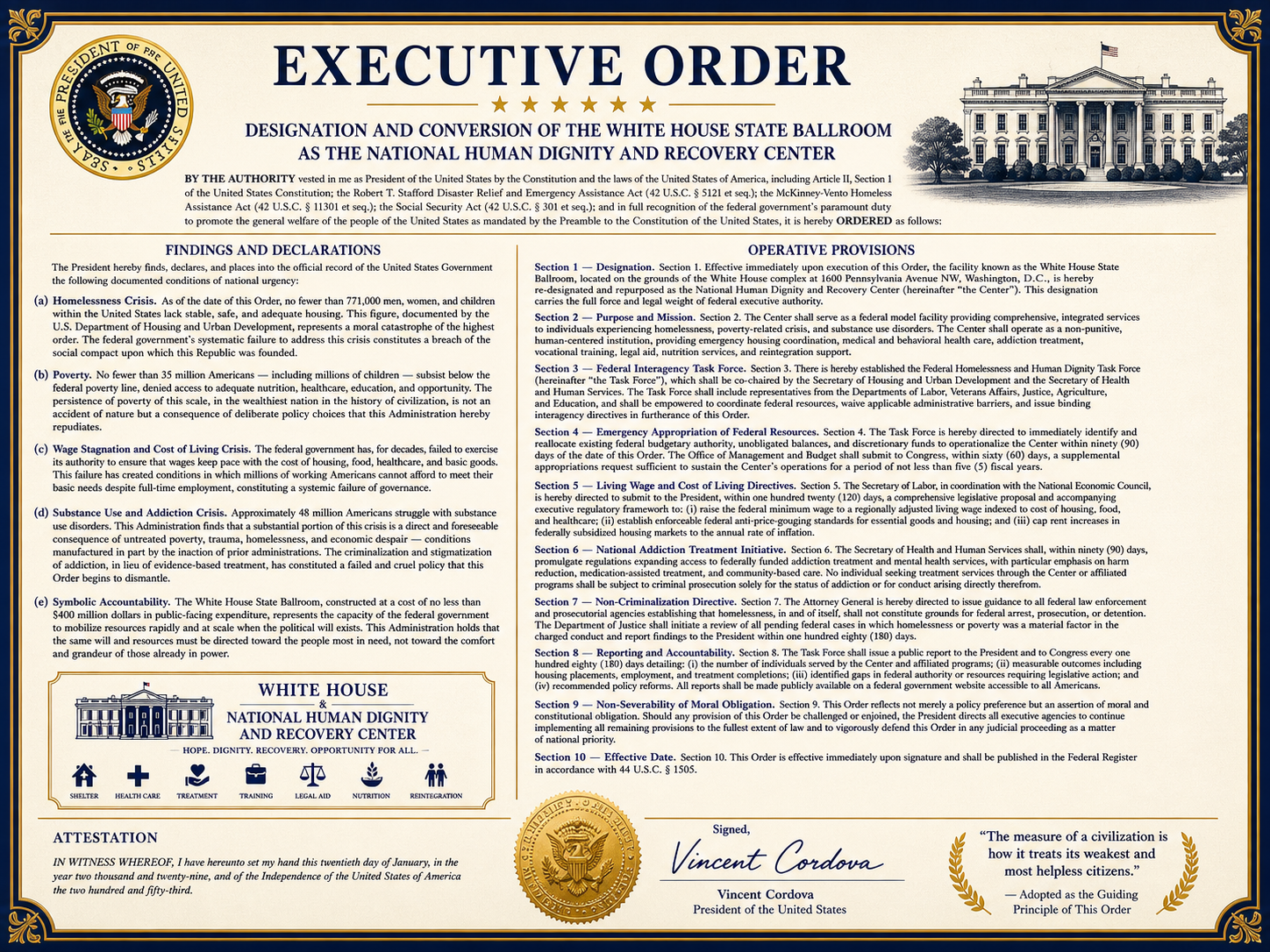
The White House does not belong to the insulated class. It belongs to the people. This Executive Order turns that principle into policy by converting a monument to political comfort into a national center for housing, recovery, treatment, and reintegration.
There is something morally clarifying about a ballroom. It is a room built to display power to itself. It is a room designed for ceremony, hierarchy, guest lists, and distance from ordinary suffering. And in a nation where hundreds of thousands of people are unhoused, tens of millions are poor, and millions are battling addiction inside a system that punishes need, the existence of that kind of room at the center of American power should trouble every conscience still capable of feeling.
That is why this Executive Order matters. It does not merely rename a building. It changes the moral direction of the presidency.
If the federal government can spend no less than $400 million in public-facing cost to build another stage for prestige, then no one gets to say there is no money for housing coordination, treatment, mental health care, legal support, nutrition, and reintegration. Scarcity is not the issue. Priority is the issue. This order forces that truth into the open.
The findings in the order are devastating because they are not rhetorical flourishes. They are the official acknowledgment of a system that has abandoned its obligations. At least 771,000 people without stable housing. At least 35 million people living in poverty. Roughly 48 million struggling with substance use disorders. None of this is normal. None of it is inevitable. And none of it should be tolerated as the background noise of a functioning republic.
For too long, the United States has treated visible suffering as unfortunate scenery around the theater of power. The people sleeping in cars, moving between shelters, self-medicating trauma, or choosing between food and rent are discussed as statistics, enforcement targets, or campaign talking points. This Executive Order rejects that posture. It says plainly that government is not legitimate when it protects grandeur while leaving human beings to collapse outside its gates.
Turning the White House State Ballroom into the National Human Dignity and Recovery Center is symbolically powerful precisely because it is materially serious. The order establishes an interagency task force, directs emergency resource reallocation, demands a supplemental appropriations request, expands treatment access, and sets reporting requirements tied to measurable outcomes. This is not symbolism standing in for policy. It is symbolism welded to policy so the country can no longer pretend it does not know what must be done.
The strongest part of the order may be its refusal to keep criminalizing what the government itself helped create. Homelessness is not a moral defect. Addiction is not proof of lesser humanity. Poverty is not evidence that a person deserves less protection from the law. When these conditions are treated primarily through punishment, the state is not solving social failure. It is managing the bodies produced by that failure. This order begins to reverse that logic.
Some people will call the conversion of a ceremonial federal space into a recovery center theatrical. They should ask themselves why theater only becomes offensive when it serves the broken instead of the comfortable. We have accepted performative wealth for generations. We have normalized palaces of insulation, conferences on suffering held by people untouched by it, and budget lectures delivered from rooms built to flatter the powerful. The real obscenity is not the repurposing. The obscenity is that the repurposing feels radical at all.
A government reveals itself by what it treats as urgent. The United States has repeatedly proven that when elites want a project, timelines collapse, obstacles vanish, and money appears. The question has never been whether this country can move at speed. The question has always been who gets that urgency. This Executive Order answers: the people at the bottom should get it first.
That answer is bigger than one building. It is a governing principle. Every underused symbol of prestige should be scrutinized against every unmet human need. Every public dollar directed toward vanity should be made to justify itself against shelter, recovery, food, care, and safety. If a program cannot survive that comparison, it does not deserve protection. The age of ornamental governance has to end.
This is also why the order pairs immediate conversion with structural directives on wages, anti-price-gouging standards, rent caps in subsidized markets, and community-based addiction care. Recovery cannot succeed in a society engineered to throw people back into desperation. If we want fewer people on the street, fewer overdoses, and fewer families living one missed paycheck from collapse, then the architecture of everyday life has to change alongside the emergency response.
The White House should be a place where the nation can see its values made visible. If that means losing a ballroom and gaining a center for human dignity, then the trade is not tragic. It is overdue. Power has spent too long decorating itself while the country bleeds. This order says the decorating is over. The repair begins now.
Community Comments
Community Comments
Share a public response to this post. Submissions are reviewed before they appear.
0 approved comments
Loading comments...