Campaign design team
They Say They Oppose the War. Their Votes Say Otherwise.
By Vincent Cordova | Candidate for U.S. President 2028
April 30, 2026
Let’s stop pretending not to see what’s happening.
Members of Congress go on television. They furrow their brows. They call the President’s strikes on Iran “unconstitutional.” They say they’re deeply concerned. They promise oversight.
And then they vote—and the war continues.
That gap between rhetoric and action isn’t a communications problem. It’s the story.
The Reality Behind the Rhetoric
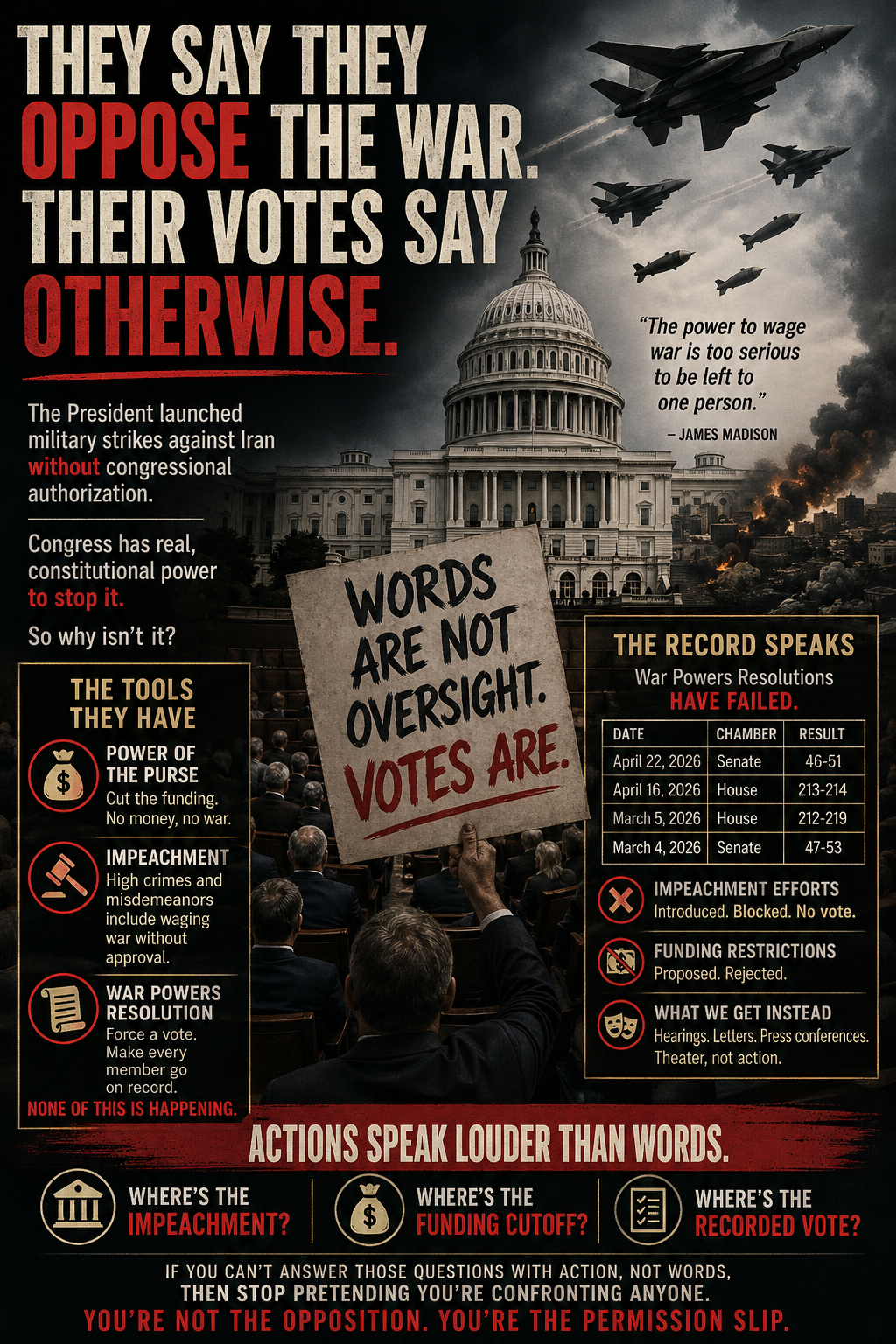
Congress does not lack tools. It has some of the most powerful authorities in the Constitution:
It can restrict or cut funding.
It can force binding votes under the War Powers Resolution.
It can initiate impeachment proceedings.
None of these are theoretical. They are active, constitutional mechanisms designed specifically to check unilateral war-making.
And to be clear—there have been attempts to use them.
War Powers resolutions have been introduced. They’ve failed.
Proposals to limit funding have been raised. They’ve been blocked.
Impeachment efforts have been floated. They’ve gone nowhere.
That matters. Because it tells us something important: this isn’t about a lack of options. It’s about a lack of votes.
What That Actually Means
If Congress truly had the political will to stop this conflict, it would show up in outcomes, not just statements.
Votes are the only currency that matters here.
So there are only a few honest possibilities:
Some members publicly oppose the war but privately support it or are willing to let it continue.
Some genuinely oppose it but cannot build a majority to act.
Others are choosing political safety over forcing high-risk votes that might fail or cost them electorally.
None of those scenarios align with the image of unified, forceful opposition that’s often presented to the public.
The Theater Problem
Instead, what we mostly see are low-cost signals:
Hearings without binding consequences
Letters and statements
Carefully worded press appearances
These actions create the appearance of resistance without requiring the accountability of a decisive vote.
Real confrontation looks different. It risks failure. It forces members on record. It has consequences.
And right now, those moments are rare and when they happen, they’re not succeeding.
The Uncomfortable Truth
Congress is not powerless in this situation. But it is constrained by votes, by incentives, and by political risk.
If lawmakers don’t have the numbers to stop the war, they should say that clearly.
If they believe the war must be stopped, they should be willing to force votes repeatedly, even if those votes fail.
What doesn’t hold up is projecting strong opposition while legislative outcomes tell a different story.
Actions Over Messaging
The Constitution didn’t give Congress war powers for symbolism. It gave them those powers to force accountability, especially when decisions carry the cost of lives and long-term conflict.
Right now, the disconnect is obvious:
Strong words.
Weak outcomes.
Until those align, the question isn’t whether Congress is speaking out.
It’s whether it’s actually exercising the power it already has.
Community Comments
Community Comments
Share a public response to this post. Submissions are reviewed before they appear.
0 approved comments
Loading comments...