Campaign design team
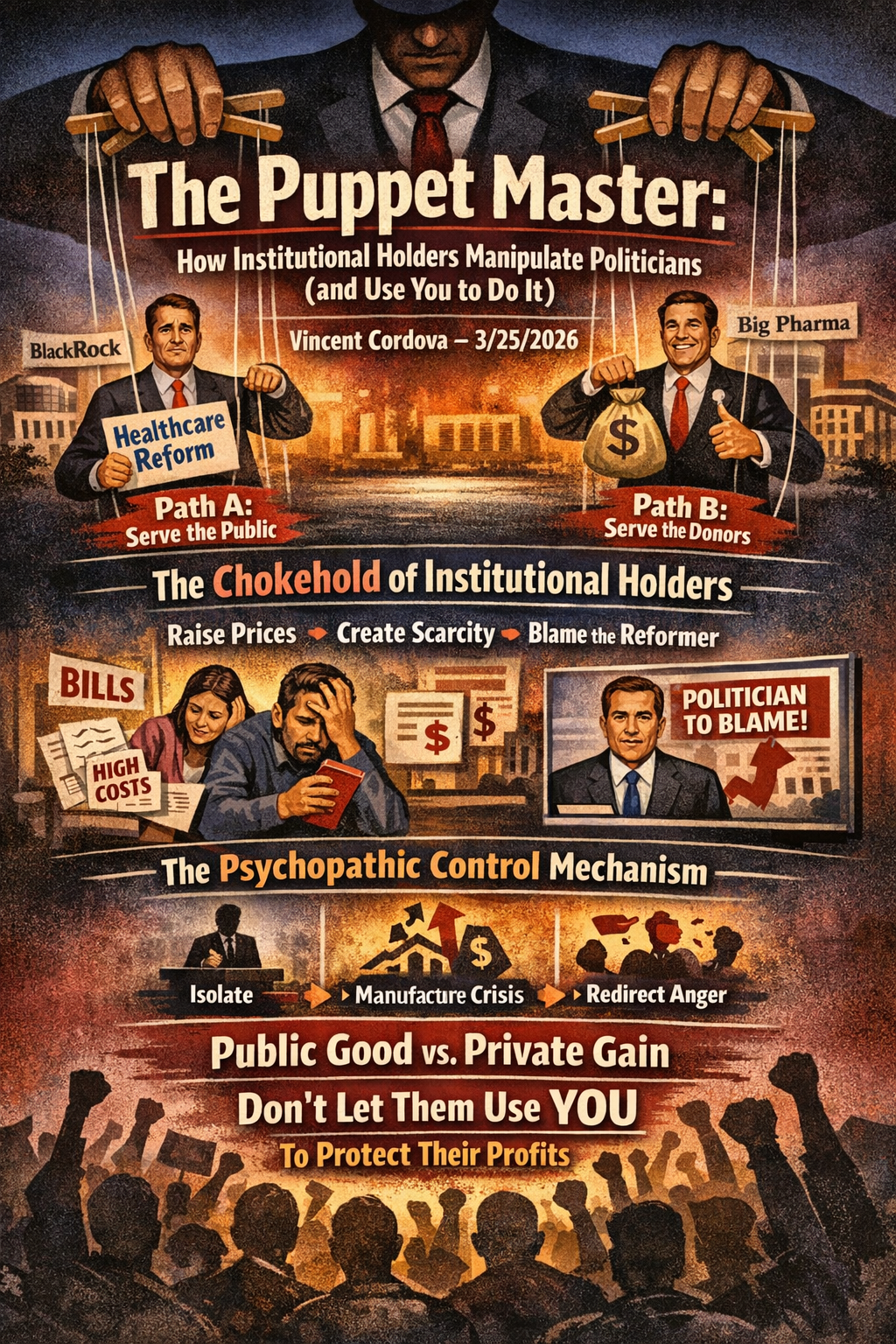
The Puppet Master: How Institutional Holders Manipulate Politicians (and Use You to Do It)
Why your healthcare costs rise when a politician tries to fix them.
By Vincent Cordova · March 25, 2026
Introduction: The Illusion of Choice
We are taught to believe that politics is a battle of ideas: Left vs. Right, Democrat vs. Republican. But that is theater. The real battle is between Public Good and Private Extraction.
I want to lay out a truth that is rarely spoken aloud: good politicians are systematically destroyed by corporations—not necessarily through direct bribery, but through the management of institutional holders and the media environments that protect them.
1. The Two Paths of a Politician
When an elected official enters office, they are presented with two unspoken paths:
- Path A (The Servant): You propose policies that benefit the public. You advocate for universal healthcare, insulin price caps, or breaking up monopolies. You refuse donations from the industries you are trying to regulate.
- Path B (The "Bipartisan" Favorite): You take the money. You go on television and promise to fix healthcare, while ensuring the final outcome funnels public dollars to the same institutional holders and managed care organizations that financed your campaign.
The trap is simple: choose Path A and you may lack the money to compete with the ad machine built to remove you.
2. The Chokehold of Institutional Holders
Large institutional holders—asset managers and mega-corporations with influence over healthcare, housing, and food supply—do not need direct threats to discipline reformers. They have a stronger weapon: the public pressure created by rising costs.
When a politician threatens profit margins, the response can be immediate: price hikes, supply chain pressure, and scarcity in the exact sectors under reform. Then the narrative follows: rising prices are blamed on the reformer rather than on concentrated private power.
3. The Psychological Control Mechanism
As families feel financial pain, anger gets redirected toward the person trying to challenge the system. The public becomes the instrument used against reform.
This dynamic follows a recognizable pattern:
- Isolate: make the public distrust the reformer.
- Manufacture Crisis: intensify price pressure and panic.
- Redirect Blame: ensure political anger avoids corporate accountability.
The result is a politician fighting not only concentrated capital, but also constituents who are absorbing a narrative built to protect that capital.
4. The Code Words
When political actors are funded by institutions they are supposed to oversee, language often shifts from substance to slogans.
- "I am going to fix healthcare" can function as a promise to preserve donor-friendly flows of public money.
- "Public-Private Partnership" can mean socialized risk for taxpayers and privatized gain for shareholders.
- "Incremental change" can become a delay strategy that preserves extraction through another election cycle.
5. The Endgame: Why Your Health Matters
I believe in free, accessible healthcare because your health matters. A person cannot become the best version of themselves while trapped in employment solely for insurance or living one medical bill away from financial collapse.
A captive public is easier to control: afraid to leave bad jobs, too financially stressed to organize, and too divided to challenge the structures extracting wealth from everyday life.
Conclusion: The Choice
This system is designed to break anyone who refuses to play by donor rules. If I accepted corporate financing, I would likely receive praise, ad support, and elite approval for performative reforms that keep the same profit model intact.
Because I reject that role, I expect to be targeted. When prices rise, blame will be redirected toward reformers. But those price shocks are not punishment of one politician—they are pressure applied to the public to enforce compliance.
Don't let institutional power use your pain as a weapon against your own liberation. Your health matters. Your freedom matters. We must stop accepting a system where public service is rewarded only when it serves private extraction.
May the world come together for a brighter future without the chains of a 500-year-old failure.
References & Further Reading
The arguments above draw on documented patterns of corporate influence, price signaling, and political manipulation. Below are sources that provide evidence and context.
- “BlackRock and Vanguard: The new power brokers” – Financial Times. Explores how large asset managers exert influence across industries.
- “How Health Care Became the Richest, Most Aggressive Lobby in America” – The Atlantic. Documents the pharmaceutical and insurance industries’ political spending.
- OpenSecrets: Top Industries – Data on lobbying expenditures and campaign contributions by sector.
- “Testing theories of American politics: Elites, interest groups, and average citizens” – Proceedings of the National Academy of Sciences. Gilens & Page (2014) show policy responsiveness heavily favors economic elites and organized interests.
- Peterson-KFF Health System Tracker: The Rising Cost of Health Care – Analyzes how market concentration and lack of price regulation drive U.S. healthcare costs.
- “The Health Care Industry Spent $2.5 Billion Lobbying Over the Last Decade” – ProPublica investigation.
- “The ‘Big Three’ are more powerful than you think” – Axios on the concentration of shareholder power in BlackRock, Vanguard, and State Street.
These references support the claims regarding institutional influence, political capture, and the mechanisms used to maintain private control over public goods.