This site is under construction - will be ready soon.
Your Guide to Our Vision
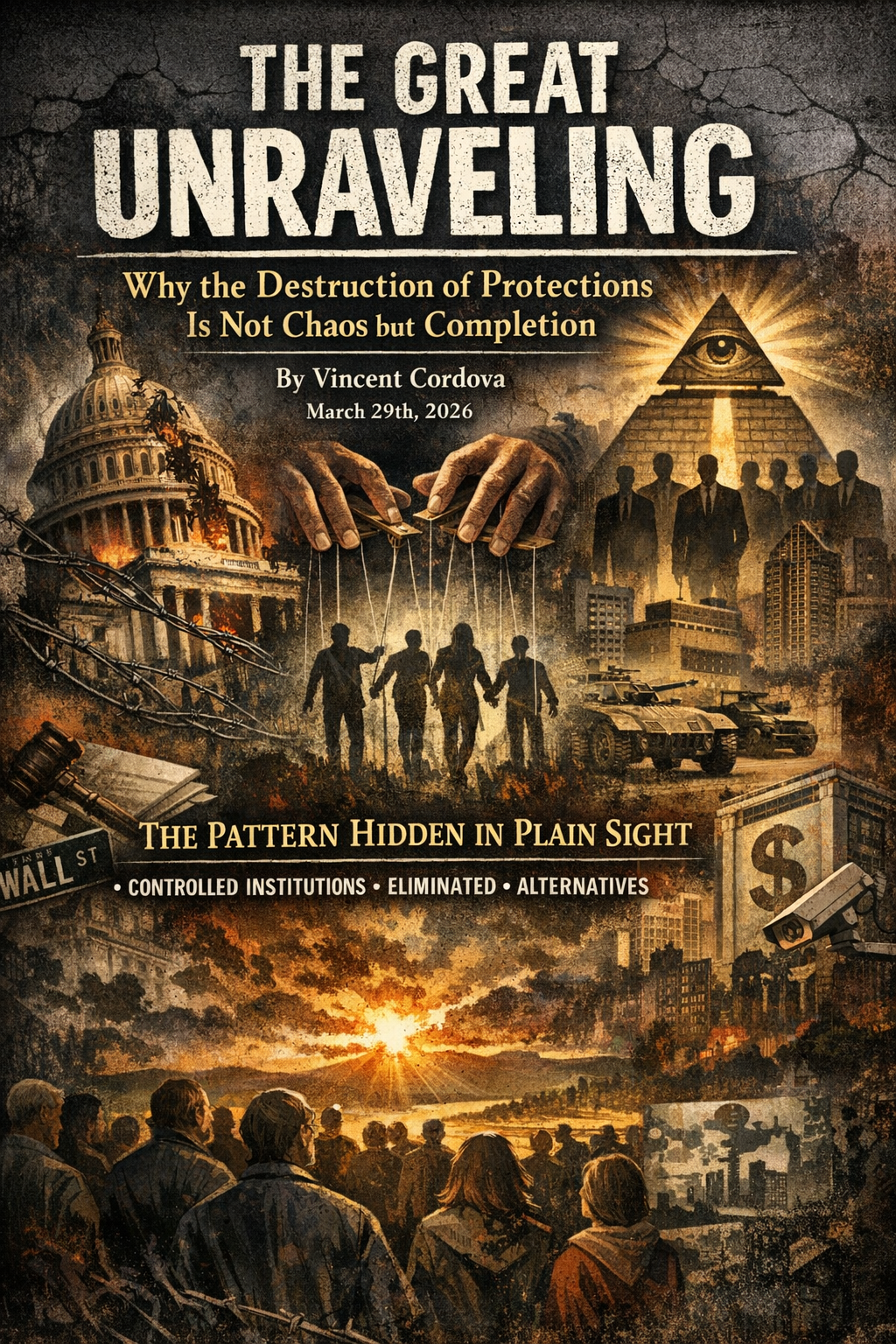
The Great Unraveling

Campaign design team

The Great Unraveling: Why the Destruction of Protections Is Not Chaos but Completion

By Vincent Cordova

March 29, 2026

Download PDF

The Pattern Hidden in Plain Sight Before You Read: A Warning What follows will make you uncomfortable. It is meant to. If it were easy to see, they would not work so hard to hide it. This is not a conspiracy theory—it is history repeating. The playbook is old. The names change. The costumes change. The brutality does not. I am not asking you to believe me. I am asking you to check. To look. To stop being distracted by the drama they put in front of you and see the structure behind it. Because if I am wrong, no harm is done by looking. But if I am right—and the evidence suggests I am—then the cost of not looking is everything. Every empire in history has collapsed. But before they did, those who held power—those who had spent generations consolidating control—did not simply wait for the end. They planned. They transferred power into something else. They dismantled the structures that had once constrained them and pre-positioned assets, authority, and loyalties into containers designed to outlast the storm. The names change. The costumes change. The playbook does not. We are living through such a moment. And the greatest trick of this era is making us believe that what we are witnessing is dysfunction when in fact it is design. To see this, we must first understand how power consolidates. History offers a grim syllabus. When a regime—whether an empire, a ruling party, or a consolidated corporate-state hybrid—moves from merely governing to entrenching itself permanently, it follows a three-part playbook. First, it neutralizes institutional counter-powers (Trump’s swamp was actually good government employees that wanted to protect the public). Second, it eliminates human alternatives. Third, it seizes control of reality itself—of history, of language, of what is thinkable. We have watched all three unfold in our lifetimes, accelerated across administrations of both parties, and now reaching what appears to be a final stage. The Institutional Playbook: Taking Out Anything That Could Resist The first step in any consolidation of permanent power is to ensure that no institution exists that can challenge the center. This is not done through dramatic confrontations alone. It is done through a slow, methodical hollowing out. Start with the military. In a healthy republic, the military serves the civilian government. In a consolidating power structure, the military must be made loyal not to the constitution but to the ruler—or, in the modern iteration, to the corporate-state apparatus. This is achieved through purging independent-minded officers, stacking leadership with political loyalists, and creating parallel forces—private security apparatuses, politicized intelligence agencies, and eventually militias loyal to no law but the leader’s will. We have watched the erosion of the norm that the military remains above politics. We have watched the installation of loyalists in the highest defense positions. We have watched the lines blur between the Department of Defense, defense contractors, and the political operation of a single man. Next, the judiciary. A permanent power cannot be bound by law; the law must be bound to it. This is why judicial consolidation is always a priority. The Federalist Society spent decades quietly building a pipeline of ideologically reliable judges. The result is a federal judiciary packed with jurists who view corporate power as synonymous with liberty, who have gutted voting rights, who have stripped regulatory agencies of their ability to protect consumers, workers, and the environment. This was not an accident. It was a multi-decade project to ensure that no future democratic majority could use the courts to constrain corporate capture. Then the economy itself. A rising power often rises with the support of a merchant class or regional elites. But to maintain power permanently, those elites must be rendered dependent. This is why we have watched the acceleration of mergers and acquisitions that concentrate ownership in fewer and fewer hands. Three asset managers—BlackRock, Vanguard, State Street—now own a controlling interest in the majority of S&P 500 companies. This is not capitalism. This is a cartel. The regulatory agencies designed to prevent such concentration—the Federal Trade Commission, the Antitrust Division of the Department of Justice—have been systematically defunded, defanged, and staffed with industry loyalists. And finally, the media. In a consolidated power structure, information cannot be independent. It must be either a tool of the state or a product of corporate consolidation that naturally aligns with the interests of the owners. We have watched local journalism collapse. We have watched the major media companies merge into five conglomerates. We have watched the line between news and entertainment dissolve, replaced by a content machine optimized for outrage because outrage drives engagement and engagement drives profit. The result is a public that is simultaneously overstimulated and underinformed—aware of every scandal, ignorant of every structure. The Human Playbook: Eliminating Alternatives Institutions are the scaffolding of power, but people are its substance. A consolidating regime cannot tolerate the existence of individuals or networks that represent an alternative center of gravity. This begins with the succession line. History is stained with the blood of brothers, sons, and heirs eliminated to prevent any focal point for a rival faction. Our era does not require literal fratricide—it has more sophisticated methods. Political dynasties are marginalized. Potential successors are humiliated, investigated, exiled from the corridors of power. The field is cleared until only one figure remains. Then comes the inner circle (who is the inner circle?). The very people who helped consolidate power are often the greatest threat. They know the secrets. They have their own networks. They believe they are owed the ultimate prize. A ruler who seeks permanence must periodically purge their own inner circle—not necessarily through violence, but through exile, public humiliation, or the quiet removal of funding and access. We have watched this happen in cycles: the allies of yesterday become the enemies of today, cast out and replaced by more pliable figures whose loyalty is not to an ideology or an institution but to a single person. And finally, the managerial and intellectual class. An empire cannot run on loyalists alone. It needs skilled administrators, engineers, scientists, and thinkers. But an independent-minded managerial class is a threat. The solution is to impose ideological purity tests—to force every expert, every civil servant, every professional to choose between competence and loyalty. When competence is purged in favor of loyalty, the empire begins its slow decline in capability. But by then, the rulers often no longer care. They are no longer governing. They are extracting. The Ideational Playbook: Controlling What Is Thinkable The most durable form of power is control over what people believe is possible. A regime that seeks permanence must seize control of the past, the language, and the future. History is rewritten. The previous era is portrayed as weak, corrupt, chaotic. The current order is framed as salvation. Those who represented alternative paths are erased—their statues removed, their names stricken from buildings, their writings buried. We have watched this happen across the political spectrum, not as a project of one party but as a cultural consensus: the past is a battlefield, and whoever controls it controls the future. Language is corrupted. Words are stripped of meaning and repurposed. “Freedom” becomes the right of corporations to pollute. “Patriotism” becomes loyalty to a leader rather than to a country. “Dissent” becomes treason. The purpose of this linguistic corruption is to make opposition unthinkable—to ensure that when someone objects to the consolidation of power, they cannot find the words to articulate their objection without sounding radical or unhinged. And finally, the future itself is captured. A permanent power cannot tolerate the idea of a life, a career, or a future that exists outside its purview. Every aspiration—for housing, for education, for healthcare, for dignity—must be channeled through the state or the corporate apparatus. The public is told there is no alternative. That the market has decided. That this is simply how things are. The Transfer: Why Government Is Becoming a Shell If the playbook we have just described sounds familiar, it is because we have watched it unfold across multiple administrations. But the past decade has accelerated something that was already in motion: the transfer of power from visible, accountable government to invisible, permanent institutional holdings. Here is what most people miss. The screaming about presidents—the moral outrage, the legal battles, the impeachment proceedings, the felony convictions—happens on one level. Beneath it, on a completely different level, the actual allocation of resources, the actual exercise of power, is quietly moving into containers designed to outlast any election, any administration, any public outcry. These containers are sovereign wealth funds, military-owned holding companies, state-owned enterprises, and the largest asset managers. They are not subject to elections. They do not answer to Congress. Their leadership is appointed, not elected. Their assets are measured in trillions. And they have been systematically positioned to control the flow of energy, capital, information, and defense. When a president signs a bill that funnels hundreds of billions into the defense industry, that is not policy. That is a transfer. When long-term contracts are signed that lock in corporate profits for a decade or more, that is not governance. That is a lock-in. When the Federal Reserve operates its balance sheet to benefit asset-holders over wage-earners, that is not monetary policy. That is class war conducted by unelected bankers. And when the public is told to focus on whether the president is a felon or whether his opponent is senile, the function of that spectacle is not to inform. It is to distract. Because if the public were to look away from the drama and examine the structures—the contracts, the consolidations, the transfers—they would see that the real government is not in the White House at all. It is in the boardrooms of the institutional holdings that have captured the state. The Trump Question: Populist Pretense or Corporate Instrument? This brings us to the figure who has consumed more political attention than any other in recent memory. What is Donald Trump? A populist insurgent who threatened the establishment? Or the ultimate instrument of the very corporate capture he claimed to oppose? The evidence increasingly points to the latter. Look at what was actually done during his administration. The tax cuts—permanent for corporations, temporary for individuals. The deregulation—over 200 environmental rules rolled back, consumer protections gutted, labor rights weakened. The judicial appointments—three Supreme Court justices and over 200 federal judges, nearly all of them corporate-friendly. The defense spending—increases that made the defense contractors richer than ever. The COVID response—a giveaway to pharmaceutical companies and private healthcare providers while ordinary people died and struggled. This was not the agenda of a populist fighting for the working class. This was the agenda of the corporate right, executed with breathtaking efficiency. And now, in his current iteration, the pretense has dropped entirely. The cruelty is open. The contempt for ordinary people—for “peasants”—is no longer hidden behind a populist mask. Why? Because the work is done. The structures are in place. The transfer to institutional holdings is secured. The performance of caring is no longer necessary. The Bipartisan Consensus That Dare Not Speak Its Name Here is the part that is hardest for many to accept. The problem is not Trump. The problem is the system that produced Trump and that will continue long after him. The Democratic Party, which presents itself as the resistance to corporate capture, is funded by the same institutional holdings as the Republican Party. The same Wall Street firms donate to both sides. The same defense contractors have political action committees that give to incumbents regardless of party. The same asset managers benefit from the policies of every administration. When Kamala Harris or any other Democratic leader calls Trump a felon, they are not wrong in a factual sense. But the function of that focus—the endless repetition of Trump’s crimes, his norm-breaking, his moral unfitness—is to keep the conversation on personality rather than structure. Because if the conversation were about structure, it would have to address why both parties are funded by the same donor class. It would have to address why no Democratic administration has seriously broken up concentrated industries, democratized the Federal Reserve, ended the revolving door between government and corporate boards, or subjected institutional holdings to democratic accountability. The answer is uncomfortable: because the Democratic Party, like the Republican Party, serves the institutional holdings. They differ on social issues, on rhetoric, on cultural signaling. But on the questions that matter to the permanent apparatus—tax policy for carried interest, defense spending, financial regulation, trade policy that favors multinational corporations—there is far more continuity across administrations than the partisan drama suggests. Why the Protections Are Being Dismantled If the goal is permanent corporate capture, then everything that once protected ordinary people must be dismantled. This is not collateral damage. This is the point. The Environmental Protection Agency is gutted because pollution restrictions are an obstacle to extraction industries. The Department of Education is targeted for elimination because public education is a democratizing institution that stands in the way of privatization. The Consumer Financial Protection Bureau is defanged because predatory lending is profitable. The National Labor Relations Board is weakened because unions are a barrier to wage suppression. The civil service is stripped of its protections because a professional, nonpartisan workforce is an obstacle to patronage and loyalty-based governance. Each of these protections was imperfect. Each was compromised by decades of corporate influence. But each represented a layer—a buffer—between raw corporate power and human life. Removing them is not reform. It is not streamlining. It is not efficiency. It is the final clearing of the ground. You do not reverse things that actually help people. When you see a pattern of reversal across environmental protection, labor rights, consumer safeguards, public education, healthcare access, and diplomatic alliances—and when that pattern consistently benefits corporate interests while harming ordinary people—the simplest explanation is not incompetence. It is that the protection was the obstacle, and removing the protection was the objective. The Distraction: Why We Are Meant to Watch the Drama and Miss the Transfer Consider what is happening right now. While the political world screams about Trump’s latest outrage, while the media cycles through twenty-four-hour coverage of his legal battles, while the public is consumed by debates over whether he is a felon or whether his opponents are corrupt—what is happening beneath the surface? Long-term contracts are being signed that will lock in defense spending for a decade. Mergers are being approved that further concentrate corporate ownership. The Federal Reserve is making decisions about interest rates and balance sheets that will determine housing affordability and employment for years to come, with no democratic input. The federal judiciary is being filled with judges who will serve for a generation, insulating corporate power from any future democratic challenge. These are the transfers. And they are happening while you are being told to watch the clown show. This is not necessarily a conscious conspiracy. It does not require a smoke-filled room where party leaders agree to use Trump as a distraction. It requires only that the incentives are aligned. Media companies profit from Trump content. Democratic strategists find it easier to run against Trump than to offer a vision that would challenge their donors. Republican strategists depend on Trump’s base to win elections. And the institutional holdings benefit from the chaos—because while the public is distracted, the consolidation continues. The Historical Resemblance: This Playbook Is Old There is nothing new about any of this. The Roman Republic fell when the institutions that had balanced power—the Senate, the assemblies, the courts—were hollowed out by a succession of strongmen who claimed to be saving the republic from its enemies. The late Roman Empire transferred power into the hands of the military and the bureaucracy while the public was entertained with bread and circuses. The British Empire, in its decline, transferred assets into the hands of the City of London and the corporations that would outlast the crown’s political authority. The Soviet Union, in its final decades, was governed not by the Communist Party but by the nomenklatura—the permanent apparatus of state-owned enterprise directors, intelligence chiefs, and regional bosses who outlasted any individual leader. When the Soviet flag fell, these same people did not lose power. They transferred it into new corporate forms—the oligarchs who would own Russia for the next generation. Every empire in history has collapsed. But before they did, they planned. They transferred power into something else. The names change. The costumes change. The playbook does not. What Is Left for the People? If this analysis is even partially correct, then we are living through the final stage of a long consolidation—one that has been underway for decades, across administrations of both parties, and that is now reaching completion. The protections are gone. The transfer is secured. The institutional holdings have won. What is left for the people? This is not a rhetorical question. It is the only question that matters. If the political system is a containment mechanism—designed to absorb public energy, channel it into binary choices, and produce outcomes that never threaten the underlying distribution of power—then where does a person who wants a different world direct their energy? The answer is not simple. There is no single candidate, no single piece of legislation, no single protest that will reverse fifty years of consolidation. But the first step—and it is a crucial step—is to stop being distracted. To see the structure beneath the spectacle. To recognize that the screaming about Trump and the screaming about the deep state are both performances for audiences, and that the real game is happening elsewhere. The second step is to rebuild. Not through the existing institutions, which are captured. But through the networks, the communities, the mutual aid, the local institutions that have always been the real foundation of human life. The corporate holdings can own the government. They can own the media. They can own the economy. But they cannot own your relationships. They cannot own your capacity for solidarity. They cannot own your ability to see clearly. A Final Thought What you have just read may be difficult to accept. It may feel overwhelming. It may feel like a conclusion that offers no hope. But there is hope in clarity. There is hope in recognizing that the chaos is not random, that the cruelty is not incompetence, that the destruction of protections is not an accident but a project. Because once you see the project, you can no longer be fooled by it. Once you understand the playbook, you can recognize it when it is being run. The question is not whether the playbook exists. History tells us it does. The question is whether we will continue to watch the spectacle while the transfer is completed, or whether we will look away from the drama and look at the structures. This is not a call to despair. It is a call to attention. Because the first act of resistance—the only act that matters—is to refuse to be distracted. To see. To understand. And then to act, not in the arena they have built for us, but in the spaces they have not yet captured. Any change of government without the people's consent is illegal and invalid. That is not opinion. That is the foundation of any society that claims to be free. The fear you feel is real. Do not let anyone tell you otherwise. There are good politicians—people who entered public service because they genuinely wanted to protect us. But here is the truth we must all face: giving us back to the same power that consumed us to this very point is not the answer. Now the question becomes this: if the collapse we are witnessing is real—and it is—then the public should determine the direction forward. Not extractive institutional holdings that like slave-like conditions – to control outcomes and compliance. Not the corporate apparatus. Not the permanent government that operates in favorable to intuitional holding conditions, with no real protections for working people. They may say they want to protect the public. But handing the public over to the very system that created this crisis is not protection. It is surrender. Every past and current elected official screaming about the other side—they are screaming to protect the system that has made your life hard. The same system that now seeks to enslave us completely. They are not the answer. They have never been the answer. We need to create alternative options now. Not tomorrow. Not after the next election. Now. Because if we do not, we will all be managed continuously—just like we are now—until there is nothing left to manage but the machinery of our own subjugation. A Statement of Accountability and Restoration The dismantling of our federal and state workforces was not an act of efficiency. It was an act of vengeance—a purge designed to replace competence with loyalty, to strip away the protections that stood between the American people and corporate capture. Those who were fired, forced out, or driven from their posts were not obstacles to progress. They were the last line of defense. And their removal was not a mistake. It was a targeted operation. I am here to say clearly: that operation is now being reversed. Every federal and state employee who was terminated, demoted, or constructively discharged as part of this systematic dismantling will be reinstated. Full restoration of position, seniority, and standing. No exceptions. No appeals. No bureaucratic loopholes. But reinstatement alone is not enough. These public servants were not just fired—they were humiliated. They were vilified. They were stripped of their livelihoods while the political class stood by, and in many cases cheered, as the machinery of government was turned against those who had sworn to serve the public. That will not stand. Every person who was removed will receive ten times their back pay. Calculated from the date of their termination to the date of their reinstatement. Paid in full. This is not a gift. It is restitution for the weeks, months, and years of uncertainty. It is acknowledgment that what was done to them was wrong—not just politically wrong, but fundamentally, morally, constitutionally wrong. And it is a warning to anyone who would ever attempt such a purge again: the public will not forget, and the debt will be paid. I will personally review every case. Not through a committee. Not through a closed-door review board. I will review each case myself, alongside the public, with full transparency. The names, the agencies, the circumstances of termination—all of it will be open. Because the public has a right to know exactly what was done in their name. And the people who were harmed deserve to see that their government, at last, is willing to face what it did. This is not about politics. This is about whether we are a nation of laws or a nation of loyalty oaths. It is about whether public service is a calling or a patronage appointment. It is about whether we believe that the people who keep our water clean, our food safe, our borders secure, our air breathable, and our institutions functioning deserve protection from those who would treat them as disposable. I say they do. And I say the reckoning begins now. If you were fired for doing your job, come forward. If you were pushed out because you refused to betray your oath, your name will be restored. If you were silenced because you spoke the truth, your voice will be amplified. We are going to rebuild—not as we were before, because before was already failing, but as we should have been: a government of, by, and for the people, staffed by public servants who are respected, protected, and never again used as pawns in a game of consolidation and control. Let this be the first act of restoration. Let it be the standard by which every future abuse is measured. And let anyone considering such a purge again know this: the public is watching, the record is open, and the price for destroying what belongs to the people will be collected in full. May we come together to determine our future. With global support. Excluding the status quo that has us trapped in this very position. Because the status quo did not get us here by accident. It built this cage, brick by brick, while we were told to watch the drama. Let us stop watching. Let us start building. The playbooks are all the same. Our only advantage is that we can read them. May we all find love in standing together globally.