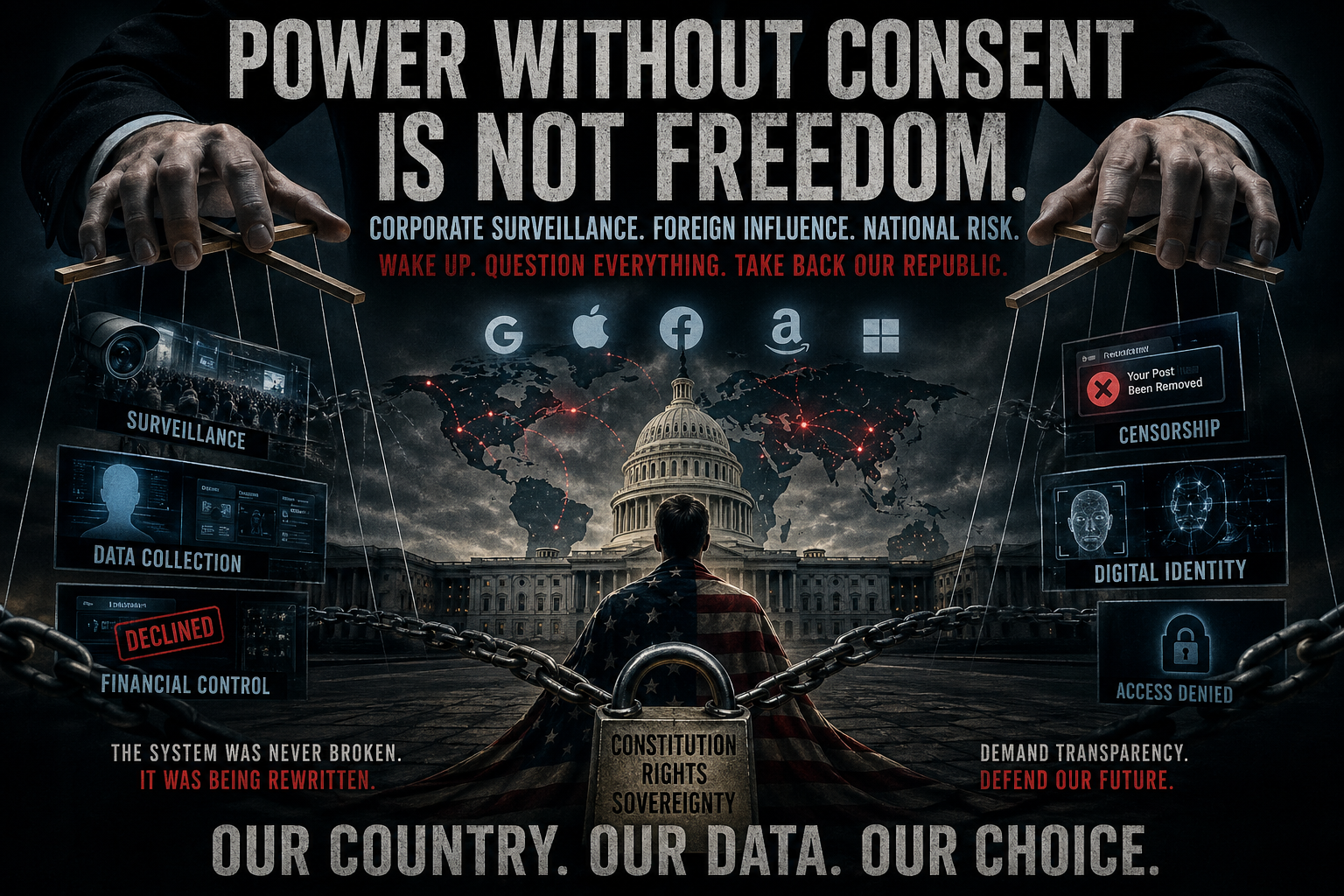
Campaign design team
The Quiet Shift of Power: Corporate Surveillance, Ownership, and the Future of American Sovereignty
By Vincent Cordova | Candidate for U.S. President 2028
April 28, 2026
There is a fundamental transformation happening in the United States, one that most people feel but cannot fully see. It is not marked by a formal vote, a constitutional amendment, or a declaration. Instead, it is unfolding quietly through corporate systems, digital infrastructure, data collection, and global capital flows.
At the center of this transformation is a simple but urgent question:
Who actually holds power over the daily lives of the American people?
For most of our history, the answer was clear. Government authority was constrained by the Constitution, elections, and the rule of law. Corporations, meanwhile, were granted limited rights to conduct business, not to govern.
That distinction is eroding.
The Rise of Corporate Governance Without Consent
Today, corporations control vast portions of what can only be described as the operating system of modern life:
- Communication platforms determine what information is seen or suppressed
- Financial systems decide who can transact or be excluded
- Data systems track behavior, location, identity, and habits
- Employment platforms influence access to income and opportunity
- Digital identity systems increasingly define access to services
These systems are not theoretical. They are real, embedded, and expanding.
Unlike government, corporations are not bound by constitutional protections such as free speech, due process, or protection from unreasonable surveillance. Their authority comes from terms of service, internal policies, and market incentives.
Yet in practice, they are exercising powers that look very similar to governance.
This creates a dangerous imbalance:
Power without accountability. Control without consent. Influence without representation.
The Government-Corporate Convergence
The situation becomes more complex, and more concerning, when government intersects with corporate power.
There is growing concern that public institutions may rely on, coordinate with, or indirectly benefit from corporate systems of surveillance and control. Whether through data access, regulatory pressure, or informal cooperation, the result is the same:
Capabilities that would face constitutional limits if performed directly by government can be carried out through private entities.
This creates a loophole in the very framework designed to protect citizens.
The Constitution does not lose its meaning simply because power is exercised through a corporate intermediary.
The Reality: Ownership Is Concentrating Quietly
Another layer of this issue is less visible, but just as important.
Across major sectors of the economy, housing, healthcare, media, logistics, technology, and food supply, ownership is becoming increasingly concentrated in the hands of large institutional investors and private equity firms.
Major firms such as BlackRock, Vanguard, and State Street hold significant ownership stakes across large portions of the market.
They do not operate these companies day-to-day, but they often represent shared ownership across competitors.
This creates something subtle but powerful:
The same capital sits behind large portions of the economy.
Why This Matters
This ownership structure introduces real risks:
- Reduced Competition: When the same institutions hold large positions in competing firms, incentives can shift away from aggressive competition.
- Short-Term Decision Making: Private equity ownership can prioritize rapid financial returns over long-term stability.
- Systemic Fragility: Concentration increases the risk that shocks in one area ripple across multiple sectors.
- Indirect Control: Ownership influences pricing, labor practices, service access, and long-term strategy.
- Limited Transparency: Most Americans have little visibility into who ultimately owns or influences the systems they rely on.
This is not about conspiracy. It is about structure.
And structure shapes outcomes.
The National Security Threat Few Are Addressing
While civil liberties concerns are serious, there is an even more urgent layer:
What happens when critical corporate systems are influenced, directly or indirectly, by foreign adversaries?
In a globalized economy:
- Ownership structures can be obscured
- Capital can flow through complex international networks
- Supply chains span multiple jurisdictions
- Software and infrastructure dependencies are globally distributed
This creates a critical vulnerability:
Systems Americans depend on daily could be exposed to influence, access, or disruption by actors whose interests do not align with those of the United States.
The Problem of Uncertainty
One of the most difficult aspects of this issue is that we may never have complete visibility.
We cannot always know:
- True beneficial ownership
- Hidden financial relationships
- Data access pathways
- Long-term external influence
That means policy cannot rely on trust alone.
It must be built on risk management, verification, and accountability.
When Systems Make Decisions and No One Is Accountable
Beyond ownership and national security, there is a growing concern that directly affects individuals:
What happens when automated systems make decisions about your life, and those decisions are wrong?
Modern systems increasingly:
- Flag individuals for attention or restriction
- Influence financial access
- Shape visibility of information
- Affect access to jobs, housing, and services
These systems rely on data. And data can be:
- Incorrect
- Outdated
- Misinterpreted
There have already been concerns raised about individuals being affected by inaccurate or unresolved system flags, leading to repeated disruptions in their lives.
And the core issue is this:
When an error exists inside these systems, most people have no clear way to see it, challenge it, or correct it.
This is no longer just a technical issue.
It is a due process issue.
Because when systems quietly influence outcomes, they are exercising power, and power must be accountable.
The Cost of Inaction
If left unaddressed, the consequences are profound:
- Erosion of civil liberties
- Loss of democratic accountability
- Increased national vulnerability
- Economic dependency on unaligned systems
- Growing public distrust
Over time, this does not just weaken governance. It redefines it.
A Path Forward
This challenge is serious, but solvable.
A responsible national approach should include:
- Transparency of ownership structures
- Stronger review of foreign investment in critical sectors
- Protection of American data sovereignty
- Independent audits of systems and infrastructure
- Clear constitutional boundaries on surveillance
- Development of domestic infrastructure alternatives
- Real enforcement for violations and concealment
This Is Not Anti-Business. It Is Pro-Sovereignty
This is not an argument against corporations.
Businesses are essential to innovation and growth.
But no entity, public or private, should hold unchecked power over the foundational systems of society.
Economic power must operate within a framework that protects liberty, security, and accountability.
A Defining Moment
We are at a turning point.
The systems being built today will shape how power operates for generations.
If we fail to act, we risk a future where:
- Control is unaccountable
- Surveillance is normalized
- Influence is invisible
That is not what our system was designed to protect.
A Question the Public Must Answer
This moment requires more than awareness. It requires clarity.
What level of surveillance, automation, and centralized control are you willing to accept in your daily life?
And just as importantly:
Where is the line you do not want crossed?
Because if that line is not clearly defined, by the public, for the public, it will be defined elsewhere.
Quietly. Gradually. Without your consent.
A Call to Act
This administration has an opportunity, and a responsibility, to act now.
Not with surface-level measures, but with a serious, comprehensive response that matches the scale of the challenge.
Delay will not make this problem easier. It will make it harder to reverse.
Action must be taken now to protect the sovereignty of this nation, the rights of its people, and the integrity of its systems.
And if that action is not taken,
Then this issue will not be ignored.
It will be addressed directly, seriously, and with urgency.
Because the future of this country cannot be left to uncertainty, hidden influence, or unaccountable power.
It must be secured, with transparency, with accountability, and with the full consent of the American people.
Community Comments
Community Comments
Share a public response to this post. Submissions are reviewed before they appear.
0 approved comments
Loading comments...