Campaign design team
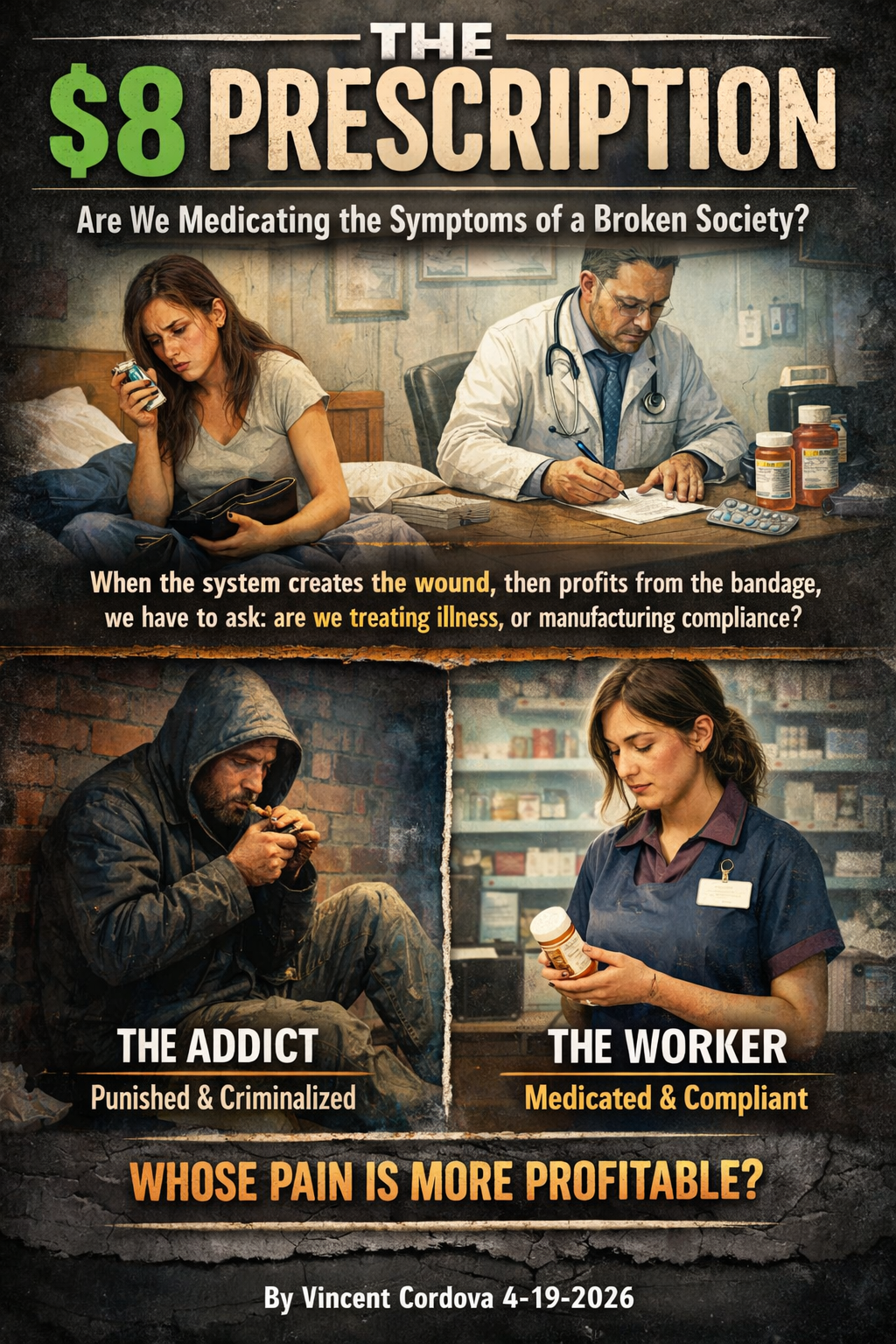
The $8 Prescription: Are We Medicating the Symptoms of a Broken Society?
When the system creates the wound, then profits from the bandage, we have to ask: are we treating illness, or manufacturing compliance?
By Vincent Cordova · April 19, 2026
There is a quiet violence happening in examination rooms across the country.
A young woman works 38 hours a week at $8 an hour. After taxes, rent, and a bus pass, she has nothing left for food. She lies awake at 3 AM calculating how many days she can skip dinner to afford her asthma inhaler.
Her body is exhausted. Her spirit is hollow.
So she goes to a doctor. And the doctor, kind and overworked, types a few words into a computer. The prescription pad rips. Here. This will help.
An SSRI. An antidepressant.
And in that moment, we have done something profound. We have taken a structural problem - poverty, wage theft, housing crises - and successfully rebranded it as a chemical imbalance.
We are not treating her depression. We are drugging her into tolerating the intolerable.
The Quiet Formula of Exploitation
Let's name the framework, because if we can't see it, we can't break it.
Modern society has built a closed loop:
- Suppress wages. Keep the federal minimum wage at a poverty-level $7.25, or allow $8 an hour to be legal. Ensure that full-time work no longer guarantees food, shelter, or safety.
- Create inevitable distress. Humans are not machines. When a person cannot meet basic needs, the brain responds appropriately: anxiety, hopelessness, fatigue, despair. This is not a disorder. This is a signal.
- Pathologize the signal. Call it Major Depressive Disorder. Remove the context of poverty, the landlord's threats, the 90-minute commute, the second job.
- Treat the individual. Offer a pill. Cognitive behavioral therapy. A meditation app.
- Return them to the same cage. The $8 wage remains. The rent is still due. But now the person is slightly more numb, slightly more compliant, slightly less likely to revolt.
That is not healthcare. That is social control with a co-pay.
The Dangerous Question We Refuse to Ask
Why is the default response to a person drowning in a broken system to teach them to breathe underwater rather than pull them out?
We have a word for adjusting a person to an unjust environment: compliance.
Think about history. If you were a slave in the 18th century and felt suicidal despair, would the humane response be to give you an opiate? Or to abolish slavery?
If you were a factory worker in 1900, lungs bleeding from asbestos, would the answer be a cough suppressant? Or workplace safety laws?
We have reversed cause and effect. Depression in a low-wage worker is not the disease. It is the diagnostic evidence that the system is diseased.
And yet, we hand out SSRIs like aspirin for a fever. We treat the symptom, because treating the cause - raising wages, building housing, enforcing labor laws - would disrupt the people who profit from $8 labor.
The Profit Motive Behind the Pill
Let's be brutally honest. The pharmaceutical industry does not make money when you quit your exploitative job. It makes money when you stay in it, depressed but functional.
The healthcare system does not bill for ending wage slavery. It bills for 15-minute medication management appointments.
And the employer? They love the arrangement. A mildly medicated, exhausted workforce asks fewer questions. They do not unionize. They do not walk out. They just show up, take their pill, and survive.
We have built an economy that requires depression and then sells the cure.
The Uncomfortable Parallel: Pills, Powder, and the Same Escape
Now let's say something uncomfortable. Let's say something that might make the respectable reader shift in their seat.
Look at the street drug user. The person smoking fentanyl in a stairwell. The one shooting heroin behind a dumpster. Society calls them weak. Broken. A moral failure.
But ask yourself: What are they running from?
Often, the same thing the $8-an-hour worker is trying to medicate away. The same unaffordable rent. The same soul-crushing job. The same childhood poverty. The same trauma that never got treated because therapy costs $150 an hour and a bag of dope costs ten bucks.
We call one person patient and the other addict. We hand one a prescription and hand the other handcuffs. But underneath the labels, the mechanism is identical.
Both are trying to survive a reality that was built to hurt them.
The worker takes an SSRI to flatten the edges of despair so they can clock in tomorrow. The street user takes heroin to flatten the edges of despair so they can survive another night on the street. One is legal. One is not. One is subsidized by insurance. The other is prosecuted by the state.
But which one is actually more honest?
The worker is told: Your depression is a chemical imbalance. Take this pill and return to your cage. The street user has simply stopped pretending. They know the cage is real. They've just chosen a different key.
I am not romanticizing addiction. I have buried people to fentanyl. But I refuse to pretend that the suburban mom on Xanax is managing her anxiety while the unhoused man on crack is a criminal. Both are coping. Both are numbing. Both are responding, perfectly rationally, to conditions that would break any animal.
The only difference is zip code, bank account, and the color of the bottle.
When we criminalize the street user while medicalizing the worker, we are not fighting drugs. We are defending a class system. We are saying: Your escape is only legal if you stay productive for the economy.
But pain does not care about productivity. And survival does not care about your tax bracket.
So if you want to judge the person smoking fentanyl in the alley, first judge the system that made that alley their only affordable home. First fix the $8 wage. First provide the housing. First offer the trauma care before the trauma metastasizes into addiction.
Otherwise, you are just punishing the symptom again while the disease runs the world.
A Better Prescription
I am not saying antidepressants have no place. For some, they are literal lifelines. But when millions of working adults are diagnosed with depression while working full-time jobs that pay poverty wages, we have crossed a line from medicine to management.
Here is what real mental healthcare would look like:
- A living wage. Not $7.25, not $8. $15, $20, $25 - whatever math says rent plus food plus rest.
- Housing as a human right. Not a commodity that bankrupts you.
- Healthcare not tied to employment. So you can leave a toxic job without losing your medication.
- Labor power. Unions, collective bargaining, strikes. The ability to say no to exploitation without becoming homeless.
Until we have those things, every antidepressant prescribed to a full-time low-wage worker should come with a second prescription: a union card.
You Are My Sister. You Are My Brother. We Are the Same.
So let me say this plainly, and I mean it from the bone:
To the cashier on $8 an hour who takes an antidepressant just to face the register - I see you.
To the person on the street, trembling through withdrawal behind a dumpster - I see you too.
You are not two different kinds of people. You are not the deserving sick and the undeserving addict. You are the same species. Same flesh. Same need for warmth, dignity, rest, and release from pain.
You are my sister. You are my brother.
And the people who run our government today? Many of them cannot see you as whole. They see a statistic, a voter, a cost center, a problem to be managed or locked away. They write laws that keep wages at $8. They defund housing and call police on tents. They allow frameworks that hurt you and then blame you for bleeding.
They will never see your full humanity. Because to see you clearly would be to see their own reflection in the broken window of a system they protect.
But we see you.
And we are not asking for pity. We are asking for change. Real change. The kind that tears down the $8 wage and builds something else. The kind that treats addiction as a wound, not a crime. The kind that remembers: a human being is not a tool for profit, and never was.
So if you are struggling - pill or powder, paycheck or panhandle - you belong in the fight for a better world. Not as a charity case. As a co-conspirator. As family.
Because the only way out of this nightmare is together.
And together, we outnumber the frameworks that hurt us.
End note: If this post resonates, share it. And then call your representative. Vote for someone who sees everyone as a whole human. That's the real antidepressant.
Community Comments
Community Comments
Share a public response to this post. Submissions are reviewed before they appear.
0 approved comments
Loading comments...