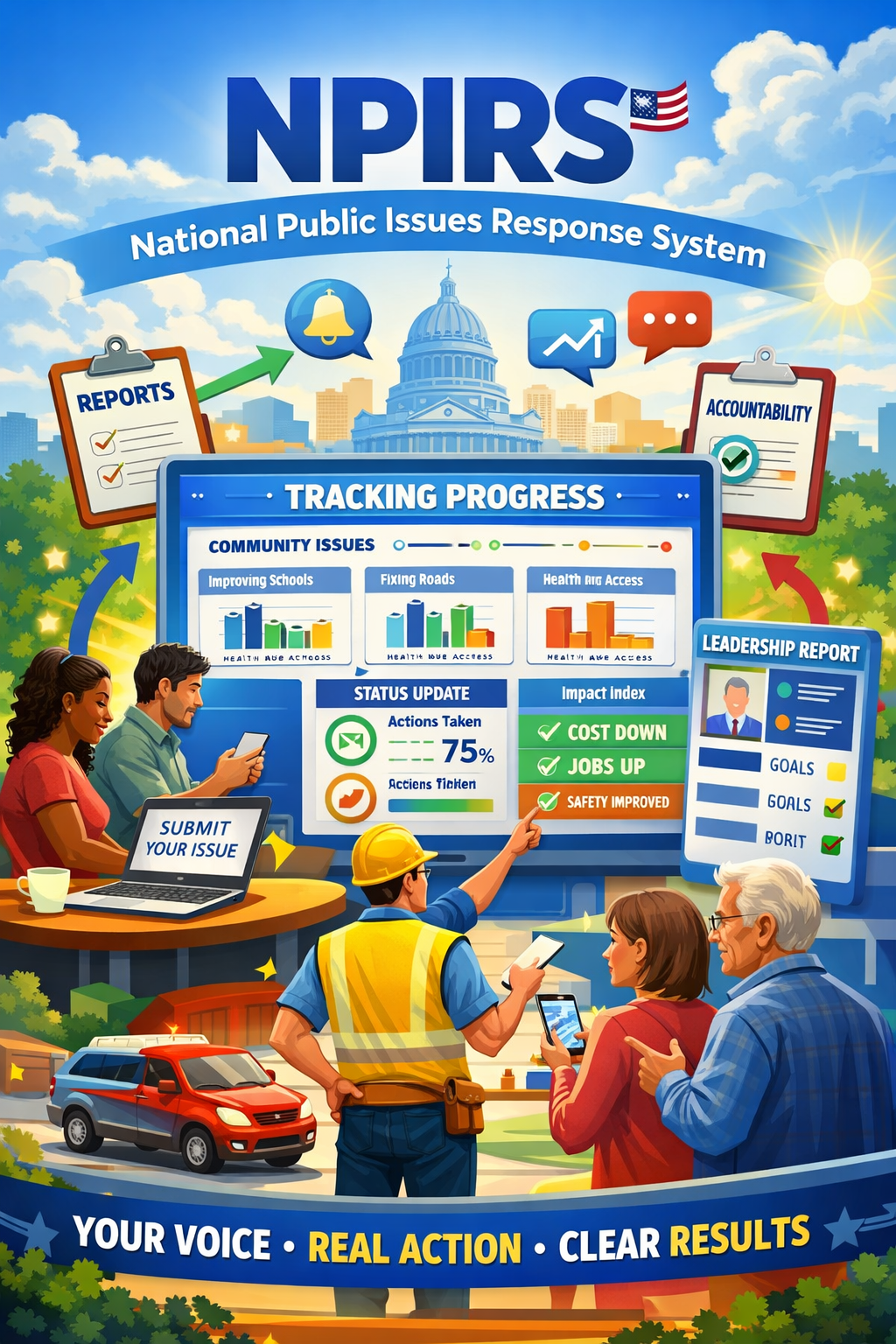
Campaign design team
The System They Said Couldn’t Be Built
By Vincent Cordova
For years, we’ve been fed the same line.
“Your voice matters.” “We’re here to help.” “We take your concerns seriously.”
But most of us know what happens next. You submit a complaint. You fill out a form. You wait. And then comes the silence.
No timeline. No clear next step. No proof that anyone even opened the file. That silence isn’t just frustrating—it’s instructional. It teaches people to expect less from the institutions that are supposed to serve them. It conditions us to accept promises in place of progress.
Yesterday, I built something that says we are done accepting that as normal.
NPIRS – National Public Insight & Response System
This is not a slogan. It is a working structure: a public system that connects public concerns to public action, and public action to measurable public outcomes.
What This Changes
This system gives people a clear path:
- Submit what is happening in your community.
- Track what happens after you submit.
- See accountability in plain view.
- Measure whether outcomes are improving real life.
That is the difference between being heard once, and being heard continuously.
One Public View, Not Fragmented Promises
Most people don’t experience government as one coordinated service. They experience disconnected offices, delayed responses, and unclear responsibility. You call one department about a pothole, another about a broken streetlight, and a third about a noise complaint—none of them talking to each other, none of them accountable to you.
This platform changes that by creating one public view of progress:
- Accountability View: Visible follow-through. You see who responded, what they said, and what they did.
- Official Scorecards: Leadership performance, stripped of press releases.
- Impact Index: Outcome trends over time. Is your street actually getting safer? Are repairs actually happening faster?
- Command Center: System-wide visibility. See the health of the entire process in one place.
When all of this is visible in one place, it becomes harder to hide delay, deflect responsibility, or confuse the public with fragmented updates.
Why the Status Quo Lasted So Long
Let’s be honest about why the old model survived. It wasn't because it worked. It survived because it benefited from confusion.
- If people cannot see the full process, they cannot measure performance.
- If they cannot measure performance, they cannot enforce accountability.
- If they cannot enforce accountability, promises remain enough.
This creates a toxic cycle: concerns are absorbed instead of resolved. Updates are controlled instead of shared. Institutions are judged by their messaging instead of their outcomes. And when that cycle repeats long enough, many people begin to believe this is simply how government must work.
It is not. The status quo lasted because it was protected by opacity, delay, and an institutional distance from everyday public experience. It kept leverage in their hands, not in public view.
Be Mindful of How the Status Quo Defends Itself
Any system that makes performance visible will trigger resistance from the systems that relied on invisibility. Pushback will come in predictable forms. They will reframe transparency as “too disruptive.” They will call public tracking “unrealistic.” They will say that showing the raw data confuses people more than it helps.
But don’t underestimate how far they will go.
When old systems feel threatened, they reach into the archives. They dig through years of public records, local news, and social media to find something—anything—that can be repackaged to look current. A resolved issue from years ago becomes “newly discovered.” A mistake that was addressed and closed becomes “evidence of pattern.” The timing is calculated: drop it right before a launch, a hearing, or any moment that threatens their control.
This tactic has a name: manufactured recency. It’s designed to force you into defense mode. If you’re explaining old news, you’re not building the future. If you’re reacting, you’re not setting the agenda.
Do not let them confuse you. Do not let them distract you. The goal is not truth—it’s to make you look away from what actually threatens them: a system that makes accountability unavoidable.
What This App Actually Does
It’s not complicated. Here’s what it does:
- Lets people submit issues they are facing.
- Lets people track updates on those issues.
- Shows public dashboards for accountability and performance.
- Shows scorecards and impact trends over time.
- Provides a command-center style overview for monitoring activity.
- Includes feedback and health checks so the platform can improve itself.
How it works, step by step:
- A person visits the site and picks a section like Submit, Track, Accountability, or Impact.
- If they submit a concern, they fill a form with details.
- The app sends that information to the backend.
- The concern is saved and organized so it can be tracked.
- Updates are attached to the issue as work progresses.
- The tracking page shows status so users can check what changed.
- Dashboard pages combine many records to show patterns, progress, and gaps.
- Search engines and social previews are supported so information is easier to find and share.
The main sections and what each one is for:
- Home: Explains the mission and guides people to key actions.
- Submit: Where someone reports a new issue.
- Track Issue: Where someone checks status and progress.
- Accountability: Shows response behavior and delivery patterns.
- Official Scorecards: Summarizes performance in a structured way.
- Impact Index: Shows whether outcomes are improving in real life.
- Command Center: Gives a broader, real-time operational view.
- Contact/Feedback: Allows direct input to improve the system.
Why This Helps the Public
This isn't about complaining. It's about closing the loop.
- It reduces the “report and disappear” frustration by showing follow-up.
- It makes progress visible instead of hidden in private channels.
- It helps identify slow areas earlier, before they become crises.
- It creates a shared record people can review over time.
- It supports better decisions by using actual issue trends and outcomes.
What’s Running Behind the Scenes
For those who care about the bones of it: a page system builds and serves all website pages. Data routes accept form submissions and provide tracking data. A storage layer keeps issue records and related updates. Monitoring scripts check health, accessibility, and content quality. There’s localization support for different languages, and safety components to check for abuse and spam.
It’s built to be reliable, because reliability is the first act of accountability.
In Short
This app turns public concerns into a visible workflow:
report → track → review → measure outcomes.
We are building a system that many said couldn’t be built. Not because it was technically impossible, but because the systems that benefit from silence didn’t want it to exist.
They will resist. They will reframe. They will reach into the past to try to bury the future. But that only tells you one thing: what you’re building is working.
Don’t accept manipulation from anyone who has grown comfortable with a system that keeps others unheard. Be better. Build differently.
Key Pages
- Submit an issue: https://www.cordova2028.com/submit
- Track your issue: https://www.cordova2028.com/track-issue
- Accountability: https://www.cordova2028.com/accountability
- Official scorecards: https://www.cordova2028.com/official-scorecards
- Impact index: https://www.cordova2028.com/impact-index
- Command center: https://www.cordova2028.com/command-center
NPIRS – National Public Insight & Response System
One public view. Real accountability.
Let’s stop asking for accountability and start building the infrastructure for it. This fight is not about you and I— it is about your children and the next seven generations.
Community Comments
Community Comments
Share a public response to this post. Submissions are reviewed before they appear.
0 approved comments
Loading comments...