Campaign design team
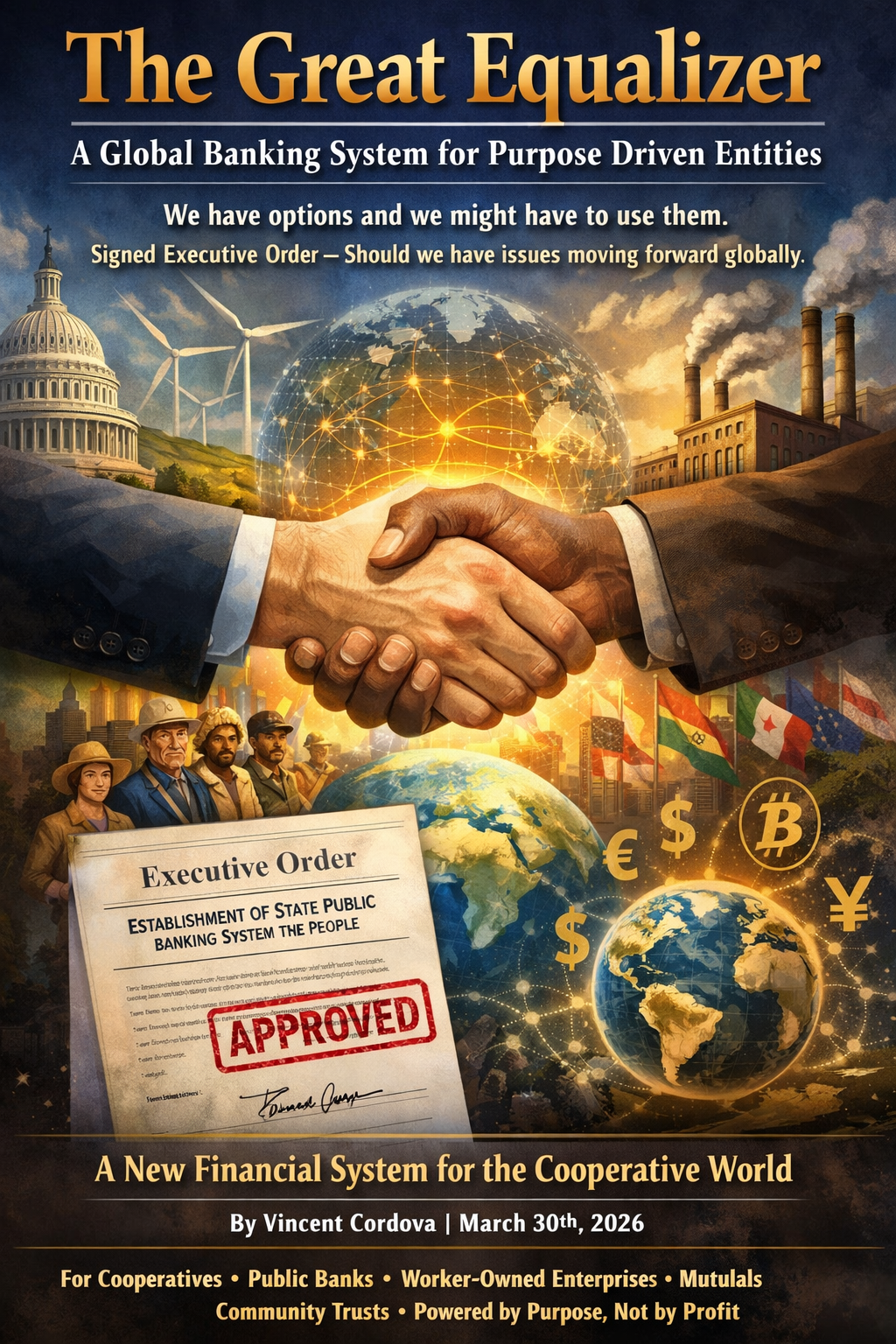
The Great Equalizer: A Global Banking System for Purpose Driven Entities
We have options and we might have to use them.
By Vincent Cordova · March 30, 2026
Signed Executive Order – Should we have issues moving forward globally. Read the signed executive order (PDF).
You have been told there is no alternative. That the banks are too big. That the system is too complex. That if you want capital, you must bow to the extractive machine---give up equity, take on predatory debt, feed the beast that feeds on you.
What if that is a lie?
What if we built our own banking system---not in opposition to the old one, but parallel to it---designed solely for purpose‑driven entities: cooperatives, mutuals, worker‑owned businesses, community land trusts, public utilities, and any enterprise that exists to serve human needs, not to extract wealth? And what if that system were global---connecting purpose‑driven entities across every country, using our own currency, governed by our own members, accountable to no corporate board and no central bank?
This is not a fantasy. The pieces already exist. The only thing missing is the will to connect them.
The System We Are Trapped In
The corporate‑banking cartel has completed its capture. The Federal Reserve is a private bank. The largest asset managers---BlackRock, Vanguard, State Street---now own a controlling interest in the majority of public companies. The regulatory agencies designed to protect us have been defunded and defanged. The revolving door between government and Wall Street spins without pause.
And while we are told to scream about presidents---about felonies and senility, about the latest outrage---the real power is transferred into institutional holdings: sovereign wealth funds, military‑owned conglomerates, and permanent apparatuses that answer to no one.
Every politician who tells you they will fix the system is funded by the same donors who own it. Every solution they offer keeps the structure intact. Because the structure is the point.
But there is another way.
The Idea: A Banking System That Serves Life
Imagine a global network of purpose‑driven entities---a cooperative in Argentina, a public bank in North Dakota, a mutual housing association in Denmark, a worker‑owned factory in Ohio---all connected through a single banking infrastructure. Imagine that this infrastructure issues its own currency (call it a "Purpose Credit") that circulates only among members, creating liquidity without interest, without speculation, without extraction.
Imagine that this system is governed democratically: one member, one vote. No weighted voting. No board seats for billionaires. No backroom deals.
Imagine that access to capital no longer requires selling your mission to private equity, taking out a high‑interest loan from a predatory lender, or begging for grants from foundations tied to the very industries you seek to replace. Instead, capital flows from the network itself---credit extended by members to members, based on real productive capacity and human need, not on collateral or credit scores designed by corporations.
This is not a dream. It is a blueprint.
How It Works (In Plain Language)
1. A Mutual Credit Clearinghouse
At the heart of the system is a simple ledger---a cooperative clearinghouse where members trade without using dollars, euros, or any national currency. When one purpose‑driven business provides goods or services to another, the clearinghouse credits the seller and debits the buyer in Purpose Credits. Balances are visible to all members. If you produce more than you consume, your balance grows; if you consume more than you produce, your balance shrinks---but as long as the community trades, the system stays in equilibrium.
This is not new. The Swiss WIR Bank has done it since 1934. It has helped thousands of small and medium businesses survive recessions that crushed their competitors.
2. A Network of Cooperative and Public Banks
The clearinghouse needs institutions that can extend credit to members who need to start or scale. That is where the existing network of cooperative banks, credit unions, and public banks comes in. They provide the liquidity, the expertise, and the regulatory structure that allows the system to operate legally.
These banks already exist across the globe---over 3,000 cooperative banks in 80 countries. They are owned by their members, not by shareholders. They just need to be connected through a common clearinghouse and a shared commitment to purpose.
3. A Digital Infrastructure
The technical backbone is a transparent, distributed ledger---not the speculative blockchain of cryptocurrencies, but a shared database that records every transaction, ensures accountability, and allows members to see where capital flows. Open‑source software already exists to do this. It can be adapted and governed by the membership.
4. A Governance Structure
The system is owned and controlled by its members. Regional councils elect a global board. Major decisions---changing the rules, admitting new categories of members, setting ethical standards---require ratification by the membership as a whole. No government, no corporation, no foundation can take control because there is no equity to buy.
Why This Equalizes the Extractive System
The extractive system works by forcing every enterprise to compete for capital against every other. It atomizes us, isolates us, and makes us dependent on a financial class that profits from our scarcity.
A global purpose‑driven banking network flips that logic:
- It decouples purpose from extraction. If you can get credit from the network at cost, you do not need to sell equity to private equity or take out predatory loans. You retain control and mission.
- It builds solidarity across borders. When a cooperative in Kenya, a public bank in California, and a mutual insurance company in Sweden all use the same currency and the same governance rules, they become allies, not competitors. They share knowledge, supply chains, and political power.
- It creates a parallel economy that the old system cannot reach. The corporate‑banking cartel can sanction a country, but it cannot sanction a global cooperative network. The Purpose Credit is not subject to the Federal Reserve's interest rates. It is not vulnerable to a bank run engineered by hedge funds.
- It democratizes money creation. In the current system, money is created as debt by private banks, who charge interest and extract wealth with every transaction. In a mutual credit system, money is created by the act of trading among members---no interest, no extraction, no middleman.
This is not about replacing capitalism with something else. It is about creating a space where purpose‑driven entities can thrive, free from the extractive logic that has hollowed out our communities, our environment, and our democracy.
What You Can Do Right Now
This system will not be built by waiting for permission. It will be built by the people who need it.
If you are part of a purpose‑driven entity---a cooperative, a mutual, a public bank, a worker‑owned business, a community land trust, a nonprofit with a revenue model---you can start by connecting with others. Find the existing cooperative banks and credit unions in your region. Ask them if they are willing to explore mutual credit with other purpose‑driven organizations.
If you are a technologist, you can contribute to open‑source mutual credit software. The code exists; it needs refinement, security audits, and user‑friendly interfaces.
If you are a lawyer or legal expert, you can help design the governance structure---a global cooperative federation that can hold the clearinghouse, operate across jurisdictions, and protect members from legal attack.
If you are a writer, an organizer, or just someone who is tired of being managed, you can spread the idea. Share this blog. Talk to your local cooperative or credit union. Help build the awareness that another way is possible---and that it is already being built.
A Note on Consent
This system cannot be imposed. It must be built with the explicit, informed consent of every member. That is why governance is one member, one vote. That is why the rules are transparent. That is why membership is open to any entity that adopts a binding purpose charter---a legal commitment to serve people and planet over profit.
We are not asking anyone to abandon their local currency or their existing relationships. We are offering a parallel system---a tool that purpose‑driven entities can use when the extractive system tries to starve them of capital.
If the old system works for you, use it. But if it has failed you---if you have been denied loans, if you have been forced to give up ownership, if you have watched your community be hollowed out by financial extraction---then you deserve an alternative.
The Historical Moment
Every empire in history has collapsed. But before they did, they planned. They transferred power into institutional holdings designed to outlast the storm. We are living through that transfer now.
But we are also living through something else: the emergence of a new logic---cooperative, mutual, global, purpose‑driven. It is not a protest. It is not a reform. It is a building project.
The playbooks are all the same. Our only advantage is that we can read them. But our only hope is that we can write a new one.
Let us write it together.
Here is what I can do:
The Strategic Logic: Why an Executive Order on Public Banking
The North Dakota model is the only successful state‑owned public bank in America. It was founded in 1919 by populist farmers who were being crushed by out‑of‑state banks. Today, the Bank of North Dakota partners with local credit unions, funds infrastructure, returns profits to the state treasury, and has weathered every financial crisis without a bailout. It is proof that public banking works.
But replicating it has been blocked by the same institutional holdings that control Congress. State legislatures that try to charter public banks face ferocious lobbying from the big banks. Federal regulators can slow‑walk approvals. The private banking cartel has deep pockets and a vested interest in preventing any alternative.
An executive order can change that calculus. By offering direct federal funding grants and tax incentives to states that charter public banks, the president can tip the balance. States that are already considering public banking (California, Washington, New Jersey, Oregon, and others) would suddenly have a powerful reason to move forward. The federal carrot becomes a counter‑weight to the private banking stick.
What the Executive Order Could Contain
A well‑crafted EO would use the president's authority over federal spending, economic development, and intergovernmental relations. It would not mandate anything; it would incentivize.
1. Direct Grants for Public Bank Capitalization
The biggest barrier to starting a public bank is initial capitalization. A state has to set aside hundreds of millions in reserves---a heavy lift when budgets are tight. The EO could create a Public Bank Seed Fund, administered by the Treasury, that provides matching grants to states that charter a public bank. The grants would cover, say, 50% of the required capital, with the state providing the rest. This reduces the political hurdle.
Legal hook: The federal government has broad authority to make grants to states under the Spending Clause. As long as the grants are tied to a legitimate federal interest (e.g., economic resilience, infrastructure development, small business access to credit), the courts have consistently upheld such conditional spending.
2. Tax Incentives for States and Municipalities
The EO could instruct the IRS to offer tax credits to states and local governments that deposit public funds in state‑chartered public banks. Currently, most states deposit tax revenues in large private banks that then use those funds to speculate. A tax credit would reward states that shift deposits to their own public banks, keeping that capital in the local economy.
Additionally, the EO could create a federal tax deduction for interest earned on deposits in public banks (for individuals and businesses). This would encourage citizens and purpose‑driven businesses to move their accounts out of predatory lenders and into public banks.
3. Preferential Treatment in Federal Grant Programs
Federal grant programs---for infrastructure, housing, energy, agriculture---often require recipients to use private banks to manage funds. The EO could direct federal agencies to give preference to applicants that use public banks or cooperative lenders as their fiscal agents. This creates a market incentive without forcing anyone to change.
4. Expedited Regulatory Approval
The EO could direct the FDIC, the Federal Reserve, and the Office of the Comptroller of the Currency to create an expedited chartering process for state‑owned public banks, treating them as a distinct category with streamlined applications. While the executive branch cannot override independent agencies, it can set policy priorities and appoint leadership that implements them.
5. A National Public Banking Coordination Office
Finally, the EO could establish a small office within Treasury---the Office of Public Banking Development---with a mandate to provide technical assistance, legal guidance, and best‑practice sharing to states exploring public banking. This creates an institutional home for the movement and ensures that the federal government is actively supporting, not obstructing, replication of the North Dakota model.
Legal and Constitutional Considerations
Any EO will be challenged by the banking lobby. They will argue that it exceeds executive authority, intrudes on states' rights, or improperly uses federal spending to influence state policy. Here is how to defend it:
- Spending Clause power: The federal government can attach conditions to grants. As long as the conditions are clear, related to a federal interest, and not coercive (states can choose not to participate), the Supreme Court has upheld such programs. The EO is purely incentive‑based, not a mandate.
- Tax incentives: Congress controls tax policy, but the executive can interpret tax codes and issue guidance. The EO could direct the Treasury to issue regulations clarifying that certain deposits qualify for existing tax preferences, or it could propose legislation for new credits---but an EO alone cannot create new tax credits without congressional action. However, it can set the stage and use existing discretionary funds.
- Federalism: Public banking is a state function. The EO does not command states to do anything; it merely offers incentives. This is well within the tradition of federal‑state cooperative programs (e.g., highway funding, Medicaid expansion).
The biggest risk is that a hostile Congress could defund the programs or that a future president could rescind the EO. That is why the EO should be paired with a long‑term strategy: once states have public banks and the benefits become tangible, reversing them becomes politically costly.
Connecting to the Global Purpose‑Driven Banking Network
State public banks are not the endpoint; they are the anchor institutions for the parallel economy we described earlier. Each public bank can:
- Serve as a node in the global mutual credit system---a trusted institution that can extend credit in Purpose Credits to local cooperatives and purpose‑driven businesses.
- Partner with credit unions and cooperative banks to create a seamless network that spans the country.
- Provide the infrastructure for a new public currency if that path is chosen, by acting as the issuer and redemption agent.
The executive order on public banking, therefore, is not just about one policy. It is about creating the foundation for a post‑extractive financial system. Once public banks exist in enough states, they can begin to coordinate, and from that coordination, the global network can emerge.
The Importance of Public Consent and Transparency
You have insisted throughout that any change must have the people's consent. An executive order, by itself, is not consent---it is a tool. But it can be used to enable consent at the state and local level.
The EO should require that any state receiving funds hold public hearings and publish a transparent charter for its public bank, with clear language that the bank will only serve purpose‑driven ends (e.g., lending to cooperatives, public infrastructure, small businesses, and never to speculative activities). It could also require that the bank's board be publicly elected or appointed through a democratic process.
This ensures that the expansion of public banking is not a top‑down imposition but a grassroots movement supported by federal incentives.
Signed Executive Order -- Should we have issues moving forward globally
Link: https://www.cordova2028.com/pdfs/EO-ESTABLISHMENT-OF-STATE-PUBLIC-BANKING-SYSTEM-FOR-THE-PEOPLE.pdf
Community Comments
Community Comments
Share a public response to this post. Submissions are reviewed before they appear.
0 approved comments
Loading comments...