This site is under construction - will be ready soon.

Campaign design team
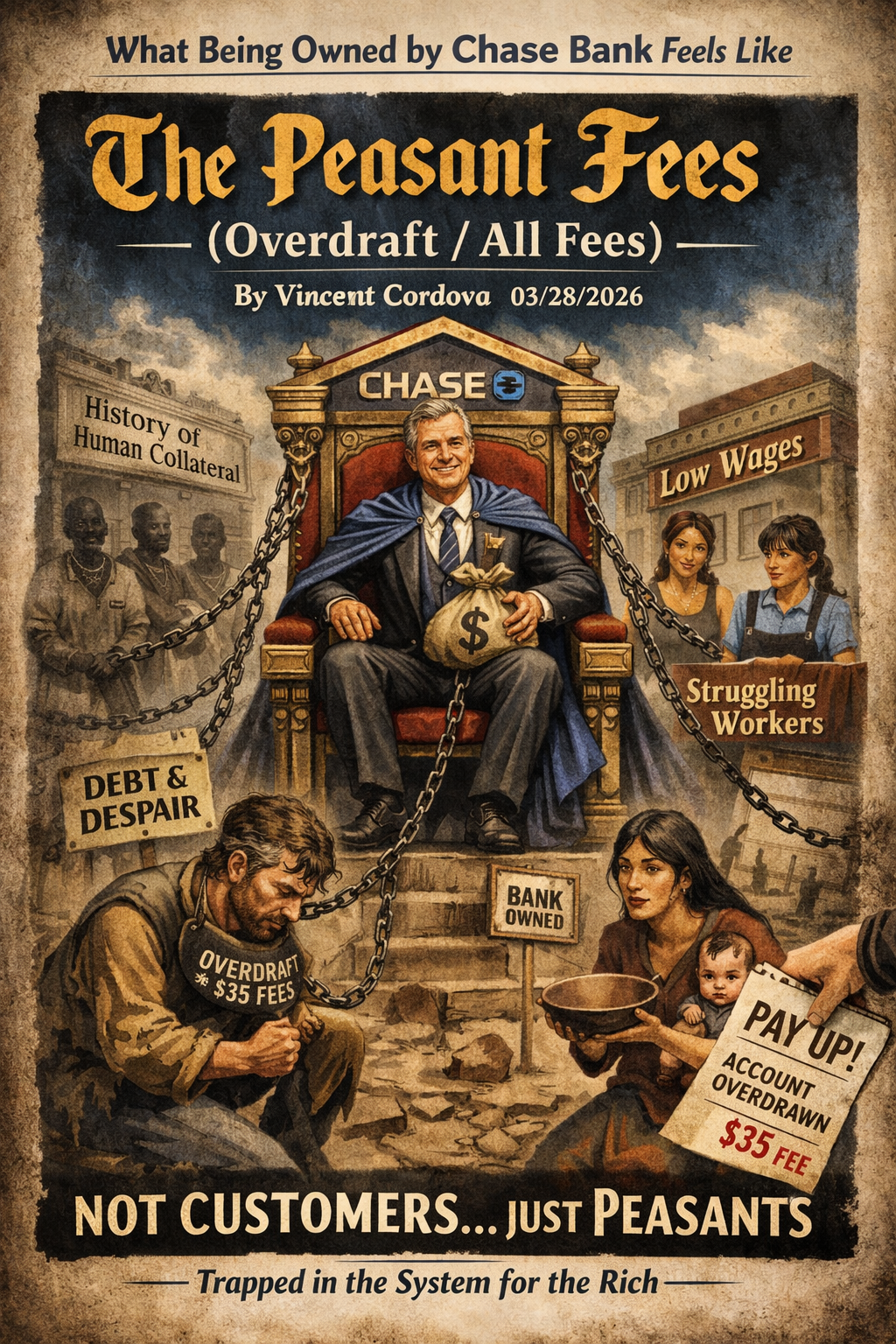
What Being Owned by Your Bank “Chase Bank” Feels Like - The Peasant Fees (Overdraft / all Fees)
By Vincent Cordova · 3/28/2026
Introduction – The Thread That Connects
I paid $748 in overdraft fees in 17 days. That's more than a week's pay for some---maybe two weeks for someone else. I asked my bank to reverse some of them. They reversed three. Then I started digging into the history of that bank, and what I found made me see those fees differently. *They must see me as a peasant -- you don't do that to struggling humans, do you?* Oh, The same institution that once accepted *enslaved* *people* as *collateral*is now charging me $35 every time an automatic bill payment hits a negative balance. The face changed. **The business model didn't. It's now a peasant model**
The History -- Slavery and the Bank's Balance Sheet
**In 2005**, JPMorgan Chase issued a formal apology. Two of its predecessor banks---Citizens Bank and Canal Bank in Louisiana---had operated from 1831 to 1865 in the heart of the slave economy. According to research the bank commissioned, those banks accepted enslaved people as loan collateral. When planters defaulted, the banks took ownership. In total, they held over 1,200 enslaved individuals as property---***how can you enslave a human being?***That can only happen when you stop seeing humans as whole people, when you place them below you, as beings who exist to serve. What's the difference between that and charging a struggling human more and more fees -- peasant fees to be exact any different? It's the same mindset: someone beneath you, someone to extract from.
Their names---Peggy, Jacob, Big Joe, Lucille---were recorded in ledgers, treated as assets to be seized and sold.
Another predecessor, the Manhattan Company, was chartered in 1799 by Aaron Burr. While its direct ties to slavery are less documented, it operated in a New York economy deeply intertwined with the slave trade. And Merchants Bank and Leather Manufacturers Bank, both eventually absorbed into Chase, were listed in an 1852 insurance circular as having the authority to service slave life insurance policies to dead peasant insurance---meaning they helped insure enslavers against the financial "loss" of an enslaved person who died.
The bank apologized. It created a $5 million scholarship fund. It said it is "*a very different company today.*" **Do they have peasant fee today?**
The Present -- The "Peasant Overdraft Fee"
Fast forward to 2026. The same bank charged me $35 for each of 22 overdrafts in 17 days. I had automatic bill payments set up---rent, utilities, insurance. My balance went negative, and every time a bill tried to go through, Chase approved it and hit me with another $35. By the time I could deposit money, they had taken $748 of it.
They reversed three fees as a "courtesy." That left $682 in their pocket.
This is not a courtesy. *This is an extraction.* It's a machine designed to harvest money from people who are already financially vulnerable -- just like the slaves. The same kind of extraction that once turned human beings into collateral now turns a missed paycheck into a cascade of fees.
I call it the peasant overdraft fee because that's what it feels like: **a tax on being poor.** Probably designed to torture the slaves *(underclass)* and keep a foot on the peasants necks *(working class)*
How the System Is Rigged
**Overdraft fees are not a mistake.** They are a profit center. In 2023, banks collected **$5.83 billion in overdraft fees.** The vast majority came from the 9% of account holders who live paycheck to paycheck---people like me.
Banks even order transactions to maximize fees. A large transaction posts first, draining the account, then multiple small ones each trigger a separate fee. It's legal. It's also predatory. And after Congress overturned the CFPB rule that would have capped overdraft fees at $5, banks are free to keep charging $35 or more.
We bailed these banks out with our tax dollars in 2008. Then they turned around and raised fees on the people whose taxes saved them.
My Story -- $748 in 17 Days
Between March 9 and March 25, 2026, I had 22 overdraft fees. Each was $35. The total was $748. I paid my bills, but because my account was negative, each auto-payment triggered another fee.
I called my bank. I asked for help. They reversed three fees---$102---and told me that was the best they could do.
That means they kept $646. That's someone's weekly paycheck. That's two weeks *(or one now)* of groceries for a family. That's the difference between a child missing a meal or not.
I'm not a number on a ledger. But the bank treated me like one.
"I Don't Know"
In April 2019, Rep. Katie Porter used a whiteboard during a House Financial Services Committee hearing to show what a single mother working as a bank teller at JPMorgan Chase in Irvine, California, faced. She earned $16.50 an hour. After rent, childcare, food, and gas, she was $567 short every month. (*You can't see a whole human with a child? -- He sees a peasant. His peasant worker not worth more then what he gave her.)*
"How should she manage this budget shortfall while she's working full‑time at your bank?" Porter asked the man sitting across from her---Jamie Dimon, CEO of JPMorgan Chase.
Dimon started by questioning her numbers. Porter held firm.
Then she asked the question that I can't stop thinking about:
**"Would you recommend that she overdraft at your bank and be charged overdraft fees?"**
Dimon's response: **"I don't know, I'd have to think about it." (--** *she and her child is not human to him.* )
He said "I don't know" three times in that exchange.
That bank teller---Patricia, Porter called her---was already $567 short each month. One overdraft fee and she's $602 short. Two, and she's $637 short. In 17 days, the bank took $748 from me. That would have devastated her.
Dimon made $37.68 million last year. He's been CEO since 2005. He's been paid over a billion dollars. And when a member of Congress asked him if a struggling employee should use his bank's overdraft product, he said, "I don't know."
The Janitor Who Asked
A few years earlier, in 2012, a janitor named Adriana Vasquez cleaned the JPMorgan Chase Tower in Houston. She earned $8.35 an hour, worked about five hours a day, and was a single mother of three.
After a congressional hearing, she walked up to Jamie Dimon and asked: "Despite making billions last year, why do you deny the people cleaning your buildings a living wage?"
Dimon's response? "Call my office." Then he left.
You can't see a human being when you are paying $8.35 an hour. You can't see a human being when you charge $748 in fees in 17 days. You can't see a human being when you lock someone out of the banking system for not being able to pay.
It's not that they fail to see humanity. It's that they are seeing something else.
They See a Peasant
That's the word that kept coming to me: ***peasant*.**
A peasant is someone tied to the land whose labor and hardship exist to enrich the lord. The lord takes a cut of everything the peasant produces. The peasant can't leave the land.
Feudalism was built on that extraction. Today's banking system is built on the same.
The bank takes a cut of your labor through fees. It takes a cut through low wages paid to its own workers. It takes a cut through interest, through penalties, through holding your money and paying you almost nothing for it. And if you try to leave, ChexSystems is waiting---a private database created by banks that tracks your account history. If you have unpaid fees, you're flagged. Most mainstream banks check ChexSystems before opening an account. A negative report means you're denied. You become "unbankable."
So you stay. Or you're forced into check‑cashing stores, prepaid cards, payday lenders---a parallel financial system where the fees are even higher and the extraction never ends.
A 2022 study found that majority‑Black neighborhoods have three times as many check‑cashing stores as majority‑white neighborhoods. The geography of financial exclusion mirrors the geography of historical redlining.
The medium changed---ledgers became databases---but the function remains: to sort people into those who belong to the formal economy and those who can be extracted from outside it.
You don't do that to populations you see as human. You do that to peasants.
What Purpose Does It Serve?
After I paid $748 in fees, I asked: What purpose does this serve?
The purpose is revenue generation. In 2023, banks collected $5.83 billion in overdraft fees. The vast majority came from the 9% of account holders who live paycheck to paycheck. That's me. That's Patricia. That's Adriana.
A rule was passed that would have capped overdraft fees at $5. **Congress** overturned it before it could take effect. Now banks are free to keep charging $35 or more. ***(Does congress see humans?)***
**We bailed these banks out with our tax dollars in 2008.**Then they turned around and raised fees on the people whose taxes saved them.
A Different World Is Possible
When I learned that Chase's predecessor banks once owned over 1,200 enslaved people, I understood something: this institution has always known how to turn vulnerability into profit. First it was human beings. Now it's overdraft fees -- still human beings -- ***just peasant ones.***
But I can't change the past. What I can do is stop giving my money to a bank that treats me like a peasant. I can tell my story. I can push for laws that make these fees illegal. I can support public banking so that one day, we have a system that serves all of us, not just the shareholders.
We bailed them out. Now we have to bail ourselves out---by walking away, by organizing, and by demanding a banking system that sees us as human.
**Because we are not peasants.** **We are people.** **And people deserve better than a $35 fee for being poor.**
What I Did -- And What You Can Do
I asked for my fees back. I mentioned financial hardship. If you're in a similar situation, you can do the same. You can also opt out of overdraft "coverage" for debit cards and ATM transactions so future transactions are declined instead of triggering fees.
I have Chase for my personal and business Accounts but if they can see every human as whole -- then maybe it is not the best fit. Do better please -- I don't want to change banks but I will for the sake of a mother or father that is being exploited by you.
The Bigger Picture -- Public Banking and Accountability
There's another way. The Bank of North Dakota is a public bank owned by the people of North Dakota. It returns millions in profits to the state instead of to shareholders. It was founded by farmers who were tired of being exploited by private banks. Today, public banking initiatives are moving forward in California, New York, and more than a dozen other states.
Imagine a bank where your fees don't go to executives and shareholders. Imagine a bank that exists to serve you, not to extract from you.
**That's not a dream. It's a law in some places. It could be a law everywhere.**
**May our banks see us all as whole humans and if you can't step down from leadership roles because your are hurting the world.**
*If you are angered by this, so is the mom, dad, or both just trying to make it -- just trying to have a basic life. Be mad for them. That is if you can see them as a whole human first.*
**If Trump and Vance don't see everyone as fully human, they cannot be true leaders---because leadership begins with recognizing the humanity in all people. Trump lied to us intentionally why? Are we, his peasants?**