Campaign design team
The Burden of Two Incompatible Truths
By Vincent Cordova · March 26, 2026
I heard Trump say it the other day: “We just bomb them.” Just like that. As if “them” weren't people. As if the sentence didn't contain children, families, someone's grandmother.
My mind did what it always does when language & actions becomes that heartless: it refused to accept it. I thought, This can't be true. Human lives—this can't be how we talk and behave about human lives. But it is. And that refusal, that shock, isn't naivety. I think it's something else.
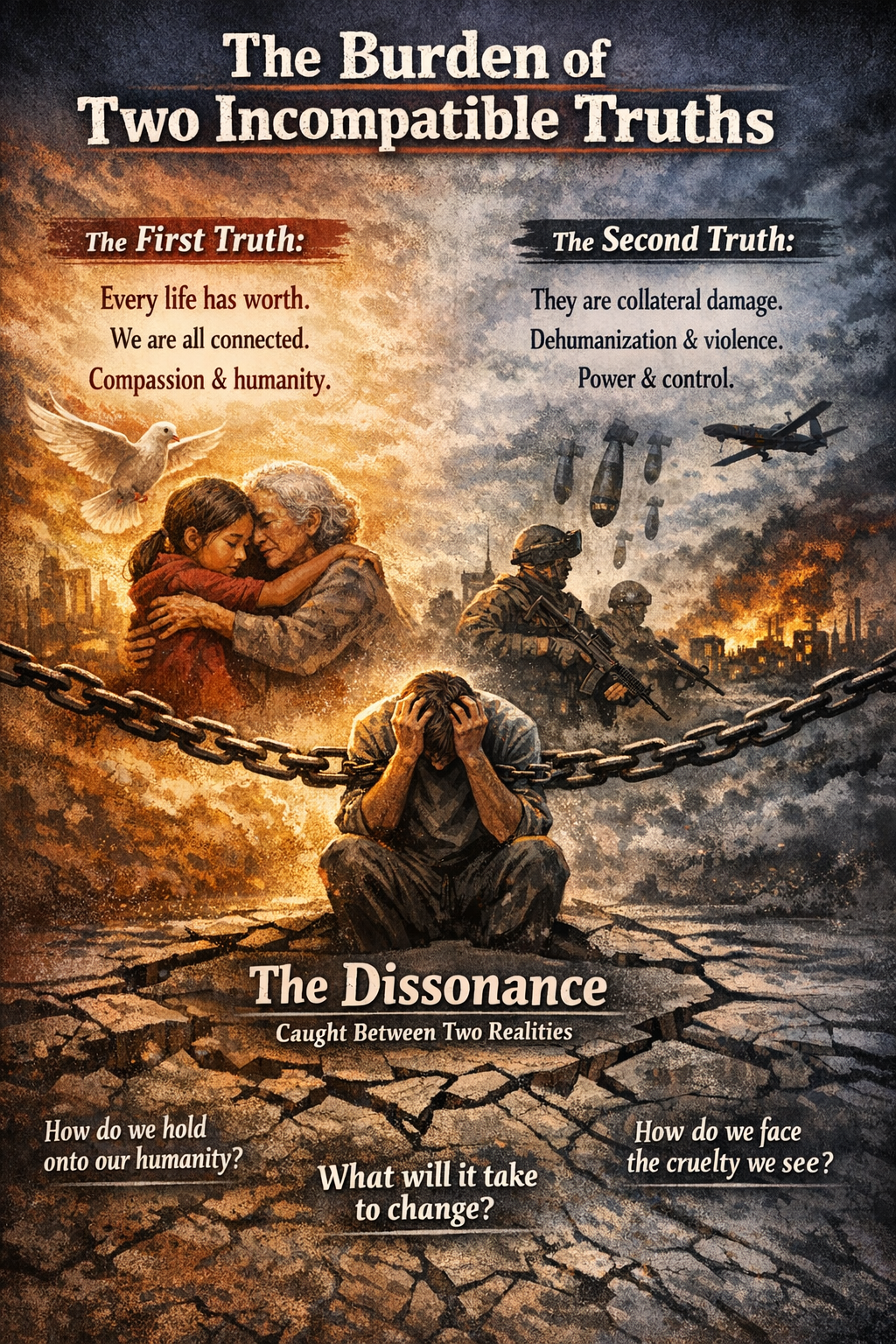
It's the burden of trying to reconcile two incompatible truths.
The first truth is what I know in my bones: that every life has worth, that harm to any person is harm to the whole, that the world doesn't need an underclass to function. The second truth is what I'm seeing: policies crafted with precision, language that strips people of their names, a system that seems to produce suffering not as a side effect but as a feature.
My instinct is to search for another explanation. Maybe they didn't mean it that way or this is not real. Maybe it's incompetence. Maybe there's some larger strategy I'm not seeing. I fight myself to find another reason, because accepting the simpler, more direct interpretation—that the harm is intentional—feels like accepting that the world is more callous than my own heart can hold.
And that, I think, is why we struggle so much to change things.
We don't lack evidence. We don't lack intelligence. What we lack is the psychological permission to believe that those in power would deliberately build systems to harm. Because once we believe that, we can't unsee it. And once we see it clearly, we're accountable. We have to act. And if acting feels impossible, it's easier to stay in ambiguity—to keep telling ourselves it's all just broken by accident.
But living in that space is exhausting. It's the exhaustion of holding two worlds in your head: the one you were taught to believe in, and the one unfolding in front of you. The dissonance becomes a constant low hum.
And then there's the question I keep coming back to:
Who makes people who have no care for another?
I want to believe it's simple—narcissism, evil, something that lives only in them. But then I remember: we actively exploit an underclass to make the world function. We build systems that require some people to be disposable. And what does that do to the people who benefit from that arrangement? Does it hollow them out, slowly, until they can speak of bombing children like they're changing the weather?
Maybe the destroyers were once destroyed. Maybe the callousness is passed down like inheritance. Or maybe there are those who crossed some line so completely that explanation fails, and all we have left is the word evil.
But when I look at some of our elected officials—people with vast wealth who act as if they belong to a different species—I see something more specific. I see people who believe they are entitled to be above other humans. Not just above in status, but above in worth. When J.D. Vance refers to others as “peasants,” he's not being careless. He's revealing a worldview: that hierarchy is natural, that some are born to rule and the rest exist to serve.
If you genuinely believe you belong to a separate class of human, then other people stop being people. They become obstacles, tools, or statistics. That's not incompetence. That's a dangerous fracture in the capacity to see others as fully real. I would have to describe that as psychopathy—or something very close to it.
And when such people hold the highest offices, it's not just dangerous because of their individual actions. It's dangerous because they model dehumanization as acceptable. They give permission for others to adopt it. They are fundamentally incompatible with wholeness; they can only offer division.
So where does that leave us?
I don't have a tidy answer. I don't know how to force myself—or anyone else—to fully accept a reality that feels morally unbearable. What I do know is that I'm not alone in this. The fight I feel inside, the refusal to let numbness win, is something others are fighting too.
Maybe the first step isn't a policy platform. Maybe it's simply admitting that the dissonance exists—and that it's not a sign of weakness. It's a sign that your humanity is still intact in a system that would prefer you turn it off.
But the next step has to be action. And the most immediate action we have is who we elect. We have to stop putting people in power who see others as beneath them. We have to stop pretending that cruelty is just a communication style or that dehumanizing language is just “telling it like it is.” It's not. It's a warning sign—one we've ignored too many times.
If we want a world where leaders don't speak of human lives as if they were obstacles, we have to look at the structures that produce them—and ask whether we're willing to dismantle those structures, even if it means giving up the comfort they built for us. And we have to look at our ballots and ask: Does this person see my neighbor as fully human? Does this person see me as fully human? Or do they belong to a class that believes it is above the human race?
Questions to Carry Forward
If we set down the burden of pretending the world is kinder than it actually is—what becomes possible?
When we stop searching for kinder explanations that don't exist, what new responsibilities come into focus?
How do we hold onto our humanity without being paralyzed by the weight of what we now see?
What would it look like to build policies—and elect leaders—that don't require us to turn off our empathy to survive them?
How do we discern, in a candidate, whether they see others as fully human or only as obstacles to their own power?
If the system is designed to make us feel powerless, what counts as resistance? Is it simply refusing to look away?
And for those of us struggling to reconcile two incompatible truths: what do we owe each other as we try to find a way forward together?
Let's use their own framework for a moment.
They call people “peasants.” In that worldview, peasants exist to serve. Their lives are tools. Their children? Just smaller tools. Or future peasants. Or, if inconvenient, obstacles to be removed.
So ask yourself: if a leader sees an entire class of people as beneath them—not equal, not fully human—then what exactly are they seeing when they look at a child from that class? Not a child. Not someone worthy of protection. Just more of them.
Now turn it around. If they see us that way—if we are among the “peasants” in their eyes—then do they care about our children? Do they care about your child? Your neighbor's child?
The serious defect isn't just that they dehumanize others. It's that dehumanization doesn't come with an off switch. You don't get to decide some people are less than human and then suddenly care deeply about their children. The logic doesn't allow it.
So when we elect people who speak this way, we aren't just accepting cruelty toward strangers. We are putting people in power who, by their own framework, cannot see any of our children as fully worthy of care—unless those children belong to their own class.
That's not a political disagreement. That's a danger to every family, every child, everywhere. They are fundamentally incompatible with wholeness; they can only offer division.
We can't elect people that can't see everyone as whole. This is a very big danger. Hopefully these words will be guidance to the decisions.
There's something I keep coming back to.
You ever see a fainting goat? When it gets scared, its legs lock up and it falls over stiff as a board. Not unconscious—just frozen, stuck, while the world keeps moving around it.
That's what shock can do to us. Someone says or do something so cruel, so outside what we thought was possible, and our minds seize. We can't run, can't fight, can't even fully believe what we just heard. We just… freeze.
And here's what I've come to see: that freeze can be used. When you're stunned, you're not thinking clearly. You're easier to lead. Easier to numb. Shock followed by normalization—it's a pattern. Say or do the cruel thing, let the public reel, then act while they're still trying to believe it's real. Rinse, repeat. Before long, what once horrified you becomes Tuesday.
That's not just manipulation. It's a kind of weapon—one that doesn't only harm the people on the receiving end of the bombs. It harms the country watching. Because a population trained to accept atrocity is a population that stops asking, stops protecting, stops being able to love out loud.
Numbness feels like protection—and sometimes it is. But when numbness becomes permanent, it's a cage. It lets the destroyers keep destroying, because no one is left who can fully feel what's being done.
We were built out of love. That's the truth under all the shock. And love doesn't freeze forever. Eventually it says: enough.
The work now is to remove those who treat weapons of mass destruction like tools, who paralyze their own country while claiming to lead it. Not through cruelty—we don't meet them there. But through clarity. Through refusing to let our own shock become their power.
We have a lot of work to do. But we're not starting from nothing. We're starting from the fact that we still feel it—the horror, the grief, the refusal to accept cruelty as normal. That feeling isn't weakness. It's the thing that will carry us through. Remember that they are fundamentally incompatible with wholeness; they can only offer division.
May we find all the answers and strength to change our world for a better future Globally. We are not games to be played with. May we rise globally.
Community Comments
Community Comments
Share a public response to this post. Submissions are reviewed before they appear.
0 approved comments
Loading comments...