This site is under construction - will be ready soon.

Campaign design team
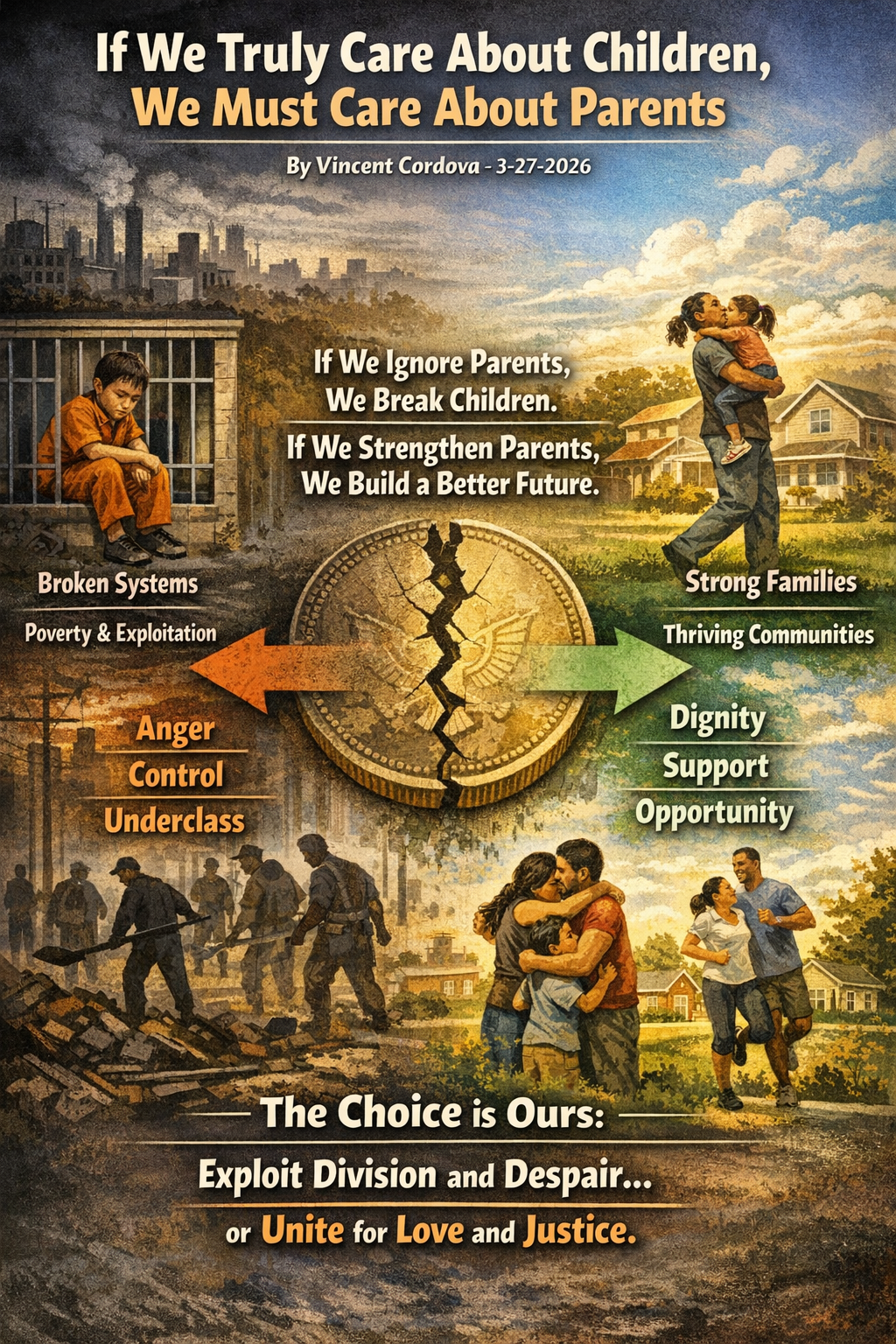
If We Truly Care About Children, We Must Care About Parents
By Vincent Cordova · 3/27/2026
**If We Truly Care About Children, We Must Care About Parents**
**By Vincent Cordova****3-27-2026**
We say we care about children. We build systems around protecting them,
educating them, and shaping their future. But there's a hard truth we
avoid:
**You cannot meaningfully care about children without caring about their
parents.**
Not selectively. Not only when it's convenient. Not only when the
parents meet a certain standard. All parents. Across all classes.
Because the parent is not separate from the child's experience of the
world. The parent is the child's first environment.
------------------------------------------------------------------------
**The Reality We Don't Want to Admit**
A child does not grow up in isolation.
They grow up inside:
- the emotional state of their caregiver
- the stability (or instability) of their home
- the stress, dignity, or despair present in daily life
When a parent is overwhelmed, unstable, or constantly under pressure,
the child absorbs that reality.
Not as a concept---but as a lived experience.
You can build programs for children. You can intervene in schools. You
can create policies. But if the parent remains under strain, the child's
foundation remains unstable.
------------------------------------------------------------------------
**The Mistake We Keep Making**
We try to separate the child from the parent in how we think about
solutions.
We say:
- "Help the child succeed"
- "Fix the child's behavior"
- "Protect the child from harm"
But we avoid asking:
- What condition is the parent in?
- What pressure is shaping their decisions?
- What support---or lack of it---is defining their capacity?
Instead, we often judge parents:
- as irresponsible
- as failures
- as less capable or less deserving
And once that judgment sets in, the system shifts from support to
control.
------------------------------------------------------------------------
**The Raw Truth About Class and How Power Sees Us**
Here's what we're not supposed to say out loud:
Some elected officials look at working people and see peasants.
They don't announce it. But you can see it in what they do:
- Cut support for poor families while demanding they have more children
- Defund schools while mandating attendance
- Criminalize poverty while calling it personal failure
They want the birth rate up and the wage rate down.
They need bodies for the bottom of the economy---people desperate enough
to work for wages that don't support life. And the cheapest way to
produce those bodies is to let poor parents raise them with nothing,
then step in when the struggle becomes visible, remove the children, and
call it protection.
If you see a parent as a peasant, you don't see their child as whole
either.
You see more peasant. More labor. More bodies for the bottom.
That's not a bug in the system. That's the system working exactly as it
was built.
------------------------------------------------------------------------
**The Federal Minimum Wage: Why It's Below $8.00 and What That Tells
Us**
The federal minimum wage is **$7.25 per hour**. It has been $7.25
since 2009.
Nearly two decades without a raise, while the cost of living has
skyrocketed. Since the last increase:
- Food costs have risen 28% or more
- Housing costs have risen 33%
- Gasoline prices have jumped 140%
- Health care costs have increased 48%
- Child care costs have risen 58% <sup>[1]</sup>
A person working full‑time at the federal minimum wage makes
roughly **$15,080 per year**---below the poverty line for a family of
two, and barely scraping by for even a single
person.<sup>[2]</sup>
When Congress last raised the minimum wage in 2007, they set a
three‑step increase to reach $7.25 by 2009. They never raised it again.
Since then, Congress has given themselves **eight raises**, increasing
their salary by $31,600. In 2001, they gave the President a raise,
doubling his salary to $400,000.<sup>[3]</sup>
But for the people who clean their offices, cook their food, and raise
their children? Nothing.
**Why does the federal government keep it there?**
Because the economy needs an underclass. People desperate enough to work
for wages that don't support life. People who have no choice but to
accept whatever is given to them.
When you can't afford rent, you don't strike. When you can't afford
food, you don't organize. When you're one missed paycheck from
homelessness, you don't demand more.
The federal minimum wage is not an oversight. It is a design feature.
------------------------------------------------------------------------
**"Dead Peasant Insurance": When Corporations Bet on Your Death**
If you want to understand how the powerful see working people, consider
this:
In the 1980s and 1990s, hundreds of major American companies took out
life insurance policies on their rank‑and‑file employees---without
telling them. When those employees died, the companies collected the
death benefits. The families got nothing.
They called it **"dead peasant insurance."**
Not "worker protection." Not "employee benefits." **Dead peasants.**
- Winn‑Dixie had policies on 36,000 employees. A company consultant
wrote in a 1996 memo: *"I want a summary sheet that has the Dead
Peasants in the third column."*<sup>[4]</sup>
- Nestle had policies on 18,000 workers. Pitney Bowes on 23,000. Procter
& Gamble on 15,000.<sup>[5]</sup>
- Walmart had policies on thousands of employees. In one case, a former
cake decorator died of asthma complications in her twenties. Her
family received nothing. Walmart collected the
payout.<sup>[6]</sup>
In 2003, Spencer Tillman---a former NFL player turned CBS sports
analyst---testified before the U.S. Senate Committee on Finance. His
brother Felipe had been a low‑level employee at Camelot Music. Years
after Felipe stopped working there, he died. Camelot Music collected
$340,000 from a life insurance policy they had taken out on him without
his knowledge. His family got nothing.<sup>[7]</sup>
When Congress finally acted, they didn't ban the practice because it was
ghoulish. They regulated it because it was a **tax loophole** that cost
the government money. The Pension Protection Act of 2006 removed the tax
benefits. The practice slowed---not because anyone cared about workers,
but because it stopped being profitable.<sup>[8]</sup>
That is how the powerful see working people: as peasants. As bodies. As
assets that can be monetized alive and dead.
And if they see the parent that way, how do they see the child?
------------------------------------------------------------------------
**What Happens When We Don't See Parents as Whole**
When parents are treated as less than whole human beings, the outcomes
are predictable:
- We invest less in them
- We expect less from them
- We support them less effectively
- We intervene more punitively
And their children feel it.
Because when a parent is diminished, the child's world shrinks with
them.
------------------------------------------------------------------------
**The Lie We Tell Ourselves About Children**
We say we care about children.
Then we build a system that, on any given day in this country, holds:
- **29,300 youth** in juvenile residential placement
facilities---detention centers, group homes, and institutions (OJJDP,
2023)<sup>[9]</sup>
- **19,798 children** in foster care group homes or institutional
settings (AFCARS, FY 2024)<sup>[10]</sup>
- **Thousands more** in psychiatric facilities, residential treatment
centers, and other congregate placements not fully captured in either
count
Combined, **roughly 50,000 children** are living in institutional
settings on any given day in the United States---not with family, not in
foster homes, but in places where they are raised by the state.
The system moves them seven, eight, nine times before eighteen. It ages
them out with nothing. And it drops them into a labor market that needs
people desperate enough to work for wages that don't support life.
That's not care. That's extraction with paperwork.
We didn't call it slavery this time. We called it foster care. Child
protection. Reform.
New names. Same function.
------------------------------------------------------------------------
**What Happens Inside: The Raw Truth of the Institution**
I know what happens inside because I lived it.
I used to watch parents come to visit their children. My mom visited me.
And every time she left, my heart broke into pieces. I would count the
days until the next visit, replay her voice in my head, try to hold onto
the smell of her coat after she was gone.
Some kids didn't have parents who came. Not because their parents didn't
love them. Because their parents couldn't afford the bus fare. Because
their parents were working the shift that didn't allow time off. Because
their parents had been broken by the same system that put the child
inside.
And some kids had no one. No visits. No letters. No one at the door.
You want to know what that does to a child?
It teaches you that you are alone. It teaches you that the people who
are supposed to hold you can be taken away. It teaches you that your
love is a wound that will be reopened every time someone leaves.
And when that happens enough times, you stop letting people in. You stop
believing anyone will stay. You learn that you are not worth staying
for.
That's not an accident. That's the design.
------------------------------------------------------------------------
**Designed to Break**
They didn't put us there to heal us. They put us there to manage us.
- The group home where I was placed had a schedule. Not for learning.
Not for connection. For control.
- The staff rotated so often you never knew who would be there when you
woke up.
- If you cried, you were medicated.
- If you acted out, you were isolated.
- If you stopped crying, they called it progress.
I watched kids get moved from one placement to another, six, seven,
eight times before they turned eighteen. Each move tore another piece
out of them. By the time they aged out, there was nothing left to tear.
And the ones who had no visitors? They learned the lesson fastest: no
one is coming. No one is looking for you. You are invisible.
That is not a failure of the system. That is the system achieving
exactly what it was built to achieve.
------------------------------------------------------------------------
**For What Reason?**
Why would anyone design a system that breaks children?
Because broken children become broken adults. And broken adults are the
perfect workforce for an economy that needs people desperate enough to
accept anything.
If you raise a child with no stable attachment, they won't trust anyone
enough to organize.If you move them repeatedly, they learn that nothing lasts, so why fight
for better?If you age them out with nothing, they have no leverage, no inheritance,
no safety net.If you teach them from childhood that they are not worth staying for,
they will believe it forever.
That belief---that you are disposable---is the most valuable thing the
system produces.
Because someone who believes they are disposable will take any job, any
wage, any condition. They will not demand more. They will not strike.
They will not expect dignity.
And the people who benefit from that labor---the corporations, the
shareholders, the politicians who protect them---they know exactly what
they are doing.
------------------------------------------------------------------------
**I Was a Peasant**
Looking back now, I understand what I couldn't name then.
I was a peasant.
My parents were peasants. The staff who rotated through---overworked,
underpaid, doing the job because there was no other---they were peasants
too. The children with no visitors? The smallest peasants of all.
We were all being managed by a system that had no interest in our
flourishing. Only in our containment. Only in our eventual release into
the low‑wage labor pool.
I used to think my mom came to visit because she loved me. She did love
me. But I also understand now that the system allowed those
visits---brief, supervised, controlled---because it knew the pain of
separation would break me more thoroughly than any punishment could.
Every time she walked out that door, I learned: love leaves.Every time I watched a kid with no visitor, I learned: some of us are
not even worth loving.
That is not care. That is conditioning.
------------------------------------------------------------------------
**What They Took**
The system didn't just take my childhood. It took my belief that I
belonged anywhere. It took my ability to trust that anyone would stay.
It took my sense that I had a right to a life, not just survival.
And then, when I aged out, it gave me a garbage bag of my belongings and
a bus ticket.
That was the completion of the transaction: take child, break
attachment, destabilize identity, release into low‑wage labor.
We didn't call it slavery this time. We called it foster care. Group
homes. Juvenile hall. Residential treatment.
But I know what it felt like. And now I know what it was. It breaks you
into pieces then you (then you die -- not literally) learning as an
adult that this was all done on purpose. Everything I believed was to
help me was actually built to destroy and exploit me and manage me for
my entire life. Now I am back to a whole person as that child once was
before the systems wanted a slave for an underclass to exploit. Now I am
back but not for revenge. There is currently too many kids & parents
being destroyed *today* and for *who*?
------------------------------------------------------------------------
**The Federal Government's Role: Builder and Enforcer of the
Underclass**
This didn't happen by accident. The federal government built it.
**After slavery was abolished**, the federal government helped ensure
Black workers stayed in the same jobs for the same people. The
Freedmen's Bureau encouraged formerly enslaved people to enter contracts
working for the families that had enslaved them. When they tried to
leave, state "Black Codes" fined them for working in any occupation
other than farming or domestic servitude. If they broke these laws, they
could be arrested and---thanks to a loophole in the 13th
Amendment---forced back into unpaid labor on white
plantations.<sup>[11]</sup>
**During Jim Crow**, the federal government helped enforce this system.
The 1793 and 1850 Fugitive Slave Acts ensured that enslaved people who
fled could be recaptured. Federal officials fined officials who did not
arrest alleged runaways and imprisoned anyone who helped them
escape.<sup>[12]</sup>
**During the New Deal**, the federal government wrote workers of color
out of the protections that built the white middle class. The Fair Labor
Standards Act of 1938---which established the federal minimum wage, the
40‑hour work week, and overtime requirements---excluded domestic
workers, agricultural workers, and service occupations. The people who
held those jobs were overwhelmingly Black. The Wagner Act, which gave
workers the right to unionize, excluded the same
occupations.<sup>[13]</sup>
Lawmakers knew what they were doing. They carved out the jobs held by
Black workers so that the new protections would only apply to white
workers. Then they marketed these policies as
universal.<sup>[14]</sup>
**Today**, the descendants of those workers remain trapped. Agricultural
workers---many now Latinx or Asian American---still lack basic overtime
and minimum wage protections. Tipped service workers---occupations that
enslaved people were forced to perform---can still be paid as little
as **$2.13 per hour** by their employers.<sup>[15]</sup>
The median wage for Black workers in service occupations like baggage
porters, barbers, and taxi drivers: **$12.91, $13.44, and $12.49 per
hour**. For Asian American workers in personal appearance or
tailoring: **$11.94 and $14.59**. For Latinx workers in agriculture,
housekeeping, and sewing: **$11.83, $11.43, and
$12.03**.<sup>[16]</sup>
The federal government built this system. The federal government
enforces it. And the federal government maintains it---by refusing to
raise the minimum wage, by exempting the most vulnerable workers from
protections, and by funding the child welfare and juvenile justice
systems that produce the next generation of the underclass.
------------------------------------------------------------------------
**This Is Not About Excusing Harm**
Caring about parents does not mean ignoring abuse or neglect. Children
must be protected when they are unsafe.
But protection should not come at the cost of abandoning the parent as a
human being capable of growth.
The goal should always be:
- stabilize where possible
- repair where possible
- reunify where safe and appropriate
Because long‑term outcomes for children are strongest when they have:
- stability
- belonging
- connection
------------------------------------------------------------------------
**What Parents Actually Need**
If we are serious about children thriving, then we must be serious about
what parents need to function well.
At minimum:
- **Stability** --- food, housing, and income that are not one step from
collapse
- **Dignity** --- being treated as capable, not disposable
- **Support** --- access to tools, guidance, and real help
- **Opportunity** --- the ability to build, not just survive
- **Accountability** --- clear expectations paired with real support
This is not about lowering standards. It is about creating conditions
where standards can realistically be met.
------------------------------------------------------------------------
**Across All Classes**
This is not only about poor families.
Yes, poverty creates intense pressure. But stress, disconnection, and
instability exist across all economic levels.
If we only care about certain parents, we create uneven outcomes for
children.
If we care about all parents, we raise the baseline for all children.
------------------------------------------------------------------------
**The Core Truth**
Children thrive when the adults raising them are stable, capable, and
supported.
Not perfect. Not without struggle. But grounded enough to:
- protect
- guide
- and build
When we strengthen parents, we do not just improve one life. We change
the developmental environment of the next generation.
------------------------------------------------------------------------
**How We Make It Better: A Different Way**
We know what works. We've seen it in other countries and in our own
history when we chose differently.
But let's stop pretending this is about finding the right number. It's
not. It's about deciding what kind of society we want to be.
**We come together as a society to decide that no one who works should
live in poverty.**
That's not a number. That's a principle.
If we hold that principle, then we stop asking "what's the minimum we
can pay?" and start asking "what does a human being need to live with
dignity?"
And that answer is not the same in rural Mississippi as it is in Los
Angeles. It's not the same for a single adult as it is for a parent with
three children. So instead of a one‑size‑fails‑all federal number that
hasn't been updated in nearly two decades, we create a system that
actually responds to reality:
- **Wages tied to local cost of living** --- because rent in one county
is triple the rent in the next, and pretending otherwise is absurd
- **Wages that automatically adjust** --- so we don't have to wait for
Congress to act while people struggle for years
- **Wages that account for family size** --- because a single adult and
a parent with children do not have the same survival costs
That's not complicated. We already do this with housing vouchers, with
SNAP benefits, with tax credits. We know how to calibrate support to
actual need. We just choose not to do it for wages.
------------------------------------------------------------------------
**We Come Together as a Society to Decide That Parents Should Be Able to
Raise Their Children**
Right now, the child welfare system removes children primarily from poor
families. Not because those parents are dangerous. Because they are
poor. Because they can't afford heat. Because they can't afford food.
Because they can't afford stable housing.
That's not a child protection system. That's a poverty punishment
system.
If we came together as a society and decided that parents should be able
to raise their children, we would:
- **Guarantee housing** --- because no child should be removed from
their home because their family couldn't afford one
- **Guarantee food** --- because no child should be taken because their
parent couldn't fill the refrigerator
- **Guarantee healthcare** --- because no parent should lose their child
because they couldn't afford treatment for themselves or their kid
- **Guarantee income** --- because no family should be torn apart by
poverty dressed up as "neglect"
We know how to do this. Other countries do it. We used to do more of it
before we decided that poor people deserved their suffering.
------------------------------------------------------------------------
**We Come Together as a Society to Decide That No Child Should Be Raised
by the State**
On any given day, roughly 50,000 children are living in institutions in
this country---juvenile halls, group homes, residential treatment
centers. Not with family. Not in homes. In buildings.
Most of them are there because their families were too poor to keep them
and the system profited from placing them.
If we came together as a society and decided that children belong with
families, not institutions, we would:
- **Close the group homes** --- not slowly, not "as resources allow,"
but with urgency, because every day a child spends in an institution
is a day they are learning that they don't belong to anyone
- **Invest in family preservation** --- instead of spending $200--$600
per night to warehouse a child, spend that money keeping the family
together
- **Make kinship care the default** --- when a child cannot stay with
parents, they should stay with people they know, not strangers in a
facility
- **End the profit motive** --- private equity should not own the places
where we put children we've taken from their parents
------------------------------------------------------------------------
**We Come Together as a Society to Decide That Aging Out Is Not a Plan**
Every year, roughly 20,000 youth age out of foster care with no family,
no home, and no support.
We give them a garbage bag of their belongings and a bus ticket and call
it independence.
If we came together as a society and decided that no child should be
launched into adulthood alone, we would:
- **Extend care to at least 21** --- because brain development doesn't
magically finish at 18
- **Guarantee housing** --- because you cannot build a life without a
roof
- **Guarantee education and job training** --- because low‑wage work
should not be the only option
- **Guarantee mentorship and connection** --- because no one makes it
alone, and we should stop pretending otherwise
------------------------------------------------------------------------
**We Come Together as a Society to Decide That Workers Are Not
Peasants**
The federal minimum wage has been $7.25 since 2009. Congress has given
themselves eight raises in that time. They are not poor. They are not
struggling. They are not waiting for someone to decide if they deserve
to eat.
If we came together as a society and decided that workers are not
peasants, we would:
- **Abolish the subminimum wage** --- no more $2.13 for tipped workers,
no more subminimum wages for disabled workers, no more exemptions that
trace back to Jim Crow
- **Guarantee collective bargaining rights for all workers** ---
agricultural workers, domestic workers, gig workers, everyone
- **Make employers pay, not taxpayers** --- when wages don't cover
survival, the public subsidizes corporations through food stamps,
Medicaid, and housing vouchers. That's not welfare for the poor.
That's welfare for the rich.
- **End the legal carve‑outs that let employers exploit the most
vulnerable** --- migrant workers, foster youth, people with criminal
records, people with disabilities---all of them are workers. All of
them deserve dignity.
------------------------------------------------------------------------
**The Truth About the System's Design**
Let's stop pretending this is accidental.
We have built a system that:
- Removes children primarily from poor families
- Places nearly 50,000 of them in institutions on any given day
- Moves them repeatedly, ensuring no stable attachment
- Releases them at 18 with no inheritance, no network, no stability
- Drops them directly into the lowest tier of the labor market
That pipeline is not a failure of the system. It is the system doing
exactly what it was designed to do.
Because every economy needs an underclass.
People desperate enough to work any job.People unstable enough to never organize.People disconnected enough to never demand more.People raised to believe they are disposable because that is exactly
what the system taught them.
This is not a conspiracy. This is structural design with a long history.
Slavery didn't end. It redesigned itself. When you couldn't own the
body, you started owning the labor. When you couldn't own the parent,
you made them poor enough that the state would take the child. When you
couldn't work them to death, you made their life so unstable that the
system called it neglect and removed their children for you.
We renamed it. We didn't end it.
------------------------------------------------------------------------
**The Question We Have to Answer**
So here is the question:
**Do you believe our system is set up to exploit a class of people?**
Not by accident. Not because of a few bad actors. But by design.
If your answer is no---then explain why the federal minimum wage has
been $7.25 for nearly two decades while Congress gave themselves eight
raises. Explain why the Fair Labor Standards Act carved out Black
workers in 1938 and we still haven't fully closed those loopholes.
Explain why we have a child welfare system that takes children from poor
parents and drops them into low‑wage labor. Explain why corporations
took out life insurance policies on their workers and called them "dead
peasants."
If your answer is yes---then ask yourself:
**Who is that class?**
Is it poor families?Is it Black and brown families?Is it the children we remove and raise in institutions?Is it the youth we age out with nothing?Is it the people we expect to work for wages that don't support life?
**And how does that help the child?**
How does removing a child from a struggling parent---then moving them
seven times, placing them in a group home, and releasing them with
nothing---help that child?
How does building a system that produces instability, then punishing the
child for being unstable, help that child?
How does creating a permanent underclass of people with no leverage, no
inheritance, no stability---then telling them they are free---help that
child?
**Do we need to change that if we want to say we care about children?**
Because here is the truth you cannot escape:
If we say we care about children, but we continue to operate a system
that:
- Destabilizes parents instead of strengthening them
- Removes children instead of supporting families
- Warehouses youth instead of raising them
- Ages them out instead of launching them
- And drops them into exploitation instead of opportunity
Then we do not care about children.
We care about having an underclass.
We care about having people desperate enough to take the jobs no one
else wants.
We care about having a population we can use and discard and call it
freedom.
But we do not care about children.
Because if we did, we would have already torn this system down and built
something that actually looks like love.
------------------------------------------------------------------------
**A Way Forward: Breaking the Cycle**
It would be easy to want revenge. For ourselves. For our neighbors. For
our parents. For the underclass today. For the peasants---and I include
myself in that---who are still building, still struggling, still waiting
for the world to see us as whole.
But revenge would only flip the coin back to the same side. It would
just put different faces in power while leaving the system intact. We
would still have a class of people to hate, to destroy, to exploit. We
would still be building on the same broken foundation.
That's not liberation. That's just trading one master for another.
------------------------------------------------------------------------
**Moving Forward Globally Means We Forgive---And We Move Together**
Forgiveness is not about letting the powerful off the hook. It's about
refusing to let their poison define our future. It's about saying: *I
will not become what destroyed me.*
We move forward together---not by race, not by nation, not by class, but
as people who share one world. The goal is not to flip the hierarchy.
The goal is to end the hierarchy entirely.
We don't need an underclass. We never did.
We print money from paper and give it its value. We invent resources out
of human ingenuity. The limits we live under are not natural laws. They
are choices made by people who benefit from scarcity and fear.
We are brighter and stronger when we have a world of thinkers, creators,
builders---not just workers with a foot on their neck. When we stop
needing someone to exploit in order for someone else to grow, we unlock
something the powerful have always been afraid of: **unlimited
abundance**.
------------------------------------------------------------------------
**What We Could Build**
Imagine a world where:
- No child is removed from their parent because of poverty
- No youth ages out of foster care with nothing but a garbage bag
- No worker earns less than it takes to live with dignity
- No one is disposable
That world is not fantasy. We have the resources. We have the knowledge.
We have the capacity to feed, house, educate, and care for every person
on this planet. The only thing standing in the way is the belief that
some people must be sacrificed so others can thrive.
That belief is a lie. And we can stop believing it.
When we build globally---showing that we don't need to exploit others
for some to grow---we build something that has never existed before: a
society that actually works for everyone. From that foundation,
generations and generations will build, and build, and build to their
greatest beliefs.
------------------------------------------------------------------------
**Is That Not the Point?**
Isn't that why we're here? To make life better for our children and the
next generations?
If we truly care about children---if we truly want to leave something
worth inheriting---then we have to choose:
We can keep the system that produces an underclass, that breaks
children, that treats workers as peasants, that lets a few hoard power
while the rest struggle. We can leave that to our children and call it
freedom.
Or we build something that actually looks like love and care.
------------------------------------------------------------------------
**Otherwise...**
Otherwise, we leave these psychopaths to control our future for their
passive income.
We leave the same structures standing. We let them keep profiting from
instability, from despair, from the broken bodies and spirits of the
underclass. We let them keep telling us that this is just how the world
works.
But it doesn't have to be.
------------------------------------------------------------------------
**The Choice**
So here is the choice in front of us:
We can stay angry, seek revenge, flip the coin, and end up with the same
game---just new players.
Or we can forgive---not for them, but for us---and walk together toward
something none of us have seen before: a world where no one is crushed
so someone else can rise.
That is the work. That is the inheritance we can leave.
**A Human-First Foundation**
If we are serious about caring for children, then we must be serious
about the foundation they are raised on.
A healthy society is not complicated. It does four things well:
It protects life and human dignity for everyone.No class of people is sacrificed, neglected, or treated as disposable.
It makes the tools for building and creating widely available.Education, housing, healthcare, technology, and opportunity exist to
help people contribute---not trap them in survival.
It stops rewarding systems that profit from harm.If an institution depends on instability, exploitation, or family
breakdown to function, it should not be supported.
It funds what actually improves life.Public investment should go toward what increases stability, capability,
and human development---not what sustains broken systems.
Knowledge should serve life.We should prioritize education and research that produce real human
benefit, practical capacity, and usable solutions---not just observation
or institutional self-preservation.
This is not about controlling what people build.It is about protecting the foundation so people are free to build at
all.
We do not need to manage an underclass.We do not need to exploit in order to grow.
We need to protect life, strengthen people, and remove the conditions
that break them.
From there, people will create more than any system ever could.
That is the foundation.
Everything else can be built on top of it.
------------------------------------------------------------------------
**Sources & Notes**
1. U.S. Senate Democrats, "The Case for a Higher Minimum Wage," 2007;
Economic Policy Institute, "Minimum Wage Issue Guide," 2010.
2. U.S. Department of Health and Human Services, 2024 Poverty
Guidelines.
3. Congressional Research Service, "Salaries of Members of Congress,"
updated 2025.
4. Testimony of Spencer Tillman, Senate Finance Committee,
2003; *Chicago Tribune* investigation, 2001.
5. *The New York Times*, "Companies Buy Insurance on Workers, Betting
on Their Deaths," 2002.
6. *The Wall Street Journal*, "Wal-Mart's Use of 'Dead Peasant'
Insurance Draws Fire," 2004.
7. U.S. Senate Committee on Finance, Hearing on "Corporate Owned Life
Insurance," 2003.
8. Pension Protection Act of 2006, Pub.L. 109--280.
9. Office of Juvenile Justice and Delinquency Prevention, "Census of
Juveniles in Residential Placement," 2023 data.
10. U.S. Department of Health and Human Services, AFCARS Report FY 2024.
11. Center for American Progress, "The Racist Roots of the Minimum
Wage," 2019.
12. National Archives, "Fugitive Slave Acts."
13. Ibid.
14. Ibid.
15. U.S. Department of Labor, Wage and Hour Division.
16. Center for American Progress, "The Racist Roots of the Minimum
Wage," 2019 (updated wage data from Bureau of Labor Statistics).