Campaign design team
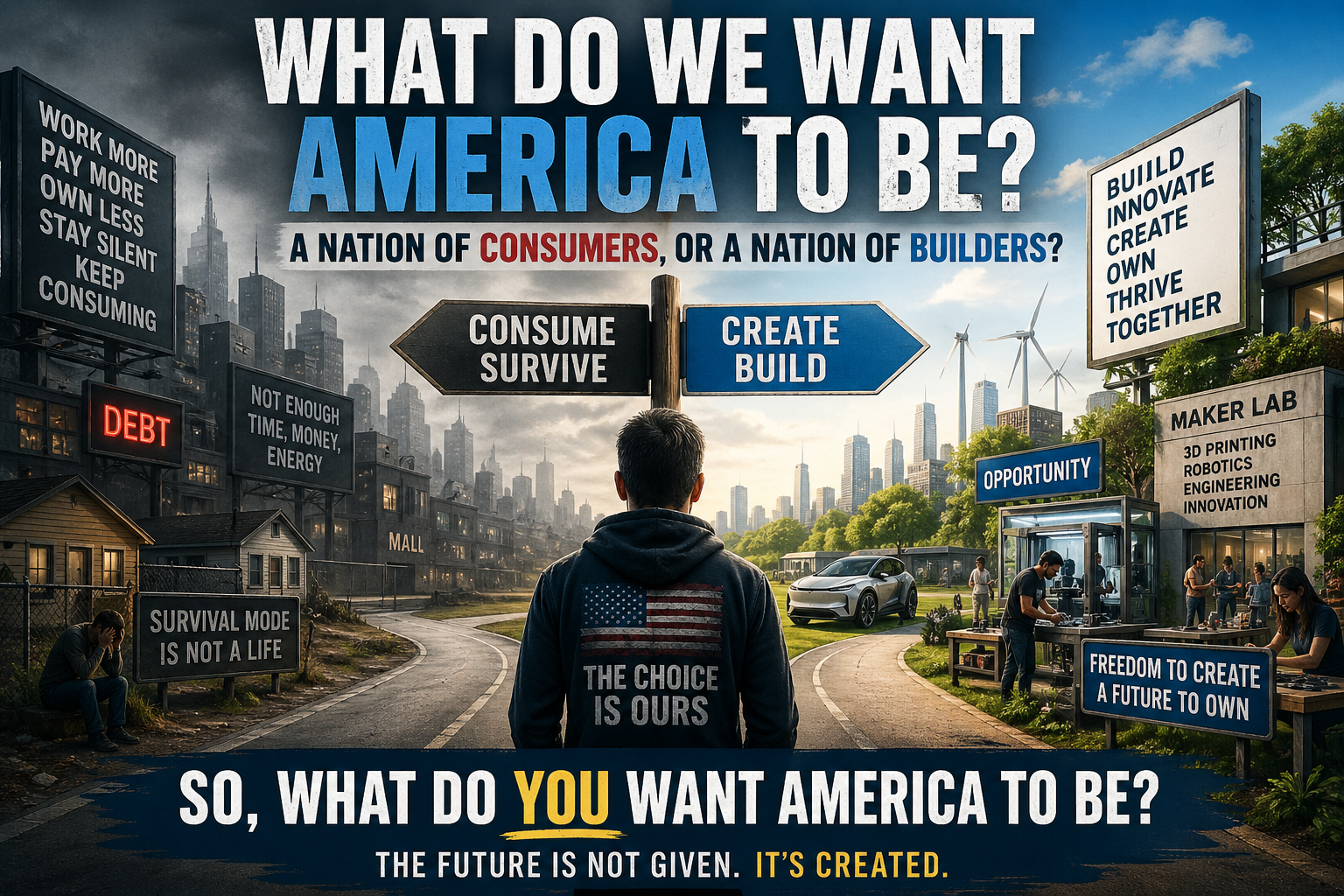
What Do We Want America to Be?
By Vincent Cordova | Candidate for U.S. President 2028
April 30, 2026
There is a fundamental contradiction at the heart of the American economy today.
We expect innovation, leadership, and global competitiveness from our people, but we place millions of them under constant financial pressure just to survive. We ask for breakthroughs from minds that are exhausted. We call for new industries while limiting the freedom to build.
A nation cannot operate this way for long.
Because the truth is simple: you cannot force people into survival mode and expect them to create the future.
The Tradeoff We Refuse to Acknowledge
Those who shape markets, large institutions, capital holders, and policymakers, are making a choice, whether they admit it or not.
They can relieve pressure on the working population, expand access to tools, capital, and opportunity, and encourage experimentation, risk-taking, and creation.
Or they can maintain high pressure on wages, cost of living, and economic insecurity, extract maximum short-term output, and keep people focused on survival instead of innovation.
What they cannot do is both.
Because innovation does not come from desperation. It comes from capacity: mental, financial, and creative.
From Builder Nation to Consumer Economy
If we zoom out, we have to ask a harder question: What is the expected role of the American people today?
Are we meant to build? To invent? To manufacture and lead? Or are we being shaped into something else entirely?
When manufacturing is hollowed out, when ownership is concentrated, and when everyday people are primarily engaged in working, borrowing, and consuming, a pattern emerges.
That pattern looks less like a builder economy and more like a consumer system.
A system where innovation is centralized, production is outsourced, and the population's primary function is to consume.
If that is the direction, then a decision has already been made about America's place in the world.
And it is not a position of leadership.
The Cost of a Consumer-Only Future
A country that primarily consumes what others produce does not set the terms of the future. It follows them.
It becomes dependent. It becomes reactive. It loses its ability to shape global direction.
Most importantly, it wastes its greatest asset: the imagination and capability of its people.
Because across this country are individuals who could design the next generation of vehicles, manufacturing systems, energy solutions, and technologies, if they had the room to try.
But when failure means financial collapse, most people will not take that risk.
And when millions of people do not take that risk, a nation stops advancing.
A Different Path
There is another option.
America can choose to become a builder nation again.
That means lowering the cost of experimentation, supporting creators without stripping their ownership, rebuilding pathways from idea to prototype to production, investing in public systems that enable innovation at scale, and allowing people to move beyond survival and into creation.
This is not about rejecting markets or capital. It is about ensuring they serve the people who build, not control them.
Because when Americans are free to create, they do not just participate in the future. They define it.
The Question We Must Answer
At some point, we have to stop drifting and decide: What do we want the United States to be?
A nation of consumers, dependent on systems we do not control? Or a nation of builders, where everyday people have the power to create, own, and shape the future?
This is not a policy question alone. It is a direction question.
So what do you want America to be?
Community Comments
Community Comments
Share a public response to this post. Submissions are reviewed before they appear.
0 approved comments
Loading comments...